

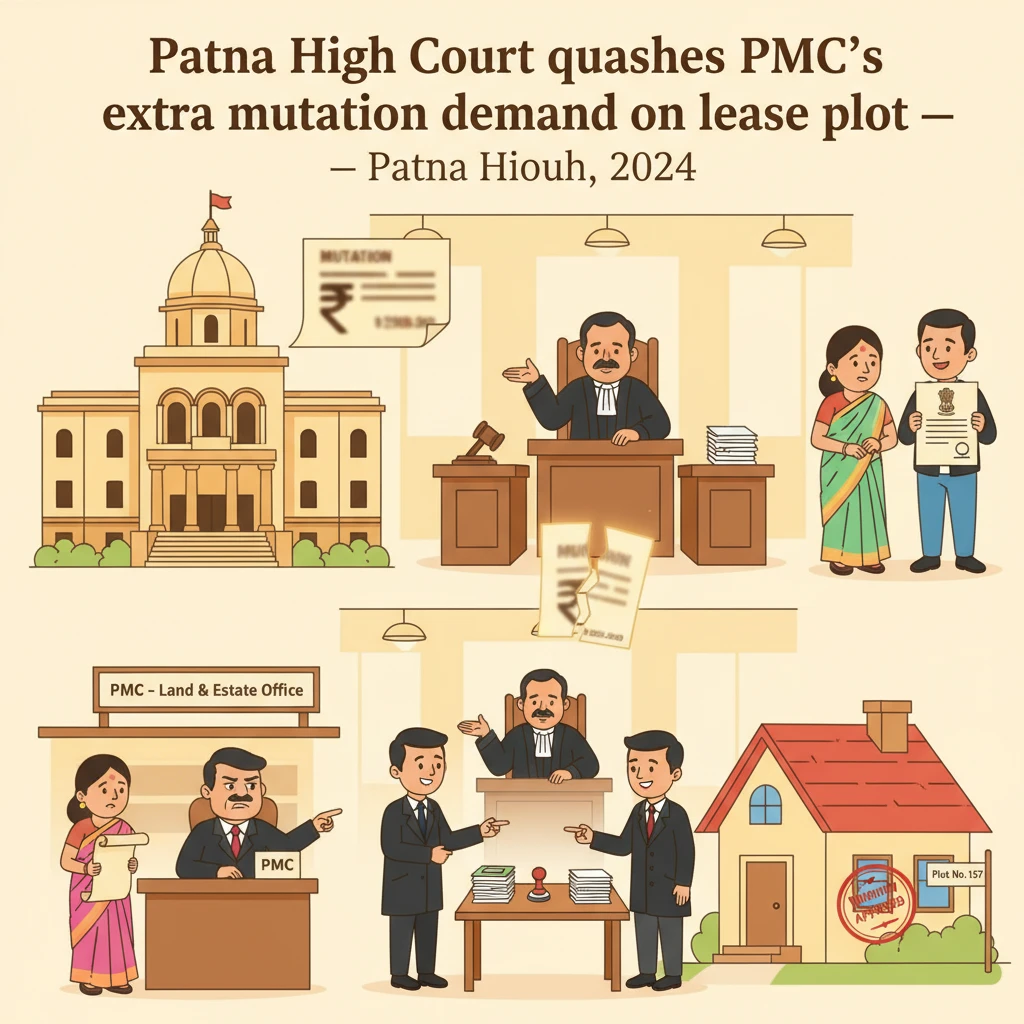
Case Background
This case arose from a long-standing lease of a residential plot in Rajendra Nagar, Patna. The original allottee of Plot No. 157, Block-B, Type-C, area 377.22 square yards, was one Punya Kala Sinha. The allotment was made under a lease deed executed by the then development authority.
The lease deed contained a specific condition. Clause 11 stated that for ten years from the date of the lease, the allottee could not transfer the plot by sale, exchange or otherwise, without the prior written consent of the authority. It also said that no consent would be needed for transfer by way of gift to an heir or relation, or by Will.
Separately, Rule 20 of the Patna Regional Development Authority Rules, 1978 governed transfer of land leased by the authority. It barred transfer of any leased plot within ten years of lease without permission of the authority. It also allowed the authority to resume the land on paying back the premium with interest, and further provided that if permission for transfer was granted, the allottee would pay a mutation fee equal to 50% of the excess sale price over the premium he had paid, subject to a minimum of 10% of the original premium.
Over time, the plot came to the share of another person, Dr. Ranvir Kumar, from the original allottee. On 17.01.2011, the present petitioners, a husband and wife, purchased the leasehold rights in the plot from Dr. Ranvir Kumar through a registered transfer deed. They thus became leasehold purchasers of the Rajendra Nagar plot.
After purchase, on 07.06.2011, they applied for mutation of the plot in their names. The then Patna Regional Development Authority, now dissolved, issued a receipt for Rs. 1,000/- acknowledging their application. However, for over a decade, no final action on mutation was taken.
On 28.11.2023, the Estate Officer of Patna Municipal Corporation, which had by then taken over, issued Letter No. 14515. In that letter, the petitioners were asked to pay Rs. 61,25,664/- as mutation fee, along with some dues towards holding tax for 2022-23 to 2023-24, totalling Rs. 61,25,689/-. The petitioners were directed to deposit this amount within 15 days so that their mutation could be processed.
Feeling aggrieved by this heavy demand, the couple approached the Patna High Court in Civil Writ Jurisdiction Case No. 2121 of 2024. They sought quashing of Letter No. 14515 dated 28.11.2023 and a direction to Patna Municipal Corporation to mutate their names without insisting on what they described as illegal and arbitrary fee.
What the Court Examined and Decided
Justice Rajiv Roy heard the matter on 20.08.2024. Counsel for the petitioners argued that the mutation demand was not only excessive but also contrary to earlier binding decisions concerning similar plots and the same authority.
The petitioners’ main grievance was that the demand notice did not mention under which legal provision the amount of more than Rs. 61 lakh was being claimed. The letter simply referred to “mutation fee” and tax dues, but was silent about the specific rules or clauses relied upon.
The petitioners connected this with earlier litigation. In 2011, a similarly placed person, Sanjay Singh, had challenged a demand for “labhansh” (dividend) or 50% of profit on transfer, raised in relation to land allotted by the erstwhile Patna Regional Development Authority. That case, CWJC No. 13886 of 2011, was decided on 10.07.2013.
In Sanjay Singh’s case, a Single Judge of the Patna High Court had carefully examined Rule 20 of the 1978 Rules and Section 93 of the Bihar Regional Development Authority Act, 1974/81. The Court held that the requirement to pay 50% of the profit as mutation fee would arise only when permission for transfer was also required from the authority.
The Court had reasoned that where permission was not required, the demand for mutation fee equivalent to 50% of earned profit would not apply. The judgment emphasised that parties are bound by the terms of their lease deed, and if the lease deed did not itself provide for payment of 50% of the profit, a later rule could not retrospectively impose such a burden.
By relying on Section 93, the Court in Sanjay Singh had also clarified that deeds of lease executed by the earlier Patna Improvement Trust would be treated as if executed by the Patna Regional Development Authority itself, and that the authority would be bound by the original terms. It concluded that PRDA could not compel the allottee to part with 50% of the earned amount under Rule 20, particularly when the transfer took place after ten years from execution of the original lease.
The Sanjay Singh writ petition was allowed, and the impugned demand communication in that case was quashed.
Patna Municipal Corporation, which had stepped into the shoes of the earlier authority, did not accept that verdict easily. It filed LPA No. 512 of 2016 before a Division Bench of the Patna High Court, challenging the Single Judge’s order. However, the appeal suffered from a long delay of two years and six days.
The Division Bench refused to condone the delay, stating that there was no special privilege for any organisation regarding limitation and no cogent explanation for the long delay. The Bench observed that the fallout of the decision and any liability on the Corporation could be recovered from those responsible for the delay. The limitation petition and the appeal were both dismissed on 13.12.2017.
Still dissatisfied, Patna Municipal Corporation carried the matter to the Supreme Court in SLP (C) No. 12463 of 2018. On 14.05.2018, the Supreme Court dismissed the Special Leave Petition, thereby letting the High Court’s orders stand. No further reasoning was recorded, but the dismissal closed the door on that dispute.
In the present case, the petitioners argued that despite this clear judicial history, Patna Municipal Corporation was still issuing similar demands, now without even mentioning the legal basis. They requested the Court to quash the letter and protect them from the burden of paying such a huge sum for mutation.
On the other side, counsel for Patna Municipal Corporation filed a counter affidavit on behalf of respondent numbers 3 to 5. The affidavit discussed several provisions of the Bihar Municipal Act, 2007. However, when it came to dealing with the Sanjay Singh precedent, it contained only a brief statement in paragraph 8, asserting that the facts in that case were different from the facts of the present matter.
Justice Rajiv Roy examined this reply and found it lacking. The affidavit did not explain in what way the facts differed, nor did it show why the reasoning of Sanjay Singh’s case should not apply. The Court observed that by failing to distinguish the earlier case, the municipal authorities had “virtually accepted” the petitioners’ contention that the present case stood on the same footing.
The Court then revisited the central holding in Sanjay Singh’s case. It noted that the earlier judgment had clearly held that the authority, then PRDA and now PMC, could not require the allottee to share 50% of the earned amount under Rule 20, where the transfer took place beyond ten years from the date of the lease deed. That situation, the Court recorded, was also present here.
The Court further noted that despite having lost before a Single Judge, a Division Bench, and finally the Supreme Court, Patna Municipal Corporation was still issuing such “draconian” demands from innocent citizens seeking to buy a small piece of land in the State capital with their hard-earned money. Justice Roy categorised such continued demands as a form of harassment.
The Court expressed concern that, six years after the Supreme Court’s dismissal of the SLP in 2018, PMC had not “closed the chapter.” Instead, it appeared to expect that each affected buyer would have to approach the Patna High Court to get relief. The Court observed that this behaviour showed a lack of respect for orders passed by the courts.
While deciding the petition, Justice Roy also addressed institutional responsibility. He requested the counsel for PMC, Mr. Prasoon Sinha, to personally apprise the Municipal Commissioner of the situation. The Judge urged the Commissioner to take cognizance of the matter and issue necessary guidelines to stop harassment of buyers by such demands.
Coming to the specific relief sought, the Court held that in light of the facts, the applicable rules, and the binding precedent of Sanjay Singh’s case, Letter No. 14515 dated 28.11.2023 issued by the Estate Officer of Patna Municipal Corporation required interference. The letter was accordingly quashed.
The Court then laid down a clear time-bound direction for completing the mutation. It recorded that the petitioners would approach Patna Municipal Corporation within four weeks with a proper application and the normal requisite fee for mutation of the plot. Once such an application was filed, PMC would be duty-bound to complete the mutation process within the next three months.
With these directions, the writ petition was allowed. No order was made as to costs.
Why This Judgment Matters
This judgment has direct practical impact for leasehold purchasers of plots originally allotted by development authorities in Patna, especially in Rajendra Nagar and similar schemes.
It confirms that Patna Municipal Corporation cannot continue demanding huge sums as “mutation fee” or “labhansh” based on Rule 20 of the 1978 Rules where the transfer takes place after ten years from the date of the original lease, and where the lease deed itself does not provide for such profit sharing.
The judgment also sends a strong message to municipal authorities that they must respect earlier court decisions, including those affirmed up to the Supreme Court. They cannot force each buyer to fight individual legal battles for the same settled issue.
For ordinary citizens, especially couples and families buying leasehold plots with their savings, this decision offers reassurance. It shows that the Patna High Court will step in when public bodies issue unexplained and excessive demands contrary to binding precedent.
Legal Issues and Answers
- Issue: Can Patna Municipal Corporation demand more than Rs. 61 lakh as mutation fee or similar charge for transfer of a leasehold residential plot, relying on Rule 20 of the 1978 Rules, when the transfer occurred long after ten years from the original lease and the lease deed itself does not provide for such payment?
Answer: No. Following the earlier decision in Sanjay Singh’s case, affirmed up to the Supreme Court, PMC cannot insist on such a demand in these circumstances. - Issue: Is PMC justified in continuing to issue similar demands after losing on the same point before the High Court and Supreme Court?
Answer: The Court strongly disapproved this practice, terming the continuing demands “draconian” and amounting to harassment, and requested the Municipal Commissioner to issue guidelines to stop such actions. - Issue: What directions did the Court give regarding mutation of the petitioners’ names?
Answer: The Court directed the petitioners to file a proper mutation application with requisite normal fee within four weeks, and ordered PMC to complete the mutation within three months thereafter.
Cases Cited by the Court
- CWJC No. 13886 of 2011, Sanjay Singh vs. The State of Bihar & Ors. (Patna High Court, decided on 10.07.2013).
- LPA No. 512 of 2016, The Commissioner, Patna Municipal Corporation vs. Sanjay Singh and Others (Patna High Court, decided on 13.12.2017).
- SLP (C) No. 12463 of 2018, The Commissioner, Municipal Corporation & Anr. vs. Sanjay Singh & Ors. (Supreme Court of India, order dated 14.05.2018).
Case Details
Case Number: Civil Writ Jurisdiction Case No. 2121 of 2024
Case Title: Bipin Trivedi & Anr. vs. State of Bihar & Ors.
Coram: Hon’ble Mr. Justice Rajiv Roy
Date of Judgment: 20.08.2024
Citation: 2024(4) PLJR 600
Advocates:
For the petitioners: Mr. Siddhartha Prasad, Advocate
For the respondents (Patna Municipal Corporation): Mr. Prasoon Sinha, Advocate
Nature of the Case: Writ petition under Civil Writ Jurisdiction challenging a demand notice for mutation fee and seeking direction for mutation of a leasehold plot.
Link to Judgment: Patna High Court Judgment in CWJC No. 2121 of 2024
If you found this explanation helpful and wish to stay informed about how legal developments may affect your rights in Bihar, you may consider following Samvida Law Associates for more updates.







