
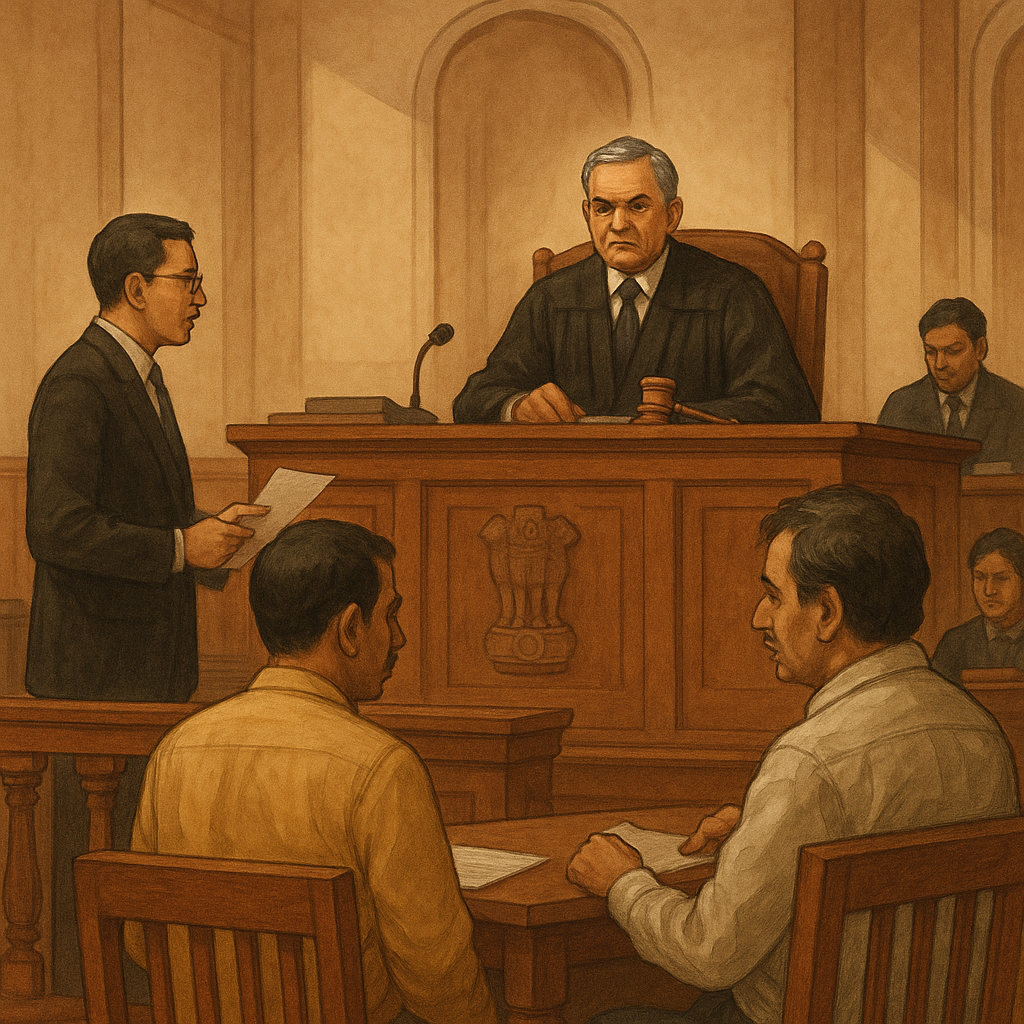
Simplified Explanation of the Judgment
The Patna High Court, in its judgment dated 10 October 2022, delivered by Hon’ble Mr. Justice Sunil Dutta Mishra, addressed an important legal issue under the Bihar Buildings (Lease, Rent & Eviction) Control Act, 1982. The Court partly allowed a civil revision filed by a tenant, holding that even if a landlord’s personal necessity for eviction is genuine, the Trial Court must also examine the possibility of partial eviction before ordering complete eviction.
The case arose from a dispute between a landlord (plaintiff) and a tenant (defendant) in Sheohar district. The landlord had filed Eviction Suit No. 3 of 2008, claiming that he required the tenanted premises in good faith for expanding his own business and wanted to use the room as a godown. The Trial Court (Munsif, Sheohar) decreed the suit on 16 June 2016, directing the tenant to vacate the premises within 60 days.
The tenant (petitioner in revision) approached the High Court under Section 14(8) of the Act, challenging the eviction decree mainly on the ground that the Trial Court failed to consider partial eviction, which is a mandatory requirement under Section 11(1)(c) of the Act.
Background of the Dispute
According to the landlord’s case, he had purchased the disputed property, built several rooms to establish a market known as “Bhukhlu Sah Market”, and rented one room to the tenant for running a printing press at ₹500 per month. Later, due to expansion of his own business, he required the same room as a godown and therefore sought eviction.
The tenant, however, denied the relationship of landlord and tenant, claiming that the property was jointly owned by the landlord, his brother, and their mother. He said he had taken the room on rent from the landlord’s brother, not from the landlord himself, in 2002. He also alleged that the rent deed (Kirayanama) dated 25 December 2005, produced by the landlord, was forged and fabricated.
Findings of the Trial Court
After examining witnesses and documents, the Trial Court concluded that the landlord had indeed rented out the premises to the tenant and that the relationship of landlord and tenant was established. The Court found that the landlord’s requirement was bona fide and genuine, and therefore decreed eviction.
However, the Trial Court did not examine whether partial eviction (evicting only a part of the premises) could have satisfied the landlord’s need.
Issue before the Patna High Court
The main legal issue before the High Court was:
Whether the Trial Court erred in not considering the possibility of partial eviction under the proviso to Section 11(1)(c) of the Bihar Buildings (Lease, Rent & Eviction) Control Act, 1982.
Arguments of the Parties
For the Tenant (Petitioner):
- The Trial Court ignored the mandatory statutory duty to consider partial eviction, even though the tenant had not raised it specifically in pleadings.
- As per law, the Trial Court must frame an issue and allow both parties to lead evidence on whether the landlord’s requirement can be substantially satisfied by partial eviction.
- Counsel relied on precedents including:
- Krishna Murari Prasad v. Mitar Singh, AIR 1994 SC 489
- Bimal Kishore Gupta v. Beena Devi, 2001 (2) PLJR 837
- Anis Khan v. Shyam Babu Sah, Civil Revision No. 179 of 2016 (Patna High Court, 2019)
In all these cases, courts held that the Trial Court must consider partial eviction even if the tenant did not demand it explicitly.
For the Landlord (Respondent):
- The landlord’s counsel argued that no such plea was taken in the written statement; hence, no issue was framed or evidence led on partial eviction.
- The rented room measured only 10 ft × 11 ft (110 sq. ft.), with a 2.5 ft entry passage, making partial eviction impractical.
- Once the landlord proved his bona fide requirement, he was entitled to occupy the whole premises.
- Reliance was placed on Veena Rani v. Ishrati Amanullah, AIR 1985 Pat 207, where the Court upheld complete eviction if partial satisfaction was not feasible.
Court’s Observations
The Patna High Court analyzed Section 11(1)(c) of the Act and noted that the proviso to this section makes it mandatory for the Court to consider whether the landlord’s reasonable requirement could be satisfied by evicting the tenant from only a part of the premises.
The Court cited the Supreme Court’s ruling in Krishna Murari Prasad v. Mitar Singh (1994) which held:
“Even if the premises consist of a single room, the Court must still examine if division or partial eviction can substantially satisfy the landlord’s need. This factual inquiry cannot be skipped.”
The Court further noted that in Bimal Kishore Gupta v. Beena Devi (2001), it was held that:
“It is the duty of the Court to frame an issue on partial eviction even if the tenant has not raised such a plea, and to allow evidence from both sides.”
The High Court also referred to its own coordinate bench’s judgment in Anis Khan v. Shyam Babu Sah (2019), involving similar facts, where the matter was remanded to the Trial Court for reconsideration of the issue of partial eviction.
High Court’s Findings and Decision
Justice Sunil Dutta Mishra observed that the Trial Court had found the landlord’s requirement to be bona fide and reasonable, and that finding remained undisturbed.
However, since the Trial Court had failed to comply with the mandatory statutory duty of considering partial eviction, the eviction decree was set aside to that limited extent.
The High Court therefore remitted the case back to the Trial Court with the following directions:
- The Trial Court shall frame an issue regarding partial eviction under Section 11(1)(c) of the Act.
- Both parties shall be given an opportunity to lead evidence on this issue.
- The Trial Court shall decide this issue and the final relief within four months from the receipt of the High Court’s judgment.
- All other findings of the Trial Court—including the finding of bona fide requirement—were left undisturbed.
Thus, the High Court partially allowed the revision, maintaining the Trial Court’s findings on necessity but remanding the matter solely for determination of partial eviction feasibility.
Significance or Implication of the Judgment
- Mandatory Duty on Trial Courts: The judgment reiterates that even if the tenant does not plead for partial eviction, the Court must independently examine whether the landlord’s need can be met by partial eviction.
- Tenant Protection in Rent Law: The decision ensures that tenants are not evicted from entire premises unnecessarily when the landlord’s need can be met otherwise.
- Balance Between Landlord and Tenant: The ruling reinforces the balanced legislative intent of the Bihar Rent Act—protecting tenants while respecting landlords’ genuine needs.
- Guideline for Lower Courts: It directs all trial courts in Bihar to frame issues on partial eviction in eviction suits under Section 11(1)(c).
- Faster Resolution: By fixing a four-month time frame for decision, the High Court aimed to ensure prompt adjudication.
Legal Issues Decided and the Court’s Reasoning
- Whether the Trial Court erred in not considering partial eviction under Section 11(1)(c)?
- Decision: Yes. The Court remanded the matter for limited reconsideration on this point.
- Whether the landlord’s requirement was bona fide?
- Decision: Yes. The landlord’s genuine need was established and not disturbed.
- Whether failure to frame an issue on partial eviction invalidates the decree?
- Decision: Yes. It renders the decree legally incomplete and requires remand.
Judgments Relied Upon or Cited by Court
- Krishna Murari Prasad v. Mitar Singh, AIR 1994 SC 489
- Bimal Kishore Gupta v. Beena Devi, 2001 (2) PLJR 837
- Anis Khan v. Shyam Babu Sah, Civil Revision No. 179 of 2016 (Patna High Court, decided on 01.08.2019)
- Veena Rani v. Ishrati Amanullah, AIR 1985 Pat 207
- Kalyan Singh Chauhan v. C.P. Joshi, AIR 2011 SC 1127
Case Title
Shyambabu Sah v. Shyam Babu Sah
Case Number
Civil Revision No. 178 of 2016
Citation(s)
2023 (1) PLJR 61
Coram and Names of Judges
Hon’ble Mr. Justice Sunil Dutta Mishra
Names of Advocates and who they appeared for
- For the Petitioner (Tenant): Mr. Surendra Kishore Thakur, Advocate
- For the Respondent (Landlord): Mr. Yogendra Mishra, Advocate; Mr. Arvind Kumar Jha, Advocate
Link to Judgment
OCMxNzgjMjAxNiMxI04=-9UnZEt5gtVA=
If you found this explanation helpful and wish to stay informed about how legal developments may affect tenancy rights in Bihar, you may consider following Samvida Law Associates for more updates.







