
Simplified Explanation of the Judgment
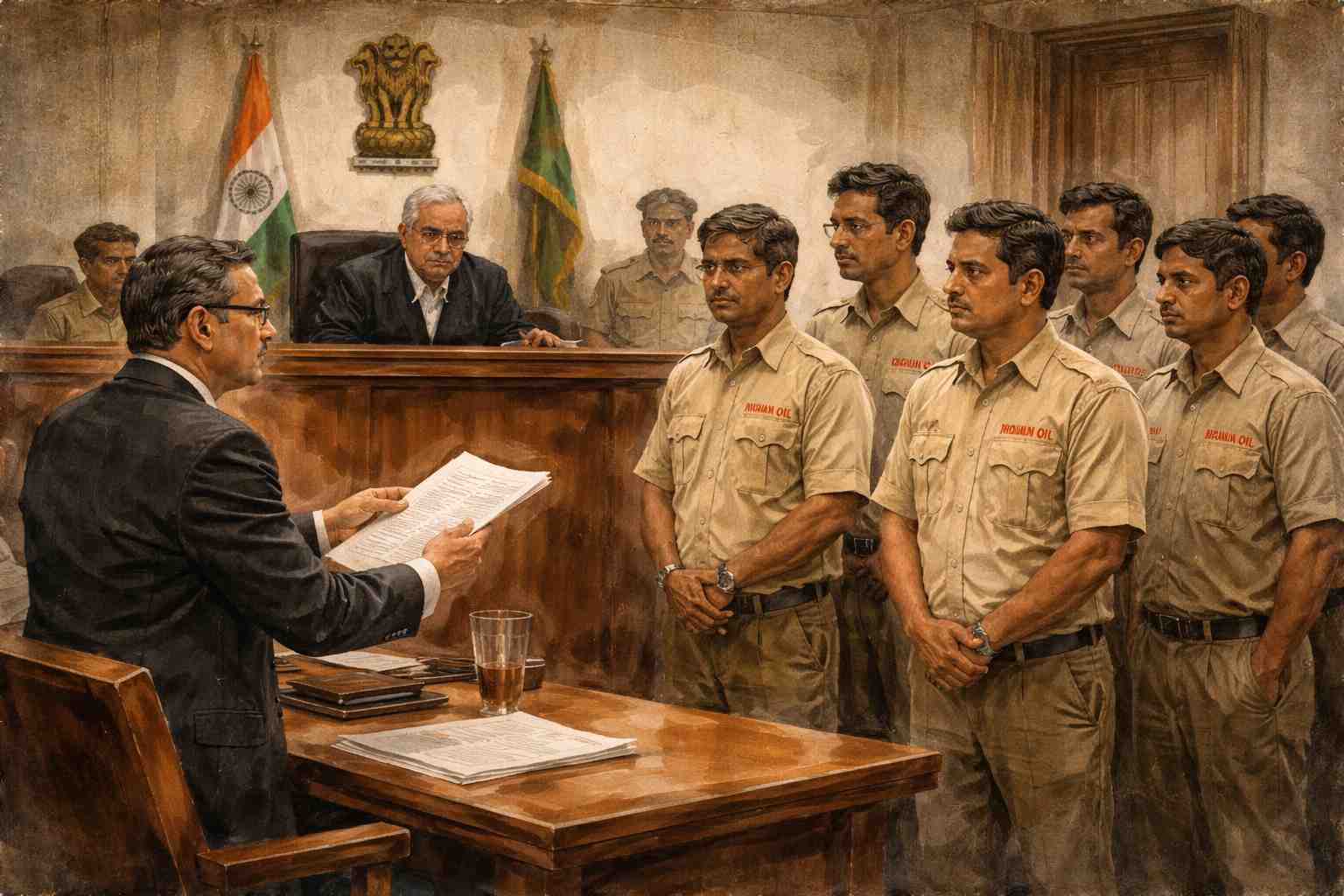
The Patna High Court, in a detailed judgment delivered on 2 December 2022, clarified the legal position regarding the regularization of casual workers employed by the Indian Oil Corporation Limited (IOCL). The case was heard and decided by Hon’ble Mr. Justice Madhuresh Prasad in Civil Writ Jurisdiction Case No. 17211 of 2019.
A group of employees working at different IOCL establishments in Bihar and Jharkhand had approached the High Court seeking a direction that they be treated as regular employees from the date of their initial engagement on 19 November 1998, when they were first placed in an “Approved List of Casual Persons (ALCP).” They also demanded all consequential benefits including seniority, pay fixation, and service continuity from that date.
These employees were engaged as casual labourers under an arrangement between IOCL management and labour unions. Their names were maintained in a separate attendance register, and they were occasionally assigned work at IOCL installations such as Patna, Barauni, Gaya, and Raxaul. However, their engagement led to objections from some labour unions, resulting in Reference Case No. 32 of 1999 before the Central Government Industrial Tribunal (CGIT), Kolkata.
The CGIT, by its award dated 11 July 2011, dismissed the union’s claims and upheld the management’s process of recruiting these casual workers, holding that there was no illegality or arbitrariness in the selection.
Following that award, the petitioners filed CWJC No. 11651 of 2012 before the Patna High Court seeking regularization. The High Court, while disposing of that petition on 22 August 2014, permitted the petitioners to make a representation to the management for consideration of their cases in terms of the principles laid down in Secretary, State of Karnataka v. Umadevi (2006) 4 SCC 1.
Subsequently, the IOCL management issued fresh appointment letters on 31 July 2017, appointing the petitioners as Junior Operators (Grade-I) on probation for one year. Upon satisfactory completion of probation, they were confirmed in service through letters issued in 2019. However, after their confirmation, the employees again approached the Patna High Court seeking retrospective regularization from 1998 instead of 2017.
Court’s Analysis and Findings
The Court analyzed the key documents produced by the petitioners — the empanelment order dated 19 November 1998, the Memorandum of Understanding (MoU) dated 6 October 2007 between IOCL and the employee union, and the communication dated 27 October 2014.
The Court found that none of these documents created a legal or legitimate expectation of regularization. The note attached to the 1998 empanelment order explicitly stated that the regularization of these casual workers “may be considered in due course,” which was merely an expression of possibility and not a promise. Similarly, the 2007 MoU recorded that management faced “constraints” in regularization and only stated that the matter would be considered “at an appropriate stage.” The letter of 2014, relied upon by the petitioners, merely confirmed that the issue was pending adjudication before the Calcutta High Court.
The Court thus held that the petitioners had no legitimate or enforceable expectation for retrospective regularization. Their subsequent acceptance of fresh appointments in 2017 without objection amounted to consent to new service terms and conditions, thereby extinguishing any claim for earlier benefits.
The Court also observed that the petitioners were never appointed through a proper selection process or against any sanctioned post. Their empanelment under the ALCP merely granted them the status of casual labourers who could be called upon as and when work was available.
Application of Legal Principles
The Court placed strong reliance on the Constitution Bench judgment of the Supreme Court in Secretary, State of Karnataka v. Umadevi (2006) 4 SCC 1. The Supreme Court had categorically held that temporary, contractual, or casual workers cannot claim regularization or permanent status merely because they have worked for several years. The doctrine of “legitimate expectation” does not apply in such cases because their engagement is outside the regular recruitment process and not against sanctioned posts.
The Court noted that the petitioners were aware of the temporary nature of their engagement from the very beginning. Since their appointment as Junior Operators in 2017 was made for the first time against sanctioned posts and after verification of their records, their employment from 1998 to 2017 could not be treated as continuous service for the purpose of regularization.
The Court also examined the three Supreme Court judgments cited by the petitioners — Direct Recruit Class-II Engineering Officers’ Association v. State of Maharashtra (AIR 1990 SC 1607), Director, Printing and Stationery Department v. Motilal (2014) 11 SCC 470, and Gauri Shankar Pd. Rai v. Sajal Chakraborty (2015) 8 SCC 163 — but found them inapplicable as they concerned employees who were irregularly (not casually) appointed against sanctioned posts.
Final Decision
After considering all arguments and evidence, the Patna High Court concluded that the petitioners were merely casual workers before their formal appointment in 2017. Their empanelment in 1998 did not grant them any legal right to claim backdated regularization. The Court observed that once the petitioners accepted their fresh appointment and completed probation, they were bound by those terms and could not revert to claim benefits retrospectively.
The Court dismissed the writ petition, holding that there was no merit in the claim for retrospective regularization. It reaffirmed that the Umadevi principles bar casual or temporary employees from seeking regularization unless their initial appointment was made in accordance with law and against sanctioned posts.
Significance or Implication of the Judgment
This decision has wide implications for public sector undertakings and government departments that employ large numbers of casual or contractual workers.
For employees, the ruling clarifies that long years of casual work do not automatically lead to regularization or seniority benefits. Accepting a fresh appointment resets the employment relationship, and any prior casual service cannot be treated as regular employment.
For employers like IOCL, the judgment safeguards management’s right to appoint workers afresh after due verification and avoids the financial burden of retrospective benefits. It also discourages repetitive litigation from casual employees after they have accepted new appointments.
For trade unions and workers’ representatives, the judgment underscores that memoranda of understanding or internal assurances cannot override constitutional and statutory procedures for recruitment.
Ultimately, this judgment reinforces the constitutional principle that public employment must follow fair recruitment processes and cannot be regularized through backdoor entries or administrative promises.
Legal Issues and Court’s Reasoning
- Whether the petitioners could claim regularization from their date of initial engagement as casual workers in 1998.
The Court held that they could not, since their empanelment was purely casual and carried no promise of regularization. - Whether the 1998 and 2007 documents created a legitimate expectation for regularization.
The Court held that they did not. The wording clearly indicated that regularization would only be considered “in due course,” not guaranteed. - Whether acceptance of new appointments in 2017 barred retrospective claims.
Yes. The Court ruled that accepting fresh appointments amounts to agreeing to new service conditions, preventing the petitioners from later claiming continuity from earlier casual service. - Whether the Umadevi judgment applied.
Yes. The High Court found that the petitioners’ engagement was purely casual and outside regular selection, squarely covered by Umadevi.
Judgments Referred by Parties
Direct Recruit Class-II Engineering Officers’ Association v. State of Maharashtra, AIR 1990 SC 1607
Director, Printing and Stationery Department, U.P. v. Motilal, (2014) 11 SCC 470
Gauri Shankar Pd. Rai v. Sajal Chakraborty, (2015) 8 SCC 163
Judgments Relied Upon by Court
Secretary, State of Karnataka v. Umadevi, (2006) 4 SCC 1
Case Title
Nawal Kishore Singh & Ors. v. The Executive Director I/C (RS), Indian Oil Corporation Ltd. (MD) & Ors.
Case Number
Civil Writ Jurisdiction Case No. 17211 of 2019
Citation(s)
2023 (1) PLJR 365
Coram and Names of Judges
Hon’ble Mr. Justice Madhuresh Prasad
Names of Advocates and Appearance
For the Petitioners: Mr. Mukul Sinha, Advocate
For the Respondents (Indian Oil Corporation): Mr. Ankit Katriar, Advocate
Link to Judgment
MTUjMTcyMTEjMjAxOSMxI04=-UqsWW4MYFmA=
If you found this explanation helpful and wish to stay informed about how legal developments may affect your rights in Bihar, you may consider following Samvida Law Associates for more updates.







