
Case Background
This case arises out of a long‑running family dispute over ancestral land at village Maldah, under Barbigha police station, then in district Monghyr.
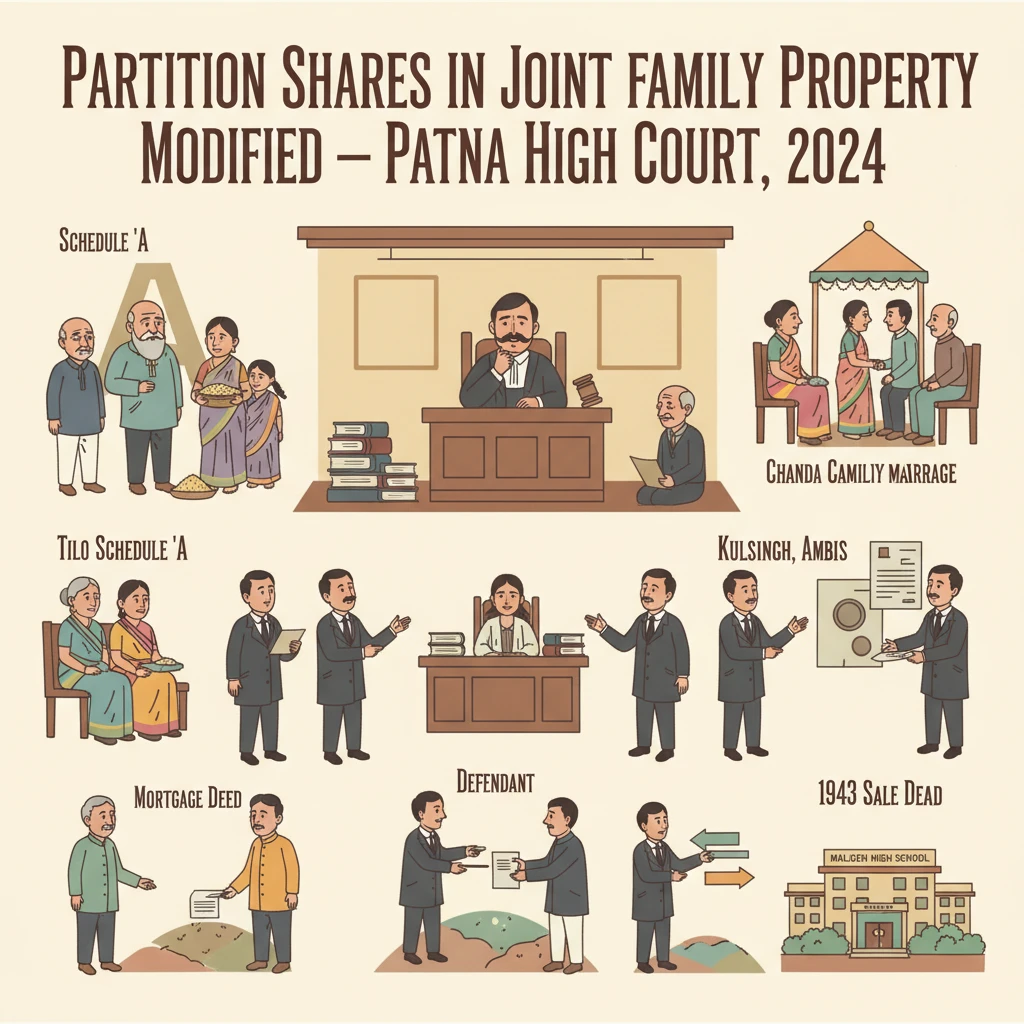
The common ancestor, Kuldip Singh, owned the properties described in Schedule “A” of the plaint. He had four sons: Narsingh Singh, Ambika Singh, Mathura Singh (defendant no.1) and Saryug (Sarjug) Singh (plaintiff no.1).
Narsingh Singh died in 1940, leaving behind his widow, Tilo Kumari, and a minor daughter, Chanda Kumari (defendant no.4). According to the plaintiffs, in Kuldip Singh’s lifetime, the widow Tilo Kumari gave up her share in the joint family property in lieu of maintenance for herself and her daughter, and she was to receive 25 maunds of grain annually.
Kuldip Singh died in 1948. After his death, according to the plaintiffs, the remaining three sons and their families continued as a joint Hindu family governed by Mitakshara law, with Mathura Singh as Karta. Chanda Kumari was married in 1949, allegedly using joint family funds.
Later, Tilo Kumari executed three registered sale deeds in 1969 and 1972 in favour of Mathura Singh (defendant no.1), his wife Desho (Desho/Desho Devi, defendant no.2) and his daughter‑in‑law Sunita Devi (defendant no.3). These deeds are said to cover lands described in Schedules B, C and D of the plaint. Tilo died on 25.10.1972.
In 1973, the plaintiffs (the branch of Saryug Singh and the branch of Sukhdeo Singh) filed Title Suit No.116 of 1973 before the Sub Judge‑II, Munger. They asked for partition of 2/3rd share in the Schedule A property and a declaration that the three sale deeds executed by Tilo in favour of defendants 1 to 3 were not binding on them.
In 1978, during the pendency of the suit, the plaintiffs withdrew their challenge to the validity of the sale deeds. The suit was converted into a pure suit for partition of the joint family property.
The 2nd Additional Sub Judge, Monghyr, by judgment dated 24.06.1978 and decree dated 04.07.1978, decreed the suit, holding that the plaintiffs had 2/3rd share and the branch of Mathura Singh had 1/3rd share.
Aggrieved, the defendants (mostly representing the branch of Mathura Singh and purchasers under the sale deeds) filed First Appeal No.667 of 1978 before the Patna High Court.
What the Court Examined and Decided
The Patna High Court, through Hon’ble Mr. Justice Rudra Prakash Mishra, examined both factual and legal issues. The focus was on three main questions:
First, was there an earlier partition by metes and bounds among the four sons of Kuldip Singh so that the family was no longer joint?
Second, what was the legal effect of the sale deeds executed by widow Tilo Kumari in 1969 and 1972?
Third, assuming the property was joint, what were the correct shares of each branch in the partition suit?
The trial court had framed nine issues, including maintainability, cause of action, defect of parties, existence of prior partition, alleged relinquishment by Tilo in lieu of maintenance, unity of title and possession, validity of Tilo’s sale deeds, and the plaintiffs’ entitlement to a preliminary decree for partition.
Both sides led extensive oral and documentary evidence. Thirteen witnesses were examined by each side, including family members and villagers. Several registered documents (sale deeds and mortgage deeds) were proved to show how different branches of the family dealt with land over time.
The defendants’ stand was that a private partition took place in 1942 between the four brothers, each getting 3.33 acres, as described in the written statement schedule. They argued that this partition was complete by metes and bounds and, therefore, later dealings by individual branches (like mortgages and exchanges) showed separate enjoyment of their respective shares.
The defendants also asserted that after Narsingh’s death, his widow, Tilo Kumari, acquired full right and title over her husband’s share and came into possession of those lands. According to them, her sale deeds in 1969 and 1972 were valid, for consideration and for legal necessity, and the purchasers came in possession. Defendant no.4, Chanda Kumari, in her additional written statement, supported this version and stated that the sale deeds executed by her mother were valid and for necessity.
The plaintiffs denied any prior partition. They said the whole property remained joint, there was unity of title and possession, and that Tilo had relinquished her rights in lieu of maintenance. They initially attacked the sale deeds, but later dropped this challenge and pressed only for partition.
The trial court accepted the plaintiffs’ case on unity of title and possession and rejected the defence of prior partition. It held:
- There was no prior partition by metes and bounds (Issue No.4 decided in favour of plaintiffs).
- Tilo had not relinquished her rights in lieu of maintenance (Issue No.5 against the plaintiffs’ earlier story).
- There was unity of title and possession between plaintiffs and Mathura Singh’s branch (Issue No.6 in plaintiffs’ favour).
- Tilo had the right to execute the sale deeds and they were valid in respect of her share (Issue No.7).
Yet, despite upholding the validity of the widow’s sale deeds, the trial court proceeded to treat the lands covered by those deeds as still part of the joint family pool, and granted the plaintiffs 2/3rd share in the entire Schedule A property.
Before the High Court, the appellants’ senior counsel argued that this reasoning was legally inconsistent. On one hand, the trial court accepted that Tilo had not relinquished her rights and that her sale deeds were genuine and valid. On the other hand, it still held that there was unity of title and possession and treated even those lands as joint family property available for partition.
The appellants emphasized Section 14 of the Hindu Succession Act, 1956. They submitted that any limited right which Tilo had in her husband’s property, or any property given to her in lieu of maintenance, became full ownership after the 1956 Act. Therefore, as an absolute owner, she could validly transfer her share, and the purchasers (defendants 1 to 3) got good title to those lands.
They also argued that by amending the plaint in 1978 and dropping the prayer to declare the sale deeds invalid or not binding, the plaintiffs themselves accepted the genuineness of the sale deeds and were now estopped from attacking them indirectly.
The High Court agreed that there was a clear contradiction in the trial court’s findings. Once the sale deeds were accepted as genuine and valid, and once it was found that Tilo had not relinquished her rights in lieu of maintenance, it was not open to the trial court to still treat the transferred lands as if they were fully joint and unaffected by the transfers.
The High Court also discussed at length the basic principles of Mitakshara joint family, coparcenary, joint and separate property, and partition as summarized in Mulla’s Hindu Law. It noted:
- There is a general presumption of jointness in a Hindu family, and the burden to prove separation lies on the party asserting it.
- Partition does not always require physical division by metes and bounds; even a clear intention to separate and to define shares can be sufficient.
- The incidents of separate property are different from joint family property; self‑acquired property is not liable to partition and devolves by succession, not survivorship.
The Court ultimately accepted that even if there was no earlier partition by metes and bounds in the strict sense, certain legal consequences had to follow from the widow’s rights and the law on partition.
A key part of the reasoning is that if a partition is now to be effected between the sons of Kuldip Singh and the widow‑mother of Narsingh (i.e., Tilo), then, according to settled principles and later Supreme Court decisions, each branch – the three sons’ branches and the widow‑mother – would be entitled to an equal share, i.e., 1/4th each in the joint property.
The High Court referred to the principles regarding the rights of women in partition from Mulla Hindu Law – that while certain female members cannot demand partition themselves, they are entitled to a share if a partition actually takes place. Particularly, a widow‑mother gets a share equal to that of a son on partition between sons.
The Court also referred to the Supreme Court’s rulings in Vineeta Sharma v. Rakesh Sharma and in Prasanta Kumar Sahoo v. Charulata Sahu, which confirm that on partition of coparcenary property between father and children, the wife/mother is also entitled to an equal share.
Applying these principles, the High Court held that the trial court had erred in allotting 2/3rd share to the plaintiffs (representing two branches: Saryug Singh and Sukhdeo Singh) and only 1/3rd share to the branch of Mathura Singh. That approach effectively ignored the share of the branch of Narsingh Singh, whose widow and daughter were on record.
The High Court concluded that, in law, each of the four branches was entitled to 1/4th share. As the plaintiffs represented only two of these branches, they could not get more than half of the total property.
Therefore, the High Court set aside the trial court’s judgment and decree, holding that the plaintiffs are entitled not to 2/3rd share but only 1/2 share in the suit property, and the defendants’ branch is entitled to the remaining half, after giving effect to the sale deeds of Tilo Kumari as valid.
Why This Judgment Matters
This judgment is important for families in Bihar and elsewhere who live in joint Hindu families and deal with ancestral land.
First, it shows that if a widow’s limited right in her husband’s property continues after the Hindu Succession Act, 1956, she becomes an absolute owner under Section 14. If she then sells the land by a valid sale deed, later generations cannot easily ignore that transfer in a partition suit.
Second, the Patna High Court makes it clear that a trial court cannot take contradictory stands: it cannot accept that a sale deed is valid and yet act as if the property is still entirely joint and unaffected.
Third, the judgment reinforces that when a partition is carried out between sons’ branches and a widow‑mother, she is also counted and entitled to a share equal to a son. Ignoring her share can lead to serious error in computing shares.
For ordinary people, the message is: if a widow in your family has sold some property after 1956, and that sale is genuine and for consideration, it is very difficult later to treat that sold land as still joint and to divide it as if nothing was sold.
It also shows that amending a plaint and dropping challenges to sale deeds has consequences – you may not later be allowed to indirectly challenge the same transactions.
Legal Issues and Answers
- Issue: Whether the trial court’s judgment granting 2/3rd share to the plaintiffs and 1/3rd to the defendants in the joint family property was legally sustainable.
Answer: No. The Patna High Court held that the trial court’s findings were contradictory and that it wrongly ignored the share of the branch of Narsingh Singh. The judgment and decree were set aside. - Issue: Whether the plaintiffs were entitled to 2/3rd share in the suit property or only 1/2 share.
Answer: The Court held that on proper partition among the four branches (three sons and widow‑mother), each would get 1/4th. Since the plaintiffs represented two branches, they were entitled to only 1/2 share in the suit property. - Issue: Whether the sale deeds executed by widow Tilo Kumari in favour of defendants 1 to 3 affected the character of the joint family property and could still be questioned in the partition suit.
Answer: The Court accepted that Tilo’s limited estate became absolute under Section 14 of the Hindu Succession Act, 1956; her sale deeds were valid, and after the plaintiffs withdrew their challenge, the trial court had no jurisdiction to treat the transferred lands as if they remained untouched joint property while simultaneously upholding the validity of the deeds.
Cases Cited by the Court
- The Patna High Court referred in detail to principles from Mulla Hindu Law and to decisions of the Hon’ble Supreme Court, including:
- Kalyani v. Narayanan, A.I.R. 1980 SC 1173 (on partition as severance of joint status).
- Vineeta Sharma v. Rakesh Sharma and Others, (2020) 9 SCC 1 (on daughters as coparceners and the wife’s share on partition).
- Prasanta Kumar Sahoo and Others v. Charulata Sahu and Others, (2023) 9 SCC 641 (reiterating widow‑mother’s and wife’s share on partition).
- The appellants’ counsel cited AIR 2003 SC 3800, (2008) 1 SCC 465 and 1999 (2) PLJR 258 to support the proposition that a Hindu widow’s limited right becomes absolute under Section 14 of the Hindu Succession Act, and that she can validly alienate property, though the judgment text does not set out the names of those cases.
Case Details
Case Number: First Appeal No.667 of 1978
Case Title: Umesh Singh & Others v. Kapildeo Singh & Others (as per cause title in judgment)
Citation: 2025(3) PLJR 173
Court: High Court of Judicature at Patna
Bench/Coram: Hon’ble Mr. Justice Rudra Prakash Mishra
Date of Judgment: 29.10.2024
Impugned Order: Judgment dated 24.06.1978 and decree dated 04.07.1978 passed by 2nd Additional Sub Judge, Monghyr in Title Suit No.116 of 1973/3 of 1977
Nature of Case: First appeal against a preliminary decree for partition passed in a title (partition) suit
Parties’ Roles:
- Appellants: Defendants in the original partition suit, mainly the branch of Mathura Singh and purchasers under sale deeds from widow Tilo Kumari.
- Respondents: Plaintiffs in the original suit, mainly the branches of Saryug (Sarjug) Singh and Sukhdeo Singh.
Advocates:
- For the Appellants: Mr. K. N. Choubey, Senior Advocate; Mr. Sumit Kumar, Advocate.
- For the Respondents: Mr. Rana Ishwar Chandra, Advocate.
Final Outcome: Appeal allowed. Trial court judgment and decree set aside. Plaintiffs held entitled to 1/2 share in the suit property instead of 2/3rd. Parties to bear their own costs.
link to judgement- MSM2NjcjMTk3OCMxI04=-Gf1WSSn4QIE=
If you found this explanation helpful and wish to stay informed about how legal developments may affect your rights in Bihar, you may consider following Samvida Law Associates for more updates.







