

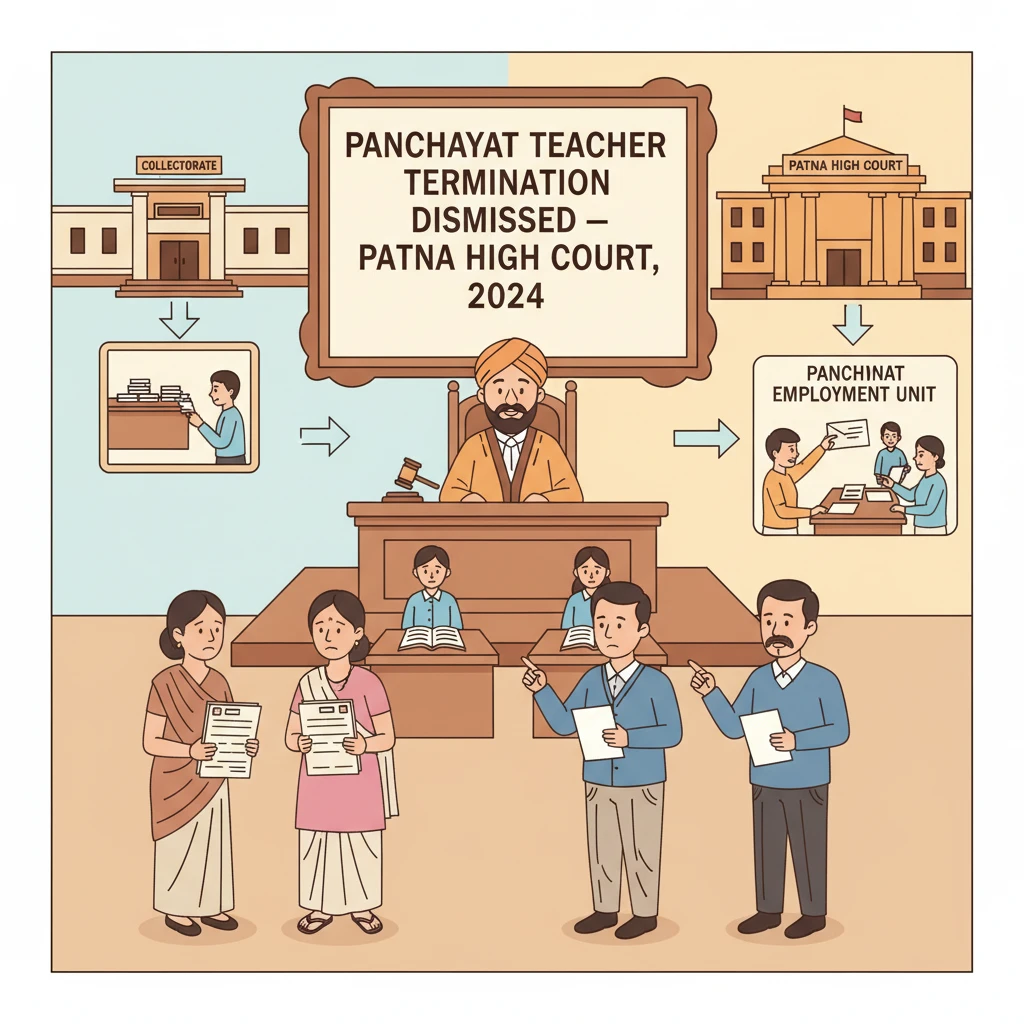
Case Background
The petitioners were engaged as Panchayat Shiksha Mitra (PSM) in the year 2003 in Panchharwa Gram Panchayat under Mejarganj Block, Sitamarhi district. Their selection was based on recommendations of the Sukh Suvidha Samiti of the Gram Panchayat.
A private candidate, later arrayed as respondent no. 12, felt aggrieved. He claimed that the appointments in the Panchayat were not proper and sought his own employment as PSM. He approached the Patna High Court in C.W.J.C. No. 13698 of 2004, challenging the employment of PSMs in Panchharwa Gram Panchayat.
On 22.03.2006, the High Court did not decide on merits but directed respondent no. 12 to file a representation before the Collector of Sitamarhi. The Court ordered that the Collector must consider and decide the representation by a speaking order within six weeks from filing.
Pursuant to this direction, respondent no. 12 submitted his representation to the Collector. The Collector, Sitamarhi examined the matter and, by memo no. 14 dated 15.11.2006, cancelled the appointments of all PSMs in that Panchayat, except one Pramod Kumar who belonged to the Scheduled Caste category.
The petitioners, whose employment stood cancelled, then filed C.W.J.C. No. 4422 of 2007 before the Patna High Court. That writ petition, along with similar matters, was disposed of by a common order on 11.07.2011. The Court gave liberty to the petitioners to approach the District Teachers Appointment Appellate Authority.
Following this liberty, the petitioners filed Appeal/Case No. 129 of 2011 before the District Teachers Appointment Appellate Authority, Sitamarhi. By order dated 05.05.2012, the District Appellate Authority dismissed their appeal and upheld the Collector’s cancellation.
The petitioners then moved the Patna High Court again in C.W.J.C. No. 16411 of 2012. By order dated 07.11.2017, the High Court directed them to approach the State Appellate Authority. Acting on this, they filed Appeal No. 170 of 2018 before the State Appellate Authority, Patna, challenging both the Collector’s order dated 15.11.2006 and the District Appellate Authority’s order dated 05.05.2012.
In Appeal No. 170 of 2018, notices were issued to the private respondents. Only respondent no. 12 appeared and filed a counter affidavit. The other private respondents, though served by speed post, did not appear. Ultimately, by order dated 10.06.2019, the State Appellate Authority dismissed the appeal.
Aggrieved, the petitioners approached the Patna High Court once more by filing Civil Writ Jurisdiction Case No. 4923 of 2021. They sought quashing of the Collector’s order, the District Appellate Authority’s order, and the State Appellate Authority’s order, and asked for reinstatement as Panchayat Teachers with consequential monetary benefits.
What the Court Examined and Decided
The Patna High Court, presided over by Hon’ble Mr. Justice Anjani Kumar Sharan, heard counsel for the petitioners, the State and the private respondents. The Court examined whether the cancellation of the petitioners’ engagements and the subsequent appellate orders were legally valid.
The petitioners’ case rested on two main planks: violation of natural justice and alleged compliance with reservation and eligibility norms. They argued that the Collector, Sitamarhi, cancelled their employment without issuing any notice or hearing them. According to them, this violated the principles of natural justice. They also complained that the District Appellate Authority did not look into whether the reservation roster had been properly followed when they were appointed.
The petitioners further submitted that they were not made parties in C.W.J.C. No. 13698 of 2004, nor before the Collector at the time of the representation filed by respondent no. 12. Despite this, their appointments were cancelled. They claimed that no show cause notice was served on them before taking such an adverse decision that affected their livelihood.
On the factual side, the petitioners contended that the private respondents had never participated in the counselling process for PSM appointments. They asserted that their own appointments were made in line with the reservation roster. They specifically stated that private respondents Upendra Singh, Arun Kumar and Ranjit Kumar Patel had appeared before the District Programme Officer, Sitamarhi and declared that they were not interested in the post of PSM at the relevant time.
The petitioners also argued that the State Appellate Authority wrongly concluded that the appointing authority (the Panchayat) had not considered the recommendation of the District Superintendent of Education (DSE), Sitamarhi. They alleged that the entire action of the authorities violated Articles 14, 16 and 21 of the Constitution of India and the principles of natural justice.
They further pointed out that the District Appellate Authority had dismissed their appeal on the grounds of non-compliance of the roster and violation of Government rules and guidelines relating to appointment of Panchayat Shiksha Mitra. According to the petitioners, this decision did not properly address their specific grievances regarding lack of notice and hearing.
To bolster their case, the petitioners relied on the judgment of a Co-ordinate Bench of the Patna High Court in Rajni Bara vs. The State of Bihar and Ors., reported in 2011 (4) PLJR 846. The portion quoted before the Court highlighted that where the authorities had not questioned the qualifications of the petitioner and had themselves failed to ensure reservation compliance in time, the appointee should not be punished for reservation violations, especially when no irregularity was found for a long period.
In response, the State filed a counter affidavit. It explained the process that led to the petitioners’ initial appointments being held invalid. The Sukh Suvidha Samiti of Panchharwa Gram Panchayat had recommended the names of certain candidates, including the petitioners, for PSM posts. The proposal, along with comments from the Block Development Officer, Mejarganj, was examined by the District Superintendent of Education, Sitamarhi.
By letter no. 3150 dated 06.08.2003, the DSE, Sitamarhi held that appointments of the private respondents and one Pramod Kumar would be in accordance with rules. The DSE directed the Gram Panchayat to make employment of PSMs accordingly, and clearly warned that if employment was not made as per his letter, the Government would not be liable to pay grant for honorarium.
Despite this direction, the Panchayat Employment Unit did not follow the DSE’s letter. Instead, it appointed the petitioners along with Pramod Kumar, in violation of the guidelines and the specific recommendation of the DSE. When respondent no. 12 later filed a complaint in pursuance of the High Court’s earlier order, the Collector, Sitamarhi re-examined the matter and concluded that the petitioners’ employment was not valid. Consequently, the Collector cancelled their employment by memo dated 15.11.2006, retaining only Pramod Kumar’s appointment.
The State Appellate Authority, while deciding Appeal No. 170 of 2018, looked into these facts. It noted that the Sukh Suvidha Samiti had recommended the names of the petitioners and Pramod Kumar. This proposal was forwarded by the Block Development Officer to the DSE, Sitamarhi with his comments. The DSE examined the proposal and found the recommendations of the Gram Panchayat to be defective. He then recommended employment of the private respondents and Pramod Kumar instead.
However, the officials of Panchharwa Gram Panchayat ignored the DSE’s clear direction and, following their earlier recommendations, employed the petitioners and Pramod Kumar. On these facts, the State Appellate Authority agreed with the District Appellate Authority that the Sukh Suvidha Samiti had made selections disregarding the Government guidelines and the DSE’s letter. It therefore upheld the cancellation of the petitioners’ appointments.
The Patna High Court considered the petitioners’ reliance on the Rajni Bara judgment. In that case, the petitioner had been appointed as Shiksha Mitra on 07.02.2006 and there was a 30-day time limit for filing complaints against such appointment. No complaint was filed within this time, and the eventual complaint was lodged much later, on 20.08.2009, by a new Mukhiya. The Court there held that the authorities could not, after such delay and without questioning the petitioner’s qualifications, unsettle the appointment solely on reservation issues without first proceeding against those responsible for the violation.
The present case, however, was found to be factually different. Here, the Panchayat Samiti had failed to comply with the DSE’s order contained in letter no. 3150 dated 06.08.2003 and had appointed the petitioners and others contrary to that direction. Respondent no. 12 promptly challenged these appointments by filing C.W.J.C. No. 13698 of 2004. Acting on the High Court’s direction dated 22.03.2006, he submitted his representation to the Collector, Sitamarhi, who then investigated and found that the petitioners’ appointments were made in violation of Government guidelines and the DSE’s instruction.
Thus, unlike Rajni Bara, this was not a case where the authorities slept over the matter for years without objection. The cancellation flowed from a specific earlier judicial direction to examine the grievances of respondent no. 12 and from a clear breach of the DSE’s binding communication.
After analysing the record and the orders of both the District Appellate Authority and the State Appellate Authority, the High Court concluded that there was no illegality or infirmity in their findings. The employment of the petitioners had already been cancelled in 2006 by the Collector, and that order had never been stayed or set aside by any competent authority.
In these circumstances, the Court refused to interfere. It held that the Collector’s order remained valid and operative. Consequently, the writ petition filed by the petitioners was dismissed, and their plea for reinstatement as Panchayat Teachers with monetary benefits was rejected.
Why This Judgment Matters
This judgment from the Patna High Court is important for candidates and officials involved in local teacher appointments, especially Panchayat Shiksha Mitras and Panchayat Teachers in Bihar.
The Court reinforces that appointments made in violation of Government guidelines and explicit directions of higher authorities such as the District Superintendent of Education can be cancelled, even if the appointees have already worked for some time.
The decision shows that when a Collector or appellate authority later discovers that a Panchayat has ignored binding instructions and selected its own candidates, the Court may side with the authorities and uphold cancellation of such irregular appointments.
At the same time, it warns Panchayat bodies and local committees like Sukh Suvidha Samitis that they cannot legally bypass directions issued by the District Education authorities. Doing so can lead not only to financial consequences, such as denial of grants, but also to later cancellation of appointments, affecting both appointees and the Panchayat.
For aspirants, the case underlines that their own appointment will remain secure only if the appointing body follows the prescribed process, reservation roster and superior officers’ directions. If the original process is defective, later litigation may result in cancellation even after many years.
Legal Issues and Answers
- Issue: Whether the cancellation of the petitioners’ appointment as Panchayat Shiksha Mitra by the Collector, followed by confirmation by the District and State Appellate Authorities, suffered from any illegality or infirmity warranting interference by the Patna High Court.
Answer: No. The Court held that the petitioners’ appointments were made by the Panchayat in violation of Government guidelines and the District Superintendent of Education’s clear directions, and therefore the cancellation orders were valid. - Issue: Whether the petitioners could rely on the earlier decision in Rajni Bara to claim protection against cancellation of their appointments.
Answer: No. The Court found the facts of Rajni Bara to be different, noting in the present case that the Panchayat had disobeyed the DSE’s order and that the challenge to the appointments was made promptly, not belatedly.
Cases Cited by the Court
- Rajni Bara vs. The State of Bihar and Ors., 2011 (4) PLJR 846.
Case Details
Case Number: Civil Writ Jurisdiction Case No. 4923 of 2021
Case Title: Rajesh Kumar Mahto & Ors. vs. The State of Bihar & Ors.
Citation: 2024 (4) PLJR 57
Coram: Hon’ble Mr. Justice Anjani Kumar Sharan
Advocates: For the petitioners – Mr. Rajeev Kumar Singh, Advocate; For the respondents – Mrs. Abhanjalli, Advocate.
Nature of the Case: Writ petition (civil) challenging cancellation of Panchayat Shiksha Mitra/Panchayat Teacher appointments and dismissal of related appeals.
Date of Judgment: 27.08.2024
Link to Full Judgment: Click here to read the Patna High Court judgment
If you found this explanation helpful and wish to stay informed about
how legal developments may affect your rights in Bihar,
you may consider following Samvida Law Associates for more updates.







