

Case Background
This case arises from a dispute within a Panchayat Samiti in Block Ghoswari, District Patna, under the Bihar Panchayat Raj Act, 2006.
The petitioner was serving as the elected pramukh of the Panchayat Samiti. Some members of the Panchayat Samiti moved a motion of no confidence against the petitioner.
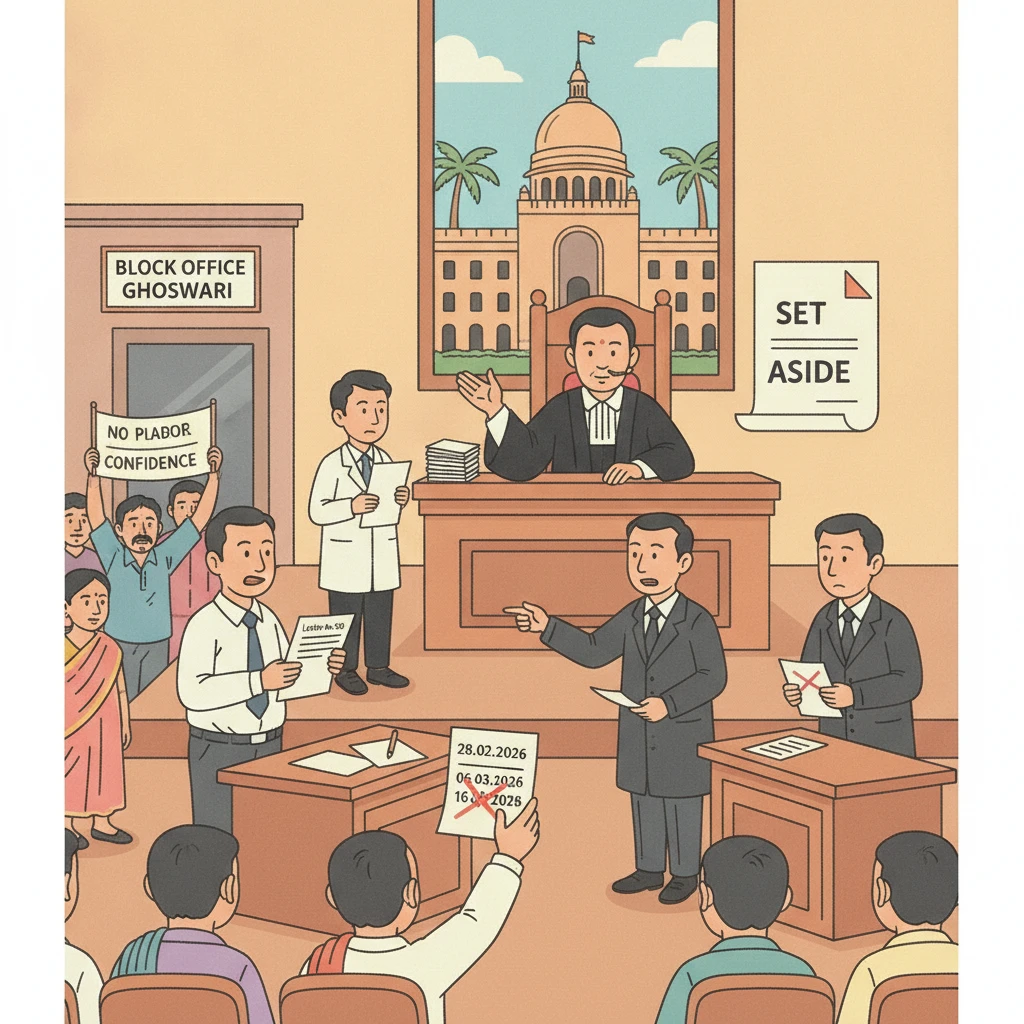
The no-confidence requisition was dated 27.02.2026. It was received by the Executive Officer on the same day, 27.02.2026.
On 28.02.2026, the Executive Officer forwarded this requisition to the petitioner/pramukh by Letter No. 155.
According to the petitioner, instead of allowing the pramukh the full statutory time to convene a special meeting, the Up-Pramukh issued Letter No. 65 dated 06.03.2026. By this letter, the Up-Pramukh fixed 16.03.2026 as the date for considering the no-confidence motion against the petitioner.
The petitioner challenged this action by filing Civil Writ Jurisdiction Case No. 3710 of 2026 before the Patna High Court.
In the writ petition, the petitioner not only attacked the Up-Pramukh’s letter fixing the date but also questioned the requisition and the Executive Officer’s forwarding letter, alleging vagueness in the allegations supporting the no-confidence motion.
What the Court Examined and Decided
The Patna High Court, through Hon’ble Mr. Justice Partha Sarthy, heard counsel for the petitioner, the State, the State Election Commission, and the private respondents.
The main relief sought by the petitioner was quashing of Letter No. 65 dated 06.03.2026 issued by the Up-Pramukh, Block Ghoswari. By this letter, the Up-Pramukh had scheduled a special meeting for 16.03.2026 to consider the no-confidence motion against the pramukh.
The petitioner argued that this action violated Section 44(3) of the Bihar Panchayat Raj Act, 2006. The contention was that the law first gives the pramukh 15 days from the date of requisition to fix the date of the special meeting. Only if the pramukh fails to act within that time can the Up-Pramukh or one-third of the members step in and fix a date.
The petitioner claimed that the Up-Pramukh had “exceeded his jurisdiction” and “usurped the power of the pramukh” by fixing the date prematurely, before the 15 days had expired.
Along with this, the petitioner also sought quashing of the requisition dated 27.02.2026 submitted by the members and the consequential Letter No. 155 dated 28.02.2026 issued by the Block Development Officer-cum-Executive Officer. It was alleged that the allegations were vague and that a no-confidence motion could not be called on such vague grounds.
The Court, however, focused its attention on the legal framework under Section 44(3) of the Bihar Panchayat Raj Act, 2006 and the timing of the actions taken.
The Court summarised the relevant statutory provision. Section 44(3) provides that when a requisition for a no-confidence motion, supported by at least one-third of the total elected members, is presented, the pramukh must convene a special meeting on a date “falling within 15 days” of such requisition.
The provision further states that if the pramukh fails to call the special meeting within this period, then the Up-Pramukh or one-third of the total number of directly elected members may fix a date for such meeting. After that, they may require the Executive Officer to give notice to members and take necessary steps to convene the meeting.
The Court clarified that, on a bare reading of Section 44(3), it is the pramukh who is primarily responsible, on receiving the requisition, to call the special meeting for considering the motion of no confidence.
Turning to the facts of this case, the Court noted that the requisition, though dated 27.02.2026, had been received by the petitioner/pramukh on 28.02.2026, when it was forwarded by the Executive Officer by Letter No. 155.
Based on this, the Court held that the 15-day period available to the pramukh for calling the special meeting would run from 28.02.2026. Therefore, the pramukh had time up to 15.03.2026 to fix the date of the special meeting for considering the no-confidence motion.
Despite this, the Up-Pramukh, by Letter No. 65 dated 06.03.2026, fixed 16.03.2026 as the date for such meeting.
The Court observed that this act of the Up-Pramukh was taken while the 15-day period in favour of the pramukh was still running. The deadline of 15.03.2026 had not yet expired when the Up-Pramukh intervened and fixed the date.
In the opinion of the Court, this conduct was “clearly in teeth of the provisions contained in section 44(3) of the Act.” In simple words, the Up-Pramukh acted contrary to the statutory scheme, because he stepped in before the law permitted him to do so.
The Court also referred to its earlier Division Bench decision in Munni Khatun vs. State of Bihar & Ors., reported in 2024 (4) BLJ 820 (DB). While the detailed reasoning of that case is not reproduced in this judgment, the reference shows that the Court relied on existing precedent to affirm the correct interpretation of Section 44(3).
After considering the facts and legal position, the Court set aside the Up-Pramukh’s action. Specifically, the Court quashed the letter dated 06.03.2026 issued by the Up-Pramukh, Block Ghoswari, District Patna, by which 16.03.2026 had been fixed as the date for the special meeting to consider the no-confidence motion.
The Court then addressed what should happen next. It noted that no meeting had yet been fixed by the pramukh pursuant to the requisition dated 27.02.2026, which was the subject matter of the writ application.
To ensure that the motion of no confidence is still considered in accordance with law, the Court directed that the pramukh would be required to fix a date for the special meeting within a period of 15 days from the date of the judgment, i.e., within 15 days from 12.05.2026, as contemplated under Section 44(3) of the Bihar Panchayat Raj Act, 2006.
In this way, the High Court both protected the statutory rights of the pramukh and ensured that the members who had moved the no-confidence motion would still get their motion considered lawfully and within a reasonable time.
Finally, the Court allowed the writ application and disposed it of with these directions.
Why This Judgment Matters
This judgment is important for elected representatives and members of Panchayat bodies in Bihar.
It makes clear that a pramukh cannot be bypassed immediately after a no-confidence requisition is submitted. The law grants the pramukh 15 days to convene a special meeting.
The Up-Pramukh or one-third of the members can step in only if the pramukh fails to act within those 15 days. Any attempt to fix a date before that period is over is illegal and can be struck down by the Court.
For ordinary Panchayat representatives, this ruling shows that no-confidence motions must follow the strict procedure in Section 44(3). Both the majority seeking removal and the pramukh facing the motion have defined rights and responsibilities.
The judgment of the Patna High Court, read with the earlier decision in Munni Khatun, reinforces that procedural safeguards in local self-government laws are not empty formalities. They protect democratic fairness within Panchayat institutions.
Legal Issues and Answers
- Issue: Could the Up-Pramukh fix a date for the no-confidence meeting against the pramukh before expiry of the 15-day period given to the pramukh under Section 44(3) of the Bihar Panchayat Raj Act, 2006?
Answer: No. The Patna High Court held that since the requisition was received by the pramukh on 28.02.2026 and the 15-day period ran up to 15.03.2026, the Up-Pramukh’s act of fixing 16.03.2026 as the meeting date on 06.03.2026 was contrary to Section 44(3). The letter fixing the date was set aside. - Issue: What follow-up action was required after quashing the Up-Pramukh’s letter?
Answer: The Court directed that, as no meeting had yet been fixed by the pramukh pursuant to the requisition dated 27.02.2026, the pramukh must now fix a date for the special meeting within 15 days from 12.05.2026, in accordance with Section 44(3).
Cases Cited by the Court
- Munni Khatun vs. State of Bihar & Ors., 2024 (4) BLJ 820 (DB).
Case Details
Case Number: Civil Writ Jurisdiction Case No. 3710 of 2026
Case Title: Smt. Lalita Kumari v. The State of Bihar & Ors.
Coram: Hon’ble Mr. Justice Partha Sarthy
Citation: 2026(3) PLJR 622
Advocates:
- For the petitioner: Mr. Manoj Kumar Pandey, Advocate; Ms. Kumari Pallavi, Advocate
- For the State: Mr. Subodh Kumar, AC to SC-26
- For the State Election Commission: Mr. Ravi Ranjan, Advocate
- For respondent nos. 7 to 12: Mr. S.B.K. Manglam, Advocate; Mr. Awnish Kumar, Advocate
Nature of the Case: Writ petition (challenge to convening of no-confidence meeting under Section 44(3) of the Bihar Panchayat Raj Act, 2006)
Link to Judgment: Click here to access the official Patna High Court judgment
If you found this explanation helpful and wish to stay informed about how legal developments may affect your rights in Bihar, you may consider following Samvida Law Associates for more updates.







