
Case Background
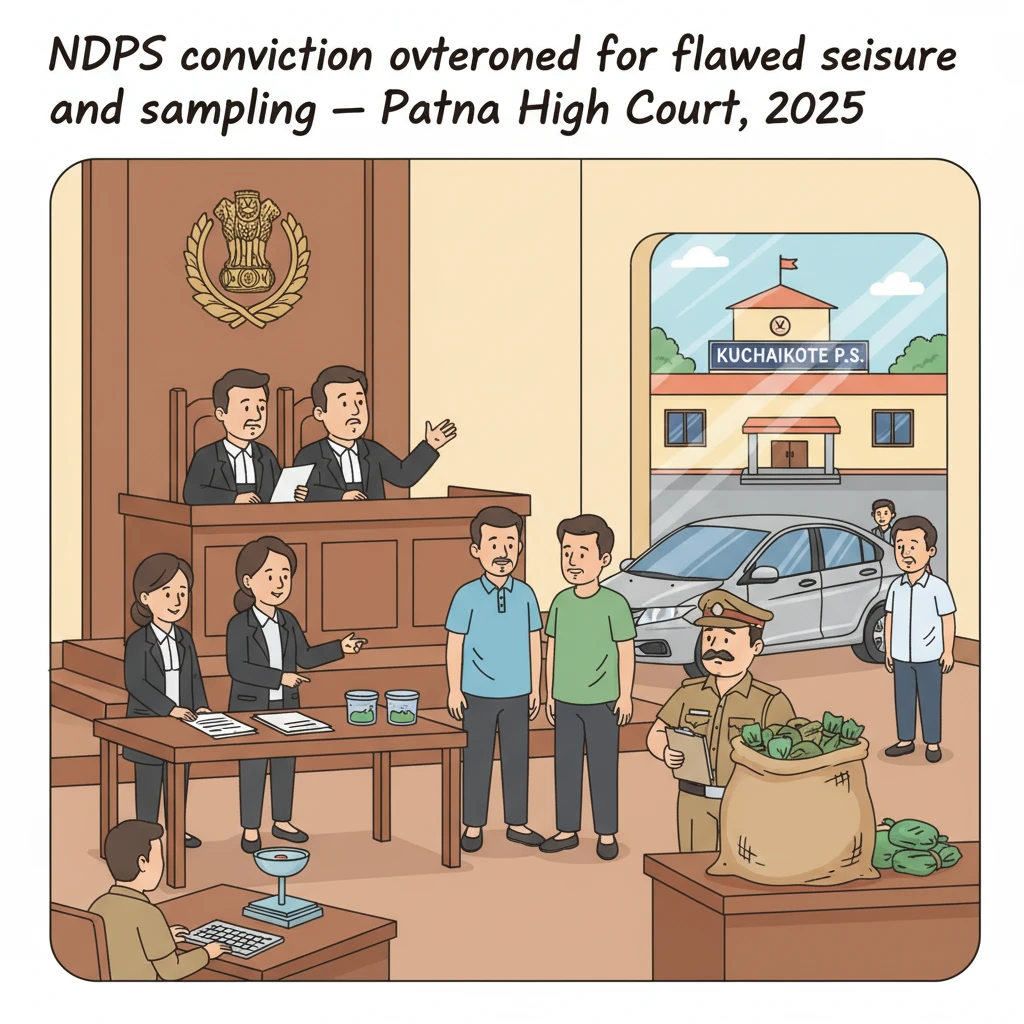
This criminal appeal arose from Kuchaikote P.S. Case No. 489 of 2020, District Gopalganj. The prosecution case began with a written application by a police Sub-Inspector (PW-1), who claimed to have received secret information on 18.12.2020 at 10:10 AM about a large consignment of illicit ganja coming from the Gopalganj side.
On this information, PW-1 recorded Sanha No. 494 of 2020 dated 18.12.2020, informed senior police officers and the nearest Magistrate (the Anchaladhikari, Kuchaikote), and asked the Anchaladhikari to come to the police station. On the directions of the Officer Incharge, a raiding team was formed, consisting of PW-1, another Sub-Inspector, Reserve force personnel and constables. They moved to Balthari Check Post on NH-28.
At the check post, the team started checking vehicles coming from Gopalganj. They stopped a silver Honda City car bearing registration number UP-16-N-1820. According to the informant, the driver and another occupant tried to flee but were caught. They allegedly disclosed their names as appellant Toofani Ram and appellant Ramkripal Yadav.
PW-1 stated that on seeing the police action, people gathered from nearby, and two persons – Godan Shah and Sandeep Basfor – agreed to act as independent seizure witnesses. On search of the car dickey, 16 packets in plastic polythene containing brown substance smelling like ganja were allegedly recovered. PW-1 claimed that the accused said it was ganja, belonging to appellant Toofani Ram.
From each accused, one mobile phone was also recovered. A weighing machine was called from the police station to the spot, and the 16 packets were weighed, totalling 1.30 quintal. On the spot itself, PW-1 claimed to have prepared two samples of 25 grams each, kept in two dibbas (boxes) and sealed. A seizure list was prepared, allegedly signed by the independent witnesses and the Circle Officer.
Based on the written application, Kuchaikote P.S. Case No. 489 of 2020 was registered on 18.12.2020 under Sections 20, 22, 25 and 29 of the NDPS Act against three accused: vehicle owner Suryakant Madesia, and the two appellants. After investigation, charge sheet No. 114 of 2021 dated 30.04.2021 was submitted under Sections 8, 20(b)(ii)(c) and 25 of the NDPS Act. Cognizance was taken on 02.07.2021.
On 18.01.2022, charges under Sections 20(b)(ii)(c) and 22 NDPS Act were framed against all three, with an additional charge under Section 25 against Suryakant Madesia. The accused pleaded not guilty. The prosecution examined eight witnesses and produced documents, including seizure list, written application, FIR, and FSL report. Sixteen bundles of alleged ganja were marked as material exhibits. The defence examined two witnesses and produced a sale letter and signature as defence exhibits.
The trial court convicted appellants Toofani Ram and Ramkripal Yadav under Section 20(b)(ii)(c) NDPS Act and sentenced them to 12 years’ rigorous imprisonment and a fine of Rs. 1,20,000/-, with one year’s further imprisonment in default. Co-accused Suryakant Madesia was acquitted. Against this conviction and sentence, the present criminal appeal (DB) No. 406 of 2023 was filed before the Patna High Court.
What the Court Examined and Decided
The Division Bench of Hon’ble Mr. Justice Rajeev Ranjan Prasad and Hon’ble Mr. Justice Sourendra Pandey heard the appellants’ challenge to the conviction and sentence passed by the Special Judge, NDPS Act, in Trial No. 30 of 2020.
Counsel for the appellants argued that mandatory and established procedures for search, seizure and sampling under the NDPS Act had not been followed. They pointed out that the two independent witnesses named in the seizure list – Godan Shah and Sandeep Basfor – were never made charge sheet witnesses and were not examined at trial. According to them, this cast serious doubt on the seizure list itself.
It was further argued that no independent witness had deposed; all prosecution witnesses were police or public officials. There were material contradictions regarding how the seizure list was prepared and how ganja was taken out from the vehicle. The prosecution, they said, failed to prove its case beyond reasonable doubt.
The defence also highlighted that although 16 bundles of ganja-like substance were allegedly seized, the individual weight of each bundle was not recorded. They emphasised that the seized ganja and samples were not produced in court with the accused on 19.12.2020. Instead, samples were brought a month later and sent to the FSL only after about two months.
Counsel pointed out that the two sample dibbas did not bear signatures of the accused and that sampling was not done in the presence of a Magistrate, as required under Section 52A(2) NDPS Act. Heavy reliance was placed on the Supreme Court judgment in Bharat Aambale vs. State of Chhattisgarh, 2025 SCC OnLine SC 110 (para 50), which summarised the law on search, seizure and sampling under Section 52A.
Another key contention was that the prosecution failed to connect the sample sent to FSL with the actual bundles allegedly seized. There was unexplained delay in sending the samples and no clarity on where they were kept in the meantime.
The State, through the Additional Public Prosecutor, supported the trial court’s findings. It was argued that the prosecution witnesses consistently supported seizure of ganja from the car dickey and that the trial court had correctly appreciated the evidence and convicted the appellants.
The High Court first scrutinised the role of the independent witnesses. It found from the record that the two independent seizure witnesses, although named in the written application and seizure list, were not examined. No plausible explanation was offered for their non-examination. The Circle Officer (PW-6) stated that the seizure list was prepared in his presence and that he signed it. However, the Investigating Officer (PW-4) clearly admitted that he had not recorded the statement of the Circle Officer during investigation.
PW-6 further said that the seizure witnesses were labourers, but he could not say whether they were private or government labourers and did not know their ages. The I.O. claimed to have recorded the witnesses’ statements at the police station. In this situation, the Court noted that non-examination of independent seizure witnesses created a serious lacuna in the prosecution case.
Next, the Court examined whether the seized ganja was produced before the court in time. The order-sheet of 19.12.2020 showed that the FIR was received, and the accused were produced with forwarding letter, arrest memo and checklist. However, that order did not record production of seized ganja. The I.O. (PW-4) stated in evidence that he produced the seized exhibits on 19.12.2020 and that the court signed all bundles, but this was not supported by the trial court’s own orders. The High Court rejected this part of the I.O.’s testimony as unsupported by record.
Further, in paragraph 10 of his deposition, PW-4 admitted that the seized ganja itself was not handed over to him; only the sample in a plastic dibba tied with cloth was given. He said the sample bore signatures of the informant, seizure witnesses and Circle Officer and that the dibba was not opened in court. He also admitted that he did not know the name of the Malkhana Prabhari who gave him the sample on 19.12.2020, nor did he know how much ganja was in the Malkhana that day. This showed that the bulk seized ganja was never produced in court and that his own statements were self-contradictory.
The Court then considered the evidence of PW-1, the informant. In paragraph 20, PW-1 stated that samples bore signatures of witnesses, but there was no signature of the accused. He further admitted that the plastic dibbas containing samples were sealed, but the 16 bundles themselves were not sealed. Those unsealed bundles remained in the Malkhana. PW-1 also did not say he handed over seized ganja to the I.O.
Reading the evidence of PW-1 and PW-4 together, the High Court concluded that the bundles of alleged ganja remained unsealed in the police station and that samples were prepared without any signature of the accused on the seal. This raised serious doubt about the integrity and identity of the seized material and samples.
The Court then looked into the movement of samples to the FSL. On 27.01.2021, about five weeks after seizure, an application was filed before the trial court for sending the seized exhibits to FSL, Muzaffarpur. The court allowed it. But from the evidence, it appeared that the sample dibbas were never opened in court. Despite the court’s order, samples were actually sent to FSL only on 19.02.2021. The Court noted that it was unknown where the samples were kept from the date of seizure till dispatch to FSL.
The FSL report, Exhibit 3(4), showed that Chaukidar 7/3 Babujaan Ansari and Chaukidar 6/3 Vasirudin Ansari delivered the samples to the FSL on 19.02.2021. However, these chaukidars were not examined at trial. The defence thus had no opportunity to cross-examine them on how they received, handled and transported the samples.
Another serious aspect was the timing of the FSL report. The charge sheet had been submitted and cognizance taken on 02.07.2021 before the FSL report was available. The FSL report was prepared only on 26.04.2022 and was called from the prosecution by court order dated 23.11.2022. Further, the 16 bundles of alleged ganja were produced as material exhibits only on 09.11.2022, when prosecution evidence was almost over, and were then marked as Exhibits M1 to M16 through PW-7.
PW-7, a Chaukidar from Kuchaikote P.S., stated that he had brought the seized exhibits from Thave Godown on the order of the Station House Officer and claimed the exhibits were produced in court on 19.12.2020. The High Court held that this claim was contrary to the trial court’s order dated 19.12.2020 and thus not acceptable.
On these facts, the High Court observed that after the alleged seizure, no inventory certification was prepared under Section 52A NDPS Act, and sampling was not done either at the place of occurrence in a legally compliant manner or later before a Magistrate under Section 52A(2). Referring to the Supreme Court’s detailed summary in Bharat Aambale and the subsequent judgment in Surepally Srinivas vs. State of Andhra Pradesh (now State of Telangana), 2025 SCC OnLine SC 683, the Court underscored that though non-compliance with Section 52A may not automatically nullify a case, where there are serious discrepancies in seizure and sampling, the court must be cautious.
In this case, the High Court held that the prosecution had failed to prove primary evidence and documents relating to lawful seizure and sampling of ganja. The basic requirements laid down by the Supreme Court for sustaining an NDPS prosecution were not met. In such circumstances, it was not safe to uphold the conviction. The benefit of doubt was extended to the appellants.
Accordingly, the Court set aside the judgment of conviction dated 18.03.2023 and the order of sentence dated 22.03.2023. The appellants were acquitted of the charge under Section 20(b)(ii)(c) NDPS Act, with a direction that they be released forthwith if not wanted in any other case. The appeal was allowed.
Why This Judgment Matters
This Patna High Court judgment is important for anyone facing NDPS cases, particularly where ganja or other contraband is allegedly seized from vehicles.
The Court did not say that ganja was never seized. Instead, it focused on whether the police and prosecution could prove, with reliable evidence, that the seized substance and the tested samples were properly handled as per law. Because the bundles were left unsealed, samples did not carry the accused’s signatures, independent witnesses were not examined, and there were delays and gaps in sending samples to FSL, the Court refused to rely on the prosecution story.
For accused persons and their families, this judgment shows that under the NDPS Act, strict punishment must be matched with strict proof. If crucial steps like seizure, sealing, sampling, safe custody and timely FSL examination are not clearly proved, courts can give benefit of doubt.
For police and prosecutors, it is a reminder that compliance with Section 52A NDPS Act and Supreme Court guidelines in Bharat Aambale and Surepally Srinivas is not just a formality. Improper documentation, missing witnesses, and unexplained delays can lead to acquittal even in cases involving commercial quantity.
Legal Issues and Answers
-
Issue: Whether the conviction of the appellants under Section 20(b)(ii)(c) NDPS Act could be sustained when seizure, sealing, sampling and production of ganja were not proved in accordance with law.
Answer: No. The Patna High Court held that serious lapses and contradictions in seizure, sampling, custody and FSL procedures created reasonable doubt, so the conviction could not be safely sustained and was set aside.
Cases Cited by the Court
- Bharat Aambale vs. State of Chhattisgarh, 2025 SCC OnLine SC 110
- Surepally Srinivas vs. The State of Andhra Pradesh (Now State of Telangana), 2025 SCC OnLine SC 683
Case Details
Case Number: Criminal Appeal (DB) No. 406 of 2023; arising out of Kuchaikote P.S. Case No. 489 of 2020
Case Title: Toofani Ram & Anr. vs. The State of Bihar
Citation: 2025(4) PLJR 731
Coram: Hon’ble Mr. Justice Rajeev Ranjan Prasad; Hon’ble Mr. Justice Sourendra Pandey
Advocates: Ms. Preety Chaudhary, Advocate for the appellants; Mr. Kumar Harshvardhan, Advocate for the appellants; Mr. Rajnikant, Advocate for the appellants; Mr. Bipin Kumar, Additional Public Prosecutor for the State
Nature of the Case: Criminal appeal (Division Bench) against conviction and sentence under the NDPS Act passed by the Additional Sessions Judge-I-cum-Special Judge, NDPS Act, in Trial No. 30 of 2020
Link to Judgment: View full judgment on Patna High Court website
If you found this explanation helpful and wish to stay informed about
how legal developments may affect your rights in Bihar,
you may consider following Samvida Law Associates for more updates.







