

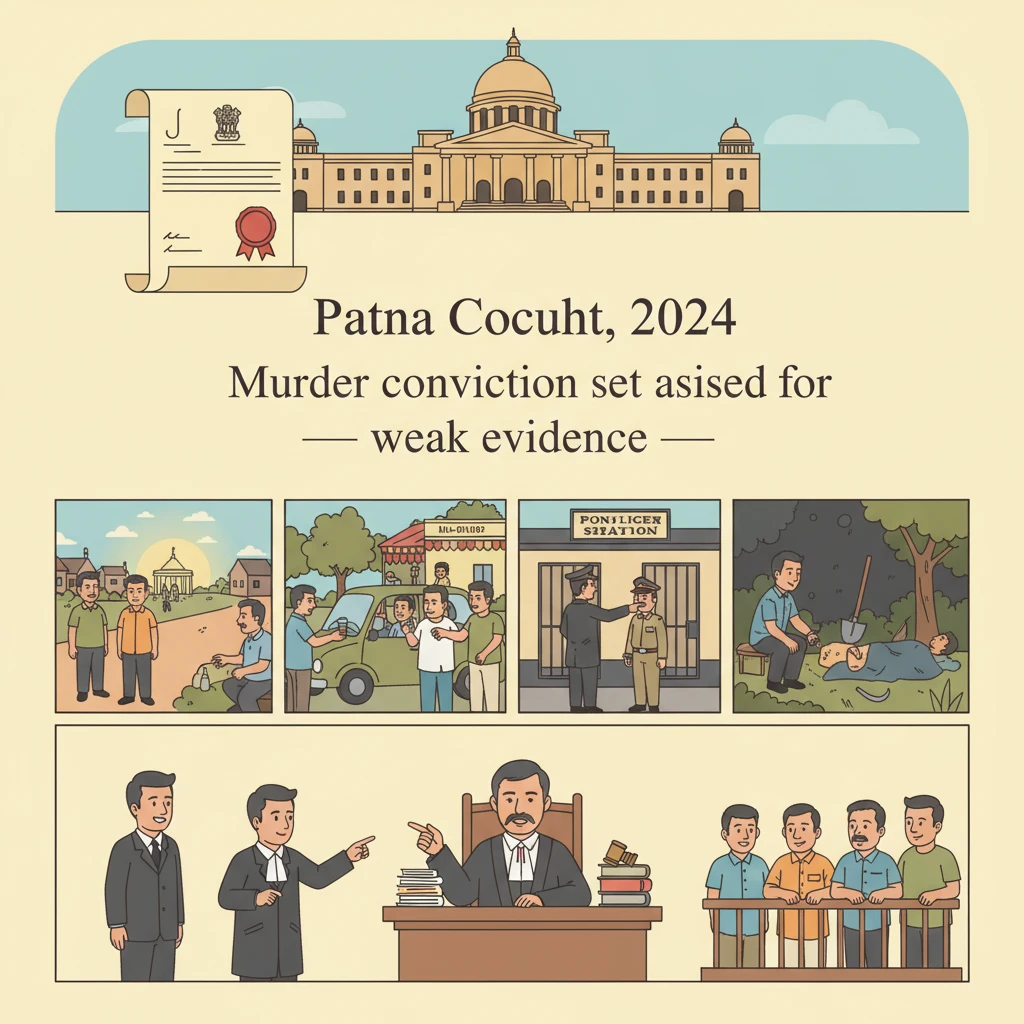
Case Background
The case started when a young man, Sanjeet Kumar, went missing from his village in Sheikhpura district. On 22.10.2015, around 6 p.m., he left home along with one Shailendra Kumar to visit a fair organised on the eve of Dussehra.
When Sanjeet did not return home by the next day, his elder brother, Sunil Kumar Suman (Prosecution Witness 14), began searching. He first enquired from Shailendra, who said that he had left Sanjeet’s company the same night.
During the search, PW14 was informed by one Binod Paswan (not examined at trial) that he had seen Sanjeet along with appellant Sanjay Mandal, standing near a vehicle belonging to Sanjay. Binod also mentioned that some other persons were drinking with the owner of a local restaurant.
On the basis of this information, PW14 suspected that Shailendra, Sanjay Mandal, the restaurant owner and others might have killed Sanjeet. He gave a written report to the police, and Ariari P.S. Case No. 116 of 2015 dated 24.10.2015 was registered against Shailendra, Sanjay and the restaurateur along with some unknown persons.
During investigation, the police dropped Shailendra and the restaurateur from the case. Instead, they focused on Sanjay Mandal and his brother Guddu Mandal, treating Sanjay as a suspect as he was allegedly last seen with the deceased.
According to the prosecution, Guddu Mandal made a confession in police custody. On the basis of this confession, police claimed to have recovered the trunk and head of a dead body and a blood-stained sickle from a jungle. Other appellants were then arrested, only because their names allegedly appeared in Guddu’s confession.
The police filed a chargesheet only against six accused persons: Sanjay Mandal, Guddu Mandal, Niranjan Kumar @ Niranjan Mandal, Dilwar @ Dilawar Mandal, Suresh Mahto @ Suresh Mandal and Bhonu Mahto @ Bhonu Mandal. They were tried in Sessions Case No. 26 of 2016 before the District & Sessions Judge, Sheikhpura.
On 19.06.2017, the trial court convicted all six under Sections 364, 302, 201, 149 and 120B of the Indian Penal Code. On 22.06.2017, they were sentenced to life imprisonment for murder, ten years’ rigorous imprisonment for kidnapping, and three years’ rigorous imprisonment for causing disappearance of evidence, with fines and a direction for compensation to the deceased’s family. No separate sentence was imposed for conspiracy.
The six convicts filed criminal appeals. Criminal Appeal (DB) No. 1091 of 2017 was filed by four appellants; Criminal Appeal (DB) No. 925 of 2017 by two appellants. The Patna High Court heard both appeals together and delivered a common oral judgment on 05.01.2024.
What the Court Examined and Decided
The Patna High Court, speaking through Hon’ble Mr. Justice Ashutosh Kumar (for the Bench), carefully examined the nature of evidence used to convict the appellants. The case was based entirely on circumstantial evidence. There was no eye-witness to any kidnapping or murder, and no clear motive alleged by the prosecution.
The prosecution story was that the appellants strangulated Sanjeet, cut off his head, and buried the body parts in a jungle. However, the Court noted that the prosecution had not shown any previous enmity between the appellants and the deceased or his family.
The defence, represented by Mr. Ajay Kumar Thakur, argued that the police and the trial court had relied heavily on inadmissible and unreliable material. The key challenge was to the alleged confession of Guddu Mandal, which supposedly led to the recovery of the dead body and a weapon.
The defence pointed out that:
- There was no arrest memo on record showing that Guddu was officially in police custody when he allegedly confessed.
- The supposed confession was not recorded in the presence of any independent witness, even though many persons were present at the police station at that time.
- No recovery memo (panchnama) for the dead body was produced in court, so the exact place and manner of recovery remained unknown.
- Without such documentation, there was no guarantee that the body was actually recovered at Guddu’s instance.
The Court found considerable force in these objections. Under Sections 26 and 27 of the Indian Evidence Act, a confession made to police while in custody is generally inadmissible, except to the limited extent that it directly leads to discovery of a new fact (for example, the location of an object or body). For this exception to apply, the prosecution must show clearly that:
- The person giving information was an accused and in police custody.
- Some fact was discovered as a result of that information.
- Only that part of the information which distinctly relates to the discovered fact can be used in evidence.
Here, the Court held that it was not even clear that Guddu was in police custody at the time of the alleged confession. Without an arrest memo or other reliable proof, this basic requirement of Section 27 was not satisfied.
Moreover, the Court stressed that “discovery of a fact” under Section 27 is not the same as simply producing an “object recovered”. Discovery includes the place from which an object is produced and the accused’s knowledge about that place. The judgment relied heavily on the classic Privy Council decision in Pulukuri Kottaya vs. King-Emperor, AIR 1947 PC 67, and on later Supreme Court authorities interpreting Section 27.
Even if the recovery was accepted at face value, the High Court said it could only be one link in the chain of circumstances, not the whole chain by itself. In any circumstantial case, each link must be established firmly, and all links together must point only to the guilt of the accused and exclude any other reasonable explanation.
The Court then examined whether the dead body that underwent post-mortem was proved to be that of Sanjeet Kumar. The post-mortem was conducted on 27.10.2015 by PW13, Dr. Dhirendra Prasad Singh. He found an incised wound at the base of the neck, with the head amputated but present on the table. The body was swollen, decomposed and emitting foul odour. He concluded that death was due to cardio-respiratory failure caused by amputation of the head with a sharp cutting instrument.
However, serious doubts arose from his cross-examination. The doctor stated that:
- The body was identified to him by a chowkidar, Gorelal Paswan.
- He was not told to which case the dead body related, and he did not note any case details in the post-mortem report.
- He could not say from the report which FIR or crime number the body belonged to.
The Court observed that there was no categorical and reliable identification of the truncated body as that of Sanjeet by any family member or other clear witness. There were only casual references by the wife and brother that the body parts recovered at Guddu’s instance were of Sanjeet. Given that the body had allegedly been buried for about five days and was decomposed, the Court found it difficult to accept that it could have been so easily identified without any detailed description being recorded.
The Court also noted another inconsistency. Dr. Singh said that from seeing the body he felt that it had been buried underground, yet he did not record this important observation in the post-mortem report. On the other hand, as there was no recovery memo, there was nothing in the official record to confirm that the body was exhumed from a burial site, or that it had been cleaned of mud before post-mortem.
Given these contradictions, the Bench questioned: “Which dead body then was subjected to the postmortem examination?” There was simply no clear connection between the body examined and Sanjeet Kumar or the police case.
Next, the Court evaluated the “last seen” evidence. Four witnesses, PWs 1 to 4 (Jitendra Kumar, Deepak Kumar, Uttam Kumar and Mithun Kumar), stated that they had gone to the fair and seen the deceased with appellant Sanjay Mandal and his associates. But their statements were recorded by police only after the recovery of the truncated body, around twenty days later.
The Court reasoned that, even if their story were true, this late statement severely reduced its value. None of them said that they saw Sanjeet actually leaving in a vehicle with the appellants. At best, they had seen him standing near Sanjay’s vehicle. Such an isolated circumstance could not complete the chain of proof.
Another witness, PW5 Rajesh Kumar, made the prosecution case even more doubtful. He claimed that at the fair he saw a red-coloured “magic” vehicle driven by Sanjay, with Bhonu, Suresh and Niranjan seated inside. He said the vehicle was parked behind a poultry farm, later recovered by police in an abandoned condition, and that he saw all appellants get out and enter the poultry farm.
The High Court pointed out that, even if believed, this only showed that the appellants went from the fair to the poultry farm and were not seen after that. The poultry farm was not shown as a place of occurrence. Also, the police strangely gave a “short-shrift” to the initial suspicion cast on Shailendra and the local restaurant owner, without properly investigating them, and instead shifted wholly to the appellants’ supposed confession.
The Investigating Officer, PW17 Balram Prasad, admitted that he did not even try to find out the relationship between the deceased and the appellants or any motive for the killing. The Court criticised this as an investigation done “with its blinders on”. Key steps were omitted: no arrest memo of Guddu, no recovery memo of the body, no production of the fly-axe allegedly used to cut the neck, and no chemical examination of blood stains on the weapon.
The Bench concluded that the trial judge had reminded himself of the law on circumstantial evidence, but had failed to apply it in practice. The chain of circumstances was full of “yawning infirmities and gaps”. The entire prosecution foundation had “vanished in thin air”.
Holding that a serious miscarriage of justice had occurred, the Patna High Court set aside the conviction and sentence of all six appellants. It allowed both appeals, acquitted the appellants of all charges, discharged the bail bonds of those already on bail, and directed that appellants Sanjay Mandal and Guddu Mandal be released forthwith if not required in any other case.
Why This Judgment Matters
This judgment is important for people facing criminal trials based only on circumstantial evidence. It shows that courts will not uphold a conviction if the police investigation is casual or incomplete, even in a serious offence like murder.
The Patna High Court emphasised that:
- Confessions to police are mostly inadmissible, and even the limited part allowed under Section 27 of the Evidence Act must strictly meet all legal conditions.
- Proper documentation like arrest memos, recovery memos and clear identification of bodies and objects is essential. Without these, the prosecution story becomes doubtful.
- Courts must insist on a complete and logical chain of circumstances before sending anyone to jail for life.
For ordinary citizens, this decision reassures that higher courts can correct wrongful convictions based on weak and speculative evidence. It is also a strong reminder to police and trial courts in Bihar that shortcuts in investigation cannot replace careful, lawful proof.
Legal Issues and Answers
- Issue: Could the alleged confession of appellant Guddu Mandal and the supposed recovery of a truncated body and weapon be relied upon under Section 27 of the Evidence Act to sustain the conviction?
Answer: No. The Court held that there was no clear proof that Guddu was in police custody when he made the statement, no recovery memo was produced, and the discovery itself was doubtful. Thus Section 27 did not apply in a way that could safely link the appellants to the crime. - Issue: Did the circumstantial evidence form a complete chain pointing only to the guilt of the appellants under Sections 302, 364, 201, 149 and 120B IPC?
Answer: No. The Court found multiple gaps: unreliable “last seen” evidence, doubtful recovery and identification of the dead body, no established motive, and investigative lapses. The chain was incomplete and could not support conviction. - Issue: Was the trial court justified in affirming guilt despite these shortcomings in investigation and evidence?
Answer: No. The High Court held that the trial court had erred in uncritically accepting the prosecution story. Given the “gossamer” nature of the circumstantial evidence, the only proper outcome was acquittal.
Cases Cited by the Court
- Hanumant vs. State of M.P., AIR 1952 SC 343
- Tufail @ Simmi vs. State of U.P., (1969) 3 SCC 198
- Ram Gopal vs. State of Maharashtra, (1972) 4 SCC 625
- Sharad Birdhichand Sarda vs. State of Maharashtra, (1984) 4 SCC 116
- Ramanand @ Nandlas Bharti vs. State of U.P., AIR 2022 SC 5273
- Subramanya vs. State of Karnataka, AIR 2022 SC 5110
- Boby vs. State of Kerala, 2023 SCC Online SC 50
- Venkatesh @ Chandra vs. State of Karnataka, 2023 Cr.L.J. 183 (SC)
- Pulukuri Kottaya vs. King-Emperor, AIR 1947 PC 67
- State of U.P. vs. Deoman Upadhyaya, AIR 1960 SC 1125
- Mohd. Inayatullah vs. State of Maharashtra, (1976) 1 SCC 828
- Anter Singh vs. State of Rajasthan, (2004) 10 SCC 657
- Jafarudheen and Ors. vs. State of Kerala, (2022) 8 SCC 440
- Rajesh and Anr. vs. State of Madhya Pradesh, 2023 SCC Online 1202
Case Details
Case Number: Criminal Appeal (DB) No. 1091 of 2017 with Criminal Appeal (DB) No. 925 of 2017; arising out of Ariari P.S. Case No. 116 of 2015, District Sheikhpura.
Case Title: Sanjay Mandal & Ors vs. The State of Bihar; Suresh Mahto @ Suresh Mandal & Anr vs. The State of Bihar.
Citation: 2024 (1) PLJR 477.
Coram: Hon’ble Mr. Justice Ashutosh Kumar and Hon’ble Mr. Justice Nani Tagia.
Advocates: For the appellants in both appeals – Mr. Ajay Kumar Thakur; For the State in Criminal Appeal (DB) No. 1091 of 2017 – Mr. Binod Bihari Singh, APP; For the State in Criminal Appeal (DB) No. 925 of 2017 – Mr. Ajay Mishra, APP.
Nature of the Case: Criminal appeals (Division Bench) against conviction and sentence in a sessions trial for offences under Sections 364, 302, 201, 149 and 120B IPC.
Date of High Court Judgment: 05.01.2024.
Link to Judgment: Click here to read the full Patna High Court judgment.
If you found this explanation helpful and wish to stay informed about
how legal developments may affect your rights in Bihar,
you may consider following Samvida Law Associates for more updates.







