

Case Background
The case arose from a dispute between an Assistant Teacher of a government primary school in Patna district and the education authorities of the State of Bihar. The petitioner was posted as an Assistant Teacher in Primary School, Bahrawa (also written as Bahrawan), under Police Station Pipra, District Patna.
According to the order, the petitioner was the senior-most teacher in that school and, on that basis, he was given additional responsibility as In-charge Headmaster. The present proceedings were not about his appointment as such, but about his claim that he worked continuously and should be paid salary for a long period for which no salary was released.
The petitioner approached the Patna High Court under its civil writ jurisdiction seeking payment of salary allegedly due from 1 May 2014 to 12 January 2016. This is the only relief recorded in the judgment. The writ petition was registered as Civil Writ Jurisdiction Case No. 6903 of 2019.
What the Court Examined and Decided
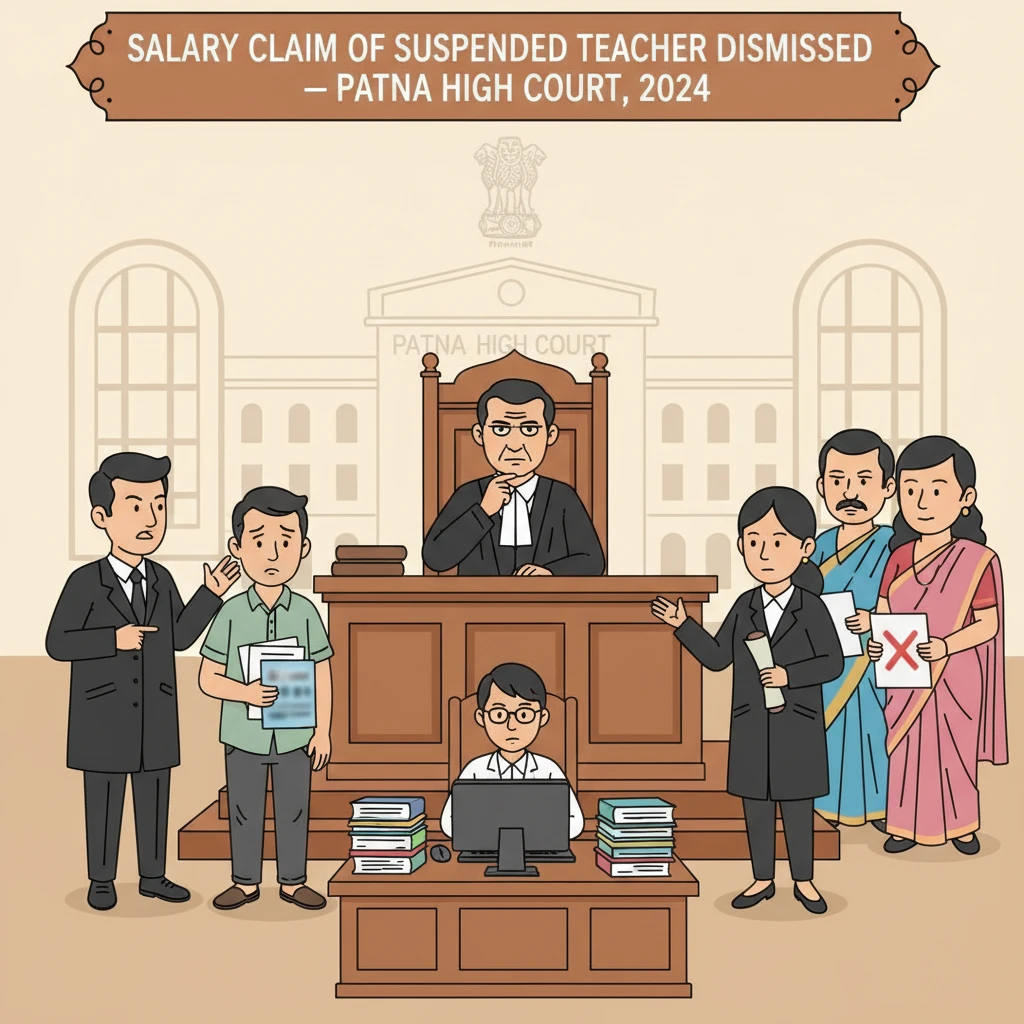
Justice Anil Kumar Sinha heard the matter. On one side was the petitioner, an Assistant Teacher, represented by counsel. On the other side were the State of Bihar and various education officials, represented by State counsel.
The petitioner’s side presented a simple story. Counsel submitted that the petitioner had been discharging his duties as a teacher and as In-charge Headmaster “with sincerity and without any complaint from any quarters and to the satisfaction of all.” It was claimed that there were no issues with his work performance.
However, according to the petitioner, things changed when another Assistant Teacher, one Jahira Khatoon, who was junior to him, was given the charge of In-charge Headmaster. The petitioner’s counsel suggested that this happened because of support from higher officials to the junior teacher.
After she became In-charge Headmaster, the petitioner alleged that she did not allow him to mark his attendance in the school attendance register for the relevant period. This directly affected proof of his presence and thus his salary claim for that time.
The petitioner’s counsel argued that despite not being allowed to sign the attendance register, the petitioner continued to work during that entire period. It was submitted that the petitioner made several representations and complaints to higher authorities about not being allowed to mark attendance.
The judgment records that the petitioner claimed support from villagers and the Secretary of the Vidyalaya Shiksha Samiti. According to the petitioner’s version placed before the Court, these persons had confirmed that he was working in the school during the disputed period.
The State’s version of events was very different. Counsel for the State argued that, at the relevant time, the petitioner was working as In-charge Headmaster but had remained absent from duty from 14 May 2014 to 12 January 2016. Thus, in the State’s view, this was a case of unauthorized absence, not a case of a teacher being wrongly denied attendance marking.
The State also placed on record serious financial allegations against the petitioner. It was submitted that he had defalcated a huge sum of money allotted to the school under several heads, including the Mid-day Meal scheme, development of the school, scholarship, and other purposes. Because of these allegations, departmental proceedings were started.
According to the State, the petitioner was suspended and departmental proceedings were initiated against him through Memo No. 425 dated 13 January 2016. A Memo of Charge in format-K, also dated 13 January 2016, was served on him.
The charge memo contained nine charges against the petitioner. Among these, Charge No. 2 related specifically to his absence from duty without information with effect from 14 May 2014. Thus, his absence from duty and the same period for which he claimed salary were already part of a formal disciplinary case.
The judgment notes that the petitioner did not remain silent in the departmental proceedings. The State counsel informed the Court that he participated in the enquiry. An Enquiry Officer was appointed, evidence was examined, and the petitioner was given an opportunity of hearing.
After completion of the enquiry, the Enquiry Officer submitted his report. As per the State’s submissions, all the charges, including the one relating to unauthorized absence, were found proved.
Consequent upon the enquiry, the disciplinary authority passed a punishment order. By Memo No. 1517 dated 20 February 2019, a major penalty was imposed on the petitioner. As part of this order, a sum of Rs. 19,47,766/- was ordered to be recovered from him. The judgment does not elaborate on the exact nature of the punishment beyond the recovery of this amount, but it clearly treats this as a major punishment following the departmental proceedings.
Justice Anil Kumar Sinha then examined the materials on record, including a copy of the enquiry report, which had been annexed as Annexure-B to the State’s counter affidavit. This enquiry report became central to the Court’s decision on whether the teacher was entitled to salary for the disputed period.
The Court records that the Enquiry Officer, after going through the attendance register and other materials, found that the petitioner was absent from 14 January 2014 to January 2016. Elsewhere, the period of absence is mentioned as 14 May 2014 to 12 January 2016. The Court ultimately summarised the relevant period as “from 14.05.2014 to January, 2016.”
Crucially, the Court noted that the petitioner’s contention that he had been working during this entire period was “not supported by any cogent material.” In simple terms, there was no reliable evidence produced to counter the findings of the departmental enquiry or to show that he had in fact been working but denied attendance marking.
Another important factor for the Court was that the petitioner had not challenged the departmental enquiry’s findings or the punishment order in any forum. The judgment specifically records that he had not questioned either the enquiry report or the punishment order before any appellate authority or any other forum.
In such circumstances, the Court treated the enquiry findings as standing and binding. Since the departmental process had already concluded that the petitioner was absent from duty for the disputed period, the High Court was not inclined to grant salary for that same period in a separate writ petition.
Justice Anil Kumar Sinha observed that, in view of the Enquiry Officer’s finding that the petitioner was absent from his duties between 14 May 2014 and January 2016 after due enquiry, there was no merit in the writ application.
Accordingly, the High Court dismissed the writ petition. No direction for payment of salary, no interference with the departmental punishment, and no other relief was granted.
Why This Judgment Matters
This decision is significant for government employees, especially teachers in Bihar, who may face similar disputes about salary during periods of alleged absence or suspension.
The judgment shows that when a departmental enquiry has already examined a period of alleged absence and found it to be unauthorized, and when that finding is not challenged in appeal or in court, it becomes very difficult to later claim salary for that same period.
The Court emphasised that claims of having worked during the disputed period must be supported by strong, reliable evidence. Mere statements, even if backed by general support from villagers or school committees, are not enough if an official enquiry has already concluded otherwise on the basis of records like the attendance register.
For employees, the case underlines the importance of promptly challenging departmental enquiry findings and punishment orders if they are considered wrong. Ignoring those findings and directly seeking monetary relief in a separate writ petition may not succeed.
Legal Issues and Answers
- Issue: Can a government school teacher obtain salary through a writ petition for a period during which a departmental enquiry has already held that he was absent from duty without authorization?
Answer: No. Since the departmental enquiry, after examining attendance records, found the teacher absent for that period and the punishment order was never challenged, the Court refused to grant salary for that time. - Issue: Does mere assertion of having worked, supported by representations and general confirmations, suffice to overturn an enquiry finding of absence?
Answer: No. The Court held that the petitioner’s claim of having worked was not backed by any cogent material and could not displace the enquiry officer’s findings based on attendance registers and other records.
Cases Cited by the Court
- No previous judicial decisions or reported cases are cited or relied upon in the text of this judgment.
Case Details
Case Number: Civil Writ Jurisdiction Case No. 6903 of 2019
Case Title: Ajit Kumar v. The State of Bihar & Others
Citation: 2024(1) PLJR 501
Court: High Court of Judicature at Patna
Coram: Hon’ble Mr. Justice Anil Kumar Sinha
Date of Judgment: 02-01-2024
Advocates:
- For the petitioner: Mr. Sarvan Kumar, Advocate
- For the respondents (State of Bihar and officials): Mr. Jitendra Kumar Roy 1 (SC13), Mr. Jai Prabhat Kishore, AC to SC 13
Nature of the case: Writ petition seeking direction for payment of salary for the period 01.05.2014 to 12.01.2016.
Link to the judgment: Patna High Court Judgment
If you found this explanation helpful and wish to stay informed about
how legal developments may affect your rights in Bihar,
you may consider following Samvida Law Associates for more updates.







