
Case Background
These criminal appeals were filed under Section 374(2) of the Code of Criminal Procedure, 1973 against a 2017 judgment of the 1st Additional District and Sessions Judge, Naugachia.
The trial arose from Naugachia P.S. Case No.149/2016 dated 20.08.2016. The case related to the murder of Vinod Yadav, who was shot dead near the house of one Shankar Yadav in village Rasalpur, District Bhagalpur.
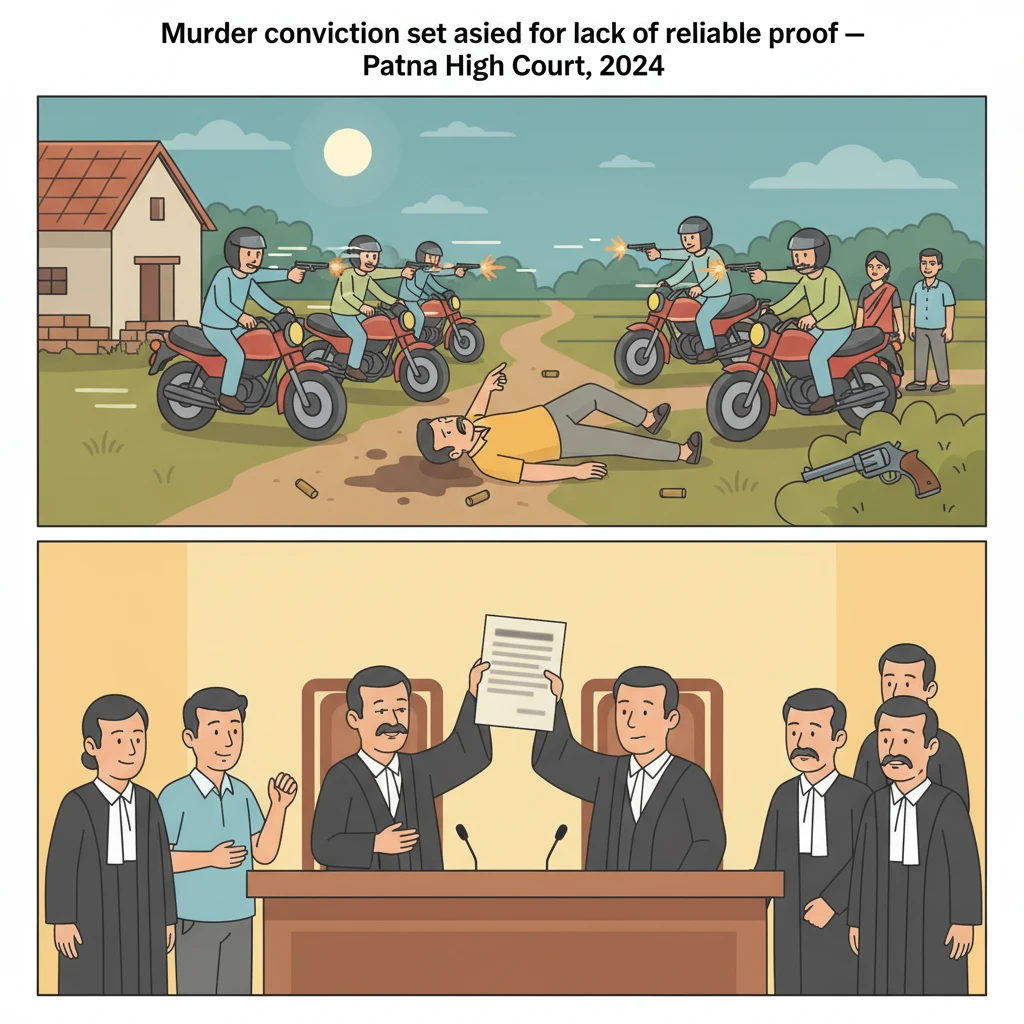
According to the fardbeyan of Sunita Devi, recorded at 09:00 a.m. on 20.08.2016 at the Sub-Divisional Hospital, Naugachia, she was going towards the “Basa” along with her brothers-in-law, namely Vinod Yadav (the deceased), Jai Krishna Kumar and Vijay Yadav.
Vinod Yadav was walking 50–60 feet ahead. Around 07:30 a.m., near the house of Shankar Yadav, three motorcycles allegedly came from the front and two from behind. Three persons were said to be riding each motorcycle. They allegedly surrounded Vinod Yadav and opened indiscriminate fire.
Sunita Devi claimed that when she and others tried to save him, the assailants pointed their guns towards them and threatened them not to move. Vinod Yadav died on the spot from firearm injuries.
In her fardbeyan, Sunita Devi named 12 accused and stated that three other unknown persons were also involved. She attributed the motive to Panchayat election rivalry and previous enmity.
The FIR was registered on that basis. Investigation followed, statements were recorded, and a charge-sheet was filed against some of the persons named, including the present appellants.
The case being triable by the Sessions Court, it was committed and registered as Sessions Trial No. 5/2017 (Trial No. 815/2017). The trial court convicted all the appellants under Sections 147, 148, 149, 302 and 120B of the Indian Penal Code and Section 27 of the Arms Act.
Each appellant was sentenced to life imprisonment and fine of Rs.25,000 under Sections 302/149 read with Section 120B IPC, three years’ rigorous imprisonment under Section 148 IPC, and five years’ rigorous imprisonment with fine of Rs.5,000 under Section 27 of the Arms Act. In default of fine, they were to undergo a further three years’ simple imprisonment. Sentences were to run concurrently.
Aggrieved, the accused persons filed separate criminal appeals before the Patna High Court, which were heard together. During hearing, the Court was informed that one appellant, Nand Kishor Mandal, had died; his appeal abated.
What the Court Examined and Decided
The Division Bench of Hon’ble Mr. Justice Vipul M. Pancholi and Hon’ble Mr. Justice Ramesh Chand Malviya re-appreciated the entire evidence from the Sessions Trial. Seven prosecution witnesses had been examined: four related or close witnesses (PW-1 to PW-5 except the doctor and Investigating Officer), the Investigating Officer (PW-6), and the doctor who conducted the post-mortem (PW-7).
The defence raised four major themes: (i) absence of independent witnesses, especially the driver who was allegedly walking with the deceased; (ii) contradictions between eye-witness versions and medical evidence; (iii) serious lapses and gaps in investigation, particularly regarding firearms and ballistic evidence; and (iv) incomplete questioning of the accused under Section 313 CrPC, causing prejudice.
Evidence of eye-witnesses and relatives
PW-2 Vijay Yadav, PW-4 Jai Krishna Yadav and PW-5 Sunita Devi were projected as eye-witnesses. All three broadly supported the prosecution story that five motorcycles, with three riders each, surrounded Vinod Yadav and that the riders, all armed, started indiscriminate firing.
They claimed to have identified a large number of accused, including the present appellants, from a distance of about 50–60 “gaj” (yards), and said they witnessed 13–25 rounds of firing. Each of them, however, admitted that they could not say who fired which shot or whose bullet hit the deceased.
PW-1 and PW-3, who were at the Basa, said they heard firing, ran towards the road, and saw the accused on motorcycles shouting that they had killed Vinod Yadav. Importantly, both PW-1 and PW-3 admitted in cross-examination that they did not actually see anyone shooting; they only saw accused fleeing on motorcycles.
PW-4 admitted that the deceased’s driver was walking with Vinod Yadav ahead of the group. He also accepted that a newspaper report had stated that three unknown persons killed Vinod Yadav over a land dispute, and that the driver had been present at the time of the murder.
The High Court emphasised that the driver, who was described as walking right with the deceased when the alleged indiscriminate firing took place, did not receive any injury. He was never examined by the police, nor produced as a witness in court.
The Court found this highly significant. If shots were fired at close range by as many as 15 armed men from both front and back, it was unusual that the driver, immediately beside the deceased, escaped completely unhurt and then disappeared from the witness box.
The Court also noted that the incident allegedly happened near the house of Shankar Yadav. Despite this, Shankar Yadav and other villagers or neighbours who allegedly saw the incident were not examined. The Investigating Officer admitted that he had not recorded their statements.
The Bench concluded that the prosecution had “suppressed material witnesses for reasons best known to it”. In such a situation, corroboration from independent or scientific evidence became especially important.
Medical evidence versus prosecution story
PW-7, Dr. Vijay Prakash Rai, conducted the post-mortem. He found 14 ante-mortem lacerated wounds on the body of Vinod Yadav, described as seven entry and seven exit wounds, all caused by firearm. There were serious internal injuries to the head, brain, chest, lungs, kidney and abdomen, and two metallic objects like bullets were recovered.
The doctor’s description indicated that some injuries, especially on the chest and abdomen, could be caused by shots fired from some distance, while many injuries on the face and head suggested close-range firing.
The High Court compared this medical evidence with the eye-witness claim of 15 accused firing simultaneously from motorcycles in motion. It found that the pattern of injuries fitted one or a few targeted shots, some possibly from close range, rather than indiscriminate firing by 15 people from moving motorcycles.
Further, only four empty cartridges and one country-made pistol with one cartridge were recovered from the spot. No other cartridges, bullets or pellets, consistent with the alleged 13–25 rounds from many weapons, were found.
The Court held that the medical evidence did not support the version of mass indiscriminate firing given by the so-called eye-witnesses. This mismatch between medical and oral evidence weakened the prosecution case seriously.
Lapses in investigation and scientific proof
The Investigating Officer (PW-6) deposed that four empty cartridges of .315 country-made pistol were seized from the scene, and one .315 country-made pistol with one cartridge was recovered from nearby bushes. Blood-stained soil was also collected.
He further stated that a Forensic Science Laboratory (FSL) team visited the site and he mentioned the FSL report in the case diary. However, crucially, he admitted that he did not send the seized firearm and cartridges to the FSL for ballistic examination.
Thus, there was no expert opinion linking the recovered pistol or cartridges with the bullets that hit the deceased. There was also no ballistic or chemical report regarding the blood-stained earth produced in court.
The Court considered this a serious omission, especially in a case built on firearm use. Citing Supreme Court decisions such as Santa Singh, Ram Singh, Sukhwant Singh and others, the Bench noted that failure to secure ballistic evidence, especially when weapons and cartridges are seized, can fatally dent the prosecution story.
Additionally, no firearm was recovered from any of the present appellants. Only motorcycles were alleged to have been recovered on their disclosure, which by itself did not link them directly to the shooting.
Prompt FIR not enough by itself
The Additional Public Prosecutor had argued that the FIR, lodged promptly at 09:00 a.m., naming 12 accused, showed that the appellants were correctly identified and not falsely implicated.
The High Court accepted that prompt FIR is generally an important circumstance. However, relying on Supreme Court rulings like Tara Chand and Dilawar Singh, it held that promptness cannot replace proof, especially where other evidence creates serious doubt.
Here, the Court found that the FIR was based entirely on the version of closely interested witnesses, without independent corroboration, and stood contradicted by medical and investigative gaps. Therefore, its prompt filing could not by itself uphold a conviction for murder.
Section 313 CrPC: prejudice to the accused
The defence also argued that all incriminating materials were not put to the accused while recording their statements under Section 313 CrPC, causing prejudice.
The Court referred to Supreme Court decisions in Sujit Biswas and Naresh Kumar, which stress that circumstances not put to the accused in Section 313 examination cannot be used against them. The Bench noted that, in this case, not all incriminating circumstances had been put before the appellants in their 313 statements.
When read together with other weaknesses in the evidence, this omission further tilted the balance towards giving the accused the benefit of doubt.
Overall finding and final order
After considering witness testimonies, medical evidence, investigative lapses and binding Supreme Court precedents on appreciation of evidence, the Patna High Court held that:
The prosecution failed to prove the charges against the appellants beyond reasonable doubt.
The Court emphasised: merely because an FIR was promptly filed and relatives claimed to be eye-witnesses, it could not ignore inconsistencies, non-examination of key independent witnesses, mismatch with medical evidence, and lack of ballistic proof.
Accordingly, by judgment dated 21.08.2024, the Court allowed all the appeals. It quashed and set aside the judgment of conviction dated 19.08.2017 and order of sentence dated 21.08.2017 passed in Sessions Trial No.5/2017.
All surviving appellants were acquitted of the charges. Those on bail (Mukesh Kumar @ Tuntun @ Rajvir @ Tuntun Yadav and Dhananjay Kumar) were discharged from their bail bonds. Those in jail (Arvind @ Arbind Yadav, Pintu Singh and Sachin @ Sachcho Yadav) were directed to be released forthwith, if not required in any other case.
Why This Judgment Matters
This judgment is important for anyone facing or following serious criminal cases in Bihar, especially murder cases arising from local rivalries and elections.
First, the Patna High Court has underlined that even in high-profile murders, conviction cannot rest only on statements of relatives when independent witnesses like drivers, neighbours, and bystanders are not examined.
Second, where the story of the eye-witnesses does not fit the medical evidence—such as the number and nature of injuries, the distance of firing, and recovered cartridges—the court will not simply accept the prosecution version.
Third, the judgment sends a strong signal to investigating officers. If firearms and cartridges are seized, they must be sent for ballistic examination, and FSL reports must be produced in court. Failure to do so may lead to acquittal even in serious offences like murder.
Fourth, the case reminds trial courts to conduct detailed Section 313 CrPC questioning and to ensure all incriminating circumstances are put to the accused. Otherwise, higher courts can treat it as causing prejudice.
For ordinary citizens, especially in rural Bihar, this decision shows that mere naming in an FIR, without solid supporting evidence, should not result in life-long imprisonment if higher courts carefully examine the record.
Legal Issues and Answers
- Issue: Whether the prosecution proved beyond reasonable doubt that the appellants participated in the murder of Vinod Yadav as part of an unlawful assembly and criminal conspiracy.
Answer: No. The Patna High Court held that inconsistencies between eye-witness testimony and medical evidence, non-examination of key independent witnesses, lack of ballistic proof, and investigative lapses created reasonable doubt. The appellants were acquitted. - Issue: Whether prompt lodging of FIR naming the appellants was sufficient to sustain conviction despite other weaknesses in the evidence.
Answer: No. The Court held that while prompt FIR is relevant, it cannot override serious doubts arising from suppressed witnesses, contradictory medical evidence, and absence of scientific corroboration. - Issue: Whether failure to put all incriminating circumstances to the accused under Section 313 CrPC affected the validity of the conviction.
Answer: Yes. Relying on Supreme Court precedents, the Court held that non-putting of all incriminating materials caused prejudice to the defence and was one of the grounds supporting acquittal.
Cases Cited by the Court
- AIR 1956 SC 526 (Santa Singh v. State of Punjab)
- AIR 1971 SC 1891 (Tara Chand v. State of Haryana)
- AIR 1991 SC 4 (Budhwa v. State of M.P.)
- AIR 2007 SC 3234 (Dilawar Singh v. State of Delhi)
- AIR 2024 SC 1176 (Ram Singh v. State of U.P.)
- 2024 (3) PLJR 588 (Md. Babar v. State of Bihar)
- Other Supreme Court precedents referred within those judgments (such as Sujit Biswas v. State of Assam; Naresh Kumar v. State of Delhi; Munna Lal v. State of U.P.; Gurucharan Singh v. State of Punjab; Sukhwant Singh v. State of Punjab), as quoted by the High Court.
Case Details
Case Number: Criminal Appeal (DB) No.1192 of 2017; with Criminal Appeal (DB) Nos.1242, 1277 (abated due to death), 1328, 1360 and 1416 of 2017, all arising out of Naugachia P.S. Case No.149 of 2016.
Case Title: Mukesh Kumar @ Tuntun @ Rajvir @ Tuntun Yadav v. The State of Bihar; with Arvind @ Arbind Yadav v. The State of Bihar; Nand Kishor Mandal v. The State of Bihar; Pintu Singh v. The State of Bihar; Dhananjay Kumar v. The State of Bihar; and Sachin @ Sachcho Yadav v. The State of Bihar.
Citation: 2024 (4) PLJR 633.
Court: High Court of Judicature at Patna.
Coram: Hon’ble Mr. Justice Vipul M. Pancholi and Hon’ble Mr. Justice Ramesh Chand Malviya.
Date of High Court Judgment: 21.08.2024 (uploaded on 06.09.2024).
Trial Court: 1st Additional District & Sessions Judge, Naugachia, Sessions Trial No.5/2017 (Trial No.815/2017).
Trial Court Judgment and Sentence: Conviction dated 19.08.2017; sentence dated 21.08.2017 for offences under Sections 147, 148, 149, 302, 120B IPC and Section 27 Arms Act, with life imprisonment and other terms.
Advocates:
- For appellant in Criminal Appeal (DB) No.1192 of 2017 (Mukesh Kumar @ Tuntun @ Rajvir @ Tuntun Yadav): Mr. Saket Kumar Singh, Advocate.
- For appellant in Criminal Appeal (DB) No.1242 of 2017 (Arvind @ Arbind Yadav): Mr. Surendra Singh, Senior Advocate, assisted by Mr. Rajiv Kumar Singh, Advocate.
- For appellant in Criminal Appeal (DB) No.1277 of 2017 (Nand Kishor Mandal): Mr. Dinesh Choudhary, Advocate.
- For appellant in Criminal Appeal (DB) No.1328 of 2017 (Pintu Singh): Mr. R.P. Sharma, Advocate, and Mr. Mritunjay Kumar, Advocate.
- For appellant in Criminal Appeal (DB) No.1360 of 2017 (Dhananjay Kumar): Mr. R.P. Sharma, Advocate, and Mr. Mritunjay Kumar, Advocate.
- For appellant in Criminal Appeal (DB) No.1416 of 2017 (Sachin @ Sachcho Yadav): Mr. K.N. Sahay, Advocate.
- For the State (in all appeals): Mr. Sujit Kumar Singh, APP.
Nature of the Case: Criminal appeals against conviction and sentence in a murder case arising from alleged unlawful assembly, common object and criminal conspiracy, under the Indian Penal Code and Arms Act.
Link to Judgment: Click here to access the full judgment on the Patna High Court website.
If you found this explanation helpful and wish to stay informed about
how legal developments may affect your rights in Bihar,
you may consider following Samvida Law Associates for more updates.







