
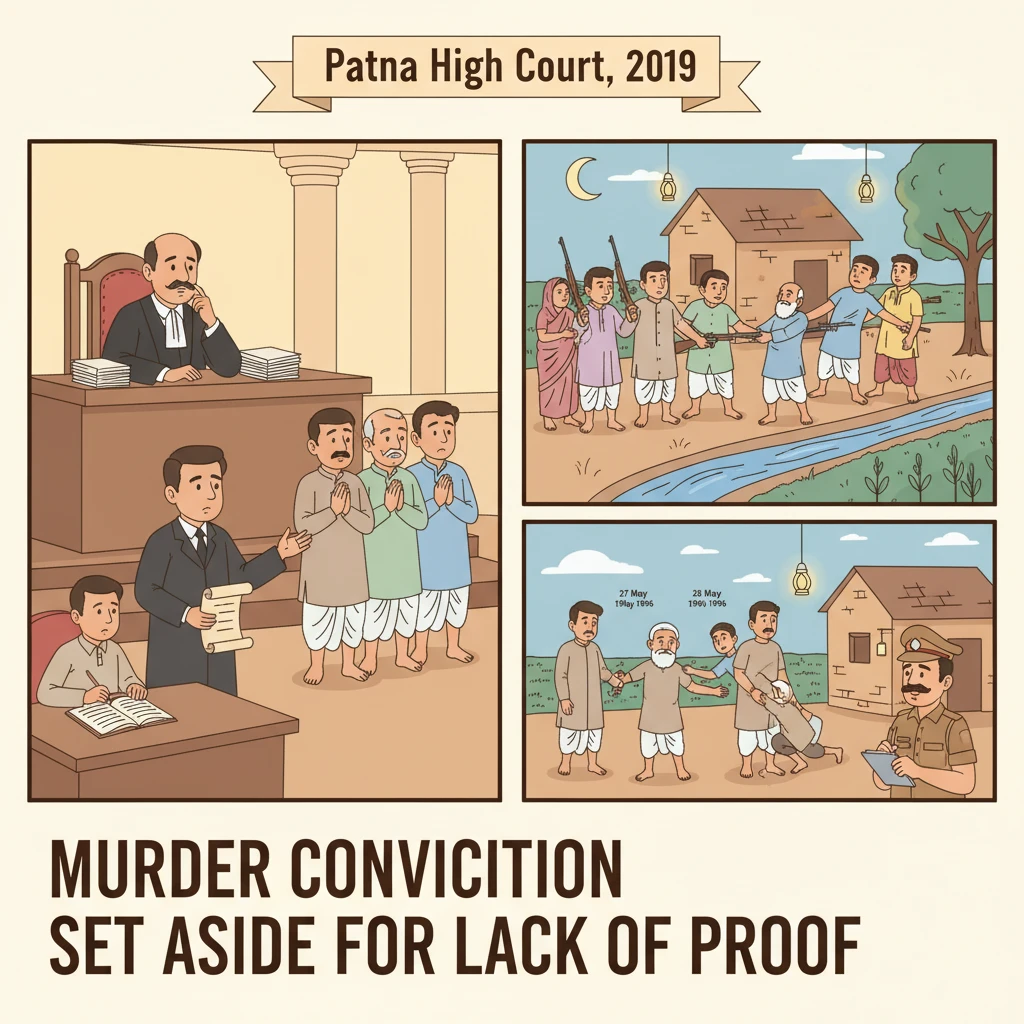
Case Background
This case arises from an incident said to have taken place on the night of 27 May 1996 in village Subedar Itawan, under Tandwa Police Station, District Aurangabad.
According to the police version, in the evening the deceased, an elderly villager, was sitting outside his house with his sons and daughters-in-law. Around 8:00 p.m., six known villagers (later the appellants) and five unknown persons allegedly reached there. Three of the unknown persons were said to be armed with guns.
The next morning, on 28 May 1996 at about 4:30 a.m., the Sub-Inspector-cum-Officer-in-charge of Tandwa Police Station, S.K. Jha, recorded the fardbeyan of the son of the deceased (P.W.6) near the door of the informant. On that basis, Tandwa P.S. Case No. 15 of 1996 was registered at 6:00 a.m. under Sections 147, 148, 149, 302 and 120B of the Indian Penal Code.
After investigation, the police submitted charge-sheet on 2 September 1996 against the six named villagers. The Chief Judicial Magistrate, Aurangabad took cognizance on 17 September 1996 and committed the case to the Court of Sessions on 7 December 1996.
On 31 May 1997, charges under Sections 147 and 302/149 IPC were framed jointly against all six accused persons. The case was tried as Sessions Trial No. 325 of 1997/Trial No. 106 of 2010 by the Adhoc Additional Sessions Judge-II, Aurangabad.
By judgment dated 27 September 2012, the Trial Judge convicted all six accused for offences under Sections 147 and 302/149 IPC. By order dated 1 October 2012, each was sentenced to one year rigorous imprisonment under Section 147 IPC, and life imprisonment with a fine of Rs. 8,000 under Section 302/149 IPC, with eight months’ further imprisonment in default.
All six convicts challenged this conviction and sentence before the Patna High Court in Criminal Appeal (DB) No. 1022 of 2012.
What the Court Examined and Decided
The Division Bench of Hon’ble Mr. Justice Rakesh Kumar and Hon’ble Mr. Justice Prakash Chandra Jaiswal heard the appeal. Separate advocates represented different sets of appellants, and an Amicus Curiae was appointed for three of them who were not otherwise represented.
The prosecution case, based on the fardbeyan of P.W.6, was that the six known accused and five unknown persons reached the house of the informant on the night of 27 May 1996. It was alleged that appellant no.1 pointed to the deceased and said that he had obstructed the marriage of the son of Satyanarayan (father of appellant no.4). On this alleged motive, he called upon the others to take away the “old man”.
According to the informant, despite requests from the family, the accused caught hold of his father, dragged him towards the south-eastern ahra (water channel) of the village, and took him to the field of one Vishwanath Singh. The informant claimed that he and others followed but were scolded and stopped by the unknown accused. After some time, he said he saw his father squirming in Vishwanath Singh’s field. With the help of villagers, the injured was brought back home, where he died.
The informant said that, due to moonlight and the light of a lantern burning at his door, he could recognize the six accused and would be able to identify the five unknown persons if seen again. He also stated that these accused had been threatening his family earlier.
During trial, the prosecution examined ten witnesses. Four family members (P.W.1, P.W.2, P.W.3 and P.W.6) were treated as eye-witnesses. Two villagers (P.W.4 and P.W.9) said they saw the deceased squirming in the field. P.W.8, Dr. T.N. Shukla, conducted the post-mortem. The investigating officer was not examined.
The defence argued before the High Court that the prosecution had failed to prove its case beyond reasonable doubt. Key points raised included:
First, the place of occurrence was not proved. The prosecution story was that strangulation took place in the field of Vishwanath Singh and the injured was then carried home, but the inquest report showed the dead body was found in the field of Tunna Singh in front of the deceased’s house.
Second, there were serious inconsistencies between medical evidence and the eye-witness versions. The family witnesses repeatedly stated that the deceased was dragged over a rough surface for 20–25 bamboos (more than 300 feet), causing abrasions on his back, and that several accused sat on his chest and pressed his neck with their hands.
However, the doctor who conducted the post-mortem found only a ligature mark on the neck with a thread present there. He found a depressed mark above the thyroid cartilage, fracture of the thyroid cartilage, and congestion of the trachea and epiglottis. He recorded that death was due to asphyxia caused by ligature around the neck, not manual strangulation. Crucially, he did not find any signs of finger pressure on the neck or any injuries on the back or other body parts.
Third, the alleged motive itself appeared shaky. In the fardbeyan, the reason given for the assault was that the deceased had obstructed the marriage of Satyanarayan’s son. But during evidence, the family witnesses either did not support this or pleaded ignorance. For example, P.W.1 clearly stated in cross-examination that appellant no.1 had not created any situation leading to non-solemnisation of that marriage, and P.W.2 said she did not know whether the deceased had created any hurdle in the marriage at all.
Fourth, the Amicus Curiae highlighted the timing and delay in lodging information. The alleged assault took place at 8:00 p.m., yet the fardbeyan was recorded at 4:30 a.m. the next morning. There was no clear explanation for this delay. P.W.6 even said in cross-examination that he had gone to the police station at night and narrated the facts, but the officer did not record his statement there; instead the police came to the village next morning and recorded his fardbeyan at his house.
Fifth, the non-examination of the investigating officer meant that contradictions between the witnesses’ statements in court and their earlier police statements could not be properly proved. Defence counsel had drawn attention to some earlier statements during cross-examination, but without I.O.’s evidence those contradictions remained uncorroborated.
Sixth, independent witnesses did not support the prosecution on the core allegations. P.W.4, a co-villager, stated that he reached Vishwanath Singh’s field on hearing a commotion, saw the deceased squirming, and helped take him home. But he also said that for the whole night he did not know how the deceased was killed or who was involved. P.W.9, a relative, suggested a different method of killing (putting a wood on the neck), and yet admitted that till the date of his evidence he did not know who was involved in the occurrence.
The State, on the other hand, relied mainly on the consistent parts of P.W.6’s testimony, arguing that as the son and informant he had clearly narrated the dragging and strangulation by the accused.
After carefully reading the evidence, the Patna High Court found that the prosecution version was full of doubts.
The Bench noted that if the deceased had really been strangulated by pressing his neck with hands in the field of Vishwanath Singh, death would normally have been almost instantaneous, within a couple of minutes. It would then be unlikely that he would be found later “squirming” in the field and then survive long enough to be carried home and die after another 5–10 minutes, as described by the prosecution witnesses.
The medical evidence that death was caused by asphyxia from a ligature (thread) around the neck, with no finger marks and no external injuries on the back or body, did not tally with the story of rough dragging and manual strangulation by several people.
The Court also attached importance to the inquest report, which indicated that the dead body was found in the field of Tunna Singh in front of the deceased’s house, not in the distant field of Vishwanath Singh. No explanation was provided by the prosecution for this mismatch.
The Bench further observed that the FIR, though lodged on 28 May 1996, reached the Court only on 30 May 1996 without any explanation of this delay, which added to doubts about the genuineness and timing of the FIR.
Taking all these aspects together—contradictions between ocular and medical evidence, uncertainty about the place of occurrence, weak and shifting motive, non-support by independent witnesses, delay in lodging and forwarding the FIR, and non-examination of the investigating officer—the Court held that it would be unsafe to uphold the conviction.
The Division Bench concluded that the prosecution had failed to establish beyond reasonable doubt that the appellants had caused the death of the deceased by strangulation as alleged. As a result, it set aside the conviction and sentence dated 27 September 2012 and 1 October 2012 passed in Sessions Trial No. 325 of 1997/106 of 2010.
Appellant nos.1 and 2, who were already on bail, were discharged from their bail bonds. The remaining appellants, who were in custody, were directed to be released forthwith if not required in any other case.
Why This Judgment Matters
This judgment shows how carefully the Patna High Court looks at criminal cases, especially when people are facing life imprisonment. It underlines that suspicion, even strong suspicion, is not enough to keep someone in jail for life.
For villagers and families, it shows that criminal cases must be built on solid evidence. The Court looked closely at whether the story told by the family members matched the medical report, the inquest, and the behaviour of witnesses immediately after the incident.
If important documents like the FIR reach the Court late, or if the police officer who investigated the case is not examined, the prosecution case can become weak. This decision reinforces that investigation must be fair and complete, otherwise innocent people may be wrongly punished.
For lawyers and trial courts, the judgment is a reminder that medical evidence and site evidence (like the place where the body is found) must be consistent with eye-witness accounts before convicting people for serious offences like murder under Section 302 read with Section 149 IPC.
Legal Issues and Answers
Issue: Did the prosecution prove beyond reasonable doubt that the appellants formed an unlawful assembly and murdered the deceased by strangulation under Sections 302/149 and 147 IPC?
Answer: No. The Patna High Court found major contradictions regarding motive, manner of assault, place of occurrence, medical findings, and delay in FIR, and held that the prosecution failed to establish guilt beyond reasonable doubt. The conviction and sentences were therefore set aside and the appellants were acquitted.
Cases Cited by the Court
- No earlier judgments have been cited or relied upon in the text of this decision.
Case Details
Case Number: Criminal Appeal (DB) No. 1022 of 2012, arising out of Tandwa P.S. Case No. 15 of 1996; Sessions Trial No. 325 of 1997/Trial No. 106 of 2010.
Case Title: Laxman Paswan & Ors. v. State of Bihar.
Citation: 2019 (3) PLJR 341.
Court: High Court of Judicature at Patna.
Coram: Hon’ble Mr. Justice Rakesh Kumar and Hon’ble Mr. Justice Prakash Chandra Jaiswal.
Date of High Court Judgment: 22-01-2019.
Trial Court Judge: Sri Vijay Kumar Pandey, Adhoc Additional Sessions Judge-II, Aurangabad.
Advocates:
- Sri Rajesh Kumar Singh, Sri Rana Pratap Singh, Sri Dharmendra Kumar Singh, Advocates for Appellant Nos. 4 & 6.
- Sri Mukesh Kumar Singh, Sri Rajeev Kumar Singh, Advocates for Appellant No. 5.
- Sri Anil Singh, Amicus Curiae for Appellant Nos. 1 to 3.
- Sri Ajay Mishra, A.P.P. for the State.
Nature of Case: Criminal appeal (Division Bench) against conviction and sentence for offences under Sections 147 and 302/149 IPC.
Link to Full Judgment: View judgment on Patna High Court website
If you found this explanation helpful and wish to stay informed about
how legal developments may affect your rights in Bihar,
you may consider following Samvida Law Associates for more updates.







