
Case Background
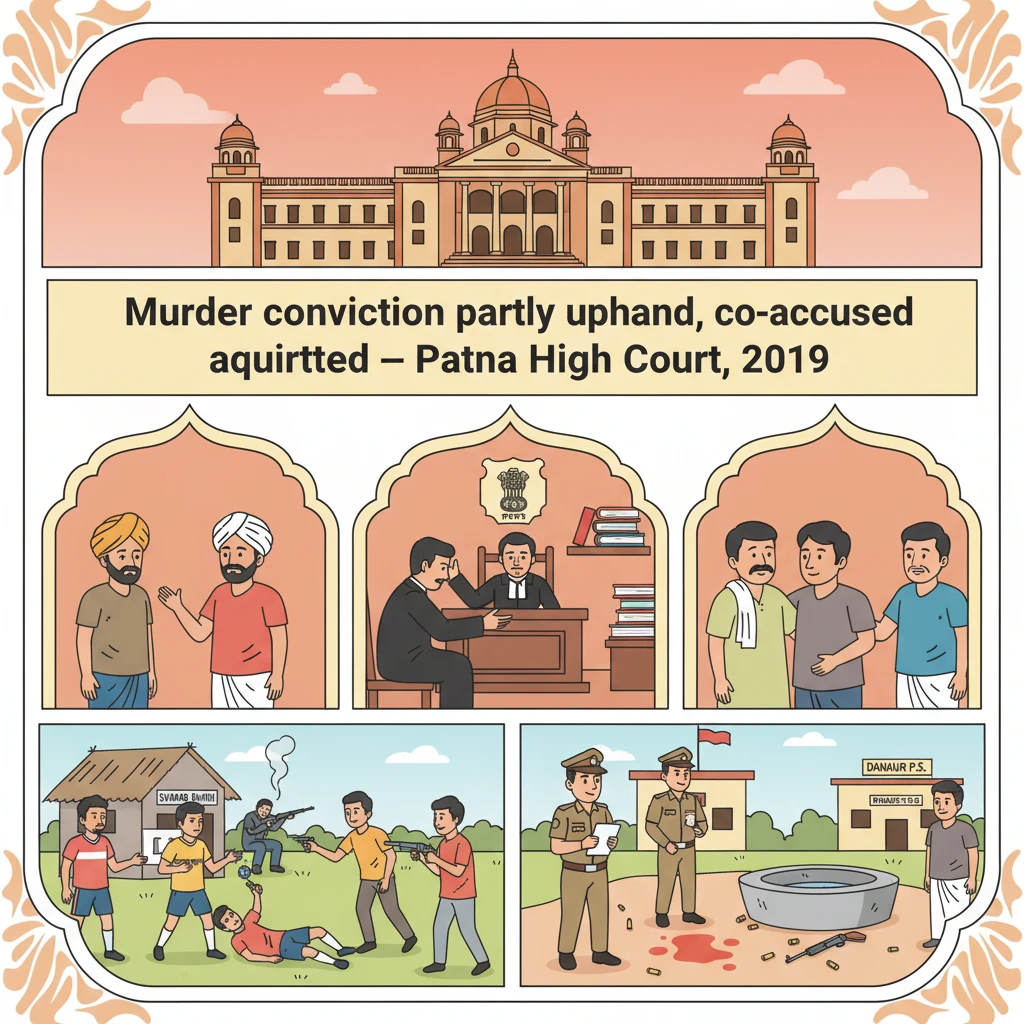
The case arose from Danapur P.S. Case No. 7 of 2005, Patna district. The incident took place on 2.1.2005 in village Lakhni Bigha/Adampur area, near an alleged illegal liquor “Sharab Bhathi” said to be run by one of the accused.
According to the prosecution, around 2:00 p.m., a young man, Ajit Paswan, was returning home with his brother Sunil Paswan after playing football in Kailash Field. When they reached near the Sharab Bhathi, a group of accused allegedly surrounded Ajit. One of them, Raghu Nandan Mahto, was said to have fired at Ajit’s temple with a country-made pistol, killing him on the spot.
Sunil’s fard-e-beyan was recorded at 3:00 p.m. on the same day by the Officer-in-Charge of Danapur Police Station (P.W.10) at village Adampur. On its basis, the FIR was registered under Sections 302/34 of the Indian Penal Code and Section 27 of the Arms Act.
The Investigating Officer inspected the spot, found blood on the ground near the Sharab Bhathi, and seized one live cartridge of .315 bore rifle, three empty cartridges and blood-stained earth. He also prepared the inquest report and recorded statements of witnesses. After investigation, a charge-sheet was filed against five accused, including appellants Raghu Nandan Mahto, Dev Nandan Mahto, Sujit Mahto and Shiv Mahto, as well as Jitendra Kumar @ Sadhu, under Sections 302/34 IPC and 27 Arms Act. Investigation against another named accused, Ajai Mahto, was kept pending.
The case was committed to the Sessions Court and registered as Sessions Trial No. 1231 of 2006/Trial No. 251 of 2015 before the Additional Sessions Judge 1st, Danapur. Charges were framed under Sections 302/34 IPC and 27 Arms Act against all the accused and, in addition, under Section 302 IPC separately against Raghu Nandan Mahto.
During trial, the prosecution examined 11 witnesses. Nine of them (P.Ws.1 to 9) claimed to be eye-witnesses, P.W.10 was the Investigating Officer, and P.W.11 was the doctor who conducted the post-mortem. Before judgment, the trial of accused Jitendra Kumar @ Sadhu Chaudhary was separated on 20.3.2015 as he absconded after framing of charge.
By judgment of conviction dated 26.5.2016 and sentence order dated 31.5.2016, the trial court convicted all appellants under Sections 302/34 IPC and sentenced them to life imprisonment with fine of Rs. 5,000/- each, with five months’ further imprisonment in default. Raghu Nandan Mahto was also convicted under Section 27 of the Arms Act and sentenced to three years’ rigorous imprisonment with fine of Rs. 3,000/-, in default three months’ further imprisonment, with both sentences to run concurrently.
Aggrieved, three separate criminal appeals were filed in the Patna High Court: Cr. Appeal (DB) No. 826 of 2016 by Raghu Nandan Mahto, Cr. Appeal (DB) No. 690 of 2016 by Dev Nandan Mahto, and Cr. Appeal (DB) No. 709 of 2016 by Shiv Mahto and Sujit Mahto. All three appeals were heard together and disposed of by a common C.A.V. judgment dated 05-04-2019 by a Division Bench.
What the Court Examined and Decided
The central question before the Patna High Court was whether the prosecution had proved, beyond reasonable doubt, that all appellants shared a common intention to murder Ajit Paswan, or whether only one of them could be held directly responsible for the shooting.
The defence attacked the prosecution evidence on several grounds. It was argued that the eye-witnesses had made contradictory statements on vital points: whether there was a scuffle before the firing, whether appellant Dev Nandan Mahto physically caught hold of the deceased or only ordered others to shoot, from what distance the shot was fired, and whether the informant Sunil had hidden behind a sheesham tree or fled the spot.
The defence also highlighted contradictions about the playing of football (one witness admitting no one was playing), about the clothes worn by the deceased, about who went to the hospital with him, and about whether any accused were caught with weapons by the police. It was further submitted that two metal fragments of bullet were found during post-mortem, but no bullet or weapon was produced in court (except as alleged at the time of arrest), and that the inquest report mentioned a wrong police case number.
On the other hand, the Additional Public Prosecutor argued that the trial court had rightly believed the consistent part of the eye-witnesses’ version. According to the State, all eye-witnesses clearly stated that the appellants and other FIR named accused encircled the deceased and that it was Raghu Nandan Mahto who fired at Ajit’s temple. Minor differences in details were said to be natural and not sufficient to discard the entire prosecution case.
The High Court first examined the medical evidence. P.W.11, Dr. Narendra Kumar Singh, conducted the post-mortem on 3.1.2005 at 8:30 a.m. He found a lacerated injury on the left temporal region of the scalp (4″ x 2″) with two rounded openings in the skull in the middle of that injury, communicating with the cranial cavity. There was blackening of skin around the injury. On opening the scalp, two metal fragments, appearing to be remnants of a bullet, were recovered and sealed. He opined that death occurred 6 to 36 hours before the post-mortem and was due to haemorrhage and shock from severe head injury caused by firearm. The death and cause of death were not in dispute.
Next, the Court considered the investigation. P.W.10 confirmed recording Sunil’s fard-e-beyan at 3:00 p.m. on 2.1.2005 and drawing up the formal FIR. He described the place of occurrence as the field of appellant Dev Nandan Mahto in village Lakhni Bigha, with a hut on the north side where Sharab Bhathi was being run. At about 10 feet south of the hut he found a pool of blood and, near a cemented “Nad” to the north of that spot, one live .315 bore cartridge and three empty cartridges. The deceased’s house was about 150 yards west of the spot, while the appellants’ house was about 600 yards away towards the west-south. He prepared a seizure list in presence of P.W.1 and P.W.2, and an inquest report at the hospital.
Turning to the alleged eye-witnesses, the Bench noted that P.W.1 to P.W.8, except P.W.9, had all stated in cross-examination that they reached the place of occurrence after hearing noise and sound of firing. Only P.W.9, Sunil Paswan (the informant and elder brother of the deceased), said that he was actually with Ajit when the group surrounded and shot him, and that he watched from behind a sheesham tree.
Though the Investigating Officer did not mention a sheesham tree while marking the place of occurrence, he did state that on the north side there was an orchard of one Ram Awtar. The Court held that this meant some trees did exist nearby, and the absence of a specific mention of a sheesham tree did not, by itself, destroy Sunil’s testimony.
The Court carefully compared the statements regarding Dev Nandan Mahto’s role. P.W.1 said Dev Nandan had caught hold of Ajit during a scuffle before the firing. But none of the other so-called eye-witnesses supported this exact version. P.W.2, P.W.3, P.W.4, P.W.5, P.W.6 and P.W.8 instead said that Dev Nandan gave an order to shoot. P.W.7 and P.W.9 did not state that Dev Nandan gave such an order at all, and P.W.9 even admitted in cross-examination that he could not hear what Dev Nandan said before the firing.
Due to these inconsistencies, the Bench concluded that the prosecution had failed to prove, beyond all shadow of reasonable doubt, that Dev Nandan either caught the deceased or instigated the firing by giving an order. The Court also emphasised that the place of occurrence was near Dev Nandan’s Sharab Bhathi, and Raghu Nandan, Sujit and Shiv were family members living nearby. Their mere presence at or near the Bhathi, even armed, could not automatically show they shared a common intention with Raghu to commit murder.
Importantly, no specific overt act was attributed to Sujit Mahto and Shiv Mahto apart from encircling the deceased. The prosecution witnesses made only a vague claim that all the appellants had made “indiscriminate firing” while fleeing, but there was no evidence that shots by anyone other than Raghu Nandan caused any injury to the deceased or to any other person.
The Court also noted that though all appellants had been charged under Section 27 of the Arms Act, the trial court itself had convicted only Raghu Nandan under that section and not the others. This showed that even the trial court was not convinced that the others had used firearms in a manner attracting Section 27. In these circumstances, the High Court held that Dev Nandan, Shiv and Sujit were entitled to the benefit of doubt.
However, the position of appellant Raghu Nandan Mahto was different. Almost all eye-witnesses, including P.W.1, P.W.2, P.W.3, P.W.4, P.W.5, P.W.6, P.W.7, P.W.8 and P.W.9, consistently stated that it was Raghu Nandan who fired the shot that hit Ajit on the temple. This core fact remained steady across their testimonies even though they varied on smaller details.
The defence tried to rely on the distance of firing—some witnesses saying 4–5 yards, others saying the pistol was placed on the temple—and on the presence of blackening around the wound, to create doubt. The Court reiterated the settled principle that when there is a conflict between medical evidence and reliable ocular evidence, and the ocular version inspires confidence, the ocular testimony prevails. Medical opinion is only advisory. The blackening and distance discrepancies were treated as minor and not enough to shake the consistent evidence that Raghu fired at the temple.
The Court also attached weight to the promptness of the FIR. The incident occurred at about 2:00 p.m., police reached within half an hour, and Sunil’s fard-e-beyan was recorded at 3:00 p.m. naming Raghu as the shooter. This immediacy reduced chances of false implication after deliberation.
Considering all this, the Bench agreed with the trial court that the prosecution had successfully proved the charge of murder under Section 302 IPC and the offence under Section 27 Arms Act against Raghu Nandan Mahto alone. His appeal was therefore dismissed, and his conviction and sentences were confirmed.
Why This Judgment Matters
This Patna High Court judgment is important for families and villagers caught up in serious criminal cases where many people are named in one incident.
The Court showed that just being present at the spot, even with relatives, is not enough to convict someone for murder. There must be clear proof of what each accused did and that they shared the intention to kill.
At the same time, the judgment confirms that when several witnesses consistently identify one person as the shooter, and the FIR is promptly lodged, the Court will uphold a conviction even if there are small contradictions about side details.
For ordinary people, the case underlines the value of early and truthful reporting to the police, and also that courts carefully separate innocent bystanders from the actual killer when evidence allows.
Legal Issues and Answers
Issue: Did the prosecution prove that all appellants shared a common intention to murder the deceased, attracting Section 302/34 IPC?
Answer: No. Due to inconsistencies about the role of Dev Nandan and absence of specific acts by Shiv and Sujit, the Court held that common intention was not proved against them and acquitted these three appellants.
Issue: Was the individual liability of Raghu Nandan Mahto for firing the fatal shot under Section 302 IPC and Section 27 Arms Act established beyond reasonable doubt?
Answer: Yes. Multiple eye-witnesses consistently named him as the shooter, the post-mortem supported firearm injury to the temple, and the prompt FIR confirmed his role. His conviction and sentences were upheld.
Issue: Should contradictions between medical evidence and eye-witness accounts about distance of firing and presence of blackening lead to acquittal?
Answer: No. The Court held that where eye-witness evidence inspires confidence, it prevails over minor inconsistencies with medical opinion, which is only advisory.
Cases Cited by the Court
- The judgment does not mention or rely upon any specific earlier case-law by name or citation.
Case Details
Case Number: Criminal Appeal (DB) No. 826 of 2016; Criminal Appeal (DB) No. 690 of 2016; Criminal Appeal (DB) No. 709 of 2016 (all arising out of Danapur P.S. Case No. 7 of 2005)
Case Title: Raghu Nandan Mahto v. The State of Bihar; Dev Nandan Mahto v. The State of Bihar; Shiv Mahto & Sujit Mahto v. The State of Bihar
Citation: 2019 (2) PLJR 918
Court: High Court of Judicature at Patna
Coram: Hon’ble Mr. Justice Hemant Kumar Srivastava; Hon’ble Mr. Justice Rajendra Kumar Mishra
Date of Judgment: 05-04-2019
Advocates:
For appellant in Cr. Appeal (DB) No. 826 of 2016: Mr. Saket Anand (for the appellant); Mr. Shivesh Chandra Mishra (for the State).
For appellant in Cr. Appeal (DB) No. 690 of 2016: Mr. Manoj Kumar Jha (for the appellant); Mr. Mayanand Jha (for the State).
For appellants in Cr. Appeal (DB) No. 709 of 2016: Mr. Shiv Ganga Kumar Gupta, Advocate (for the appellants); Mr. Dilip Kumar Sinha (for the State).
Nature of the Case: Criminal appeals (Division Bench) against judgment of conviction and sentence in Sessions Trial No. 1231 of 2006 / Trial No. 251 of 2015 arising out of Danapur P.S. Case No. 7 of 2005, involving offences under Sections 302/34 IPC and Section 27 of the Arms Act.
Link to Judgment: Click here to read the full judgment of the Patna High Court
If you found this explanation helpful and wish to stay informed about
how legal developments may affect your rights in Bihar,
you may consider following Samvida Law Associates for more updates.







