

Case Background
The incident in this case took place on 11.04.1983 near village Warsaliganj in District Nawadah. A group of villagers, including the eventual deceased and his relatives, had gone to Nawadah town and were returning by train in the evening.
They got down from the train at Baghi-Vardiha Railway Station at about 7.30 p.m. and started walking towards their village. The group consisted of the deceased Sukhdeo Singh, his brother and first informant Kamta Singh (P.W.10), Mithilesh Prasad Singh (P.W.3), Ram Nandan Singh (P.W.4) and one Shailendra Singh.
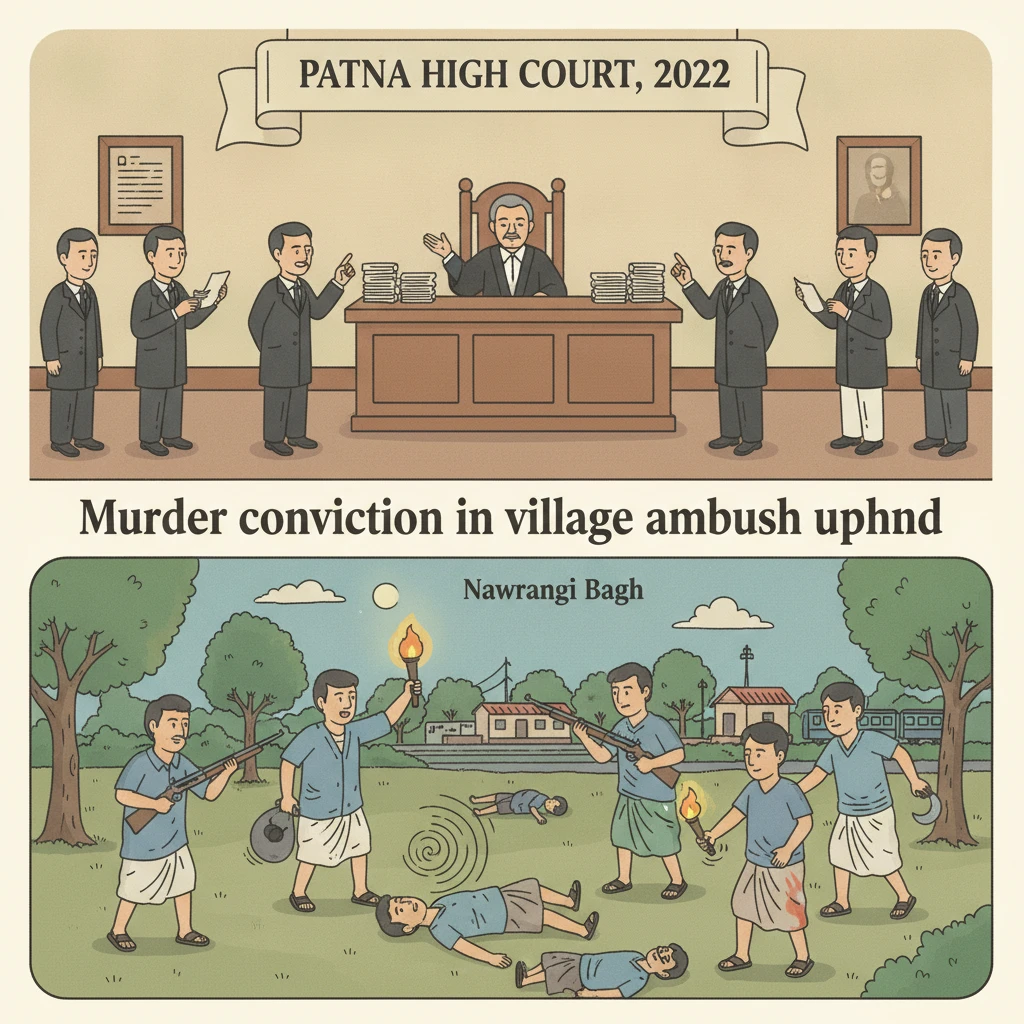
When they reached near an orchard known as Nawrangi Bagh, they were allegedly waylaid by a group of accused persons from the same village. According to the prosecution, the accused were armed with guns, a knife, a gadasa (sharp cutting weapon), torches and bombs.
At the spot, there was a sudden and violent attack. Firearms were used, a bomb was hurled, and sharp weapons were employed. Sukhdeo Singh died on the spot. P.W.4 Ram Nandan Singh received injuries and was taken to a hospital for treatment.
P.W.10 Kamta Singh went to the police station and lodged the First Information Report naming six persons as assailants. The dead body of his brother was sent to Sadar Hospital, Nawadah, where P.W.2 Dr. Ajay Kumar conducted the post-mortem.
Police carried out the usual investigation, inspected the spot through Investigating Officer P.W.11 Sita Ram Singh, and seized material from the scene. After investigation, a charge-sheet was filed against six accused persons.
During trial, one accused, Krishnandan Singh, died and the case against him abated. The remaining accused faced Sessions Trial No.399/83 (101/87) before the 3rd Additional Sessions Judge, Nawadah. By judgment dated 23.12.1993, all surviving accused were convicted under Sections 302/149 and 307/149 of the Indian Penal Code. Two of them, Ram Jiwan Sharma and Kaushalendra Singh, were additionally convicted under Section 27 of the Arms Act.
All were sentenced to life imprisonment for murder and seven years for attempt to murder. The two appellants convicted under the Arms Act received a further seven years’ rigorous imprisonment. Sentences were ordered to run concurrently.
Against this judgment, Criminal Appeal (DB) No.17 of 1994 and Criminal Appeal (DB) No.67 of 1994 were filed before the Patna High Court. By the time of final hearing, two of the appellants from Appeal No.17 of 1994, namely Ishwar Dayal Singh and Ramadhin Singh, had died and their appeals stood abated. The appeal survived only for appellant Bijay Singh. Appeal No.67 of 1994 remained pending for appellants Ram Jiwan Sharma and Kaushalendra Singh.
What the Court Examined and Decided
The Division Bench of the Patna High Court, comprising Hon’ble Mr. Justice A. M. Badar and Hon’ble Mr. Justice Sunil Kumar Panwar, heard the criminal appeals. The central question was whether the convictions recorded by the trial court were justified on the evidence.
On behalf of the appellants, it was argued that the prosecution case rested only on three eyewitnesses: P.W.3 Mithilesh Prasad Singh, P.W.4 Ram Nandan Singh (injured witness) and P.W.10 Kamta Singh (informant and brother of the deceased). It was pointed out that they were closely connected to the deceased and therefore “interested” witnesses whose testimonies, according to the defence, should not be accepted without corroboration.
The defence further highlighted that other villagers who might have been present were not examined. They also contended that several witnesses, namely P.W.1, P.W.5 and P.W.9, were only hearsay witnesses, while P.W.6, P.W.7 and P.W.8 were tendered without full examination, and thus the prosecution evidence was weak.
A key argument for the appellants was that there was no proper evidence of any light at the place of the incident at around 7.45 p.m. Without sufficient light, the defence claimed, the witnesses could not have correctly identified the assailants or seen who fired and who hurled the bomb. They asked the Court to doubt the entire story on this basis.
The learned Additional Public Prosecutors, appearing for the State, supported the trial court judgment and maintained that the evidence of the three eyewitnesses, especially the injured witness, was reliable and fully supported by medical and investigative records.
The High Court first checked whether the prosecution had proved that the death of Sukhdeo Singh was homicidal. The Court referred to the evidence of P.W.10 Kamta Singh and P.W.4 Ram Nandan Singh, both of whom said that Sukhdeo was hit by bullets and died on the spot at the orchard.
This oral account was matched with the medical evidence. P.W.2 Dr. Ajay Kumar described eight ante-mortem injuries on the body, including:
an incised wound just below the left eye, damage to the left eye, an entry gunshot wound on the right side of the chest with blackening, a corresponding exit wound on the back, lacerated and scorched wounds on the right forearm and wrist, swelling of the right forearm, and fracture of the radius and ulna at the lower part of the right forearm.
The doctor explained that the gunshot injury fractured the 6th and 9th ribs on the right side and damaged the right lung and pleura. He attributed the facial injury to a sharp cutting weapon like a dagger, the chest and back injuries to firearms, and some of the limb injuries to bomb explosion. Other injuries could be caused by the blunt part of a gadasa. He clearly stated that death was due to shock and haemorrhage from these injuries. The post-mortem report (Exhibit 1) supported his testimony. On this basis, the Court held that Sukhdeo Singh had died a homicidal death, principally because of firearm injuries.
The High Court then turned to whether the accused had formed an unlawful assembly with the common object of killing Sukhdeo and attempting to kill others. For this, the Court closely examined the eye-witness accounts of P.W.3, P.W.4 and P.W.10.
P.W.3 Mithilesh Prasad Singh described that at about 7.45 p.m. on 11.04.1983, while walking from Baghi-Vardiha Railway Station towards their village with the deceased and others, they were stopped near Nawrangi Bagh. According to him, appellant Bijay Singh flashed a torch at them and stopped them. He saw appellants Ram Jiwan Sharma and Kaushalendra Singh carrying guns, accused Ishwar Dayal Singh with a torch and knife, accused Krishnandan Singh with a bag of bombs, and accused Ramadhin Singh with a gadasa.
P.W.3 stated that appellant Bijay Singh exhorted the others to kill. On this order, appellants Ram Jiwan Sharma and Kaushalendra Singh fired bullets which hit Sukhdeo Singh. Then Krishnandan Singh threw a bomb, causing injuries to the right groin area of P.W.4 and to the hand of Sukhdeo. P.W.3 identified all the accused in court.
In cross-examination, the defence attempted to show that he may not have been present or that he could not see the attackers clearly. However, he consistently maintained that there was light from two torches carried by the accused. He explained why he did not run away immediately, stating that many villagers in his village keep guns, so the group did not at first expect such a serious attack. He said the wounded person was about six cubits away from the shooters, and he only ran after the bomb exploded. The High Court found no major discrepancy in his testimony and considered it natural and trustworthy.
Next, the Court emphasised the importance of the evidence of P.W.4 Ram Nandan Singh, the injured witness. P.W.12 Dr. Abdul Hakim Ansari, who examined P.W.4 shortly after the incident at the State Dispensary, Warisaliganj, found two lacerated wounds with scorched margins on the inner aspects of his right thigh. He opined that these were caused by explosive substances, and proved the injury report (Exhibit 5).
Because P.W.4 himself was injured at the scene, the Court noted, relying on Supreme Court authority including Bonkya v. State of Maharashtra (1995) 2 SCC 447, that an injured witness is a “stamped” witness whose presence at the scene cannot be doubted. P.W.4’s narrative closely matched that of P.W.3. He confirmed the same sequence: being stopped at Nawrangi Bagh, seeing the accused with guns, knife, torch, bomb and gadasa, hearing Bijay Singh order firing, and seeing bullets fired by appellants Ram Jiwan Sharma and Kaushalendra Singh, one of which hit Sukhdeo. He further described how a bomb hurled by Krishnandan Singh exploded near his right leg, causing him to fall at some distance.
In cross-examination, P.W.4 stated that the bomb was thrown at him from about nine cubits away and that after being hit he ran away, and did not thereafter hear the sound of firing. The Court read this as showing that the gunshots had been fired before the bomb was thrown, which is consistent with the prosecution version. His testimony about the weapons and the conduct of each accused remained firm.
P.W.10 Kamta Singh, brother of the deceased and informant, provided another eye-witness account that supported P.W.3 and P.W.4. He confirmed that he and others were returning from Nawadah after completing some work, including meeting an advocate. Near Nawrangi Bagh, Bijay Singh flashed a torch at them and stopped them, accompanied by the same group of armed associates. He stated that, on Bijay Singh’s order, appellant Ram Jiwan Sharma fired a bullet that hit Sukhdeo. He also spoke about the bomb being hurled by Krishnandan and the knife blows given by Ishwar Dayal to Sukhdeo.
In cross-examination, defence counsel tried to question his journey details, but he explained his purpose of going to Nawadah. He clarified that the torch was flashed from a distance of about 10–12 feet, after which two persons fired bullets, and then a bomb was thrown. The Court observed that instead of weakening the prosecution, his cross-examination actually strengthened it by clearly identifying the source of light and confirming the sequence of events.
Having reviewed these testimonies together, the Patna High Court concluded that the three eye witnesses were consistent and reliable. Their accounts dovetailed with each other, with the prompt FIR, and with the medical evidence on the deceased and the injured witness. The Court rejected the argument that lack of independent villagers made their testimonies unsafe. It also rejected the claim that there was no source of light, noting that even in cross-examination the defence elicited that two torches were being used by the accused, which provided sufficient light to see them and their weapons.
The Bench then applied the legal concept of unlawful assembly and common object. It held that the way in which the accused group assembled at night, armed with guns, a bomb, knife, gadasa and torches, and then accosted and attacked the victims, clearly showed a common object to kill Sukhdeo and attempt to kill the others. Because of this common object, all members of the group were vicariously liable for the murder and attempt to murder under Sections 302/149 and 307/149 IPC.
The Court further noted that while the bomb caused only simple injuries to P.W.4, what matters for Section 307 IPC is not the degree of hurt but the act done with the requisite intention or knowledge to cause death. Throwing a bomb at the victims after firing bullets plainly showed such intention.
In the end, the High Court found no reason to disturb the findings of the trial court. It held that the convictions and sentences were fully supported by the evidence and the law. Accordingly, both Criminal Appeal (DB) No.17 of 1994 (as it survived for Bijay Singh) and Criminal Appeal (DB) No.67 of 1994 (of Ram Jiwan Sharma and Kaushalendra Singh) were dismissed. The convictions and sentences imposed by the 3rd Additional Sessions Judge, Nawadah, thus stood confirmed.
Why This Judgment Matters
This judgment is significant for several reasons that affect both victims and accused persons in serious criminal cases in Bihar and beyond.
First, the Patna High Court has reinforced that evidence of related or “interested” witnesses is not to be discarded merely because of their relationship, if it is otherwise consistent and reliable. Many violent incidents occur in rural family or village settings where outsiders may not be present. In such situations, the testimony of relatives and companions, if trustworthy, can sustain a conviction.
Second, the Court has highlighted the special weight given to an injured eyewitness. Where a person is himself injured in the same occurrence, courts treat his presence on the spot as beyond doubt. His version, if coherent and supported by medical records, can be decisive even if independent witnesses are not examined.
Third, the judgment clarifies that in night-time incidents, identification can still be accepted if there is credible evidence about the source of light, such as torches carried by the assailants themselves. Accused persons cannot easily escape by simply claiming that it was dark when their own conduct created sufficient light to be identified.
Fourth, the case underlines that for the offence of attempt to murder under Section 307 IPC, the real question is the intention and the nature of the act, not just the seriousness of the injury. Here, although the bomb caused simple injuries to P.W.4, the deliberate act of hurling a bomb at the group after firing guns was enough to show an attempt to kill.
Lastly, the decision confirms that when several people come together armed with deadly weapons and act in concert, they may all be punished for the final result under the law of unlawful assembly and common object. This serves as a warning that joining such a group even without personally firing a shot can still attract the same severe punishment as the principal attackers.
Legal Issues and Answers
Issue: Did the prosecution prove beyond reasonable doubt that Sukhdeo Singh died a homicidal death caused by the accused persons?
Answer: Yes. The Court relied on consistent eyewitness testimony and detailed post-mortem findings showing firearm, bomb and sharp weapon injuries leading to death by shock and haemorrhage.
Issue: Were the appellants wrongly convicted based only on related eyewitnesses without independent villagers and without proper proof of light at the scene?
Answer: No. The Court held the three eyewitnesses, including an injured witness, to be reliable. Their evidence on the torches carried by the accused provided a clear source of light, making identification trustworthy.
Issue: Did the facts establish an unlawful assembly with common object to commit murder and attempt to murder, attracting Sections 302/149 and 307/149 IPC and Section 27 of the Arms Act?
Answer: Yes. The armed gathering, exhortation to kill, firing of guns, use of bomb and sharp weapons together showed a shared common object, making all members vicariously liable, and justified additional conviction of the gun-wielding appellants under Section 27 of the Arms Act.
Cases Cited by the Court
Bonkya v. State of Maharashtra, (1995) 2 SCC 447 – cited to emphasise that injured witnesses are “stamped witnesses” whose presence at the scene is beyond doubt.
Case Details
Case Number: Criminal Appeal (DB) No.17 of 1994 with Criminal Appeal (DB) No.67 of 1994
Case Title: Bijay Singh v. The State of Bihar; Ram Jiwan Sharma & Anr. v. The State of Bihar
Citation: 2022 (2) PLJR 446
Court: High Court of Judicature at Patna
Coram: Hon’ble Mr. Justice A. M. Badar and Hon’ble Mr. Justice Sunil Kumar Panwar
Judgment Date: 11.04.2022
Trial Court Judgment Under Challenge: Judgment and order dated 23.12.1993 of the 3rd Additional Sessions Judge, Nawadah, in Sessions Trial No.399/83 (101/87)
Appellants in Criminal Appeal (DB) No.17 of 1994: Bijay Singh (appeal survived only for him; co-appellants Ishwar Dayal Singh and Ramadhin Singh died during pendency and their appeals abated)
Appellants in Criminal Appeal (DB) No.67 of 1994: Ram Jiwan Sharma and Kaushalendra Singh
Respondent: The State of Bihar
Advocates (Appeals No.17 and 67 of 1994): For the appellants – Mr. Arun Kumar Arun, Advocate; Mr. Shankar Kumar, Advocate. For the State (Appeal No.17 of 1994) – Ms. S. B. Verma, A.P.P. For the State (Appeal No.67 of 1994) – Mr. Manish Kumar No.2, A.P.P.
Nature of Case: Criminal appeals (Division Bench) against conviction and sentence under Sections 302/149 and 307/149 of the Indian Penal Code and Section 27 of the Arms Act.
Final Outcome: Appeals dismissed; convictions and sentences affirmed.
Link to Full Judgment: Patna High Court Judgment – 11.04.2022
If you found this explanation helpful and wish to stay informed about
how legal developments may affect your rights in Bihar,
you may consider following Samvida Law Associates for more updates.







