

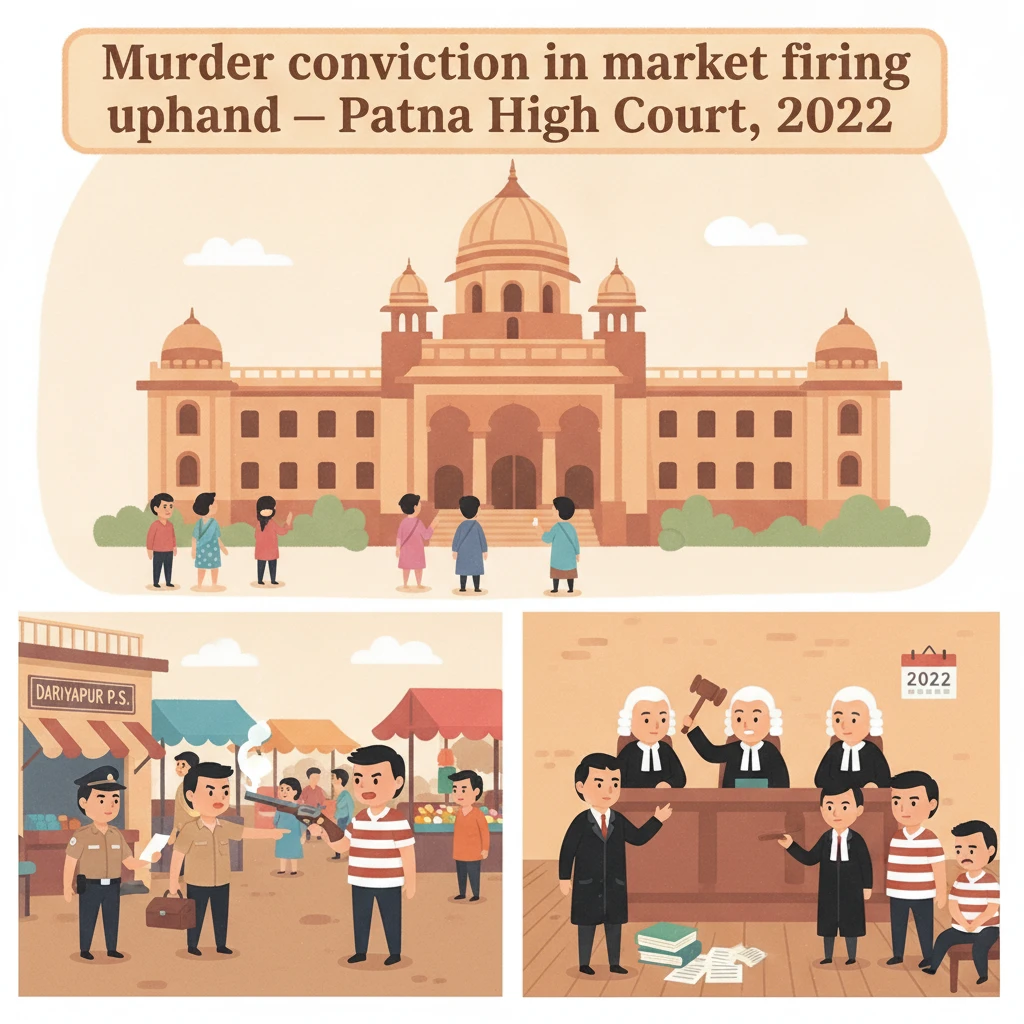
Case Background
This case arises from a violent attack in Dariyapur Bazar, District Saran, in May 2005. The appellant was tried along with others for firing and bomb attacks on local jewellery and general shops, which left two persons dead and several injured.
The prosecution case began with the fardbeyan of informant Amod Kumar Gupta (PW 1), recorded by the police at 3:00 p.m. on 4.5.2005 at Dariyapur Police Station. Based on this statement, Dariyapur P.S. Case No. 33 of 2005 was registered at 16:30 hours on the same day.
According to PW 1, about a week before the main incident, accused Ajay Rai had come as a customer to the jewellery shop of his uncle, Ram Chandra Sah (PW 5) at Dariyapur Bazar. Ajay Rai asked for jewellery on credit. When PW 5 refused, an altercation took place which turned into a fight, though it was later settled.
After two to four hours of that earlier quarrel, five named accused including the present appellant allegedly took one Mithilesh Kumar away from the shop and beat him with fists and slaps. At that time, two of the accused, Sipahi Rai and the appellant Rajeshwar Rai, allegedly threatened the local jewellers that they would face consequences. Being businessmen, they did not take the threats seriously.
On 4.5.2005 at about 1:00 p.m., according to the prosecution, multiple accused came to the bazar on several motorcycles, three persons on each vehicle, armed with pistols, kattas, carbine and bombs. What followed was a series of shootings and bomb blasts at different nearby shops, causing death and serious injuries.
After investigation, the police submitted chargesheet under Section 302 and other provisions of the Indian Penal Code and Section 27 of the Arms Act. A supplementary chargesheet was later filed against the appellant and others. Cognizance was taken on 5.8.2005, and the case was committed to the Court of Sessions on 8.2.2007.
The 3rd Additional Sessions Judge, Saran at Chapra, conducted Sessions Trial No. 105 of 2007. Charges were framed against the appellant under Sections 302, 307, 145, 148 and 149 of the Indian Penal Code, Section 27 of the Arms Act and Section 3/4 of the Explosive Substances Act.
By judgment dated 7.9.2010 and order dated 15.9.2010, the trial court convicted the appellant under Sections 302/149, 148 and 307/149 IPC and Section 27 of the Arms Act. He was sentenced to rigorous imprisonment for life for Section 302/149, three years for Section 148, ten years for Section 307/149, and seven years for Section 27 of the Arms Act. A fine of Rs. 25,000/- was also imposed under Section 307/149 IPC, with one additional year of rigorous imprisonment in default. All sentences were to run concurrently.
The appellant filed Criminal Appeal (DB) No. 1182 of 2010 before the Patna High Court challenging his conviction and sentence. During the pendency of the appeal, co-appellant Sipahi Rai died, and the appeal continued only with respect to appellant Rajeshwar Rai.
What the Court Examined and Decided
The Division Bench of the Patna High Court, comprising Hon’ble Mr. Justice Ashwani Kumar Singh and Hon’ble Mr. Justice Partha Sarthy (author of the judgment), focused on a central question: whether the prosecution witnesses were reliable and whether their evidence proved the charges against the appellant beyond reasonable doubt.
The prosecution examined ten witnesses. These included the informant and several eye-witnesses from the bazar, two injured persons, two doctors and the Investigating Officer. Five defence witnesses were examined to support the plea that unknown criminals, not the appellant, had committed the offence.
PW 1, the informant and an injured eye-witness, gave a detailed account. He repeated in court that after the earlier dispute at PW 5’s shop, the accused had threatened the jewellers. On the day of occurrence, he saw the accused arrive on about five motorcycles. He identified eleven accused, including the appellant.
According to PW 1, the group first went to the shop of Kishori Sah, where accused Sanjay Rai shot Shivnath Sah, who died on the spot. After bomb explosions and further firing at other nearby shops and doors, the group came to his own shop.
PW 1 stated that there, the appellant hit him on his forehead with the butt of a pistol, causing injury. When his son Vikash Kumar @ Sonu (PW 2) came forward, the appellant fired at him, hitting his arm and chest. When PW 1’s younger brother, Chhathilal, came to their rescue, Shailesh Rai allegedly fired at him on the order of the appellant, and Chhathilal died on the spot.
PW 2 Vikash Kumar, the son of PW 1 and himself an injured witness, corroborated his father’s version. He stated that after hearing bomb blasts and firing, he came out and saw the accused, including the appellant. He saw the appellant assaulting his father with the pistol butt. When he tried to run, the appellant fired at him and he received gunshot injuries on his left arm and chest. On his uncle Chhathilal coming to help, Shailesh Rai shot him dead.
PW 3 Sheo Pujan Sah also described the attack. He said twelve accused came on four to five motorcycles, armed with bombs, pistols and carbine. He saw Sanjay Rai shoot Shivnath Sah dead and stated that a bomb exploded by the appellant caused injury to Madan Sah’s leg. He then saw the group proceed to the shop of PW 1, where the appellant beat PW 1 with a pistol butt and then shot PW 2. He also confirmed that on the appellant’s order, Shailesh Rai fired at and killed Chhathilal.
PW 4 Pancham Prasad Gupta, younger brother of deceased Shivnath, was declared hostile. Yet he admitted that after hearing firing and blasts, he came out and found his brother fallen with chest injury.
PW 5 Ram Chandra Sah, uncle of PW 1, testified about the earlier quarrel at his shop and about Mithilesh Kumar being beaten afterward. Regarding the main incident, he said that hearing sounds of firing, he went to his rooftop and saw Sanjay shooting Shivnath. He further stated that the accused, armed with bombs and pistols, continued their attack, during which Chhathilal was killed and Amod, Vikash and Madan were injured.
PW 7 Om Prakash Gupta, full brother of PW 1, also supported the prosecution. He stated that on hearing blasts he came out and saw twelve persons on 4–5 motorcycles. They first went to Shivnath’s shop where a bomb exploded. Then they came to PW 1’s shop where the appellant hit PW 1 with the pistol butt, then fired at PW 2 causing injuries to his left hand and chest. On Chhathilal coming to save them, Shailesh, on the appellant’s order, fired and killed him. Later, Pancham informed PW 7 that Sanjay Rai had killed Shivnath and that Madan Prasad had suffered leg injuries.
PW 6, a shopkeeper, only heard firing and blasts and saw some persons fleeing on a motorcycle; he could not identify them.
PW 8 Dr. Akhileshwar Kumar, Medical Officer at Primary Health Centre, Dariyapur, examined PW 2, Madan Prasad and PW 1 soon after the incident. He found firearm injuries on PW 2 and injuries caused by explosive material on Madan Prasad. On PW 1 he found a lacerated wound on the right eyebrow measuring 1 cm x 1/3 cm x 1/3 cm caused by a hard and blunt substance, consistent with a pistol butt blow. He stated that original injury reports were sent to the police and produced the injury register prepared through carbon process.
PW 9, the Investigating Officer, proved the inquest reports of both deceased, Chhathilal and Shivnath, and described his inspection of three places of occurrence: at the house of Kishori Sah where Shivnath was killed, the house of Madan Sah where Madan received bomb injuries on his leg, and the shop of PW 1 where PW 1 and PW 2 were injured and Chhathilal was killed. He also spoke about seizure of bomb residue and sanctions obtained under the Arms Act and Explosive Substances Act.
PW 10 Dr. Jay Prakash Singh conducted the post-mortems at Sadar Hospital, Chapra. For Shivnath, he found two communicating firearm injuries in the chest and opined that death was due to haemorrhage and shock from firearm injuries within 12 hours. For Chhathilal, he found a lacerated wound on the right upper arm with blackening around the wound, and firearm injuries in the chest that were communicating, along with fracture of the 7th rib. In both cases, cause of death was haemorrhage and shock due to firearm injuries. Post-mortem reports were exhibited as Ext. 7 and 7/A.
The defence witnesses stated generally that the incident had occurred in the market but was committed by unknown criminals due to some previous enmity, and that the appellant had been falsely implicated.
The High Court closely evaluated whether the evidence of the prosecution, particularly that of injured witnesses PW 1 and PW 2 and eye-witnesses PW 3, PW 5 and PW 7, was trustworthy.
The Bench noted that PW 1 and PW 2 were not only eye-witnesses but also injured in the same occurrence, lending strong weight to their testimony. Their statements were consistent about the appellant’s acts: assaulting PW 1 with pistol butt, shooting PW 2, and ordering Shailesh to fire at and kill Chhathilal.
The Court further observed that their accounts were corroborated by independent medical evidence. The injuries described by PW 1 matched the lacerated wound noted by PW 8. The gunshot injuries described by PW 2 matched the entry and exit wounds recorded by PW 8. The manner of death of Shivnath and Chhathilal, as described by the witnesses, matched the firearm injuries found by PW 10 in post-mortem examinations.
PW 3, PW 5 and PW 7 independently confirmed the same sequence of events at PW 1’s shop. The Court found that their testimonies regarding place and manner of occurrence aligned with each other and with the medical and investigative evidence.
The defence attempted to rely on some statements of PW 9 suggesting that certain details, like the pistol butt assault on PW 1, were not mentioned to him earlier. The Court, however, took into account that the witnesses had spoken of a protest petition filed against the Investigating Officer which was placed before the Superintendent of Police, Saran, but no action was taken. In this background, the Court did not consider such omissions sufficient to discard the clear, consistent ocular and medical evidence.
After weighing both sides, the Bench concluded that the prosecution witnesses “are consistent and inspire confidence of the Court” and that there was no valid ground to disbelieve them. The defence evidence did not create any reasonable doubt about the appellant’s role. The Court held that the prosecution had proved the charges against the appellant beyond all shadows of reasonable doubt.
On this basis, the High Court found the trial court’s judgment to be “consistent” and “well reasoned” and held that there was no reason to interfere. The criminal appeal was dismissed, and the conviction and sentences of the appellant were maintained.
Why This Judgment Matters
This decision of the Patna High Court is important for cases involving violent attacks in crowded markets and lanes where many local people are present. It shows that the Court gives strong value to the evidence of injured witnesses and multiple eye-witnesses whose accounts agree with each other and with medical reports.
For victims and their families, the judgment indicates that even when the accused allege false implication and bring defence witnesses, the Court will look carefully at whether the prosecution version is supported by injuries, post-mortem findings and prompt reporting to the police.
The ruling also shows that where a person not only personally attacks victims but also directs others to open fire, the Court may hold him liable for murder and attempt to murder with the aid of common object provisions like Section 149 IPC.
In practical terms, this judgment reassures shopkeepers and small traders that brutal acts of group violence in bazaars can lead to firm convictions when the community comes forward to give clear and consistent statements.
Legal Issues and Answers
Issue: Did the prosecution prove beyond reasonable doubt that the appellant actively took part in the firing and bomb incident, causing death and injuries, so as to justify his conviction under Sections 302/149, 307/149, 148 IPC and Section 27 of the Arms Act?
Answer: Yes. The Patna High Court held that the consistent and corroborated testimony of injured and eye-witnesses, supported by medical and investigative evidence, proved the appellant’s role beyond reasonable doubt, and therefore upheld the conviction and sentences.
Cases Cited by the Court
- No earlier judgments or case law have been cited or relied upon in the text of this decision.
Case Details
Case Number: Criminal Appeal (DB) No. 1182 of 2010
Case Title: Rajeshwar Rai v. The State of Bihar
Citation: 2022 (1) PLJR 810
Court: High Court of Judicature at Patna
Coram: Hon’ble Mr. Justice Ashwani Kumar Singh and Hon’ble Mr. Justice Partha Sarthy
Date of Judgment: 09.02.2022
Advocates:
- For the Appellant: M/s S.K. Lal, Shyameshwar Kumar Singh, Advocates
- For the State/Respondent: Mr. D.K. Sinha, APP
Nature of the Case: Criminal appeal (Division Bench) against conviction and sentence in Sessions Trial No. 105 of 2007 arising out of Dariyapur P.S. Case No. 33 of 2005.
Result: Appeal dismissed; conviction and sentences upheld.
Link to Full Judgment: Patna High Court Judgment in Cr. App. (DB) No. 1182 of 2010
If you found this explanation helpful and wish to stay informed about
how legal developments may affect your rights in Bihar,
you may consider following Samvida Law Associates for more updates.







