
Case Background
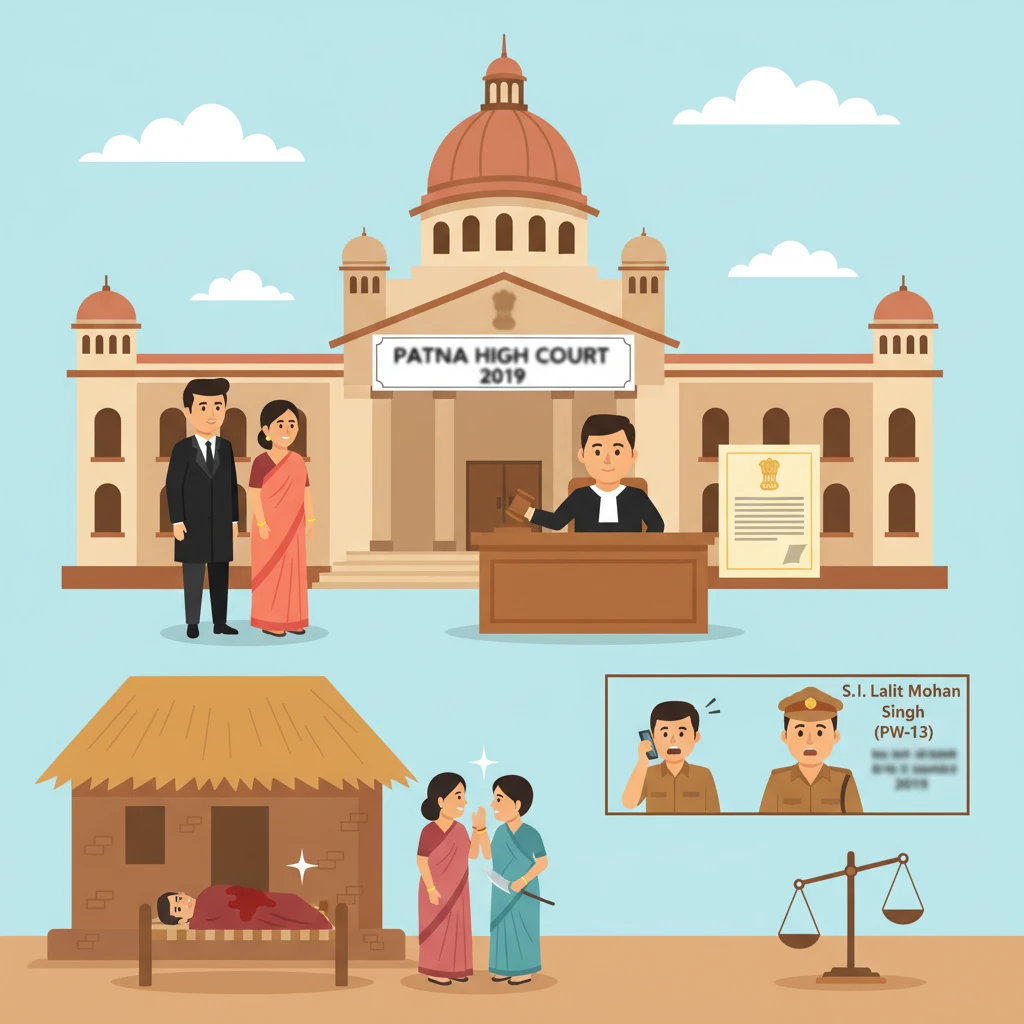
This case arose from Puraini P.S. Case No. 22 of 2012, District Madhepura, registered under Section 302/34 of the Indian Penal Code (IPC). The FIR was based on the fardbeyan of the deceased’s brother, recorded on 02.04.2012 at about 2:00 PM by the Investigating Officer (I.O.), S.I. Lalit Mohan Singh, at village Aurlaha.
According to the informant, his younger brother, Md. Tarik, had married the appellant about one year earlier. On 31.03.2012, the brother went to his matrimonial home at village Aurlaha to bring back his wife on bidai. On 02.04.2012 at about 11:30 AM, the informant received a phone call from Aurlaha that his brother had been killed.
When he reached the matrimonial house, he found his brother’s blood-soaked body lying on a chowki with a grievous neck injury. From enquiries with local people, he allegedly came to know that the appellant had “cordial relations” with one Md. Ashish. It was alleged that, along with Ashish and an unknown person, she had conspired to kill her husband by cutting his neck with a sharp weapon so that she could later marry Ashish.
On completion of investigation, the police submitted charge-sheet against the appellant and one Md. Sajir under Section 302/34 IPC, keeping investigation pending against Md. Ashish. The Magistrate took cognizance and committed the case to the Court of Session, where it came to the Adhoc Additional Sessions Judge-IV, Madhepura, as Sessions Trial No. 139 of 2012.
The trial court framed charge under Section 302/34 IPC against the appellant and co-accused Md. Sajir. Both pleaded not guilty. After trial, the court acquitted Md. Sajir by extending benefit of doubt, but convicted the appellant under Section 302/34 IPC, sentencing her to life imprisonment and a fine of Rs. 10,000, with six months’ simple imprisonment in default. Aggrieved, she filed Criminal Appeal (DB) No. 901 of 2013 before the Patna High Court.
What the Court Examined and Decided
The Division Bench of Hon’ble Mr. Justice Rakesh Kumar and Hon’ble Mr. Justice Prakash Chandra Jaiswal heard the appeal. The central question before the Patna High Court was whether the prosecution had proved the charge of murder against the appellant beyond reasonable doubt on the basis of the evidence on record.
The Court first looked at the nature of evidence. No one had seen the murder happening. Therefore, the case was based entirely on circumstantial evidence. The prosecution examined thirteen witnesses, but many of them did not support the prosecution story.
PW-1 was a hearsay witness and admitted he had not seen the occurrence. PW-2, PW-3, PW-4, PW-5, PW-6, PW-7 and PW-9 turned hostile. Among them, PW-3 and PW-5 were the appellant’s father and mother. The main supporting witnesses were PW-10 Sahabuddin (informant and brother of the deceased) and PW-11 Naiyar Alam (another brother).
The Court noted that even PW-10 and PW-11 were not eye-witnesses. They only said that the deceased had gone to the appellant’s paternal house to bring her on bidai, and that he was found murdered there. They repeated the allegation that the appellant had cordial relations with Md. Sajir and Md. Ashish and, in conspiracy with them, killed the deceased with a dabiya by slitting his neck.
However, the High Court pointed out that there was no direct or independent evidence to prove this alleged “cordial relation” or any conspiracy. PW-10 and PW-11 were only narrating what they had heard. No other witness or document was produced to show any relationship between the appellant and the co-accused.
The Bench then examined the remaining incriminating circumstances relied on by the prosecution: (i) the murder occurred in the appellant’s paternal house; (ii) recovery of blood-stained soil and a blood-stained dupatta from the place of occurrence; and (iii) an alleged confessional statement of the appellant leading to recovery of a blood-stained dabiya said to be the weapon.
On the alleged confession, the Court held that any confession made to a police officer is barred by Section 25 of the Indian Evidence Act and is not admissible as proof of guilt. Only that part of a statement which leads to discovery of a fact may sometimes be relevant, but here even the alleged recovery was doubtful.
The I.O. (PW-13) stated in his examination-in-chief that the appellant took out the blood-stained dabiya from grass and weeds near the place of occurrence beside her paternal house. Yet in his cross-examination he stated that the dabiya was recovered from the north-east corner of the verandah of the house. This clear contradiction in the place of recovery weakened his version.
Moreover, PW-8 Abdul Jabbar, the seizure list witness for the dabiya, said in cross-examination that he had gone to the police station where the officer-in-charge showed him the weapon and asked him to sign the seizure list there. He had not read the contents of the seizure list. This contradicted the I.O.’s claim that the weapon was seized at the place of occurrence. The Court held that this created serious doubt about any recovery being made on the basis of the appellant’s disclosure.
The High Court also observed that the alleged confessional statement was never exhibited in evidence. Thus, even as a document it was not part of the proved record. The Bench concluded that the so-called statement had “no evidentiary value in the eye of law” and had not in fact led to any legally acceptable recovery.
The Court further noted that, as per the I.O. himself, the blood-stained soil, blood-stained dupatta, and the alleged blood-stained dabiya were never sent to the Forensic Science Laboratory for chemical examination. Therefore, there was no proof that the blood found on these materials was human blood, or that it matched the deceased’s blood group, or that the weapon bore the fingerprints of the accused. This failure seriously weakened the prosecution case.
The Bench also examined the reliability of the first statement (fardbeyan) that formed the basis of the FIR. According to the fardbeyan itself and the I.O.’s cross-examination, it was recorded at the door of Md. Nizam (the appellant’s father) in village Aurlaha. But in cross-examination, the informant (PW-10) said that after getting information he went from his house to Aurlaha, then went from Aurlaha to the police station with the police, and that his statement was written by the police at the police station. He also said the police wrote things on their own and merely took his signature. This contradiction, in the Court’s view, raised serious doubt about the sanctity of the fardbeyan and, therefore, the overall prosecution story.
The defence examined two witnesses, DW-1 Md. Arshad and DW-2 Md. Mahboob. Both stated that, at the time of occurrence, the appellant was in the field along with her parents. The prosecution did not produce convincing material to discredit this version.
The State argued that under Section 106 of the Evidence Act, since the deceased’s dead body was found in the appellant’s paternal house, the burden lay on her to explain how the death occurred. The High Court rejected this contention. It noted that the house was not exclusively under the appellant’s control; it was her paternal home, also occupied by her parents and several family members, who were themselves not accused. In such a situation, it could not be presumed that only the appellant knew about the incident.
To frame its approach on circumstantial evidence, the Patna High Court relied on two Supreme Court decisions. First, it cited Shard Birdhichand Sarda v. State of Maharashtra, 1984 (4) SCC 116, which lays down that in a case based on circumstantial evidence: the circumstances must be fully established; they must be consistent only with the guilt of the accused; they must be of conclusive nature; they must exclude every other hypothesis except guilt; and there must be a complete chain of evidence leaving no reasonable ground consistent with innocence.
Second, the Court referred to Kanhaiya Lal v. State of Rajasthan, (2014) 4 SCC 715. The Supreme Court there held that “last seen together” by itself does not prove guilt; there must be something more connecting the accused with the crime. Non-explanation of such circumstance alone is not enough to convict when the case rests on circumstantial evidence.
Applying these principles, the High Court held that the circumstances in this case did not form a complete and conclusive chain pointing only towards the appellant’s guilt. Many key witnesses turned hostile, the alleged relationship with co-accused was unproved, the recovery of weapon was doubtful, forensic testing was not done, and the very recording of the fardbeyan was in serious doubt. The Court found that the prosecution had “utterly and miserably” failed to establish any solid incriminating material against the appellant.
Ultimately, the Bench concluded that the conviction under Section 302/34 IPC could not be sustained. It set aside the judgment of conviction dated 11.06.2013 and sentence dated 13.06.2013 passed by the Adhoc Additional Sessions Judge-IV, Madhepura, in Sessions Trial No. 139 of 2012. The appellant was acquitted of the charge and, as she was in custody, the Court directed that she be released forthwith if not wanted in any other case.
Why This Judgment Matters
This judgment shows how carefully courts must examine cases that rest only on circumstantial evidence, especially when they involve serious charges like murder and life imprisonment.
For families and accused persons, it underlines that suspicion and village rumours cannot take the place of solid proof. Even if a dead body is found in a family house, that does not automatically make every family member a murderer.
The decision also highlights the importance of proper police investigation. Failure to conduct forensic tests, contradictions in recording of statements, and doubtful seizure of weapons can all be fatal to the prosecution case. When liberty and life are at stake, such lapses cannot be ignored.
For lawyers and trial courts in Bihar, this Patna High Court decision reinforces settled Supreme Court rules on circumstantial evidence and limits on using confessions made to police officers.
Legal Issues and Answers
-
Issue: Whether the appellant’s conviction for murder under Section 302/34 IPC could be sustained on the basis of the circumstantial evidence on record.
Answer: No. The Patna High Court held that the prosecution failed to prove a complete and conclusive chain of circumstances; the evidence was inconsistent, key witnesses turned hostile, the alleged confession was inadmissible and unsupported by a valid recovery, and forensic examination was not done. The conviction was therefore set aside and the appellant was acquitted. -
Issue: Whether mere recovery of the dead body from the appellant’s paternal house shifted the burden onto her under Section 106 of the Evidence Act to prove her innocence.
Answer: No. The Court held that the house was jointly inhabited by several family members who were not accused, so exclusive knowledge could not be attributed to the appellant alone. Section 106 could not be used to fill gaps in the prosecution case. -
Issue: Whether the alleged confessional statement to the police and consequent recovery of weapon could be relied upon to convict the appellant.
Answer: No. The Court held that the confession itself was hit by Section 25 of the Evidence Act, had not been exhibited, and the alleged recovery was doubtful due to contradictions between the I.O. and the seizure witness. Hence it had no evidentiary value.
Cases Cited by the Court
- Shard Birdhichand Sarda v. State of Maharashtra, 1984 (4) SCC 116 – on principles governing circumstantial evidence.
- Kanhaiya Lal v. State of Rajasthan, (2014) 4 Supreme Court Cases 715 – on “last seen together” and the standard for inference of guilt in circumstantial evidence cases.
Case Details
Case Number: Criminal Appeal (DB) No. 901 of 2013; arising out of Puraini P.S. Case No. 22 of 2012; Sessions Trial No. 139 of 2012, District Madhepura.
Case Title: Khusbu Khatoon v. The State of Bihar.
Citation: 2019 (2) PLJR 1052.
Coram: Hon’ble Mr. Justice Rakesh Kumar and Hon’ble Mr. Justice Prakash Chandra Jaiswal.
Advocates: For the appellant – Mr. Dinesh Prasad Verma, Advocate, assisted by Mr. Rohit Kumar Sharma, Advocate. For the State – Mr. Ajay Mishra, Additional Public Prosecutor.
Date of Patna High Court Judgment: 12.04.2019.
Nature of the Case: Criminal appeal (Division Bench) against conviction and sentence under Section 302/34 IPC.
Final Outcome: Appeal allowed; conviction and life sentence set aside; appellant acquitted and directed to be released from custody if not wanted in any other case.
Link to Full Judgment: Patna High Court Judgment in Cr. Appeal (DB) No. 901 of 2013
If you found this explanation helpful and wish to stay informed about
how legal developments may affect your rights in Bihar,
you may consider following Samvida Law Associates for more updates.







