
Case Background
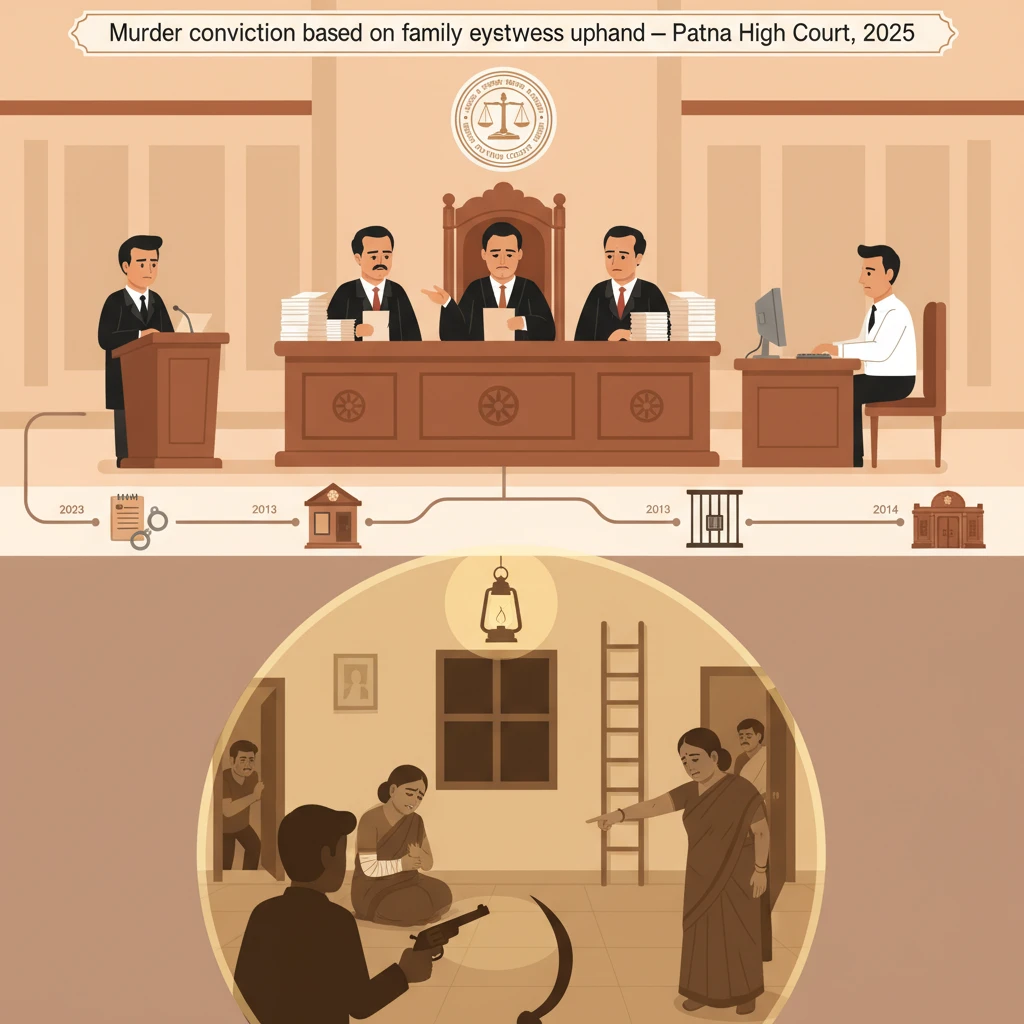
This case arises from a midnight attack inside a village home in Paliganj, District Patna, in the year 2003.
According to the prosecution, on the night of 31.07.2003, the informant, his wife, his son Raju Singh and other family members were sleeping in their house. Around 12:45 a.m., three men allegedly entered the house using a ladder.
The informant, Chandradeo Singh, gave his fardbeyan on 01.08.2003 at 11:30 a.m. He named three accused: the present appellant Sharwan Singh (also known as Ravi or Shravan), and two others, Sitaram Singh and Upendra Paswan.
On the basis of this statement, Paliganj P.S. Case No. 101 of 2003 was registered under Sections 324, 307, 302/34 IPC and Section 27 of the Arms Act. After investigation, the police submitted charge sheet against all three accused under Sections 324, 326, 307, 302/34 IPC and Section 27 of the Arms Act.
The learned ACJM took cognizance. Later, the Investigating Officer informed the court that the appellant was already in judicial custody at Gaya in connection with Konch P.S. Case No. 83 of 2005 under a changed name “Ravi Singh”. A production warrant was issued, and on 11.11.2013 the appellant was produced and remanded in this case.
The case records of the appellant were separated from those of the other two accused and committed to the Court of Sessions as Sessions Trial No. 365 of 2014. Charges under Sections 302, 307, 326/34 IPC and Section 27 of the Arms Act were framed against the appellant. He pleaded not guilty and claimed trial.
In 2022, the Additional Sessions Judge-I, Danapur, convicted the appellant and sentenced him to life imprisonment under Section 302 IPC, ten years each under Sections 307 and 326 IPC, and three years under Section 27 of the Arms Act, with fines. All sentences were to run concurrently.
The appellant then filed Criminal Appeal (DB) No. 219 of 2023 before the Patna High Court challenging both the judgment of conviction dated 25.05.2022 and the order of sentence dated 30.05.2022.
What the Court Examined and Decided
The Division Bench of the Patna High Court, speaking through Hon’ble Mr. Justice Ashok Kumar Pandey, examined the full record of the trial, including oral and medical evidence and the grounds of appeal.
The prosecution case, based on the fardbeyan of the informant, was that three accused scaled the house using a ladder. The appellant was armed with a pistol and a sharp-cutting weapon (described as pahsul/kata), while the two co-accused carried pistols.
It was alleged that the appellant shot Raju Singh on the head while he was sleeping, killing him on the spot. Thereafter, the appellant allegedly attacked the informant’s wife, Sheo Ratri Devi (PW-7), with the sharp-cutting weapon, causing serious injuries including an amputated finger. The informant stated that he hid in the bathroom out of fear and came out only after the assailants fled.
At trial, the prosecution examined ten witnesses and produced documents including the post-mortem report, injury report, fardbeyan, FIR, charge sheet and a certified copy of another sessions judgment.
Key eyewitnesses were PW-4 Pramila Devi (wife of the deceased), PW-5 Rekha Devi (sister-in-law of the deceased) and PW-7 Sheo Ratri Devi (injured mother of the deceased and wife of the informant). According to the FIR and their evidence, they were present in the house at the time of occurrence.
PW-4 deposed that her husband Raju Singh was sleeping inside the house, while she, her mother-in-law PW-7 and her sister-in-law PW-5 were sleeping in the “osara”. She stated that the accused entered the house with the help of a ladder, which they identified in the light of a lantern. She said the accused carried pistols and a sharp-cutting weapon. She clearly stated that the appellant Sharwan shot her husband on the head and he died on the spot.
PW-4 further said that the appellant then attacked PW-7 with a sharp weapon, resulting in amputation of her finger. In cross-examination she admitted that the ladder and lantern were not seized by the police, and that despite her alarm no one from outside came. She also stated that her husband and the appellant were not on talking terms for about six months and that the houses were adjacent.
PW-5 Rekha Devi substantially confirmed PW-4’s account. She supported the version that the appellant fired at Raju Singh and then assaulted PW-7 with a sharp-cutting weapon, leading to serious hand injuries.
PW-7, the injured witness, gave a detailed and direct account. She stated the time of occurrence as 12:45 a.m. She confirmed that she, her two daughters-in-law (PWs 4 and 5) and Raju Singh were present in the house, while her husband slept on the roof. She deposed that the accused entered the house using a ladder and that the appellant fired at Raju’s head, causing his death on the spot.
PW-7 said she saw the occurrence in the light of a lantern and that the appellant assaulted her with “pahsul”, resulting in amputation of her finger. During her deposition she showed her amputated finger to the trial court, which was recorded. In cross-examination, she admitted that the appellant was her brother-in-law’s son and that their houses were adjacent. She also clearly stated that there was a land dispute between the parties.
Two doctors gave crucial medical evidence. PW-8, Dr. Ram Niwas Prasad, conducted the post-mortem on Raju Singh on 02.08.2003 at S.D.H., Danapur. He found a lacerated wound on the right occipital region with blackening and burnt hair, indicating a firearm entry wound, and a larger lacerated wound on the left occipital-temporal region continued with the entry wound, indicating an exit wound. Part of the brain matter was outside through the exit wound. He opined that death was due to shock and haemorrhage from head injury caused by firearm, within 48 hours prior to examination.
PW-10, Dr. Jagat Prasad, examined injured PW-7 at 11:30 a.m. on 01.08.2003 at the referral hospital, Paliganj. He found multiple sharp-cut wounds on the right side of her face, near the right eye and ear, over the right scapular region, and importantly an almost amputated right ring and little finger, with additional sharp-cut wounds on the right index and middle fingers. He opined that injury no. (iii) was grievous; others were reserved pending X-ray. All injuries were caused by a sharp-cutting heavy object, and within twelve hours. He conceded in cross-examination that such injuries could also be caused by a fall on a sharp object, but there was no evidence suggesting such an accidental fall.
Other witnesses, PW-1, PW-2, PW-3 and PW-6, were not eyewitnesses. They either heard the sound of firing and cries but did not come out due to fear, or came to know later about the occurrence. They confirmed the basic fact of the killing and injury but could not identify the assailants from their own observation.
PW-9, the Investigating Officer, mainly proved the fardbeyan, FIR and charge sheet. He also clarified that substantial investigation was done earlier by another officer, and that he primarily submitted the charge sheet showing the accused as absconders.
The defence did not lead any evidence. In his statement under Section 313 CrPC, the appellant denied the prosecution case and pleaded innocence. Through counsel, he argued before the High Court that:
• the trial court delivered the judgment in a hurry without proper appreciation of evidence;
• no one had actually seen the occurrence and the case was based on assumptions;
• there were vital contradictions and the case was one of circumstantial evidence with an incomplete chain;
• identification in lantern light at midnight in a village without electricity was doubtful;
• the witnesses were related and “interested” witnesses; and
• the informant was not examined because he died during trial, which should cast doubt.
The State, through the Additional Public Prosecutor, argued that the trial court had correctly appreciated the evidence, that the occurrence took place inside the house at night, and that the inmates of the house were the most natural witnesses. In such circumstances, the absence of independent witnesses from outside was not suspicious.
The High Court closely re-examined the evidence of PWs 4, 5 and 7. It found that all three consistently placed the appellant at the scene, clearly attributed the gunshot to him, and described his assault on PW-7 with a sharp-cutting weapon. Their accounts matched the medical evidence.
The Court then addressed the argument about related and interested witnesses. It referred to the Supreme Court’s decision in Raju v. State of Tamil Nadu, (2012) 12 SCC 701, where the Supreme Court observed that evidence of a related or interested witness is not to be discarded merely because of relationship. Instead, it must be examined with greater care and caution, but each case has to be decided on its own facts. The Patna High Court also cited Dalip Singh v. State of Punjab, as quoted in Raju, which held that ordinarily a close relation would be the last person to screen the real culprit and falsely implicate another.
The Court further relied on the Supreme Court judgment in Lakshman Singh v. State of Bihar, (2021) 9 SCC 191, which reiterates that the testimony of an injured witness has great evidentiary value and is usually very reliable. An injured witness carries an inbuilt guarantee of presence at the scene and is unlikely to spare the real assailant.
In this case, PW-7 was both an eyewitness and an injured witness, and she had shown her amputated finger to the trial court. Her injuries were fully supported by PW-10’s medical report. The Court held that her testimony, supported by PWs 4 and 5 and consistent with medical evidence, could not be lightly discarded.
On the argument about lantern light and identification in the dark, the Court noted that the appellant was a close relative and immediate neighbour of the witnesses. They knew him well. The occurrence happened inside their own house, and they had sufficient opportunity to recognise him even in lantern light. The Court did not find any serious contradictions in their statements on this aspect.
The High Court also highlighted that the post-mortem showed a single gunshot to the head from close range, consistent with the oral version that the appellant fired at a sleeping Raju from close quarters inside the room. The description of injuries to PW-7’s fingers and face matched her account of being attacked with a sharp-cutting weapon.
On a full re-appreciation of evidence, the Bench agreed with the trial court’s detailed findings (particularly paragraph 24 of the trial court judgment). It held that the prosecution had proved its case against the appellant beyond reasonable doubt. The fact that other witnesses were not present at the exact time of occurrence did not weaken the clear and credible testimony of the three women who were present.
Finding no error in the conviction under Sections 302, 307, 326 IPC and Section 27 of the Arms Act, the High Court upheld both the conviction and the sentences and dismissed the appeal as lacking merit.
Why This Judgment Matters
This judgment from the Patna High Court is important for victims and families in rural areas where crimes often occur inside homes at night and there may be no “outside” independent witness.
The Court made it clear that:
• being a relative does not automatically make a witness unreliable;
• the testimony of an injured family member present at the scene can be the strongest piece of evidence; and
• medical evidence, like post-mortem and injury reports, can strongly support what eyewitnesses say.
For ordinary people, this judgment shows that if a serious crime like murder or attempt to murder takes place inside the house, the law does not require some outsider to see it for the case to succeed. If family members who are present give a clear, consistent account, and doctors’ findings match their version, courts can and do rely on such evidence.
It also shows that delay in arrest or trial, or the death of the original informant during trial, does not automatically help the accused if other reliable evidence exists on record.
Legal Issues and Answers
- Issue: Can a conviction for murder and related offences be sustained mainly on the testimony of related family members, one of whom is an injured witness, in the absence of independent witnesses from outside the house?
Answer: Yes. The Patna High Court held that the evidence of related and injured eyewitnesses, if consistent and supported by medical evidence, is sufficient to prove the prosecution case beyond reasonable doubt. Independent witnesses are not necessary when the occurrence is inside the house at night. - Issue: Did alleged contradictions, questions about identification in lantern light, and the informant’s non-examination due to death create reasonable doubt in favour of the appellant?
Answer: No. The Court found no material contradictions in the core narrative. It held that identification was reliable because the appellant was a close relative and neighbour, and the injured witness’s testimony was fully corroborated by medical evidence. The informant’s death during trial did not damage the prosecution case, as other witnesses proved the incident. - Issue: Was there any ground for the High Court to interfere with the trial court’s conviction and sentence under Sections 302, 307, 326 IPC and Section 27 of the Arms Act?
Answer: No. On re-appreciation of all evidence, the High Court held that the trial court’s judgment was well discussed and free from error. The conviction and sentences were affirmed, and the appeal was dismissed.
Cases Cited by the Court
- Raju v. State of Tamil Nadu, (2012) 12 SCC 701
- Dalip Singh v. State of Punjab, (1953) 2 SCC 36 : AIR 1953 SC 364 : 1953 Cri LJ 1465 : 1954 SCR 145 (quoted in Raju)
- Lakshman Singh v. State of Bihar, (2021) 9 SCC 191
- State of M.P. v. Mansingh, (2003) 10 SCC 414 : (2007) 2 SCC (Cri) 390 (referred in Lakshman Singh)
- Abdul Sayeed v. State of M.P., (2010) 10 SCC 259 : (2010) 3 SCC (Cri) 1262 (referred in Lakshman Singh)
- Ramvilas v. State of M.P., (2016) 16 SCC 316 : (2016) 4 SCC (Cri) 850 (referred in Lakshman Singh)
Case Details
Case Number: Criminal Appeal (DB) No. 219 of 2023
Trial Case Reference: Sessions Trial No. 365 of 2014 arising out of Paliganj P.S. Case No. 101 of 2003
Case Title: Sharwan Singh @ Ravi Singh @ Shravan Singh v. State of Bihar
Citation: 2025(3) PLJR 80
Coram: Hon’ble Mr. Justice Rajeev Ranjan Prasad and Hon’ble Mr. Justice Ashok Kumar Pandey
Date of High Court Judgment: 01.05.2025 (uploading and transmission on 08.05.2025)
Advocates:
For the Appellant: Mr. Saroj Kumar Sharma, Advocate
For the State: Mr. Ajay Mishra, Additional Public Prosecutor
Offences Involved: Sections 302, 307, 326 read with Section 34 of the Indian Penal Code; Section 27 of the Arms Act
Nature of the Case: Criminal appeal (Division Bench) against conviction and sentence passed by the Court of Session in a sessions trial for murder, attempt to murder, causing grievous hurt, and use of firearm.
Outcome: Appeal dismissed; conviction and sentences affirmed.
Link to Judgment: https://patnahighcourt.gov.in/viewjudgment/NSMyMTkjMjAyMyMxI04=-PV2HBjB–am1–lnI=
If you found this explanation helpful and wish to stay informed about
how legal developments may affect your rights in Bihar,
you may consider following Samvida Law Associates for more updates.







