
Case Background
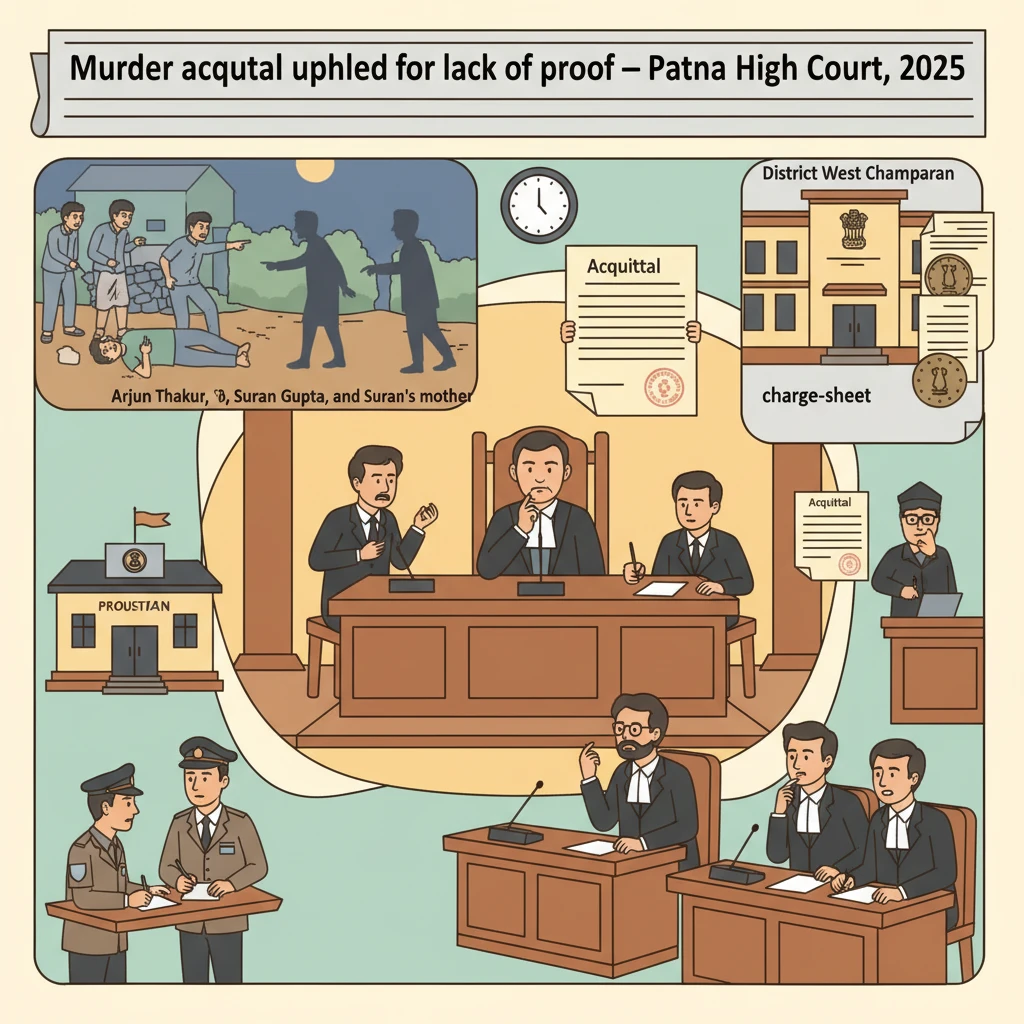
The case arises from Thakraha P.S. Case No. 74 of 2001, District West Champaran, registered under Section 302/34 of the Indian Penal Code (IPC) for murder with common intention.
The prosecution case started with the fardbeyan of Amar Tiwary (later examined as PW-6). His statement was recorded by S.I. V.K. Jha, Officer-in-Charge, Thakraha Police Station, on 13.11.2001 at 23:30 hours at the police station.
According to this fardbeyan, on 13.11.2001 at about 7:00 PM, Arjun Thakur (respondent no. 2) came to the house of Amar’s uncle, Hareram Tiwary (the deceased), to take a loan. Arjun allegedly took his dinner there and left for his house around 8:00 PM.
At about 9:15 PM, Amar claims he received information from someone that his uncle had been stabbed near the house of Arjun Thakur. He went there along with some people from his tola and allegedly found his uncle lying dead on the ground.
At the place of occurrence, Amar says that the mother of Arjun and some neighbours told him that at about 9:00 PM, Hareram had a heated quarrel with one Suran Gupta. In that quarrel, Suran’s mother allegedly caught hold of the deceased’s testicles and pulled them, and Suran allegedly attacked Hareram with a knife on his head, neck, stomach, thigh and other parts of the body.
In his fardbeyan, Amar further alleged that after the occurrence, Arjun Thakur absconded. He also stated that Hareram had no prior enmity with anyone and suggested that the murder occurred due to the sudden quarrel. He raised suspicion against one Awadhesh Thakur, saying that Awadhesh had quarrelled with Hareram earlier that same evening on some issue.
On this written report, the Officer-in-Charge registered Thakraha P.S. Case No. 74 of 2001 on 13.11.2001 under Section 302/34 IPC.
After investigation, the Investigating Officer submitted charge-sheet no. 08/2002 dated 14.02.2002 against some FIR-named accused under Section 302/34 IPC. The learned A.C.J.M., Bagaha took cognizance on 18.02.2002 against respondent nos. 2 and 3.
Later, a supplementary charge-sheet no. 62/2002 dated 07.10.2002 was filed against respondent no. 4. Cognizance under Section 302/34 IPC was also taken against him by order dated 09.10.2002.
On 03.12.2003, the case was committed to the Court of Sessions, Bagaha, and registered as Sessions Trial No. 490 of 2003. Charges under Section 302/34 IPC were framed against all accused, which they denied, claiming trial.
The prosecution examined nine witnesses (PW-1 to PW-9) and produced documentary evidence including the postmortem report and signatures on the fardbeyan and inquest report. After prosecution evidence, the accused were examined under Section 313 Cr.P.C. and denied the allegations.
The defence examined three witnesses (DW-1 to DW-3) to support its case. After full trial, the Additional Sessions Judge-III, Bagaha acquitted respondent nos. 2 to 4 of the charge under Section 302/34 IPC by judgment dated 30.07.2022.
Against this acquittal, the informant filed Criminal Appeal (DB) No. 34 of 2023 before the Patna High Court.
What the Court Examined and Decided
The Division Bench of the Patna High Court, comprising Hon’ble Mr. Justice Rajeev Ranjan Prasad and Hon’ble Mr. Justice Shailendra Singh, heard the appeal. The Court examined the entire trial court record and the reasoning adopted by the trial court.
The core question before the High Court was whether the trial court had wrongly acquitted the accused, or whether its view was a reasonable one based on the evidence.
The trial court had found that no prosecution witness had given categorical evidence linking the respondents to the murder. PW-1 and PW-2 admitted that they had not seen the actual occurrence. PW-2 further denied having told the police that he had seen Arjun taking the deceased to his house at 8:00 PM. PW-2 and PW-5 were declared hostile. PW-7 admitted that his evidence was based on hearsay. Importantly, the Investigating Officer (I.O.) was not examined at all.
On this basis, the trial court concluded that the prosecution had failed to prove the charge beyond reasonable doubt and acquitted the accused.
In appeal, counsel for the appellants (informant’s side) argued that the trial court had not properly appreciated the evidence, especially the evidence of PW-6, the informant. Counsel pointed out that PW-6 had stated in his examination-in-chief that at 7:00 PM on 13.11.2001, Arjun took his meal at the house of the deceased and then took the deceased to his house. They argued that PW-6 had proved his signature on the fardbeyan (Exhibit-2) and that the trial court erred in not relying on this evidence.
On the other hand, the State and counsel for respondent nos. 2 to 4 supported the acquittal, contending that no one had seen the murder, and there was no reliable evidence connecting the respondents to the killing of Hareram. They also stressed the legal position that an appellate court must be slow to interfere with an acquittal, relying on Supreme Court judgments in H.D. Sundara and Others v. State of Karnataka, (2023) 9 SCC 581, and Babu Sahebagouda Rudragoudar and Others v. State of Karnataka, (2024) 8 SCC 149.
The High Court carefully re-examined the evidence. It noted that the prosecution case rested on the fardbeyan of PW-6 (Exhibit-2). In the fardbeyan, PW-6 had clearly stated that Arjun left the house of the deceased alone after dinner at about 8:00 PM. In paragraph 8 of his deposition in court, PW-6 himself admitted that he had got recorded in the fardbeyan that Arjun had left alone from the deceased’s house.
However, in his examination-in-chief (paragraph 1), PW-6 gave a different version, saying that Arjun had taken Hareram with him to his house. This direct contradiction led the High Court to conclude that PW-6 was not a wholly reliable witness, as he changed his version at different stages.
The Court further examined the evidence about the alleged presence of people at the place of occurrence. PW-6 claimed that when he reached the spot, he found Hareram lying dead and 25–30 people present, including specific names like Urmila Devi, Dharmatma Tiwary, Sattan Tiwary, Kalawati Devi and Punam Devi.
But PW-2 (Dharmatma) stated that PW-6 came to him at 9:15 PM and informed him about the stabbing. PW-2 then went with PW-6 to the place of occurrence and saw the dead body. This showed that PW-2 was not already present at the spot when PW-6 arrived, contradicting PW-6’s version.
Punam Devi (PW-3) and Kalawati Devi (PW-5) did not support the prosecution case and were declared hostile. PW-9, a signatory to the inquest report, only proved his signature but said that the police did not record his statement about the death. He too was declared hostile.
Crucially, PW-6 admitted in paragraph 13 of his deposition that the incident did not occur in his presence and he had no personal knowledge of it. He said he had given his fardbeyan based on what he had heard from others. He did not disclose the name of the person who informed him about his uncle’s death, either in the fardbeyan or in his deposition. Thus, the prosecution story was entirely based on hearsay.
Defence witnesses gave another angle. DW-1, DW-2 and DW-3 stated that the deceased, Hareram, was a drunkard, a miscreant-type person, involved in lending money on interest, and often used to quarrel. They stated that he was killed by unknown criminals. DW-3 said he had heard of Hareram’s murder by criminals.
The medical evidence, given by PW-4 (doctor), also raised serious doubts about the prosecution version of time and place of death. The deceased was brought for postmortem at the Sub-Divisional Hospital, Bagaha, on 14.11.2001 at 10:30 AM. The doctor found 14 ante-mortem injuries on the body and opined that time since death was within 28–30 hours.
The postmortem report (Exhibit-1) showed that the postmortem had been conducted by 11:30 AM on 14.11.2001. If the prosecution story was correct—that the murder took place around 9:00 PM on 13.11.2001—then the time gap between death and postmortem would be about 12–13 hours. But the doctor’s opinion of 28–30 hours did not match this timeline.
This mismatch supported the defence suggestion that the murder may have taken place earlier and not in the manner or at the time claimed by the prosecution. It also weakened the link between the respondents and the alleged occurrence near Arjun’s house at 9:00 PM on 13.11.2001.
The High Court also noted that there was inconsistency about the place of occurrence. In the fardbeyan, PW-6 said the place of occurrence was near the house of Arjun Thakur. But in his examination-in-chief during trial, he stated that his uncle died at the door of Awadhesh Thakur and that the house of Arjun was “nearby”. This suggested that PW-6 was not sure about the actual place of occurrence.
Since the Investigating Officer was not examined, the prosecution could not properly prove the exact place of occurrence or explain these contradictions. The High Court held that this non-examination of the I.O. was fatal to the prosecution case.
After considering all the evidence and the trial court’s reasoning, the High Court held that the trial court had correctly appreciated the material on record. It found no perversity in the findings. Applying the Supreme Court’s principles in H.D. Sundara and Babu Sahebagouda Rudragoudar, the Court reiterated that an acquittal strengthens the presumption of innocence, and an appellate court can interfere only if the trial court’s view is not even a possible view.
In this case, the trial court’s view—that the prosecution had failed to prove the guilt of the accused beyond reasonable doubt—was certainly a possible and reasonable view on the evidence.
Accordingly, the Patna High Court refused to interfere with the acquittal and dismissed the informant’s appeal, holding that the appeal had no merit.
Why This Judgment Matters
This judgment is important for criminal cases where the main witnesses are not eyewitnesses, but only repeat what they have heard from others. The Patna High Court made it clear that such hearsay evidence, without strong supporting proof, cannot be the basis for convicting someone for murder.
The decision also highlights that contradictions in a key witness’s statements—about whether an accused went alone or took the deceased along, and about where exactly the death took place—seriously weaken the prosecution case.
For families of victims, this case shows that courts need clear and consistent evidence. Suspicion, even strong suspicion, is not enough for conviction. For accused persons, it underlines that if the prosecution fails to prove time and place of occurrence, or to examine crucial witnesses like the Investigating Officer, an acquittal can and will be upheld.
Finally, the judgment reinforces that appellate courts will rarely disturb an acquittal unless the evidence clearly leaves no room for doubt about guilt. This gives stability to trial court decisions and protects the presumption of innocence.
Legal Issues and Answers
- Issue: Whether the acquittal of the accused under Section 302/34 IPC in Sessions Trial No. 490 of 2003 was unjustified and required interference by the Patna High Court in appeal?
Answer: No. The Patna High Court held that the prosecution failed to prove the guilt of the respondents beyond reasonable doubt; the trial court’s view was a possible and reasonable view, so the acquittal could not be disturbed. - Issue: Whether the evidence on record reliably established the time, place and manner of death of the deceased, and the involvement of respondent nos. 2 to 4?
Answer: No. The Court found major contradictions in the informant’s statements, hostile prosecution witnesses, absence of the I.O.’s evidence, and medical evidence inconsistent with the alleged time of death, leading to the conclusion that the prosecution version was not fully proved. - Issue: What standard should an appellate court apply while dealing with an appeal against acquittal in a murder case?
Answer: The appellate court must re-appreciate the evidence but can interfere only if the trial court’s view is not a possible view and if the only possible conclusion from the evidence is guilt beyond reasonable doubt. The presumption of innocence is strengthened by an acquittal.
Cases Cited by the Court
- H.D. Sundara and Others v. State of Karnataka, (2023) 9 SCC 581
- Babu Sahebagouda Rudragoudar and Others v. State of Karnataka, (2024) 8 SCC 149
Case Details
Case Number: Criminal Appeal (DB) No. 34 of 2023; arising out of Thakraha P.S. Case No. 74 of 2001, District West Champaran; Sessions Trial No. 490 of 2003
Case Title: Amar Tiwari & Anr. v. The State of Bihar & Ors.
Citation: 2025 (3) PLJR 687
Coram: Hon’ble Mr. Justice Rajeev Ranjan Prasad; Hon’ble Mr. Justice Shailendra Singh
Date of High Court Judgment: 31.07.2025 (Uploading Date: 04.08.2025)
Advocates:
- For the Appellants (informant side): Ms. Sushmita Mishra, Advocate; Mr. Surya Narayan Sah, Advocate
- For the State: Mr. Ajay Mishra, Additional Public Prosecutor
- For the Informant (before trial court / respondents context): Mr. Bimlesh Kumar Pandey, Advocate; Mr. Krishna Kant Pandey, Advocate
Nature of the Case: Criminal appeal (Division Bench) against judgment of acquittal in a murder case under Section 302/34 IPC
Link to Judgment: Patna High Court Judgment – Criminal Appeal (DB) No. 34 of 2023
If you found this explanation helpful and wish to stay informed about
how legal developments may affect your rights in Bihar,
you may consider following Samvida Law Associates for more updates.







