

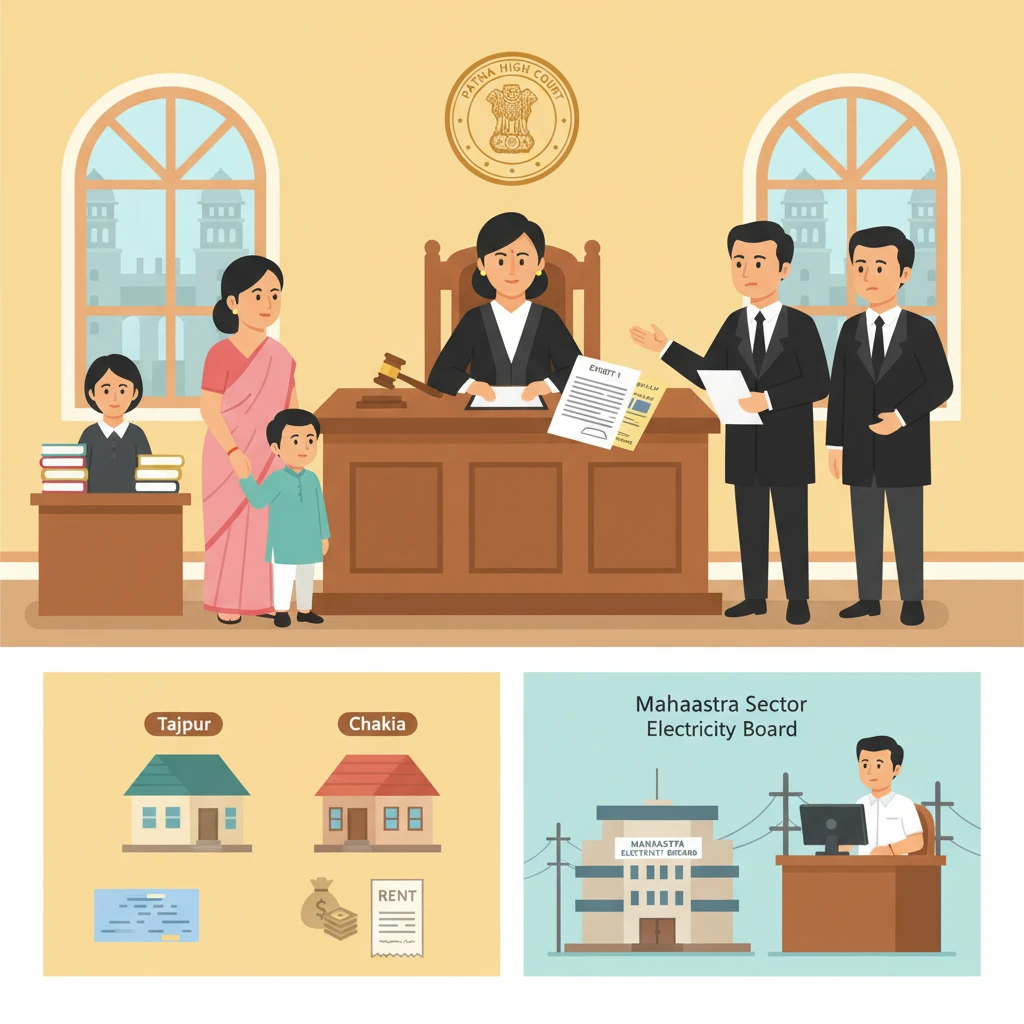
Case Background
The petitioner married opposite party no. 2 on 29.11.2012 according to Hindu rites and customs. After some time, the relationship turned sour. The wife alleged that the behaviour of her husband changed and he started committing atrocities upon her.
During her pregnancy, she felt that her husband was not taking care of her. Because of this, she went back to her parental home. A male child was born on 09.11.2013. After the birth, her parents took her to Mumbai so that she could live with her husband.
However, according to the wife, even in Mumbai the husband assaulted her. Finally, on 04.06.2015, she was compelled to leave the husband’s residence in Mumbai and returned to her parental home along with the minor son. She alleged that the husband never took care of her and the child and neglected them.
The wife claimed she was facing financial hardship in maintaining herself and her son. She stated that her husband was working in a public sector undertaking and was earning a good salary, and he also had income from house rent and other properties. On this basis, she filed an application under Section 125 of the Code of Criminal Procedure before the Principal Judge, Family Court, Vaishali at Hajipur, seeking maintenance for herself and the minor son.
The husband appeared and opposed the maintenance claim. He alleged that the wife was of weak mind, indisciplined, selfish, quarrelsome and assaulted him. He accepted that a son was born from the marriage and claimed that he was always giving monetary help to the wife.
On income, the husband said he was working as an Assistant Engineer under the Maharashtra Electricity Board and was drawing only Rs. 25,000 per month as salary. He denied the wife’s claim that his salary was about Rs. 70,000 or Rs. 80,000 per month. He further claimed that the wife was well educated and working in a private firm, and that the high cost of living in Mumbai made it difficult for him to pay maintenance, especially when, according to him, the wife had left his house without any justifiable reason.
The Family Court framed an issue on whether the wife was unable to maintain herself and whether the husband, despite having sufficient means, was neglecting her.
Both sides led evidence. The marriage and birth of the son were admitted. The husband produced his salary slip, marked as Exhibit 1. Five witnesses, including the petitioner, were examined on behalf of the wife. The husband, his father and his mother were examined for the defence.
On appreciation of the evidence, the Family Court held that the relationship between the parties was admitted, there were allegations that the wife had been ousted from the matrimonial home without just cause, and that she was unable to maintain herself. The Family Court held that she was entitled to maintenance.
The Family Court took the salary income of the husband as being between Rs. 60,000 and Rs. 70,000. It noted that the wife had not produced documents about the shops, godown and other properties allegedly belonging to the husband and had only filed the salary slip. It also noticed that by order of the High Court in a miscellaneous case, the husband was already paying Rs. 10,000 per month to the wife.
In its final order dated 11.04.2018, the Family Court granted total maintenance of Rs. 10,000 per month, i.e. Rs. 5,000 per month to the wife and Rs. 5,000 per month towards maintenance and education of the minor son, to be paid from the date of filing of the application, after deducting any amount being paid under any other forum.
The wife then filed Criminal Revision No. 22 of 2019 before the Patna High Court, challenging the quantum of maintenance as inadequate.
What the Court Examined and Decided
Before the Patna High Court, the wife limited her challenge to the amount of maintenance. The husband did not file any challenge to the Family Court’s findings. Therefore, the dispute in revision was only about how much maintenance was fair and legal.
On behalf of the wife, it was argued that the Family Court wrongly took into account only the net “take home” salary of the husband, after deducting instalments of his personal loans. Counsel pointed out that Exhibit 1 showed a gross salary of Rs. 63,949, out of which Rs. 31,346 was being deducted. In the deduction column, Rs. 16,178 was being deducted for “MSEB Emp CCSoc Mumbai”, which was repayment of a loan availed by the husband.
The wife’s counsel relied on the Supreme Court decision in Dr. Kulbhushan Kunwar vs. Smt. Raj Kumari and another, AIR 1971 SC 234. He also relied on Seema and another vs. Gourav Juneja, 2018 SCC OnLine P&H 3045, and Nitin Sharma vs. Sunita Sharma and others, 2021 SCC OnLine Del 694. These judgments state that, for fixing maintenance, only deductions towards income tax and compulsory contributions like GPF/EPF can be considered, and not deductions towards house rent, electricity, loan repayment, LIC payments and similar items.
The wife’s counsel further submitted that the husband had failed to prove that the wife was earning. The husband could not even name the alleged private firm in which she was said to be working, while the wife consistently denied any employment. Reliance was placed on the Supreme Court judgment in Sunita Kachwaha and others vs. Anil Kachwaha, (2014) 16 SCC 715, to argue that a mere bald statement without proof that the wife is earning cannot be the basis for reducing maintenance.
On behalf of the husband, it was contended that he lives in Mumbai with his parents, the cost of living there is very high, and his parents have no independent income. Therefore, he has the responsibility to maintain his parents as well. For this proposition, reliance was placed on Rajnesh vs. Neha and another, (2021) 2 SCC 324, where the Supreme Court held that expenses incurred for dependent parents are a relevant factor in fixing maintenance.
The husband’s counsel further pointed out that he was facing criminal prosecution in Mahua P.S. Case No. 294 of 2016 under Section 498A IPC and had been granted anticipatory bail on the condition that he would pay Rs. 10,000 per month to the wife and appear regularly before the trial court at Hajipur. Because he works in an essential service at Mumbai, he has to frequently take short leave and travel by air to attend the trial, which adds to his expenses. He argued that a rigid application of the formula in the Delhi High Court judgment would cause immense hardship to him. He relied on Bharat Petroleum Corporation vs. N.R. Vairamani and another, (2004) 8 SCC 579, to stress that precedents should not be applied like mathematical theorems without considering differences in facts.
The Patna High Court first examined the evidence on record. The wife had deposed that the husband earned about Rs. 70,000 per month as salary and also had houses at Tajpur and Chakia from which he received rent. She specifically said she had lived in the Tajpur house. She denied being employed or earning between Rs. 25,000 to Rs. 30,000 per month, as suggested by the husband’s side.
During cross-examination, the husband’s side did not even suggest to her that there were no rented houses at Tajpur or Chakia. More importantly, in evidence, the husband did not rebut her claim of rent income.
The husband admitted that the wife had stayed for some time in the Tajpur house. His mother, examined as O.P.W.3, went further and clearly admitted in examination-in-chief that she had a house at Tajpur with shops and received rent income of about Rs. 32,000 to Rs. 35,000 per month. The husband is the only son of his parents. His father, O.P.W.2, also accepted the existence of rent income.
Significantly, neither parent stated in evidence that they lived with their son in Mumbai or that they were dependent on his income. In these circumstances, the Patna High Court held that the husband’s plea that he had to bear the burden of maintaining his parents was not supported by the evidence on record. At the same time, the rent income from house property/shops to the extent of Rs. 32,000 to Rs. 35,000 per month was treated as an admitted fact which the Family Court had failed to consider.
On salary income, the High Court agreed with the wife’s submission. It held that the deduction of Rs. 16,178 per month shown in Exhibit 1 towards the MSEB cooperative society was a loan repayment and could not be deducted for the purpose of fixing maintenance for the wife and minor child.
The Court quoted paragraph 19 of Dr. Kulbhushan Kunwar, where the Supreme Court held that only income tax and compulsory provident fund contributions are deductible when assessing “free income” for maintenance; house rent, electricity and similar personal expenses cannot be excluded. It also referred to the Punjab and Haryana High Court in Seema, which held that a husband cannot reduce his liability to pay maintenance by taking loans and paying EMIs. The Delhi High Court in Nitin Sharma had adopted the same principle, allowing only statutory deductions like tax and compulsory GPF/EPF.
The Patna High Court also cited Vinny Parmvir Parmar vs. Parmvir Parmar, (2011) 13 SCC 112, and Jasbir Kaur Sehgal vs. District Judge, Dehradun and others, (1997) 7 SCC 7. These judgments emphasise that maintenance must allow the wife to live in reasonable comfort according to the status and lifestyle she enjoyed in the matrimonial home, keeping in mind the husband’s capacity and reasonable expenses. There is no fixed formula; each case depends on its own facts.
During the revision, the Court was informed that the husband had since been promoted to Deputy Executive Engineer with a gross salary of Rs. 1,14,564 per month. However, he had taken further loans, and total deductions had gone up to Rs. 80,405, including Rs. 43,600 per month as EMI to the MSEB cooperative society. A salary slip for February 2023 was produced to this effect. The wife’s side argued that these loans were taken to reduce the visible take-home pay and thereby minimise maintenance.
The Court then discussed the Supreme Court’s detailed judgment in Rajnesh vs. Neha. In that case, the Supreme Court examined maintenance under various statutes such as the Special Marriage Act, Hindu Marriage Act, Hindu Adoptions and Maintenance Act, the Code of Criminal Procedure and the Protection of Women from Domestic Violence Act. It laid down criteria for determining maintenance, directed that orders of maintenance be enforceable like civil decrees, and mandated that both parties in all maintenance proceedings file an Affidavit of Disclosure of Assets and Liabilities.
In paragraph 130 of Rajnesh, the Supreme Court required courts to consider the criteria listed in Part B-III of that judgment while fixing maintenance, though those factors are not exhaustive. This view was recently reiterated in Aditi @ Mithi vs. Jitesh Sharma, 2023 INSC 981; 2023 SCC OnLine 1451.
The Patna High Court noted that when the Family Court passed its order on 11.04.2018, it did not have the benefit of Rajnesh, which came later, during the pendency of the revision. In light of the legal principles from Rajnesh and other judgments, and considering the evidence of salary and rent income, the High Court concluded that the maintenance of only Rs. 10,000 per month could not withstand legal scrutiny.
Therefore, the Court set aside the Family Court’s order only on the question of quantum. It did not disturb the findings on relationship, neglect or entitlement to maintenance.
The matter was remanded to the Principal Judge, Family Court, Vaishali at Hajipur, to re-fix the amount of maintenance afresh. The Family Court was directed to give both parties an opportunity to file their affidavits of assets and liabilities in terms of Rajnesh. The Family Court must then reconsider the materials already on record and pass a fresh order on quantum within four months from receipt or production of a copy of the High Court’s order.
The Patna High Court also directed that, in the meantime, the husband must continue paying Rs. 10,000 per month to the wife as per the High Court’s earlier order in the miscellaneous case. While refixing maintenance, the Family Court must consider the husband’s salary as on the date of the original judgment as well as the subsequent enhancement in his salary.
Why This Judgment Matters
This judgment is important for women seeking maintenance under Section 125 CrPC, especially where the husband is a salaried employee with additional rental income.
Firstly, the Patna High Court has clearly said that a husband cannot reduce his liability by taking loans and showing low take-home pay. For fixing maintenance, only statutory deductions like income tax and compulsory provident fund can be excluded. EMIs on personal loans and similar deductions cannot be used as an excuse.
Secondly, the Court has emphasised that if there is clear evidence of rental income from properties, that income must also be considered while fixing maintenance. Here, the husband’s parents admitted rent income from shops, and that evidence could not be ignored.
Thirdly, the judgment brings the guidance of the Supreme Court in Rajnesh vs. Neha into practical effect. It directs the Family Court to obtain affidavits of assets and liabilities from both sides and to decide maintenance using the detailed criteria laid down by the Supreme Court.
In simple terms, for spouses and children who are neglected, this order shows that the Patna High Court will closely scrutinise a husband’s true financial capacity and will not allow technical or artificial deductions to defeat their right to a fair maintenance amount.
Legal Issues and Answers
-
Issue: Whether the Family Court was right in fixing total maintenance at Rs. 10,000 per month by taking the husband’s net salary after loan deductions and ignoring rental income.
Answer: No. The Patna High Court held that deductions towards loan EMIs could not be excluded while computing income for maintenance and that admitted rental income had been overlooked. The quantum part of the order was set aside. -
Issue: What procedure should the Family Court now follow in fixing maintenance in light of later Supreme Court rulings.
Answer: The Family Court must call for affidavits of assets and liabilities from both parties in terms of Rajnesh vs. Neha, consider the husband’s salary (including subsequent enhancements) and rental income, and refix maintenance within four months. -
Issue: Whether the husband’s obligation to maintain his parents reduced his liability towards wife and minor child on the facts of this case.
Answer: No, because there was no evidence that the parents were dependent on the husband or living with him in Mumbai, while rent income from their property was admitted.
Cases Cited by the Court
- Dr. Kulbhushan Kunwar vs. Smt. Raj Kumari and another, AIR 1971 SC 234
- Seema and another vs. Gourav Juneja, 2018 SCC OnLine P&H 3045
- Nitin Sharma vs. Sunita Sharma and others, 2021 SCC OnLine Del 694
- Sunita Kachwaha and others vs. Anil Kachwaha, (2014) 16 SCC 715
- Rajnesh vs. Neha and another, (2021) 2 SCC 324
- Bharat Petroleum Corporation vs. N.R. Vairamani and another, (2004) 8 SCC 579
- Vinny Parmvir Parmar vs. Parmvir Parmar, (2011) 13 SCC 112
- Jasbir Kaur Sehgal vs. District Judge, Dehradun and others, (1997) 7 SCC 7
- Aditi @ Mithi vs. Jitesh Sharma, 2023 INSC 981; 2023 SCC OnLine 1451
Case Details
Case Number: Criminal Revision No. 22 of 2019 (arising out of Maintenance Case No. 153 of 2016)
Case Title: Jyoti Raj vs. The State of Bihar and another
Citation: 2024(1) PLJR 749
Coram: Hon’ble Mr. Justice Rajeev Ranjan Prasad
Advocates:
- For the petitioner: Mr. Nikhil Kumar Agrawal, Advocate; Ms. Aditi Hansaria, Advocate; Mr. Yash Sahay, Advocate
- For the State/Respondent no. 1: Mr. Akhileshwar Dayal, APP
- For respondent no. 2: Mr. Ankit Katriar, Advocate
Nature of the Case: Criminal revision against an order under Section 125 CrPC passed by the Family Court, confined to the question of quantum of maintenance.
Date of Patna High Court Judgment: 22.12.2023
Result: Application allowed in part; Family Court’s order on quantum of maintenance set aside; matter remanded for fresh decision on quantum, with interim maintenance of Rs. 10,000 per month to continue.
Link to Judgment: View full judgment on Patna High Court website
If you found this explanation helpful and wish to stay informed about
how legal developments may affect your rights in Bihar,
you may consider following Samvida Law Associates for more updates.







