

Case Background
The criminal revision arose from a long matrimonial dispute between a husband (petitioner) and wife (opposite party no. 2) from Khagaria and Madhubani districts.
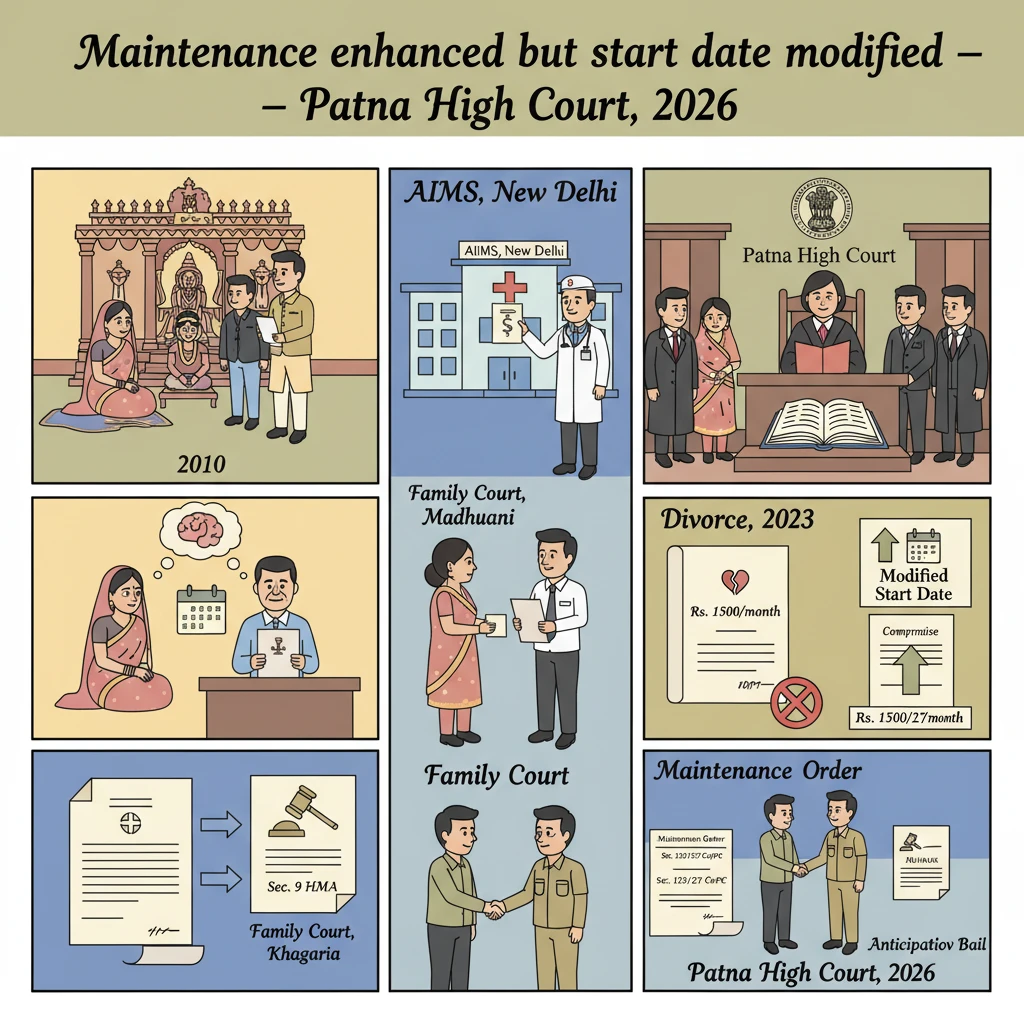
The parties married on 09.06.2010 at Budhanath Shiv Temple, Bhagalpur. According to the husband, his wife’s behaviour soon became “eccentric and abnormal” and she went back to her parental home. After 17.02.2011 she did not return to the matrimonial house.
On 16.04.2011, the husband filed Matrimonial Suit No. 24 of 2011 under Section 9 of the Hindu Marriage Act before the Principal Judge, Family Court, Khagaria seeking restitution of conjugal rights. During these proceedings, it emerged that the wife had been suffering from Bipolar Affective Disorder even before marriage and was under treatment at AIIMS, New Delhi.
On the husband’s case, this illness was incurable and had been suppressed by the wife’s family. The Principal Judge, Family Court, Madhubani, ordered medical examination of the wife. Jawahar Lal Nehru Medical College and Hospital, Bhagalpur submitted a report on 09.01.2012 stating that the wife suffered from an incurable mental medical problem.
After this report, the husband withdrew his petition for restitution of conjugal rights, and an order of withdrawal was passed on 23.01.2013.
Later, the husband filed a divorce case bearing Matrimonial Case No. 109 of 2013 in the Family Court, Khagaria. The wife filed her written statement on 07.11.2013. A transfer petition was allowed and the divorce case records were sent to the Family Court, Madhubani, where the wife filed a second written statement on 20.08.2014.
According to the High Court’s narration, the wife then lost interest, remained absent, and was not represented on hearing dates. The Family Court finally passed a detailed decree of divorce on 20.06.2023.
Parallel to this, criminal proceedings and maintenance proceedings were also going on.
The wife filed a maintenance case, MR No. 26 of 2011, on 03.03.2011 before the Principal Judge, Family Court, Madhubani. On 15.02.2012 the parties filed a compromise petition. The husband, as opposite party in that case, agreed to pay Rs. 1,500 per month as maintenance to his wife. He also agreed to withdraw a criminal complaint case (No. 246 of 2011) that he had filed against her.
On the same date, 15.02.2012, the Family Court disposed of the maintenance case in terms of the compromise and recorded the agreed monthly maintenance of Rs. 1,500.
Separately, in anticipatory bail proceedings before the Patna High Court in Criminal Misc. No. 38391 of 2014, a Single Judge directed the husband on 21.10.2014 to deposit Rs. 750 per month as interim maintenance.
Later, the wife moved for enhancement of maintenance. She filed Miscellaneous Case No. 115 of 2015 under Section 127 of the Code of Criminal Procedure, 1973 before the Principal Judge, Family Court, Madhubani, seeking higher maintenance.
The husband appeared as opposite party and filed his written statement. After evidence, the Family Court on 24.12.2024 enhanced the wife’s maintenance from Rs. 1,500 per month to Rs. 4,500 per month, with effect from the date of filing of the enhancement petition, i.e. 21.08.2015. Litigation expenses of Rs. 2,500 were also awarded.
Aggrieved, the husband filed Criminal Revision No. 373 of 2025 before the Patna High Court challenging this enhancement order.
What the Court Examined and Decided
The Patna High Court, through Hon’ble Mr. Justice Arun Kumar Jha, examined the husband’s objections to the enhanced maintenance as well as the Family Court’s reasoning under Section 127 CrPC.
The husband’s main attack was that the Family Court order was “illegal and erroneous” and unsustainable on facts and law. He argued that since the original maintenance of Rs. 1,500 per month had been fixed by a compromise in 2012, there was no scope to enhance it later at the wife’s instance.
He also claimed that the Family Court had not recorded any reason or identified any “change in circumstances” since 2012 to justify enhancement under Section 127 CrPC. According to him, the wife filed the enhancement case within three years of the compromise, and no material was shown to prove any change in situation.
The husband further contended that under the compromise the wife was bound to drop all criminal cases against him, which she had allegedly not done. He portrayed the enhancement petition as an attempt to harass him.
On evidence, he submitted that the Family Court had relied only on the wife’s oral deposition without documentary support. He stated that the wife examined herself after about 11 years of the first maintenance order. He also complained that he was not given sufficient time to examine his witnesses and that many proceedings took place during the Covid-19 period.
Another major plank of his case was his alleged low income. He claimed to be a casual labourer earning only Rs. 5,000 per month and argued that raising maintenance to Rs. 4,500 was unjust and unrealistic. He also emphasised that their marriage stood dissolved by a decree of divorce on the ground of the wife’s incurable mental disease, and on that basis questioned her right to maintenance.
The husband further alleged that the Family Court had ignored Supreme Court guidelines in Rajnesh vs. Neha & Anr., (2021) 2 SCC 324 on maintenance determination.
In support, he cited:
- Shaikh Sadiq Shaikh Rahim vs. Shabanabi S. Ali and Others, 2009 Supreme (Bom) 1451, where enhancement without considering the payer’s income was held bad.
- Sayantani Ghosh vs. Sukesh Ranjan Koley (RVW 158 of 2023, Calcutta High Court), where absence of pleaded change in circumstances led to dismissal of an enhancement plea.
- Manisha Kedia vs. Manoj Kumar Kedia, 2024 Supreme (Cal) 177, stressing consideration of status, needs, and paying capacity while fixing maintenance.
The wife’s counsel supported the Family Court order. They pointed out that the original order dated 15.02.2012 was more than nine years old when the enhancement order was passed on 24.12.2024.
They argued that a compromise-based order cannot forever bar a needy spouse from seeking higher maintenance when cost of living rises. They also highlighted that the wife had filed an affidavit of assets and liabilities, whereas the husband did not file such an affidavit and did not lead any evidence.
Importantly, counsel submitted that the husband never cross-examined the wife when she appeared as a witness. In such a situation, they argued, he could not later challenge her assertions or introduce new factual disputes in revision.
They relied on:
- Manish Jain vs. Akanksha Jain, AIR 2017 SC 1640, which clarifies that maintenance is payable where the claiming spouse has no sufficient independent income.
- Shamima Farooqui vs. Shahid Khan, AIR 2015 SC 2025, where the Supreme Court emphasised that Section 125 CrPC aims to relieve financial hardship and mental agony of a deserted wife, and that small amounts like Rs. 2,000 per month are often unrealistic.
- The Delhi High Court judgment in Chander Prakash Bodhraj vs. Shila Rani Chander Prakash, AIR 1968 Delhi 174, quoted with approval in Shamima Farooqui, which presumes that an able-bodied man is capable of earning enough to maintain his wife and child, and casts a burden on him to show why he cannot.
- Dattatraya Bhaurao Manekar vs. Anupreeta Dattatraya Manekar, 2023 Supreme (Bom) 980, where non-examination of the husband led the Court to infer he wanted to avoid uncomfortable facts.
After hearing both sides, the Patna High Court analysed Section 127 CrPC. The Court reproduced the full text of Section 127 and highlighted that it allows alteration of maintenance on proof of change in circumstances of the person receiving or paying maintenance.
The Court specifically referred to sub-section (3), which deals with divorced women. It noted that if a divorced woman has not remarried and has not voluntarily surrendered her right to maintenance, she can continue to receive maintenance under Section 125 read with Section 127.
On this basis, the Court held that the husband’s argument that, because of the divorce decree, the wife was no longer entitled to maintenance was not acceptable. There was nothing on record to show that she had remarried or given up her right to maintenance.
On the effect of the 2012 compromise, the Court clarified that the agreed maintenance of Rs. 1,500 per month was not a one-time full and final settlement. It was a monthly maintenance arrangement. Therefore, the Court held, it did not bar the wife from seeking enhancement in future if circumstances warranted.
The Court observed that when parties agree to a monthly amount, it is implicit that in future the amount may require enhancement due to rising expenses. Accordingly, the plea that compromise had permanently closed the door for enhancement was rejected as having “no merit”.
On the question of “change in circumstances”, the Court took a practical view. It noted that the initial maintenance order was of 2012 while the enhancement order was passed in 2024. The passage of this long period, by itself, was enough for the Court to reasonably assume that cost of living and inflation had increased substantially.
Even if the wife had not expressly proved every detail or filed many documents, the Court held that inflation and decline in the value of money could not be ignored. The husband’s failure to cross-examine the wife was also held against him; he “cannot take advantage of his own wrong”.
On the quantum, the Court compared the old and new amounts. In 2012, the wife was getting Rs. 1,500 per month. After more than 12 years, the Family Court enhanced it to Rs. 4,500 per month. The wife had deposed as the sole witness, while the husband, despite opportunity, neither cross-examined her nor adduced evidence. He only stated in his written statement that he earned Rs. 5,000 per month.
The Court observed that if the husband could pay Rs. 1,500 per month in 2012, it was natural to infer that his income would have increased over 12 years. Taking into account inflation, rising living costs and prevailing circumstances, the Court held that Rs. 4,500 per month could not be called unreasonable.
However, the Court found fault with one part of the Family Court order: making the enhanced amount payable from the date of the enhancement petition, 21.08.2015.
The husband had claimed that the wife adduced her evidence in the enhancement case after eight years of filing the petition. This assertion was not denied by the wife. In these circumstances, the High Court felt that directing payment of Rs. 4,500 per month from 2015 would be improper.
On this “short point”, the Court interfered and set aside the direction that the enhanced rate would apply from the filing date. It directed that the matter be remitted to the Principal Judge, Family Court, Madhubani, to pass a fresh order, after hearing both sides, calculating the correct quantum of maintenance payable between 21.08.2015 and 24.12.2024.
The High Court also noted from the impugned order that the husband was a defaulter and had accumulated arrears by not paying regularly. The Family Court was therefore directed to ensure that the husband clears arrears before proceeding further.
Finally, the High Court made it clear that from the date of the Family Court’s impugned order, i.e. 24.12.2024, the husband must continue to pay Rs. 4,500 per month to the wife.
With these modifications, the criminal revision was disposed of. All pending applications were also disposed.
Why This Judgment Matters
This judgment matters for separated and divorced spouses, particularly women, who depend on maintenance to survive.
First, the Patna High Court confirms that a compromise-based maintenance order does not close the door forever. If living costs rise, a wife can still seek enhancement under Section 127 CrPC, even if the earlier amount was fixed by agreement.
Second, the Court makes it clear that divorce alone does not end a woman’s right to maintenance. Unless she remarries or clearly gives up her right, she can continue to claim maintenance from her former husband.
Third, the Court recognises inflation and rising cost of living as a strong ground for enhancement, especially over a long time gap. Poor documentation or lack of formal bills cannot by itself defeat a genuine claim, particularly when the husband does not contest evidence seriously.
Fourth, it sends a message to husbands that they must participate properly in maintenance cases. If they avoid cross-examination or do not bring their own evidence, courts can draw a presumption against them.
At the same time, the judgment protects husbands from unfairly large arrear burdens when there is an unexplained delay in leading evidence. By remitting the question of arrears between 2015 and 2024 to the Family Court, the High Court balances both sides’ interests.
Legal Issues and Answers
- Issue: Can a wife seek enhancement of maintenance under Section 127 CrPC when the original maintenance was fixed by a compromise, and the marriage has since been dissolved by divorce?
Answer: Yes. The Patna High Court held that a compromise-based monthly maintenance is not a one-time final settlement. A divorced wife who has neither remarried nor surrendered her right can still claim and receive enhanced maintenance under Section 127 CrPC. - Issue: Was enhancement from Rs. 1,500 to Rs. 4,500 per month justified after about 12 years without detailed proof of changed circumstances?
Answer: Yes. The Court held that the long passage of time, inflation, increased cost of living, the wife’s unrebutted testimony, and the husband’s failure to lead evidence or cross-examine were sufficient to uphold the enhanced amount as reasonable. - Issue: From which date should the enhanced maintenance of Rs. 4,500 per month be payable in this case?
Answer: The High Court set aside the direction making it payable from 21.08.2015 and directed the Family Court to recalculate arrears for the period 21.08.2015 to 24.12.2024 after hearing the parties. However, it confirmed that the husband must pay Rs. 4,500 per month from 24.12.2024 onwards.
Cases Cited by the Court
- Manish Jain vs. Akanksha Jain, AIR 2017 SC 1640.
- Shamima Farooqui vs. Shahid Khan, AIR 2015 SC 2025.
- Chander Prakash Bodhraj vs. Shila Rani Chander Prakash, AIR 1968 Delhi 174 (quoted in Shamima Farooqui).
- Shaikh Sadiq Shaikh Rahim vs. Shabanabi S. Ali and Others, 2009 Supreme (Bom) 1451.
- Sayantani Ghosh vs. Sukesh Ranjan Koley, RVW 158 of 2023 (Calcutta High Court).
- Manisha Kedia vs. Manoj Kumar Kedia, 2024 Supreme (Cal) 177.
- Dattatraya Bhaurao Manekar vs. Anupreeta Dattatraya Manekar, 2023 Supreme (Bom) 980.
Case Details
Case Number: Criminal Revision No. 373 of 2025
Case Title: Chandeshwar Kumar Rai @ Moti @ Chandeswar Kumar Rai vs. The State of Bihar & Anr.
Coram: Hon’ble Mr. Justice Arun Kumar Jha
Citation: 2026(3) PLJR 271
Advocates:
- For the Petitioner: Mr. Ravish Mishra, Advocate; Mr. Rakesh Kumar Tiwary, Advocate
- For the Respondents: Ms. Somali Acharya, Advocate; Mr. Ajay Kumar Thakur, Advocate
Nature of the Case: Criminal revision under Section 397/401 CrPC challenging an order under Section 127 CrPC enhancing maintenance.
Date of High Court Judgment: 09.04.2026
Impugned Order: Order dated 24.12.2024 passed by the Principal Judge, Family Court, Madhubani in Miscellaneous Case No. 115 of 2015.
Link to Judgment: View full judgment on the Patna High Court website
If you found this explanation helpful and wish to stay informed about
how legal developments may affect your rights in Bihar,
you may consider following Samvida Law Associates for more updates.







