

Case Background
The dispute concerns agricultural land in Mouza Hasanpur, Thana No. 651, under Bahadurpur Police Station, Sonki Out Post, District Darbhanga. The land details mentioned in the record include Khata No. 136 and several Khesra numbers, with different decimal areas.
According to the police, there was a dispute regarding title and possession of this land between the petitioner and opposite party no. 2, as well as another family member. The Officer-in-charge of Sonki O.P. recorded this in D.R. No. 183A of 2015.
On the basis of this police report, the Sub-Divisional Magistrate (SDM), Sadar, Darbhanga, first started a proceeding under Section 144 CrPC. This provision is used to prevent immediate threats to peace and public order.
Later, on 17.07.2015, the SDM converted the Section 144 proceeding into one under Section 145 CrPC in M.R. Case No. 1251 of 2015. The SDM stated that, looking at the facts, there was a possibility of breach of peace and that for a “permanent solution” of the dispute, a Section 145 proceeding was required.
The petitioner challenged this conversion order before the Sessions Court. He filed Criminal Revision Case No. 547 of 2015 before the Additional Sessions Judge-II, Darbhanga. On 17.05.2016, the Revisional Court upheld the SDM’s order.
Aggrieved by both these orders, the petitioner approached the Patna High Court by filing Criminal Miscellaneous No. 37021 of 2016 under Section 482 CrPC, seeking quashing of the SDM’s order dated 17.07.2015 and the Revisional Court’s order dated 17.05.2016.
What the Court Examined and Decided
The Patna High Court, through Hon’ble Mr. Justice Jitendra Kumar, examined whether the SDM was justified in invoking Section 145 CrPC in this land dispute, and whether the Revisional Court correctly upheld that order.
The petitioner’s counsel argued that the land was in his possession after a family partition. According to him, the dispute was essentially about civil rights over land, not about public peace.
He contended that Section 145 CrPC is an extraordinary power. It can be used only when there is a real apprehension that a dispute over land may lead to breach of public peace due to forceful dispossession. He pointed out that neither the police report nor the SDM’s order mentioned any clear facts showing such a situation.
The petitioner’s counsel submitted that at best, this was a private dispute between family members regarding title and possession. For such issues, the proper remedy is to approach the Civil Court and, if required, seek interim relief such as injunctions. He therefore argued that the SDM had no jurisdiction to initiate proceedings under Section 145 CrPC on these facts.
To support this stand, the petitioner relied on the Patna High Court judgment in Yugal Kishore Choudhary v. State of Bihar, reported in 2023 (6) BLJ 360. That decision, by the same Court, had elaborated the limits of Section 145 CrPC jurisdiction.
On the other side, the Additional Public Prosecutor for the State defended the orders of both the SDM and the Additional Sessions Judge-II, Darbhanga. He supported the view that the SDM’s action was proper.
Counsel for opposite party no. 2 also strongly defended the impugned orders. He claimed that opposite party no. 2 was in possession of the land and that the petitioner was trying to forcibly dispossess him and harvest the standing crop.
The High Court then turned to the legal position laid down in Yugal Kishore Choudhary. In that earlier case, the Court had discussed Chapter X of the Code of Criminal Procedure, which deals with “Maintenance of Public Order and Tranquility,” and specifically Sub-Chapter D (Sections 145–148) dealing with disputes concerning immovable property.
Quoting paragraph 9 of Yugal Kishore Choudhary, the Court noted that Section 145 CrPC allows an Executive Magistrate to intervene in land and water disputes that are likely to cause breach of the peace. The Magistrate must be satisfied, on a police report or other information, that such a dispute exists and is likely to cause breach of the peace, and must record the grounds for that satisfaction.
The earlier judgment had also made it clear that the Magistrate’s jurisdiction under Section 145 CrPC is founded on the existence of a dispute giving rise to apprehension of breach of peace. If such apprehension does not exist, or ceases to exist, the Magistrate must drop the proceedings.
Further, the earlier decision explained that the enquiry under Section 145(4) is confined to who was in actual possession on the relevant date, not to the deeper question of who has the better title. The role of the Magistrate is temporary protection of possession until parties approach the appropriate court of law.
The Patna High Court then referred to paragraph 53 of Yugal Kishore Choudhary. That paragraph summarized important principles: Section 145 is meant to protect possession where taking forceful possession would lead to apprehension of breach of public peace. Apprehension of breach of public peace is a sine qua non—that is, an essential condition—for invoking this jurisdiction.
The Court also emphasized, following the earlier decision, that “public peace and tranquility” is a broader concept than ordinary “law and order.” Not every quarrel or criminal act is a breach of public peace. Acts that affect mainly two individuals, even if they involve penal offences, do not automatically become matters of public peace.
Similarly, purely civil disputes between individuals cannot be treated as public peace problems. Civil disputes must be addressed in civil courts. Criminal breaches are to be dealt with by criminal courts.
The earlier decision cautioned that Executive Magistrates should not, on the pretext of apprehension of breach of peace, take over the role of civil or criminal courts. Such use of Section 145 CrPC would be a colourable exercise of power, against its object and spirit, and would harass citizens by dragging them into unnecessary proceedings.
Applying these principles to the present case, the Patna High Court carefully read the record. It found that the dispute between the parties was about title and possession over the land. There was no reference to any incident of forceful dispossession in the police report or in the SDM’s order initiating Section 145 proceedings.
The Court noted that the SDM had only made a bald statement that, due to the dispute between the parties, there was a “possibility of breach of peace” and that to resolve the dispute permanently, a Section 145 proceeding was needed. However, the SDM had not disclosed any factual basis for concluding that there was apprehension of breach of public peace.
On these facts, the High Court held that this was a classic civil dispute between family members over land. The Court stated clearly that only the Civil Court has jurisdiction to finally decide such issues. If either party needs temporary protection or orders, they can seek interim relief in the civil suit itself.
The Court went on to hold that there was no occasion for the SDM to use Section 145 CrPC in this matter. Calling the SDM’s action a “colorable exercise of power,” the Court said the SDM had effectively usurped the jurisdiction of the Civil Court, which is not permissible.
Consequently, the High Court found that the Revisional Court also erred in upholding the SDM’s order, as the foundation of jurisdiction under Section 145 CrPC was missing.
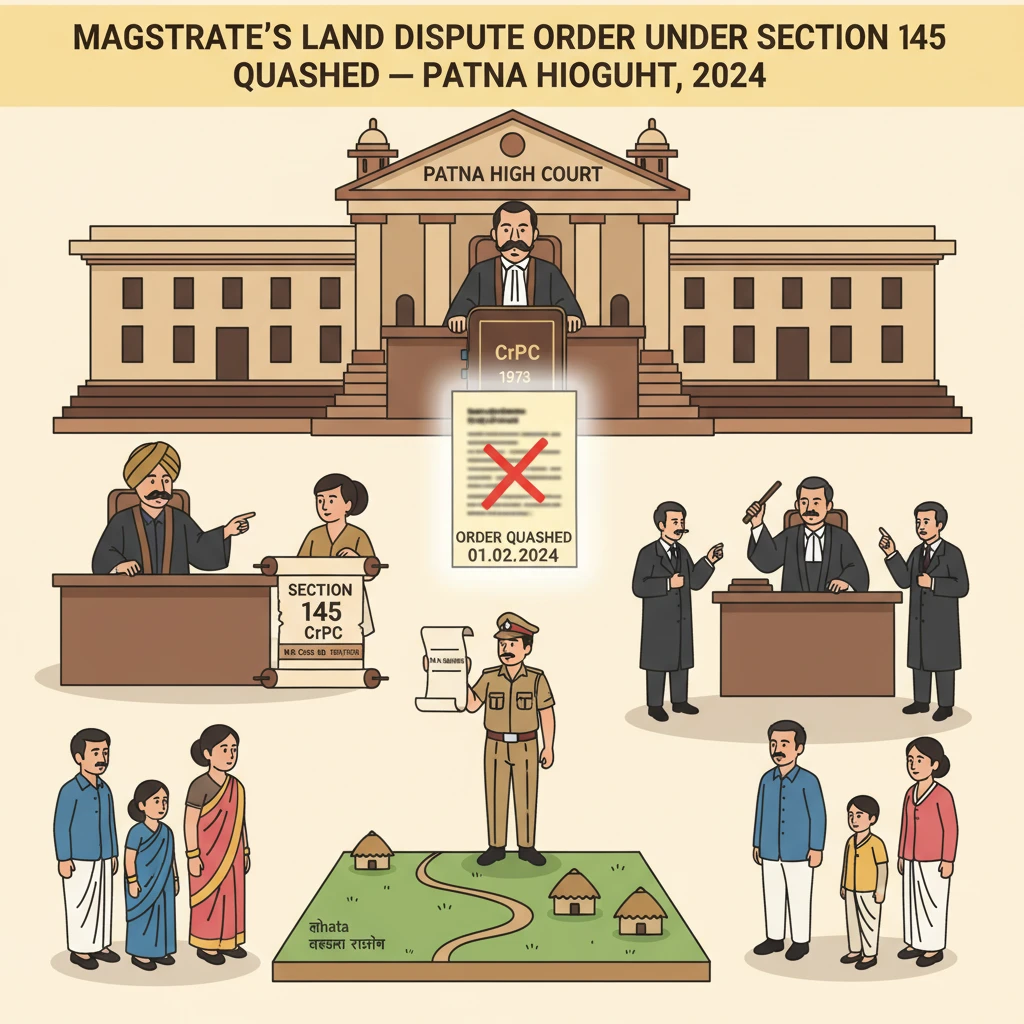
In the result, the Court quashed both the orders: the order dated 17.05.2016 passed by the Additional Sessions Judge-II, Darbhanga in Criminal Revision Case No. 547 of 2015, and the order dated 17.07.2015 passed by the SDM, Sadar, Darbhanga in M.R. Case No. 1251 of 2015. The criminal miscellaneous petition under Section 482 CrPC was allowed.
Why This Judgment Matters
This judgment is important for people involved in family and land disputes in Bihar and elsewhere. It sends a clear message that not every land quarrel can be turned into a Section 145 CrPC case before the Executive Magistrate.
Where the dispute is mainly about who owns the land or who should possess it, and where there is no clear material showing that public peace is really at risk, the correct forum is the Civil Court. Parties should file civil suits, not try to pull the other side into criminal-type preventive proceedings.
The decision also protects citizens from unnecessary harassment. It warns Executive Magistrates not to use Section 145 as a shortcut to “permanently solve” civil disputes. Their role is limited to preventing true public peace disturbances, not to deciding land rights.
For lawyers and litigants, the ruling, read with Yugal Kishore Choudhary, clarifies that any Section 145 order must clearly record specific reasons and facts which show a real apprehension of breach of public peace. A bare statement that “there may be breach of peace” is not enough.
Legal Issues and Answers
Issue: Can an Executive Magistrate invoke Section 145 CrPC in a family land dispute without any specific material showing apprehension of breach of public peace, and can such an order be upheld in revision?
Answer: No. The Patna High Court held that apprehension of breach of public peace is a mandatory condition for Section 145. In this case, only a civil dispute over title and possession was shown, with no factual basis for public peace apprehension. The SDM’s order was a colourable exercise of power, and both the SDM’s and Revisional Court’s orders were quashed under Section 482 CrPC.
Cases Cited by the Court
- Yugal Kishore Choudhary v. State of Bihar, 2023 (6) BLJ 360.
Case Details
Case Number: Criminal Miscellaneous No. 37021 of 2016 (arising out of M.R. Case No. 1251 of 2015 and Criminal Revision Case No. 547 of 2015)
Case Title: Raj Kumar Prasad Singh v. The State of Bihar & Anr.
Coram: Hon’ble Mr. Justice Jitendra Kumar
Citation: 2024 (1) PLJR 802
Advocates:
- For the petitioner: Mr. Ranjeet Kumar, Advocate
- For the State: Mr. Upendra Kumar, APP
- For Opposite Party No. 2: Mr. Girijish Kumar, Advocate
Nature of the Case: Petition under Section 482 CrPC challenging an order of the Sub-Divisional Magistrate under Section 145 CrPC and the confirming revisional order of the Additional Sessions Judge.
Link to Judgment: Click here to view the official Patna High Court judgment
If you found this explanation helpful and wish to stay informed about
how legal developments may affect your rights in Bihar,
you may consider following Samvida Law Associates for more updates.







