

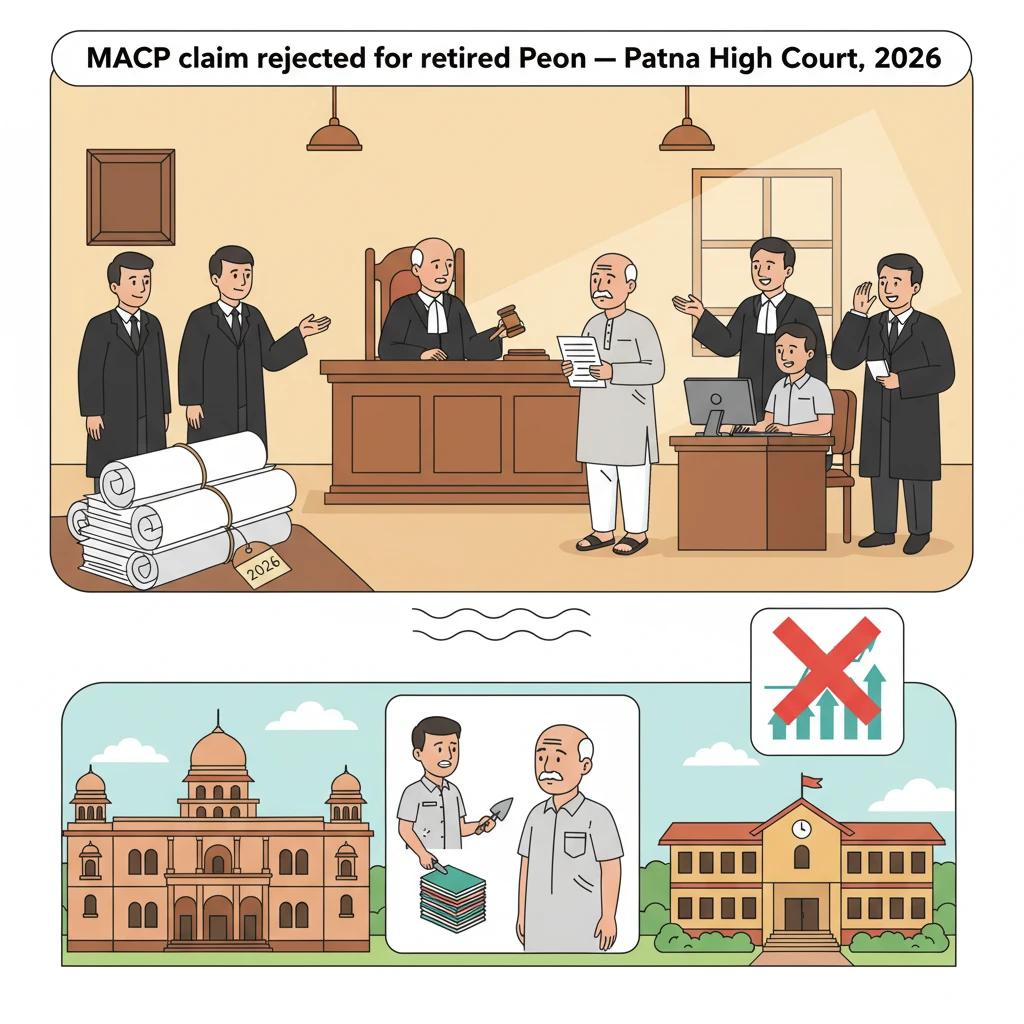
Case Background
The petitioner worked in a Government Girls School at Gardanibagh, Patna, under the Education Department of Bihar.
He was first engaged on the post of Mali on purely temporary basis through Memo No. 659 dated 20.12.1976, issued by the then Principal of the school. His pay scale at that time was Rs.155-1-160-2-190, with applicable allowances, and his wages were paid from the contingent head.
Later, after a regular Peon in the school retired, the petitioner was appointed on the vacant post of Peon. This appointment was made by Letter No. 19 dated 31.01.1984. He joined on 01.02.1984 in the regular establishment and continued to work as Peon till his superannuation on 31.10.2011.
After completion of 10 years of service, the petitioner was granted the benefit of upgradation with effect from 20.12.1986, and his pay scale was fixed at Rs.800–1150. This was done by Letter No. 6271-6355 dated 11.11.1992 issued by the School Inspector-cum-Deputy Director, Education, Government of Bihar, Patna.
On completion of 12 years of service, he became eligible for the first Assured Career Progression (ACP). By Letter No. 1802 vi (02) dated 23.03.2006, issued by the same authority, he was granted first ACP with effect from 09.08.1989 and second ACP with effect from 20.12.2000, after completion of 24 years of service.
In 2010, the Modified Assured Career Progression (MACP) Scheme came into effect. Under this scheme, three financial upgradations are to be granted on completion of 10, 20 and 30 years of service.
The petitioner superannuated from service on 31.10.2011.
After his retirement, by Memo No. 285 dated 11.11.2013, issued by the Secretary to the Commissioner, Patna Division, the first time bound promotion granted earlier to the petitioner and similarly placed employees was confirmed. In this memo, the date of first time bound promotion for the petitioner was shown as 20.12.1986, i.e., 10 years from his first engagement as Mali.
Subsequently, by Letter No. 17 dated 18.01.2022, the Regional Deputy Director of Education, Patna Division, wrote to the Principal of the school stating that the petitioner completed 30 years of service only on 01.02.2014. As he had retired on 31.10.2011, he was held ineligible for MACP benefits for not having completed 30 years of service before retirement.
The petitioner filed this writ petition before the Patna High Court challenging that letter and seeking grant of MACP benefits.
What the Court Examined and Decided
The core dispute before the Patna High Court was about how the petitioner’s “service” should be counted for financial upgradation under the MACP Scheme.
The petitioner argued that his service should be counted from 20.12.1976, when he was first engaged as a Mali on temporary basis, and not merely from 01.02.1984, when he joined as Peon in the regular establishment.
He pointed out that while granting him first and second ACP, the authorities had in fact counted his service from 1976. The first time bound promotion and subsequent benefits were fixed taking his initial date as 20.12.1976. On this basis, he claimed he had already completed 30 years of service in 2006 and therefore became entitled to MACP benefits from that year itself.
The petitioner contended that it was unfair and arbitrary for the authorities to count his service from 1976 for giving earlier financial benefits, but ignore that period when it came to MACP, and then deny him the third upgradation on the ground that he had not completed 30 years of service.
He relied on Rule 4 of the ACP Scheme, 2003. According to him, this rule provides that if a person working as Sweeper is later appointed as Peon and both posts carry the same pay scale, then past service on the earlier post must be counted for ACP. He argued that he had worked as Mali in the same pay scale before becoming Peon, and therefore his earlier service was required to be counted.
On the other side, the State authorities, through their counsel, strongly opposed the writ petition.
They submitted that the petitioner’s engagement as Mali in 1976 was purely temporary and on daily wage basis under “contingent mining”, with payment made from the contingent head. No sanctioned and vacant post of Mali was available in the school at that time.
According to the State, this engagement could not be treated as ad hoc or regular employment in the establishment, and therefore this period could not be counted for regular service or for MACP benefits.
The State pointed out that the petitioner’s regular appointment in the establishment was made only on 31.01.1984 on the post of Peon, and he joined on 01.02.1984. In the order granting him first time bound promotion with effect from 20.12.1986, it was clearly mentioned that he had been appointed in regular establishment on 01.02.1984.
The State further stated that under the MACP Scheme, 2010, only those employees who have completed 30 years of “qualifying service” are entitled to the third upgradation. Since the petitioner was appointed on 01.02.1984 and retired on 31.10.2011, he completed less than 28 years of service and would have reached 30 years only on 01.02.2014, well after his retirement.
The State also referred to the meeting of the ACP/MACP Screening Committee held on 15.11.2021. In that meeting, the Committee examined the petitioner’s claim for third MACP and rejected it on the ground that he had not completed 30 years of service as on the date of his retirement. The petitioner’s name appeared at serial no. 23 in those proceedings.
The counter affidavit further relied on Rule 4 of the ACP Rules, 2003. While Rule 4(1) provides that previous service will be counted where a person moves from Sweeper to Orderly in the same pay scale, the Explanation to Rule 4(4) makes it clear that service rendered on casual, daily wage, contract, or temporary basis shall not be counted for financial progression under the scheme.
Based on this Explanation, the State submitted that the petitioner’s earlier engagement as Mali, which was on daily wage and contingent basis, could not be treated as qualifying service either for ACP or MACP calculations.
After hearing both sides and examining the documents, the Patna High Court summarised the undisputed facts. The Court noted that:
The petitioner was appointed as Mali on temporary basis on 20.12.1976 and later appointed as Peon on 31.01.1984 in the concerned school because there was no sanctioned post of Mali. He joined the Peon post on 01.02.1984 and worked there continuously till his retirement on 31.10.2011.
He was granted first time bound promotion after completion of 10 years’ service as Peon and later granted first ACP with effect from 1999 and second ACP with effect from 2000. However, these earlier benefits had mistakenly taken his service from 20.12.1976, without noticing that his regular appointment in the establishment was actually from 01.02.1984.
The Court further recorded the respondents’ admission in the counter affidavit that the first time bound promotion and the two ACP benefits were granted by calculating his service from 1976 “without noticing” the true date of regular appointment. Later, when the authorities discovered this discrepancy, they refused MACP benefits because he had not actually completed 30 years of qualifying service before retirement.
The Court accepted the State’s stand.
It held that the petitioner’s regular service as Peon began on 01.02.1984. Counting from this date, he did not complete 30 years of qualifying service before his retirement on 31.10.2011. He would have completed 30 years only on 01.02.2014, which was after his retirement.
The Court also took note of the fact that the petitioner had never raised any grievance during his entire service period about counting of his past service or about the manner in which his earlier appointments were treated. He had accepted all earlier financial benefits without protest.
On these facts, the Court concluded that the authorities were right in rejecting his claim for MACP. It found no legal or factual basis to interfere with Letter No. 17 dated 18.01.2022.
Consequently, the Patna High Court dismissed the writ petition, holding that there was no merit in the claim for third MACP. Pending applications, if any, were also disposed of.
Why This Judgment Matters
This judgment is important for government employees who have worked for some time on daily wage or contingent basis and later get regular appointment in the same or a similar post.
The Patna High Court has underlined that for financial upgradations like MACP, what matters is “qualifying service” in the regular establishment, not the earlier daily wage or temporary engagement, especially where the rules specifically exclude such service.
The Court also accepted that authorities can correct earlier mistakes. Even though the petitioner had received first and second ACPs by wrongly counting his service from 1976, that earlier error did not force the State to grant him MACP as well.
For employees, this means that just because earlier benefits were given on a mistaken understanding of service length, it does not create a permanent right to further benefits based on that mistake.
For departments, the decision reinforces that they must strictly follow the MACP and ACP rules, especially the provisions that exclude daily wage and casual service from the computation of qualifying service.
Legal Issues and Answers
- Issue: Whether the petitioner’s service as a temporary Mali from 20.12.1976 could be counted for computing 30 years of qualifying service for MACP, or whether only his regular service as Peon from 01.02.1984 could be counted.
Answer: The Court held that only his regular service as Peon from 01.02.1984 could be counted. His earlier daily wage/temporary engagement as Mali could not be treated as qualifying service under the MACP Scheme and Rule 4 of the ACP Rules, 2003. - Issue: Whether the earlier grant of time bound promotion and ACP benefits by counting service from 1976 created a right in favour of the petitioner to claim MACP on the same basis.
Answer: The Court held that those earlier benefits had been granted without noticing the correct date of regular appointment and, once the error was discovered, the authorities rightly denied MACP because the petitioner had not in fact completed 30 years of qualifying service before retirement.
Cases Cited by the Court
- No prior judicial decisions are cited or relied upon in the text of this judgment.
Case Details
Case Number: Civil Writ Jurisdiction Case No. 7681 of 2022
Case Title: Nand Kishor Mahto v. The State of Bihar & Ors.
Citation: 2026(3) PLJR 268
Court: High Court of Judicature at Patna
Coram: Hon’ble Mr. Justice Ritesh Kumar
Date of Judgment: 09.04.2026
Advocates:
- For the Petitioner: Mr. Dhananjay Kumar, Advocate; Mr. Kundan Kumar Ojha, Advocate; Ms. Sadhna Parashar, Advocate
- For the State-Respondents: Mr. Madhaw Pd. Yadaw, G.P.23; Mr. Arvind Kumar, A.C. to G.P.23
Nature of the Case: Writ petition under civil writ jurisdiction challenging denial of MACP benefits and seeking quashing of Letter No. 17 dated 18.01.2022.
Link to Judgment: Full text of the Patna High Court judgment
If you found this explanation helpful and wish to stay informed about how legal developments may affect your rights in Bihar, you may consider following Samvida Law Associates for more updates.







