

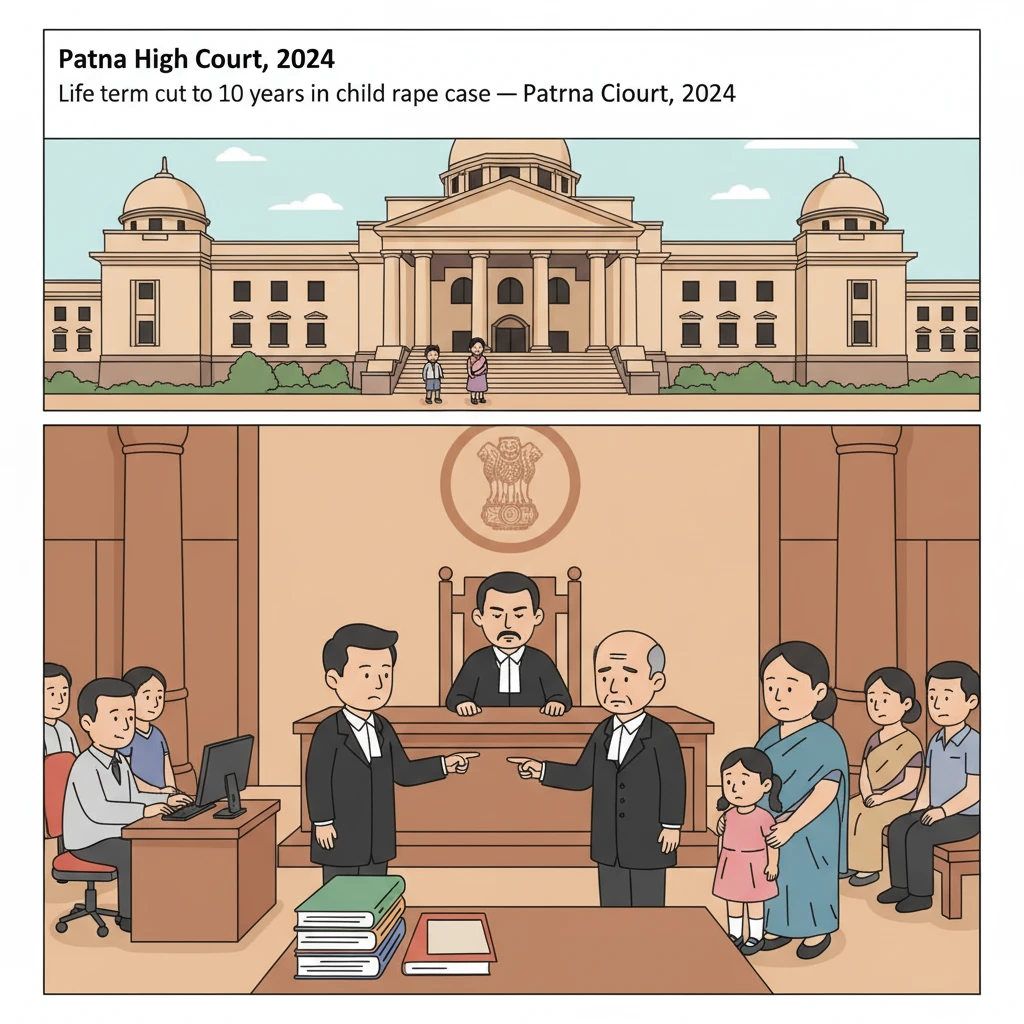
However, it reduced his sentence from life imprisonment to 10 years.
The Court said the offence occurred before harsher punishment laws came into force and the old law must apply.
The man will remain convicted, but his prison term now stands at 10 years, with sentences running together.
Case Background
This criminal appeal came before the Patna High Court as Criminal Appeal (DB) No.1173 of 2019.
The appellant was earlier tried and convicted by the Trial Court for offences under Section 376 of the Indian Penal Code (IPC) and Sections 4 and 6 of the Protection of Children from Sexual Offences (POCSO) Act, 2012.
The case arose from Laukahi P.S. Case No.53 of 2017, District Madhubani.
The incident is alleged to have taken place on 30.03.2017.
The prosecutrix was an eight-year-old girl, who is the granddaughter of the appellant.
According to the prosecution, the child went to the appellant’s house in the evening to watch television, as children of the village regularly gathered there for that purpose.
The FIR was lodged by the victim herself on 31.03.2017 at Sadar Hospital, Madhubani.
Her statement (fardbeyan) was recorded by Sub-Inspector Kanchan Kumari, then posted at the Women Police Station, Madhubani.
In her fardbeyan, the victim stated that while she and other neighbourhood children were watching television, the appellant called her alone into his room and committed rape on her.
She started bleeding from her private parts and raised alarm.
Her friends allegedly banged on the closed door, after which the appellant opened it and she came out and went towards her home.
On the way she met her mother, became unconscious on the road, and regained consciousness only in the hospital.
On this basis, an FIR was registered under Section 376 IPC and Sections 4 and 6 POCSO Act.
After investigation, police submitted charge sheet.
The Trial Court examined eight prosecution witnesses and three defence witnesses, then on 01.08.2019 convicted the appellant.
On 06.08.2019, it sentenced him to life imprisonment under Section 376 IPC and 20 years’ rigorous imprisonment each under Sections 4 and 6 POCSO Act, with fines, all sentences to run concurrently.
The appellant challenged this conviction and sentence before the Patna High Court, leading to this judgment dated 09.09.2024, delivered orally by Hon’ble Mr. Justice Ashutosh Kumar, sitting with Hon’ble Mr. Justice Jitendra Kumar.
What the Court Examined and Decided
The High Court heard arguments from both sides.
On behalf of the appellant, Senior Advocate Mr. Rama Kant Sharma argued that the case was false and motivated by property dispute.
He also questioned the medical evidence, the forensic handling of clothes, and inconsistencies in witness statements.
The State, represented by APP Mr. Abhimanyu Sharma, defended the conviction and highlighted the prompt reporting and medical examination.
The appellant’s first defence was that he was the victim’s grandfather and had been falsely implicated due to a land dispute.
He had earlier sold land to the uncles of the victim.
There were bamboo trees on that land which he wanted to cut and take away, but the vendees objected.
On this basis, he claimed the rape case was fabricated to harass him.
The second defence was about his age.
Though he was described around the time of occurrence as being 45 years old, even the Trial Court had assessed his age as about 65 years.
This, he argued, should have been taken into account.
Thirdly, he pointed to the medical evidence.
The Medical Board found lacerations on the victim’s private parts but no definite sign of completed rape: the hymen was intact, there was no bleeding on touch, and the vaginal smear did not show spermatozoa.
He argued that the Trial Court was wrongly influenced by a forensic report indicating semen on his clothes, without proper proof that those clothes were seized from him or were connected to the incident.
The Investigating Officer (PW-5) claimed one Sundar Devi had handed over his wearing apparel, but her relationship with the appellant and the chain of custody were not proved.
The appellant also complained that although he was arrested the next day, he was never medically examined under Section 53 CrPC.
He argued that courts have repeatedly held that the prosecution must explain why this step is not taken, and the omission weakens the case.
He further highlighted alleged discrepancies in the victim’s versions between the fardbeyan, statement under Section 164 CrPC, and her deposition in court, along with the non-examination of the victim’s father and the friends who allegedly knocked at the door at the time of occurrence.
In response, the State stressed that there was no delay in reporting the offence.
The FIR was recorded the very next day at the hospital.
The APP argued that a child’s vocabulary is limited, and her statement must be understood in that light.
He submitted that minor inconsistencies should not lead to rejection of the child’s version, especially in a sexual assault case.
The State further pointed out that the victim was promptly produced before a Medical Board of four doctors, including Dr. Rama Jha (PW-6) and Dr. Gargi Sinha (PW-7).
They found the hymen intact but observed bruises and lacerations on the genital area.
The APP argued that the story of false implication due to a property dispute was not believable because the victim’s father was not among the land vendees, and no family would sacrifice the dignity of its minor child merely to settle a land dispute, particularly in a village setting where many communities live together.
After examining the whole record, the High Court found the child victim’s testimony to be clear and forthcoming, given her age and limited vocabulary.
She consistently said that a “bad act” was done to her by the appellant, and she explained why she was at his house and how she was taken into his room, subjected to the act, bled, and then became unconscious.
The Court noted that it was a regular practice for children, including girls, to gather at the appellant’s house to watch television.
From among those children, the appellant, who was her grandfather, took her into his room and committed a “shameless and dastardly act”.
She was immediately taken for medical examination, which showed injuries only on her private parts.
PW-6, Dr. Rama Jha, deposed that the victim’s sexual characters had not developed, there was no external injury on her body, but there were lacerations on the hymen and labia minora, with bruises whose margins were not clearly defined.
The injuries were about 24 hours old.
Vaginal smear did not show spermatozoa.
She initially opined the injuries could be due to “attempt to rape”, and in cross-examination stated there was no sign of rape and that such lacerations could also occur if the child fell on a rough, hard surface.
Similar statements were made by PW-7, Dr. Gargi Sinha.
Despite these reservations in cross-examination, the High Court held that the medical examination clearly proved that the victim was subjected to acts that amounted to rape as defined under Section 375 IPC, because of the bruises and lacerations on her private parts.
The absence of spermatozoa or a torn hymen was not treated as decisive.
The Court then assessed the evidence of family witnesses.
PW-2 (aunt), PW-3 (mother) and PW-4 (grandmother) broadly supported the prosecution.
However, the Investigating Officer (PW-5) showed through his testimony that some details claimed in court by these witnesses had not been stated to him in their earlier statements, such as specific descriptions of the act, bleeding, or treatment details.
The Court recognised these inconsistencies but did not find them sufficient to discard the prosecution case.
It also noted weaknesses in the investigation.
The IO admitted he had not examined or even tried to examine the other children of the locality who allegedly banged on the door.
He also did not ensure the medical examination of the appellant, despite his arrest soon after the incident.
The origin of the appellant’s seized clothes from “Sundar Devi” was not established.
The High Court held that because of these lapses the prosecution could not rely on the forensic report about semen on the appellant’s clothes.
Yet, the Court concluded that these investigative shortcomings and the non-examination of some witnesses did not justify completely disbelieving the victim.
It found that the essential facts were proved: the minor child went to the appellant’s house to watch TV, was taken into his room, subjected to sexual assault causing lacerations on her private parts, became unconscious, and was promptly taken for medical treatment.
On this basis, the High Court affirmed that the appellant was rightly convicted under Section 376 IPC and Sections 4 and 6 POCSO Act.
No challenge had been raised during trial regarding the victim’s age, which was medically assessed around seven to eight years.
The Court then turned to the question of sentence.
The Trial Court had imposed life imprisonment relying on the later, more stringent amendments to IPC and POCSO, under which minimum sentences for rape of minors and aggravated penetrative sexual assault had been raised to 20 years, extendable to imprisonment for the remainder of natural life, and in some cases even death.
The High Court carefully traced the changes in law: pre-2013 IPC provisions, the 2013 Criminal Law (Amendment) Ordinance, the Criminal Law (Amendment) Act, 2013, the Criminal Law (Amendment) Act, 2018 introducing Section 376(3) and 376-AB, as well as the 2019 amendments to POCSO Act enhancing punishment under Section 6.
It stressed that the incident in this case took place in 2017, before the 2018 and 2019 amendments making 20-year minimum terms mandatory.
Relying on Article 20(1) of the Constitution of India, the Court held that no person can be subjected to a penalty greater than what existed at the time of the offence.
Therefore, the harsher post-2018 and post-2019 punishments for rape of minors and aggravated penetrative sexual assault could not be applied to the appellant.
The Court also took into account that there was no material on record to show the appellant had any criminal antecedents, that he was a family man, and that there was no reason to think he would repeat similar acts in future.
The Court considered a jail conduct certificate showing that for seven and a half years his behaviour in prison had been exemplary and that he was imparting education to jail inmates, earning appreciation from the Jail Superintendent.
Additionally, according to the Trial Court’s assessment, the appellant would now be a septuagenarian.
Taking the overall circumstances together, the High Court held that the maximum sentence imposed by the Trial Court was not justified.
Accordingly, while sustaining the conviction under Section 376 IPC and Sections 4 and 6 of POCSO Act, the Court modified the sentence.
It reduced the punishment to 10 years’ imprisonment for the offences under Section 376 IPC and Sections 4 and 6 POCSO Act, with the sentences to run concurrently.
The appeal was dismissed with this modification in sentence, and the Trial Court records were directed to be sent back.
Why This Judgment Matters
This judgment is important for two clear reasons.
First, it shows that the Patna High Court will not lightly discard a minor victim’s testimony in a child sexual assault case, even when there are investigative lapses, missing witnesses, or imperfect medical evidence.
If the basic story of the child is consistent and supported by injuries, the Court can uphold a conviction.
Second, it explains that punishment must follow the law that existed on the date of the offence.
Even in a serious case like rape of a child, courts cannot apply later, harsher sentencing laws to incidents that took place earlier.
This protection flows from Article 20(1) of the Constitution.
For families and victims, this case underlines the importance of immediate reporting and medical examination, which helped here to support the child’s version.
For accused persons and lawyers, it shows that while bad investigation may reduce reliance on some pieces of evidence, it will not automatically lead to acquittal if the core facts are proved.
Legal Issues and Answers
- Issue: Whether the conviction of the appellant for rape of his minor granddaughter under Section 376 IPC and Sections 4 and 6 POCSO Act should be set aside due to alleged false implication, medical doubts, and investigative lapses.
Answer: No. The Patna High Court held that the victim’s consistent account, supported by medical evidence of lacerations on her private parts and prompt reporting, established the offence, despite deficiencies in investigation and non-examination of some witnesses. - Issue: What sentence could lawfully be imposed for the 2017 offence under Section 376 IPC and Sections 4 and 6 POCSO Act, in light of later statutory amendments enhancing punishment.
Answer: The Court held that Article 20(1) of the Constitution bars imposition of a penalty greater than what existed at the time of the offence. It therefore reduced the sentence to 10 years’ imprisonment for each offence, to run concurrently, instead of life imprisonment and 20-year terms imposed by the Trial Court.
Cases Cited by the Court
- The judgment discusses various versions of Sections 375, 376, 376-A IPC and Sections 5 and 6 of the POCSO Act, and their amendment history.
However, no specific earlier case law names or citations are mentioned in the extracted text. - Therefore, no prior judicial precedents are expressly cited by name in this judgment segment.
Case Details
Case Number: Criminal Appeal (DB) No.1173 of 2019; arising out of Laukahi P.S. Case No.53 of 2017, District Madhubani.
Case Title: Rajendra Yadav v. The State of Bihar.
Court: High Court of Judicature at Patna.
Date of Judgment: 09.09.2024.
Coram: Hon’ble Mr. Justice Ashutosh Kumar; Hon’ble Mr. Justice Jitendra Kumar.
Citation: 2024 (4) PLJR 211.
Advocates: For the appellant – Mr. Rama Kant Sharma, Senior Advocate; Mr. Lakshmi Kant Sharma, Advocate. For the State – Mr. Abhimanyu Sharma, APP.
Nature of the Case: Criminal appeal (Division Bench) against conviction and sentence under Section 376 IPC and Sections 4 and 6 of the POCSO Act, 2012.
Link to Judgment: Click here to read the full judgment of the Patna High Court
If you found this explanation helpful and wish to stay informed about
how legal developments may affect your rights in Bihar,
you may consider following Samvida Law Associates for more updates.







