

Case Background
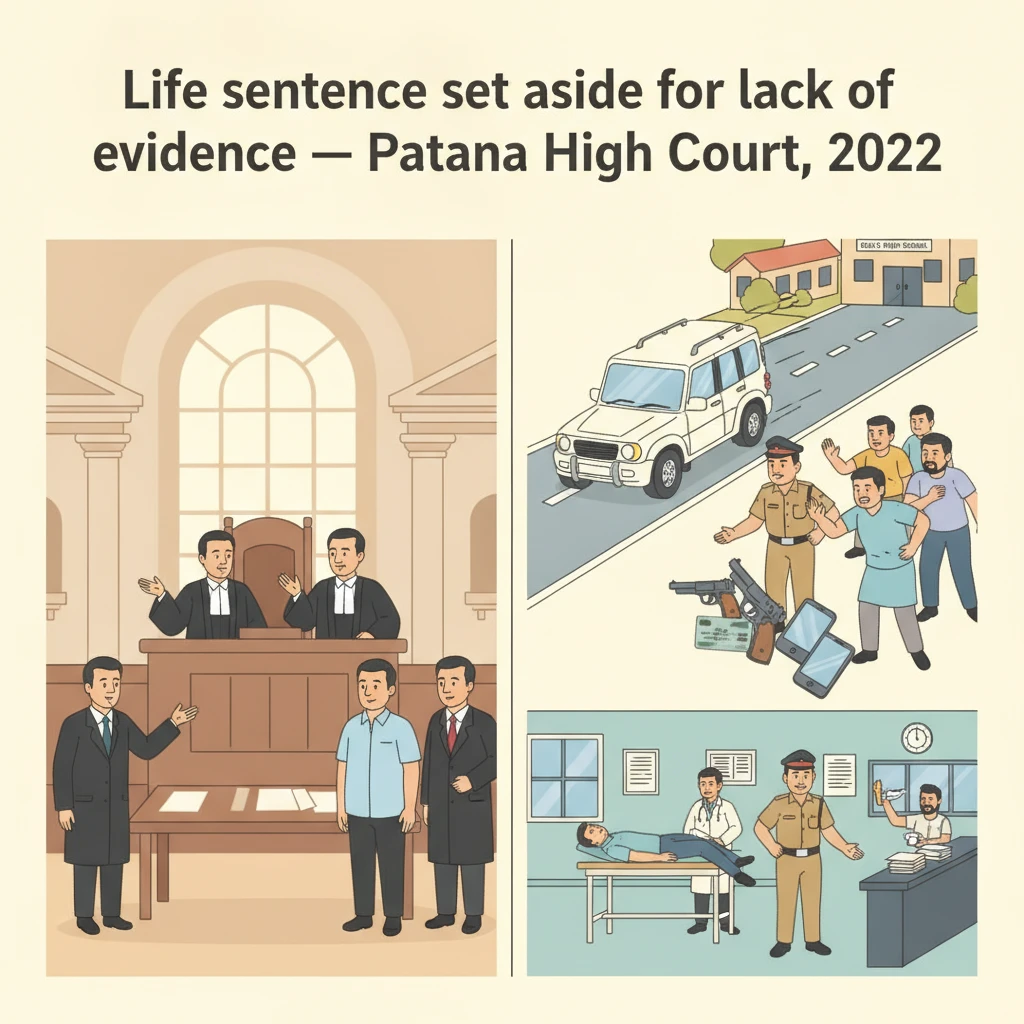
The case arose from Kochas P.S. Case No.124 of 2011 in district Rohtas. On 12.12.2011, at about 2:30 pm, the Officer-in-charge of Kochas Police Station heard a sound of firing while on patrol near NH-31. He claimed that upon reaching in front of the Girl’s High School, he found a man lying dead on the road with a gunshot injury to his head.
According to his self-statement, local people told him that the killers had come in a white Scorpio vehicle bearing registration no. UP-67H-4188, had thrown the driver’s body on the road and fled eastwards with the vehicle. He said he left one home guard near the body and chased in the same direction.
Near Nowan College turning, he allegedly saw villagers had blocked the road and stopped the Scorpio. Three men were being assaulted by the crowd. He claimed to have rescued them, interrogated them and recovered mobile phones, two country-made pistols, an ATM card and three Bihar State Road Transport Corporation tickets from their possession.
From documents found in the vehicle, a notebook, a driving licence and a mobile number, he said he learnt that the driver of the Scorpio was one Md. Mokhtar Ansari Ahmad, who had brought the vehicle on hire from Mohania to Kochas. He suspected that the three apprehended persons had killed Mokhtar Ansari, dumped his body and looted the vehicle.
On the basis of his self-statement recorded at 3:30 pm on 12.12.2011, Kochas P.S. Case No.124 of 2011 was registered on 13.12.2011 at 1:30 am under Sections 302, 394, 411/34 IPC and Section 27 of the Arms Act. Sub-Inspector Nitish Kumar took over investigation.
After investigation, charge-sheet was submitted against three accused under the same sections. Cognizance was taken by the Chief Judicial Magistrate, Sasaram on 12.03.2012. The case was committed to the Sessions Court on 01.05.2013. Two of the accused, Ritesh Kumar @ Chhotak and Bittu Kumar, were found to be juveniles and their cases were sent to the Juvenile Justice Board, Sasaram.
The case against the remaining accused, the present appellant, was tried as Sessions Trial No.243 of 2013. The Additional Sessions Judge-IV framed charges under Sections 302/34, 394/34, 411 IPC and Section 27 of the Arms Act on 13.06.2013. Later the case was transferred to the court of Additional Sessions Judge-VIII, Rohtas at Sasaram, who conducted the trial.
By judgment dated 15.03.2016, the trial court convicted the appellant for offences under Sections 302/34, 394 and 411 IPC and sentenced him on 21.03.2016 to life imprisonment with fine for murder, ten years’ rigorous imprisonment with fine for robbery and two years’ rigorous imprisonment for dishonest possession of stolen property, all sentences to run concurrently. The appellant challenged this conviction before the Patna High Court in Criminal Appeal (DB) No.367 of 2016.
What the Court Examined and Decided
The Patna High Court carefully re-examined all the evidence produced during trial. Ten prosecution witnesses were examined. The Court first looked at whether any witness had actually seen the crime taking place.
The father of the deceased, examined as P.W.1, said in chief that his son Mokhtar Ansari, the Scorpio driver, was killed by the accused when they tried to run away with the vehicle and that the appellant fired the gunshot. But in cross-examination he clearly admitted that he had not seen the occurrence. He came to the spot only after receiving information. He further admitted that he had not told the police that the appellant was caught while fleeing. The Court therefore treated him as a hearsay witness whose statement could not be used as direct proof.
Two supposed eyewitnesses, P.W.3 and P.W.4, completely denied knowledge of the incident. They said they did not even give statements to the police. The prosecution had them declared hostile, but nothing helpful emerged from their cross-examination.
Other family members of the deceased, P.W.5 and P.W.6, only proved that they had signed the inquest report. They admitted they had not seen the incident and could not identify any accused person. P.W.10, an advocate’s clerk, only proved signatures on the inquest report and had no personal knowledge about the case.
Thus, from P.Ws.1, 3, 4, 5, 6 and 10, the Court found no evidence which could connect the appellant to the killing or the alleged robbery.
The Court then evaluated the official witnesses. P.W.2, the doctor at Sadar Hospital, Sasaram, had performed the post-mortem on Mokhtar Ansari on 12.12.2011. He found a single firearm entry wound in the right occipital region of the head, with blackening of skin and inverted margins. He opined that death was due to shock and haemorrhage caused by the firearm injury, and estimated time since death as 6–24 hours.
However, in cross-examination he admitted two important points: no external marks of violence were found around the wound and, in his opinion, the shot was fired from a distance of 3–5 metres (approximately 9–16 feet). The High Court saw this as inconsistent with the prosecution’s broad case that the driver was shot from very close range inside or just outside the vehicle.
The key police witness, P.W.8, the SHO, repeated his self-statement and said that he seized firearms, mobiles, an ATM card and bus tickets from the three apprehended persons in presence of two local witnesses. But those two seizure witnesses were never examined in court. He also admitted that the seized articles were not before him at the time of his evidence.
Most significantly, his version about how the police party reached the place of occurrence was contradicted by P.W.9, Home Guard Fulendra Kumar. P.W.8 claimed that he himself was on patrolling duty with an Assistant Sub Inspector and home guards, heard the firing, went to the spot and then chased the fleeing vehicle. In contrast, P.W.9 stated that on that day around 4:00 pm he was on patrol with an Assistant Sub Inspector and three constables, and that they only went to the place of occurrence after the Assistant Sub Inspector received a telephone call. He added that at that time the SHO was actually present at the police station, not on patrol. He further said his party simply brought the dead body to the police station and that he did not know anything else about the incident.
The High Court held that if P.W.9 is to be believed, the SHO’s entire story in the FIR and in his deposition – of personally rushing to the spot on hearing gunfire, posting a guard at the body, chasing the Scorpio and rescuing the accused from the villagers – stands completely falsified. Additionally, neither P.W.8 nor P.W.9 claimed to have seen the actual shooting.
The Investigating Officer, P.W.7, said he inspected the place of occurrence in front of the Girl’s High School and found blood marks on the road. He claimed that the forensic team collected blood samples and that the palm and fingerprints of the accused were taken before a Magistrate and sent for examination. However, in cross-examination he admitted that:
he had not noted in the case diary that blood was collected;
he never received any Forensic Science Laboratory (FSL) report regarding the blood, fingerprints or palm prints;
he had not investigated the bus tickets recovered from the appellant; and
the SIM card in the seized mobile phone and the ATM card both belonged to the appellant’s parents, Asha Devi and Devendra Kumar Singh, not to the deceased.
He also accepted that none of the key family witnesses, P.W.5 and P.W.6, had earlier told him that the appellant fired at the deceased and threw out the body. He found no criminal antecedent of the appellant.
The material exhibits – the pistols, cartridges, mobiles, ATM card and bus tickets – were produced in court through a court witness, a police official from the malkhana. But he admitted that:
he had not brought the malkhana register;
the exhibits were not in sealed condition;
they did not bear any malkhana number or case number; and
he had no personal knowledge of the case and was not an arms expert.
Because of these serious lapses, the High Court held that the material exhibits could not safely be linked with this particular case.
Another striking gap noted by the Court was that the alleged Scorpio vehicle itself was neither seized nor produced before the trial court. No villager who was said to have intercepted the vehicle and caught the accused – around fifty people according to P.W.8 – was examined in court. The chowkidar who identified the body at post-mortem and the owner of the vehicle, Hasina Parvin, whose statement had been recorded during investigation, were also not examined.
Putting all this together, the Patna High Court concluded that the prosecution evidence proved only one thing: that Mokhtar Ansari died of a gunshot wound to the head. There was absolutely no direct or reliable circumstantial evidence that the appellant participated in killing him or robbing the vehicle, or that any stolen property was recovered from him.
The Court found that the trial court had “completely failed to appreciate” the evidence and appeared to have presumed the appellant guilty until proven innocent, contrary to the basic rule that every accused is presumed innocent until proven guilty beyond reasonable doubt.
Accordingly, the High Court allowed the appeal. It set aside the judgment of conviction dated 15.03.2016 and the sentence dated 21.03.2016 passed by the Additional Sessions Judge-VIII, Rohtas at Sasaram in Sessions Trial No.243 of 2013. The appellant was acquitted of the charges under Sections 302/34, 394 and 411 IPC and directed to be released from jail forthwith, if not required in any other case.
Before closing, the Bench referred to several Supreme Court precedents including Ghuran Yadav v. State of Bihar, Shrawan Singh v. State of Punjab, Narendra Kumar v. NCT of Delhi, Bijender @ Mandar v. State of Haryana and Paramjeet Singh v. State of Uttarakhand. Relying on these, the Court strongly reminded trial judges that:
conviction cannot be based on suspicion, however strong;
the distance between “may be true” and “must be true” must be covered by legal, reliable and unimpeachable evidence; and
it is better that guilty persons escape than that one innocent person suffers.
The Court directed that a copy of this judgment be circulated to all District Judges in Bihar, to be further circulated to all judicial officers in their districts.
Why This Judgment Matters
This decision is important for anyone facing serious criminal charges, especially in cases built only on suspicion or weak investigation. The Patna High Court made it clear that even in a grave case involving murder and alleged robbery of a vehicle, the prosecution must still bring proper, legal evidence.
The judgment shows that:
family members’ fear or public anger cannot replace proof;
police versions must be tested against other evidence and witnesses; and
seizure of articles, forensic reports and witness statements must be properly proved and linked to the case.
For drivers, transport workers and poor accused persons, this ruling signals that higher courts will correct wrongful convictions where trial courts ignore gaps in evidence. For trial judges and investigating officers, it is a direct reminder to follow the law strictly, document every step, and not treat the FIR as unquestionable truth.
Legal Issues and Answers
- Issue: Did the prosecution prove beyond reasonable doubt that the appellant murdered the Scorpio driver and robbed the vehicle and its property?
Answer: No. The Patna High Court held that there was no direct or reliable circumstantial evidence linking the appellant to the crime. Witnesses were hearsay or hostile, the medical evidence did not support the prosecution story, key witnesses and the vehicle itself were not produced, forensic reports were absent, and the seizure of articles was not properly proved. - Issue: Was the conviction under Sections 394 and 411 IPC sustainable without proof of stolen property and its recovery from the appellant?
Answer: No. The Court found that no clear finding was given by the trial court on recovery of any stolen property from the appellant. The exhibits were unsealed, not properly connected to the case and, in fact, some items like the SIM card and ATM card belonged to the appellant’s parents. Hence, the robbery and stolen property charges could not stand. - Issue: How should trial courts approach criminal cases where evidence is weak or incomplete?
Answer: The Court reiterated that trial judges must base convictions only on legal, reliable evidence, not on conjecture, suspicion or the seriousness of the crime. They must carefully appreciate evidence, safeguard the rights of the accused, and remember that the burden of proof always lies on the prosecution.
Cases Cited by the Court
- Ghuran Yadav v. State of Bihar, (1971) 1 SCC 311
- Shrawan Singh v. State of Punjab, AIR 1957 SC 637
- Narendra Kumar v. NCT of Delhi, (2012) 7 SCC 171
- Bijender @ Mandar v. State of Haryana, Criminal Appeal No.2438 of 2010 (judgment dated 08.11.2021)
- Paramjeet Singh v. State of Uttarakhand, (2010) 10 SCC 439
Case Details
Case Number: Criminal Appeal (DB) No.367 of 2016; arising out of Kochas P.S. Case No.124 of 2011; Sessions Trial No.243 of 2013
Case Title: Vikash Ranjan Singh @ Golu v. State of Bihar
Citation: 2022(2) PLJR 31
Coram: Hon’ble Mr. Justice Ashwani Kumar Singh; Hon’ble Mr. Justice Rajeev Ranjan Prasad
Advocates: Mr. Kanhaiya Prasad Singh, Senior Advocate; Mr. Jay Prakash Singh, Advocate; Mr. Shambhu Sharan Singh, Advocate (for the appellant). Ms. Shashi Bala Verma, APP (for the State).
Nature of the Case: Criminal appeal (Division Bench) against conviction and sentence passed by the Additional Sessions Judge-VIII, Rohtas at Sasaram in a murder and robbery case.
Link to Judgment: Full text of Patna High Court judgment
If you found this explanation helpful and wish to stay informed about how legal developments may affect your rights in Bihar, you may consider following Samvida Law Associates for more updates.







