

Case Background
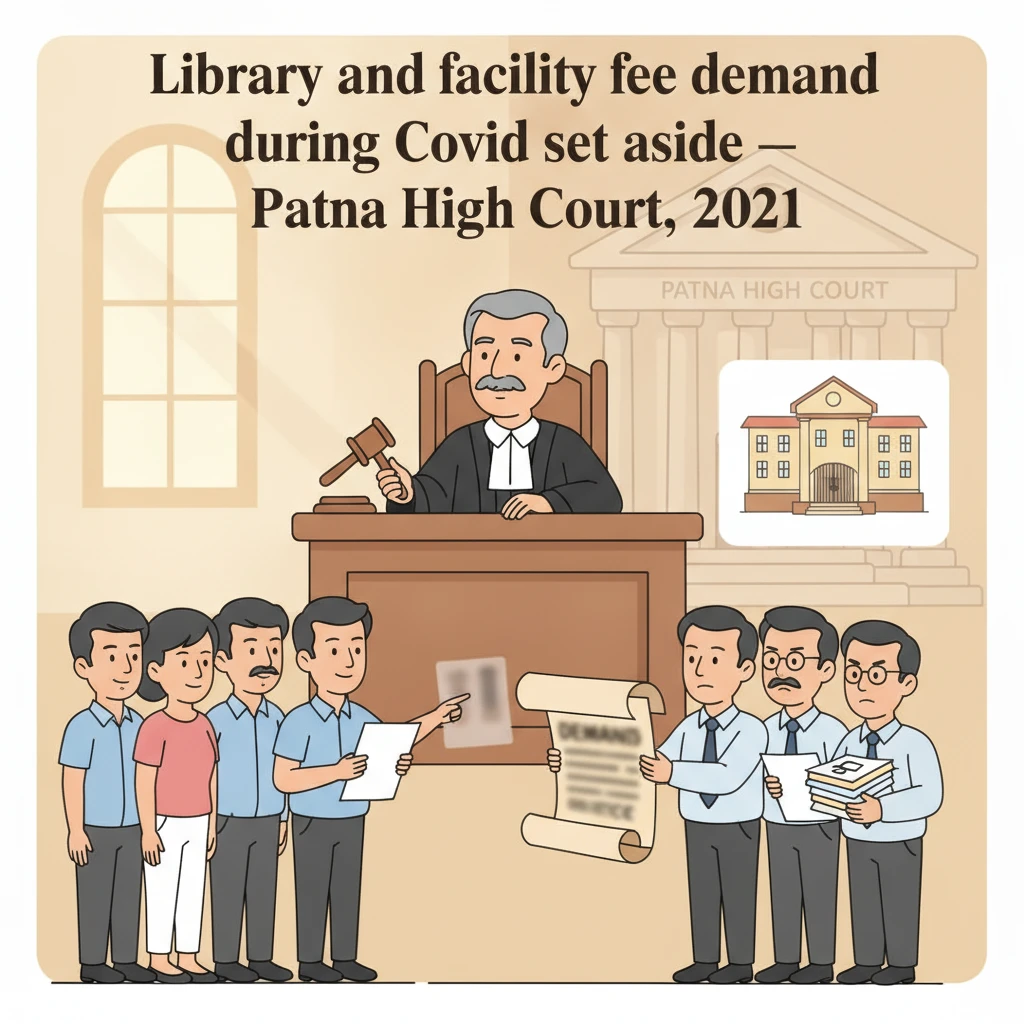
This case arose out of a dispute between students of Chanakya National Law University, Patna, and the University administration over fees charged during the Covid-19 pandemic.
The petitioners were 29 students of different batches (from second to fifth year) of the B.A., LL.B. (Hons.) course at the University. They filed a writ petition under the civil writ jurisdiction of the Patna High Court in Civil Writ Jurisdiction Case No. 7792 of 2020.
On 07.08.2020, the University issued Demand Notice-cum-Letter No. CNLU/45(a)/2020-323. Through this notice, it directed students to deposit the complete fees for the academic year 2020–21 in one lump sum before 31st August 2020. The notice also warned that failure to pay would lead to penal action against the students.
By that time, due to the Covid-19 pandemic and lockdown, the physical functioning of the University had been stopped. Classes and normal on-campus activities were not taking place.
The students challenged this demand notice and the fee structure for the pandemic period. They also raised questions about fees paid earlier, when the campus had been closed.
What the Court Examined and Decided
Justice P. B. Bajanthri heard the matter and delivered an oral judgment on 22.11.2021, after hearing both sides.
The core question identified by the Court was narrow and specific: whether the University was entitled to collect fees from the students towards “facilities fees” and “library fees” during the Covid-19 pandemic period, when the students were not attending classes on campus.
From the official memorandum dated 07.08.2020, the Court noted the fee breakup demanded by the University. The University sought:
- Tuition fee of Rs. 94,500/- (and Rs. 2,62,500/- for NRI sponsor category students);
- Examination fee;
- Facilities fee of Rs. 15,000/-; and
- Library fee of Rs. 5,000/-.
The petitioners’ main contention was that, during the Covid-19 pandemic, they did not attend physical classes and could not use the campus, hostel, library, or other facilities. This was not due to any fault on their part, but because of the pandemic restrictions and closure of the University’s physical functioning.
Therefore, according to them, it was arbitrary and illegal for the University to demand facility fees and library fees for that period. They also sought refund of certain charges already paid for March and April 2020 (for mess, electricity, accommodation, library and other facility fees, except tuition) on the same logic, namely that services had not been used once the University had shut down physical operations.
In addition, the petitioners requested directions that for the academic year 2020–21 only tuition fees be charged, given that they were not availing hostel or campus services, and that payment be allowed in instalments with gaps of at least two months between instalments.
On the other hand, the University, through its counter affidavit, tried to justify the fee structure. In paragraph 4(iii) of its counter affidavit, the University stated that it had considered the guidelines of the Bar Council of India and the fee structures of other universities for the academic session 2020–21.
The University claimed it had full sympathy for the financial constraints of students and had granted concessions and waivers. Specifically, it stated that it had waived:
- Rs. 6,000/- towards infrastructure fees;
- Rs. 3,000/- towards development charges;
- Rs. 3,000/- towards welfare fund; and
- Rs. 5,000/- towards electricity charges.
According to the University, this amounted to a total concession of Rs. 17,000/- per student, which, for around 600 students, came to approximately Rs. 1,02,00,000/-.
The University also asserted that it was not charging hostel room rent, mess fee, and hostel electricity charges at that time, although hostel rooms were still under occupation of students. These charges, it said, would be levied only from the date of physical reopening of the University on a pro-rata basis. The University further stated that its decision on the fee structure, concessions, and waivers had been placed before and approved by the Academic Council.
The Court carefully examined this paragraph of the counter affidavit. It observed that the paragraph did not reveal any clear description of the actual “facilities” being provided to students during the pandemic period under the head “facilities fees”, nor how the library was being used by students to justify a separate “library fee”.
The Court remarked that merely purchasing books and maintaining infrastructure at the institutional level does not, by itself, justify demanding facility and library fees from students when they are not actually able to benefit from those facilities.
To guide its reasoning, the Patna High Court referred to observations of the Supreme Court regarding school fee structures during the pandemic year 2020–21. The Supreme Court had noted that managements of educational institutions should be sensitive to the difficulties faced by people due to the pandemic and should provide relief to students and parents in those harsh times.
The Supreme Court had clarified that insisting on payment for facilities that were not provided to students would amount to profiteering, which must be avoided. It had held that schools could not, in law, collect fees for activities and facilities not actually provided or availed of by students owing to circumstances beyond their control.
Demanding fees in respect of such unused facilities or overheads would amount to profiteering and commercialisation. Judicial notice was taken of the fact that, due to lockdown, schools remained closed for a substantial portion of the academic year 2020–2021, leading to savings on costs like fuel, electricity, maintenance, water, stationery and similar overheads.
The Supreme Court had also stated that educational institutions should not be rigid. Since they are supposed to be engaged in a charitable activity of imparting education, they must be responsive to the situation and take remedial steps to reduce hardship of students and parents. They should reschedule fee payments so that no student loses the opportunity to continue education, reflecting the principle of “live and let live”.
Referring further to the Supreme Court’s reasoning, the Patna High Court quoted that savings in overheads and operating costs during closure would amount to “undeservedly earned” amounts if facilities were not actually provided. The Supreme Court had invoked the principle of “quid pro quo”, meaning that payment should correspond to services actually rendered. Without going into exact calculations, the Supreme Court had assumed that school managements must have saved around 15% of annual school fees during the pandemic. It also observed that students were not liable to pay fees for unutilised facilities in the relevant pandemic period of 2020–21.
The Patna High Court also drew support from the Directive Principles of State Policy in the Constitution of India. It referred to Article 41, which speaks of securing the right to work, to education, and to public assistance in certain cases such as unemployment, old age, sickness and disability. The Court also mentioned Article 46, which concerns the education of weaker sections of the people. The Court held that these Articles assist the grievances of the petitioners.
After considering the pleadings and the law, the Court concluded that the students had made out a case for interference with the impugned demand notice, but only to a limited extent.
It held that the University’s demand for facilities fees of Rs. 15,000/- and library fees of Rs. 5,000/- during the Covid-19 pandemic period was arbitrary and illegal. As the students had not attended physical classes and could not use the facilities, these charges could not be justified.
Accordingly, the Court set aside the demand for facility and library fees under the official memorandum dated 07.08.2020. At the same time, it directed the petitioners to pay “the then fees” as demanded in that memorandum, other than the facility and library fees. This indicates that tuition fee and other permissible charges (such as examination fee) remained payable.
The Court further ordered that if the University had collected any amount from any student under the head of “Facilities” or “Library” fee pursuant to this demand, it must refund that amount at the earliest.
On this basis, the writ petition was allowed in part. The Court did not grant the full range of reliefs requested, such as complete restriction of all non-tuition fees or mandatory instalment plans, but confined its relief to cancellation and refund of facility and library fees.
Why This Judgment Matters
This judgment is important for students and educational institutions alike, especially in situations like the Covid-19 pandemic when physical campuses remain shut.
For students, the Patna High Court has clearly affirmed that they cannot be forced to pay for facilities they did not and could not use because the institution itself was closed. Charges like “facilities fees” and “library fees” must reflect actual use and benefit.
For universities and colleges, the decision reiterates that while they may charge tuition and some other legitimate fees, they must be sensitive to the economic hardship caused by events like a pandemic. They are expected to avoid profiteering and must align their fee policies with the principle of quid pro quo and the broader constitutional focus on education.
The judgment also reinforces the Supreme Court’s broader message: educational institutions, even if they are autonomous or self-financing, are not free to treat fee collection as a commercial profit-making venture, particularly in crisis situations.
Legal Issues and Answers
-
Issue: Can a university demand and retain facility and library fees from students for a period when, due to the Covid-19 pandemic, physical classes and on-campus facilities were not available?
Answer: No. The Patna High Court held that demanding Rs. 15,000/- as facilities fees and Rs. 5,000/- as library fees in such circumstances was arbitrary and illegal, and set aside the demand under these heads, directing refund where already collected. -
Issue: Did the entire fee structure for the academic year 2020–21, including tuition fees, stand invalidated by the Court?
Answer: No. The Court only interfered with the facility and library fees. It directed the petitioners to pay the remaining fees as demanded in the official memorandum dated 07.08.2020.
Cases Cited by the Court
- The judgment refers to principles and observations of the Supreme Court regarding fee structures of schools during the Covid-19 pandemic year 2020–21, including concepts like avoidance of profiteering, savings in overheads during closure, and non-liability of students for unutilised facilities. The specific case name and citation are not mentioned in the text of this judgment.
Case Details
Case Number: Civil Writ Jurisdiction Case No. 7792 of 2020
Case Title: Kartikay Trivedi & Ors. v. Chanakya National Law University Patna & Ors.
Coram: Hon’ble Mr. Justice P. B. Bajanthri
Date of Judgment: 22.11.2021
Citation: 2022(2) PLJR 309
Advocates for the Petitioners: Mr. Sumit Kumar Singh, Advocate; Mr. Shubham Bajaj, Advocate; Mrs. Shatakshi Sahay, Advocate; Ms. Sarita Bajaj, Advocate; Mr. Suyash Rawat, Advocate.
Advocates for the Respondents: Dr. Anshuman, Advocate; Mr. Sanjay Kumar, Advocate; Mr. Shadwal Harsah, Advocate.
Respondent No. 1: Chanakya National Law University, Patna, through the Registrar.
Nature of the Case: Writ petition (civil) challenging a university fee demand notice and seeking refund and restructuring of fees during the Covid-19 pandemic period.
Link to the Judgment: Click here to read the full Patna High Court judgment
If you found this explanation helpful and wish to stay informed about
how legal developments may affect your rights in Bihar,
you may consider following Samvida Law Associates for more updates.







