
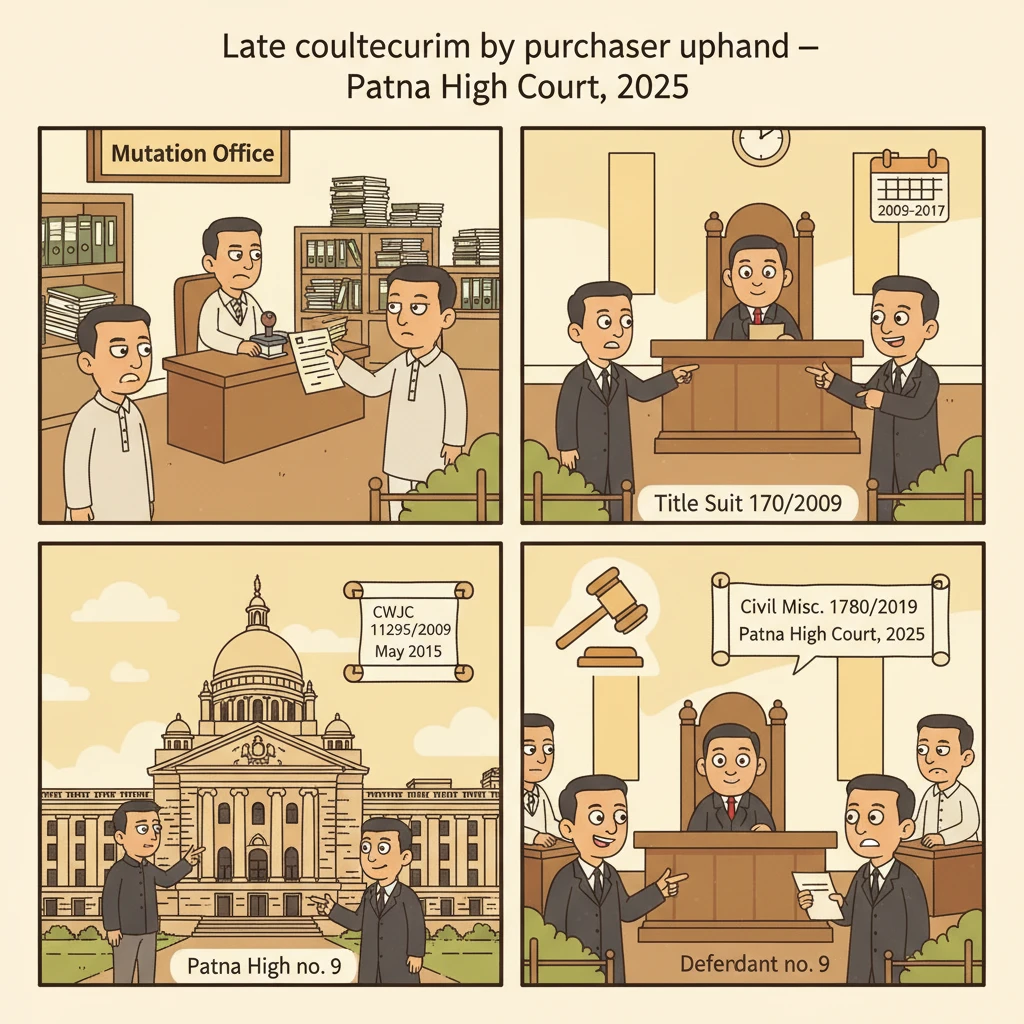
Case Background
A title suit, Title Suit No. 170 of 2009, was filed by the plaintiff for declaration of title over certain suit land. The plaintiff also sought a declaration that none of the defendants had any right, title, interest, or possession over the land, along with confirmation of the plaintiff’s possession. The plaintiff further challenged the Revisional Survey entry relating to the land as wrong, baseless, and incorrect.
The defendants (originally defendant nos. 1 to 9) appeared in the suit and filed their written statement. Another written statement was filed on 07.01.2016, and this was accepted by the trial court by order dated 14.01.2016. Issues were framed and both sides led their evidence. After closure of evidence, final arguments were concluded on 23.02.2017.
During arguments, the defendants relied upon their first written statement. The plaintiff objected to this, and that objection was allowed. Meanwhile, the defendants filed an application for transfer of the case to another court, which was allowed on 22.03.2017.
Separately, defendant no. 9 had filed CWJC No. 11295 of 2009 before the Patna High Court, challenging an order dated 15.07.2009 of the District Magistrate, Nawada, passed in Mutation Revision Case No. 57(R)/08/29(R)/2009. By order dated 01.05.2015, the Patna High Court disposed of that writ petition, observing that the title suit had been pending since 2009. Both parties were directed to cooperate for early disposal, and the trial court was asked to decide the suit preferably within nine months, without granting unnecessary adjournments.
Despite this direction and the conclusion of arguments, the trial court did not dispose of the suit. In the meantime, on 03.11.2016, after closure of evidence, respondent no. 10 (later added as defendant no. 10) purchased a portion of the disputed land through a registered sale deed. On that basis, he later sought to participate in the suit.
Respondent no. 10 filed an application on 09.08.2018 under Order I Rule 10 and Section 151 of the Code of Civil Procedure to be impleaded as a party. The trial court allowed this application by order dated 27.06.2019, on the condition that he file his written statement within seven days and conclude his evidence within sixty days.
In compliance, respondent no. 10 filed his written statement on 04.07.2019. From 08.07.2019 to 08.08.2019, he examined six witnesses. During the course of his evidence, on 02.08.2019, he filed an application under Order VIII Rule 6A CPC to set up a counterclaim. By order dated 17.09.2019, the learned Civil Judge (Senior Division)-I, Nawada allowed this counterclaim.
The plaintiff, feeling aggrieved, filed the present Civil Miscellaneous Petition No. 1780 of 2019 before the Patna High Court under its civil miscellaneous jurisdiction, challenging the trial court’s order dated 17.09.2019.
What the Court Examined and Decided
Hon’ble Mr. Justice Arun Kumar Jha of the Patna High Court examined whether, in the specific circumstances, the trial court was justified in allowing the counterclaim when it was filed during the recording of evidence of defendant/respondent no. 10.
The petitioner’s senior counsel, Mr. J.S. Arora, argued that the trial court had ignored both facts and law. He submitted that respondent no. 10 had purchased the property during the pendency of the suit, and even after recording of evidence had concluded. As a subsequent purchaser, his right was said to depend entirely on the fate of the suit being contested by his vendor, defendant no. 8, who had already filed a written statement.
Mr. Arora stressed that respondent no. 10, after being impleaded, did not file a counterclaim along with his written statement. According to him, the trial court failed to properly understand Order VIII Rule 6A CPC. He pointed out that the very purpose of a counterclaim is to avoid multiplicity of proceedings and save judicial time, but such a right is not unlimited and must be exercised within clear procedural bounds.
He relied heavily on the Supreme Court decision in Mahesh Govindji Trivedi v. Bakul Maganlal Vyas, (2023) 11 SCC 516, which itself referred to a three-Judge Bench decision in Ashok Kumar Kalra v. Surendra Agnihotri, (2020) 2 SCC 394. In Ashok Kumar Kalra, the Supreme Court held that Order VIII Rule 6A does not bar filing a counterclaim after the written statement, but the cause of action must have accrued within the time allowed for filing the defence.
More importantly, the Supreme Court held that this does not give an absolute right to file a counterclaim with substantial delay, even if the limitation period has not expired. It was clearly stated that the court has to consider an “outer limit” for filing a counterclaim, pegged till the framing of issues. The Court also listed factors like delay, limitation, reasons for delay, similarity of cause of action, prejudice, and potential abuse of process, to be evaluated by the court.
Mr. Arora submitted that, as issues had long been framed and evidence concluded, the counterclaim was impermissibly late. He further argued that the reliefs claimed by respondent no. 10, challenging various registered sale deeds ranging from 1967 to 21.01.2011, were themselves time-barred. On this basis, he urged that the impugned order was illegal and must be set aside.
On the other side, senior counsel for respondent no. 10, Mr. S.S. Dwivedi, supported the trial court’s order. He explained the chain of events: respondent no. 10 purchased 20¼ decimals of suit land by registered sale deed dated 03.11.2016 from defendant no. 8, came into physical possession, and got his name mutated. Against this mutation, the plaintiff filed Mutation Appeal No. 69/2017 before the D.C.L.R., Nawada. There, respondent no. 10 first came to know about Title Suit No. 170 of 2009.
After learning of the pending title suit, respondent no. 10 moved for impleadment on 09.08.2018, which was allowed on 27.06.2019 with strict timelines for written statement and evidence. Mr. Dwivedi pointed out that this order remained unchallenged. In compliance, respondent no. 10 promptly filed his written statement and led evidence. During this ongoing evidence, he filed his counterclaim on 02.08.2019.
Mr. Dwivedi argued that due to these exceptional circumstances, it was practically impossible for respondent no. 10 to file his counterclaim before the settlement of issues, because he was not a party then. He emphasised that the court had to balance the prejudice: whether greater harm would fall on the plaintiff if the counterclaim was allowed, or on respondent no. 10 if it was refused.
He relied on Vijay Prakash Jarath v. Tek Prakash Jarath, (2016) 11 SCC 800, where the Supreme Court had allowed a counterclaim filed about two and a half years after framing of issues, because the plaintiff would not suffer serious injustice or irreparable loss by its adjudication along with the main suit.
Mr. Dwivedi also raised the concern of res judicata. He pointed to issues 8, 9, and 10 already framed in the suit and submitted that if these issues were decided without his counterclaim on record, respondent no. 10 could later be barred from raising the same matters in a fresh suit, as they would be hit by res judicata.
He contended that, as a purchaser under a sale deed, respondent no. 10 was entitled to protect his right, title, interest, and possession over the purchased land. The fact that his vendor, defendant no. 8, had not filed a counterclaim did not bar him from doing so. He further submitted that Supreme Court jurisprudence recognises three manners of bringing counterclaims: in the written statement, by amendment, and through subsequent pleadings. He said respondent no. 10 had rightly used the third route.
In reply, Mr. Arora reiterated that defendant no. 8 had already filed a written statement and that respondent no. 10’s rights, as a purchaser pendente lite, depended on the vendor’s success. He stressed that respondent no. 10 filed the counterclaim after examining five witnesses, which indicated a delaying tactic. He also noted that 14 sale deeds had been challenged in the counterclaim, despite respondent no. 10 being aware of them earlier. He insisted that allowing such a counterclaim was contrary to Mahesh Govindji Trivedi and Ashok Kumar Kalra.
The Patna High Court then turned to the statutory provisions of Order VIII Rule 6A and Rule 9 CPC and surveyed the Supreme Court case law: Ashok Kumar Kalra, Ramesh Chand Ardawatiya v. Anil Panjwani, (2003) 7 SCC 350; Rohit Singh v. State of Bihar, (2006) 12 SCC 734; Vijay Prakash Jarath; and Mahesh Govindji Trivedi.
From these decisions, the Court noted the general principle that counterclaims should ordinarily be filed along with the written statement, and at the latest by the stage of framing of issues. It also recognised that, in exceptional situations, courts have allowed counterclaims even when the plaintiff’s evidence was being recorded, so long as the cause of action existed and allowing it did not cause undue prejudice or delay.
Applying these principles, the Court carefully examined the timeline in this case. Respondent no. 10 was not an original party. His impleadment was allowed only on 27.06.2019, and he was then bound by the court’s direction to file his written statement within seven days and conclude his evidence within sixty days. The plaintiff’s evidence had already been closed before his entry into the suit.
The Court found that respondent no. 10 had been acting strictly under the trial court’s directions. After filing his written statement and starting evidence, he filed the counterclaim on 02.08.2019. In these circumstances, the Court held that his explanation for not filing the counterclaim earlier deserved sympathetic consideration.
The High Court stressed that delay and stage of trial are not the only factors. It referred to Vijay Prakash Jarath, where even a counterclaim filed after significant lapse of time from framing of issues was allowed, as the plaintiff would not suffer serious injustice thereby. The Patna High Court concluded that, although the counterclaim was belated, declining to entertain it would amount to denial of justice to respondent no. 10.
The Court invoked the settled principle that procedural law is a handmaiden of justice, not its master. It referred to Sambhaji & Ors. v. Gangabai & Ors., (2008) 17 SCC 117, and to observations in Ashok Kumar Kalra emphasizing that procedural rules should not be interpreted to defeat substantive justice. The Court noted that rules under the Limitation Act and procedural provisions must be applied in a manner that furthers justice, without completely nullifying legislative intent.
In light of these “peculiar facts and circumstances”, the Patna High Court held that the trial court’s order allowing the counterclaim did not suffer from any jurisdictional error or illegality. It affirmed the impugned order dated 17.09.2019 and dismissed the civil miscellaneous petition.
However, to ensure fairness to the plaintiff, the Court specifically directed that the trial court must give ample opportunity to the plaintiff/petitioner to rebut the counterclaim in accordance with law. This means the plaintiff can file a written statement to the counterclaim and lead rebuttal evidence.
Why This Judgment Matters
This judgment is significant for land dispute litigants and purchasers of property during ongoing cases. It shows that the Patna High Court is willing to look beyond rigid procedural timelines where a party was not originally in the case and later acquired rights in the disputed property.
For subsequent purchasers, it clarifies that they can seek to protect their interests through a counterclaim, even at a late stage, if they enter the suit later and act promptly once impleaded. The Court may still allow such a counterclaim in the interest of complete and final adjudication, provided the other side is given a fair chance to respond.
For original plaintiffs, the judgment is a reminder that even long-pending suits may see new parties and claims if there are later transactions in the disputed land. However, the Court has also protected the plaintiff by ordering sufficient opportunity to rebut the counterclaim, balancing both sides’ rights.
Procedurally, the decision reinforces that courts in Bihar, including the Patna High Court, view the Code of Civil Procedure as a tool to achieve substantive justice, not as a trap to shut out genuine claims purely on technical delay, especially where a party joined the proceedings late due to circumstances beyond their control.
Legal Issues and Answers
- Issue: Can a newly impleaded defendant, who purchased suit property during the pendency of the case, be allowed to file a counterclaim at the stage when his evidence is being recorded, long after issues were framed and original evidence closed?
Answer: Yes. In the special facts, the Patna High Court held that the trial court rightly exercised its discretion in allowing the counterclaim, as respondent no. 10 was impleaded late, acted under the court’s directions, and denying the counterclaim would cause injustice. The order did not suffer from excess of jurisdiction.
Cases Cited by the Court
- Ashok Kumar Kalra v. Surendra Agnihotri, (2020) 2 SCC 394
- Mahesh Govindji Trivedi v. Bakul Maganlal Vyas, (2023) 11 SCC 516
- Ramesh Chand Ardawatiya v. Anil Panjwani, (2003) 7 SCC 350
- Rohit Singh v. State of Bihar, (2006) 12 SCC 734
- Vijay Prakash Jarath v. Tek Prakash Jarath, (2016) 11 SCC 800
- Sambhaji and Others v. Gangabai and Others, (2008) 17 SCC 117
Case Details
Case Number: Civil Miscellaneous Jurisdiction No. 1780 of 2019
Case Title: Saurabh Suman v. Tutari Nonian & Ors.
Citation: 2025(3) PLJR 36
Court: High Court of Judicature at Patna
Coram: Hon’ble Mr. Justice Arun Kumar Jha
Date of Judgment: 14-05-2025
Nature of the Case: Civil miscellaneous petition challenging an order of the Civil Judge (Senior Division)-I, Nawada in Title Suit No. 170 of 2009, by which a counterclaim under Order VIII Rule 6A CPC filed by defendant/respondent no. 10 was allowed.
Trial Court Order Challenged: Order dated 17.09.2019 passed in Title Suit No. 170 of 2009 by the Civil Judge (Senior Division)-I, Nawada.
For the Petitioner: Mr. J.S. Arora, Senior Advocate; Mr. Rakesh Kumar, Advocate; Mr. Prabhat Ranjan Singh, Advocate
For the Respondents: Mr. S.S. Dwivedi, Senior Advocate; Mr. Madhu Prasun, Advocate; Mrs. Renu Kumari, Advocate
Link to Judgment: https://patnahighcourt.gov.in/viewjudgment/NDQjMTc4MCMyMDE5IzEjTg==-HCqilBf50ow=
If you found this explanation helpful and wish to stay informed about
how legal developments may affect your rights in Bihar,
you may consider following Samvida Law Associates for more updates.







