
Case Background
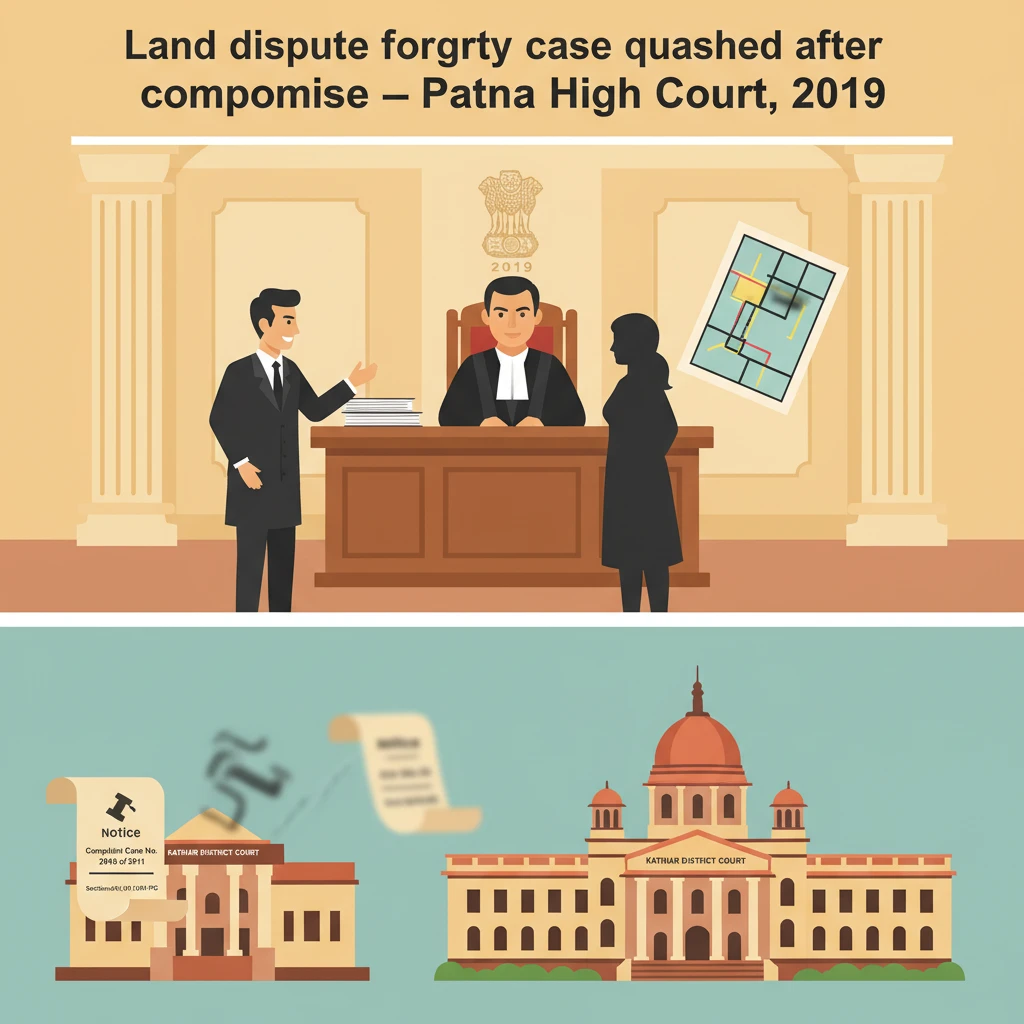
The dispute started as a land-related quarrel in Katihar district. Opposite party no. 2 filed Complaint Case No. 2948 of 2011, alleging that the petitioner and others had, by fraud and forged papers, managed to get a sale deed registered in the petitioner’s favour.
On the basis of this complaint, the Chief Judicial Magistrate, Katihar, passed an order on 16.01.2012. In that order, the Magistrate took cognizance of offences under Sections 467, 468, 471 and 120B of the Indian Penal Code and issued summons to the petitioner to appear in the criminal case.
Feeling aggrieved, the petitioner moved the Patna High Court under Section 482 of the Code of Criminal Procedure, 1973. She challenged the Magistrate’s cognizance order and the continuation of the complaint case against her.
While the criminal case was pending, an important development took place in the trial court. Opposite party no. 2 herself filed a compromise petition in the complaint case. In this compromise, various properties, including the disputed land, were apportioned between the parties. A specific prayer was made that, on the basis of the compromise, the complaint case be disposed of.
When the High Court took up the Section 482 application, it noticed this compromise. On 11.03.2019, the Court recorded the petitioner’s argument about the compromise and issued notice to opposite party no. 2. However, despite service of this notice, opposite party no. 2 did not appear when the matter was heard.
What the Court Examined and Decided
Hon’ble Mr. Justice Ahsanuddin Amanullah heard learned counsel for the petitioner and the learned APP for the State of Bihar. No one appeared for the complainant-opposite party no. 2, even though notice had been served.
The core relief sought by the petitioner was quashing of the Chief Judicial Magistrate’s order dated 16.01.2012, by which cognizance had been taken under Sections 467, 468, 471 and 120B IPC in Complaint Case No. 2948 of 2011 and summons issued to her.
The basic allegation in the complaint was that the petitioner, in connivance with other accused persons, had got a sale deed executed in her favour by playing fraud and relying on forged and fabricated documents relating to land.
The petitioner’s counsel drew the Court’s attention to the compromise petition filed by opposite party no. 2 in the complaint case before the trial court. This compromise dealt with land and its distribution among the parties, including the petitioner. The compromise also carried a request that the complaint case be disposed of based on its terms.
On this basis, the petitioner argued that continuing the criminal case would be an abuse of the process of court. The dispute had already been settled by dividing the lands between the parties, including the very land which was the subject of the alleged forged sale deed.
The learned APP for the State opposed the quashing. He submitted that the allegations involved forging and fabricating documents, which are offences that are non-compoundable. Under the Code of Criminal Procedure, certain offences can be formally “compounded” (settled) with permission of the court, but serious forgery offences do not fall in that list.
The High Court carefully considered the submissions and the overall facts. It acknowledged that the case was rooted in a land dispute. The complaint concerned the registration of a sale deed allegedly based on forged and fabricated documents in favour of the petitioner.
Crucially, after this criminal process had started, it was the complainant herself who filed the compromise. This compromise apportioned various properties, including the disputed lands, between the parties and expressly prayed for disposal of the complaint.
The Court accepted that the APP was correct: offences relating to forging and fabricating documents are not compoundable under Section 320 CrPC. This meant that the Magistrate could not simply close the complaint case on the basis of the compromise, even if both sides wanted peace.
Because of this legal limitation in the trial court, the petitioner had to approach the Patna High Court. The High Court examined whether, in these circumstances, it should exercise its inherent powers under Section 482 CrPC.
Section 482 gives the High Court power to act to prevent abuse of the process of any court and to secure the ends of justice. The question was whether allowing the criminal case to continue, despite the compromise, would amount to such an abuse and would go against the ends of justice.
The Court concluded that the matter was essentially a land or property dispute between private parties. The party who had originally alleged forgery had, by her own free act, entered into a compromise and agreed on distribution of the disputed land along with other lands.
In this background, the Court felt that letting the complaint case continue would not serve the ends of justice. Rather, it would undermine the settlement reached between the parties and keep alive a dispute that they themselves had chosen to bury.
To support its approach, the Patna High Court referred to the judgment of the Hon’ble Supreme Court in Yogendra Yadav vs. State of Jharkhand, reported in 2014(4) PLJR (SC) 518. The Court reproduced paragraphs 4 to 6 of that judgment.
In Yogendra Yadav, the Supreme Court had explained that although non-compoundable offences cannot be formally compounded under Section 320 CrPC, the High Court can still use its powers under Section 482 to quash criminal proceedings when the parties have amicably settled the dispute and the victim has no objection.
The Supreme Court stressed that such quashing will depend on the facts of each case. Offences involving moral turpitude or grave offences like rape and murder, which affect society at large, generally cannot be quashed on the basis of compromise, as doing so may send a wrong signal.
However, where the offences are entirely personal in nature, do not affect public peace or tranquillity, and quashing would bring about peace and secure the ends of justice, the High Court should not hesitate to quash the proceedings. In such cases, continuing the prosecution becomes a “lame prosecution” and a waste of time and energy.
The Supreme Court also referred to its earlier decision in Gian Singh v. State of Punjab and clarified that the guiding factor is whether continuation of the criminal case would be an exercise in futility and whether justice demands that the dispute be brought to an end to restore peace between the parties.
Applying these principles to the present case, the Patna High Court observed that the dispute here was personal and related to landed property between private individuals. The complainant herself had chosen to compromise and divide the lands, including the disputed plot, with the petitioner and others.
There was nothing to show that the alleged acts had broader public impact or that their continuation was necessary for public interest. Instead, it was evident that maintaining the complaint case would upset the compromise and prolong conflict between neighbours.
On these facts, the Court held that a case for interference had been made out. In exercise of its inherent powers under Section 482 CrPC, to prevent abuse of the process of the court and to secure the ends of justice, it quashed the criminal proceedings.
Specifically, the Court allowed the application and ordered that the entire criminal proceeding in Complaint Case No. 2948 of 2011, pending before the court at Katihar, “as far as it relates to the petitioner,” stands quashed.
Why This Judgment Matters
This judgment shows how the Patna High Court can protect parties who have genuinely settled their land disputes from being dragged through long criminal cases based on the same dispute.
Even where the alleged offences are non-compoundable, the Court clarified that its inherent powers can be used to close a criminal case if the matter is essentially private, arises out of land or property disputes, and the complainant has voluntarily compromised.
For ordinary people in Bihar involved in similar land quarrels, this decision underlines an important point. If both sides settle their property dispute and share the land by agreement, and the original criminal complaint is only a part of that dispute, the High Court may step in to end the criminal case in suitable situations.
At the same time, the judgment reminds that serious offences affecting society at large, like rape or murder, or crimes involving grave moral wrongdoing, cannot simply be washed away by private compromise.
Legal Issues and Answers
Issue: Can the Patna High Court quash criminal proceedings for non-compoundable offences of forgery and conspiracy arising out of a land dispute when the complainant and accused have entered into a compromise and divided the property?
Answer: Yes. Relying on its inherent powers under Section 482 CrPC and guided by the Supreme Court’s decisions in Yogendra Yadav and Gian Singh, the Court held that, since the matter was essentially a private land dispute and had been amicably settled, continuation of the complaint case would be an abuse of process and would not serve the ends of justice. The proceedings were therefore quashed as against the petitioner.
Cases Cited by the Court
- Yogendra Yadav vs. State of Jharkhand, 2014(4) PLJR (SC) 518, with reference to the principles earlier stated in Gian Singh v. State of Punjab.
Case Details
Case Number: Criminal Miscellaneous No. 48919 of 2014, arising out of Complaint Case No. 2948 of 2011, Katihar
Case Title: Anuradha Gupta vs. The State of Bihar & Mosmat Nirmala Devi
Coram: Hon’ble Mr. Justice Ahsanuddin Amanullah
Date of Judgment: 14.05.2019
Citation: 2019 (2) PLJR 946
Advocates: Mr. Krishan Chandra, Advocate for the petitioner; Mr. B. N. Pandey, APP for the State. Appearance of counsel for opposite party no. 2 is not recorded in the judgment.
Nature of the Case: Petition under Section 482 of the Code of Criminal Procedure seeking quashing of cognizance order and criminal proceedings in a complaint case involving allegations under Sections 467, 468, 471 and 120B IPC.
Link to Judgment: Patna High Court Judgment
If you found this explanation helpful and wish to stay informed about
how legal developments may affect your rights in Bihar,
you may consider following Samvida Law Associates for more updates.







