
Case Background
The matter arose from a criminal case registered as P.S. Case No. 91 of 2016 at Bausi Police Station, District Purnia. The alleged occurrence took place on 20.06.2016.
The petitioner, a male aged about 19 years as described in the cause title of the revision, claimed that he was a juvenile at the time of the alleged occurrence. His claim of juvenility was considered by the Juvenile Justice Board and thereafter by the appellate court.
Both the Juvenile Justice Board and the appellate court rejected his plea of juvenility. They relied on a medical report which assessed his age, but according to the petitioner they failed to properly apply Rule 12(3)(b) of the Juvenile Justice Rules, 2007.
Aggrieved by these orders, the petitioner filed Criminal Revision No. 106 of 2019 before the Patna High Court. He sought to have the impugned order set aside and to be declared a juvenile in conflict with law under the Juvenile Justice (Care and Protection of Children) Act, 2015.
What the Court Examined and Decided
The revision was heard by Hon’ble Mr. Justice Rajeev Ranjan Prasad. On 31.01.2020, after hearing the petitioner’s counsel, the Court passed an interim order that recorded the core contention and directed further steps.
The petitioner’s main argument was that both the Juvenile Justice Board and the appellate court had failed to appreciate the “actual import” of Rule 12(3)(b) of the Juvenile Justice Rules, 2007. This rule deals with how age is to be determined when relying on medical opinion.
The medical board had examined the petitioner on 13.06.2018. In its report, it assessed his age to be between 20 and 21 years as on that date. The Juvenile Justice Board itself had considered that on the date of the alleged occurrence (20.06.2016), his age would have been between 18 and 19 years based on this medical assessment.
The petitioner’s counsel argued that once the medical board gave a range and the Board accepted that he was 18–19 years on the date of occurrence, Rule 12(3)(b) required that he be given the benefit of one year on the lower side when exact age could not be determined. Reliance was placed on the Supreme Court judgment in Darga Ram @ Gunga vs. State of Rajasthan, reported in (2015) 2 SCC 775.
In that earlier order dated 31.01.2020, the High Court recorded the petitioner’s submission that if the benefit of one year was granted as per Rule 12(3)(b) and as interpreted in Darga Ram, then his age on the date of occurrence would come down to about 17 years, making him a juvenile under the law.
The petitioner was permitted to place on record the medical report of the Medical Board. The matter was directed to be listed on 10.02.2020 and the State was asked to be prepared on the issue.
Subsequently, a supplementary affidavit was filed on behalf of the petitioner enclosing the medical board’s report dated 13.06.2018. This report clearly stated that his age was between 20 and 21 years as on that date.
At the final hearing, the petitioner’s counsel reiterated that, since the occurrence took place on 20.06.2016, there was a gap of about two years between the occurrence and the medical examination. Therefore, if his age was 20–21 years in June 2018, he would have been 18–19 years at the time of the alleged occurrence in June 2016.
The Court also recorded that the State’s counsel opposed the application, but described this opposition as “a very feeble kind of opposition” without any material placed to counter the petitioner’s claim or the legal position explained.
The Court then carefully examined the Supreme Court judgment in Darga Ram alias Gunga vs. State of Rajasthan, (2015) 2 SCC 775. It reproduced paragraphs 15, 16, and 17 of that decision, which interpret Rule 12(3)(b) of the Juvenile Justice Rules, 2007.
Rule 12(3)(b), as quoted by the Court, provides that when documentary evidence such as birth certificate, school certificate or matriculation certificate is not available, the age is to be determined on the basis of medical opinion given by a duly constituted Medical Board. If the exact assessment of age cannot be done, the Court or Board may give the benefit to the child or juvenile by considering his or her age on the lower side within a margin of one year, and record a finding accordingly.
In Darga Ram, the Supreme Court had to deal with a situation where the Medical Board determined the age of the accused to be “about 33 years” at the time of medical examination, based on a range of 30 to 36 years. The Supreme Court explained the general rule that medical age determination can vary plus minus two years.
The Supreme Court in that case considered the upper extremity of the range (36 years) and then applied a plus-minus variation of two years to treat 34 years as a reasonable age on the date of medical examination. Calculating backwards to the date of occurrence, the Supreme Court found that the accused was about 18 years, 2 months, and 7 days old then. The Court further held that even then, he could be given an additional benefit of one year under Rule 12(3)(b), reducing his age to 17 years and 2 months, which made him a juvenile at the time of the incident.
The Patna High Court drew a clear parallel between that reasoning and the petitioner’s case. Here, the upper limit of the medical age range on 13.06.2018 was 21 years. Applying the principle of plus-minus two years as recognised by the Supreme Court, the High Court reasoned that 21 minus 2 would bring the age down to about 19 years as on the date of medical examination.
From there, the Court considered the two-year gap between the date of occurrence (20.06.2016) and the date of medical examination (13.06.2018). If the petitioner was taken to be around 19 years on 13.06.2018 after applying the plus-minus two year principle to the upper limit, then two years earlier, on 20.06.2016, he would be around 17 years of age.
Having thus arrived at a figure of approximately 17 years on the date of occurrence, the Court then applied Rule 12(3)(b). This rule permits the authority, where exact age cannot be determined from medical opinion, to give the benefit of one year on the lower side within the margin of one year. In practical terms, this reinforced the conclusion that the petitioner was below 18 years on the date of occurrence.
The Court expressly stated that, in these circumstances, there was no reason to take any other view than that the petitioner was entitled to be declared a juvenile under the provisions of the Juvenile Justice (Care and Protection of Children) Act, 2015.
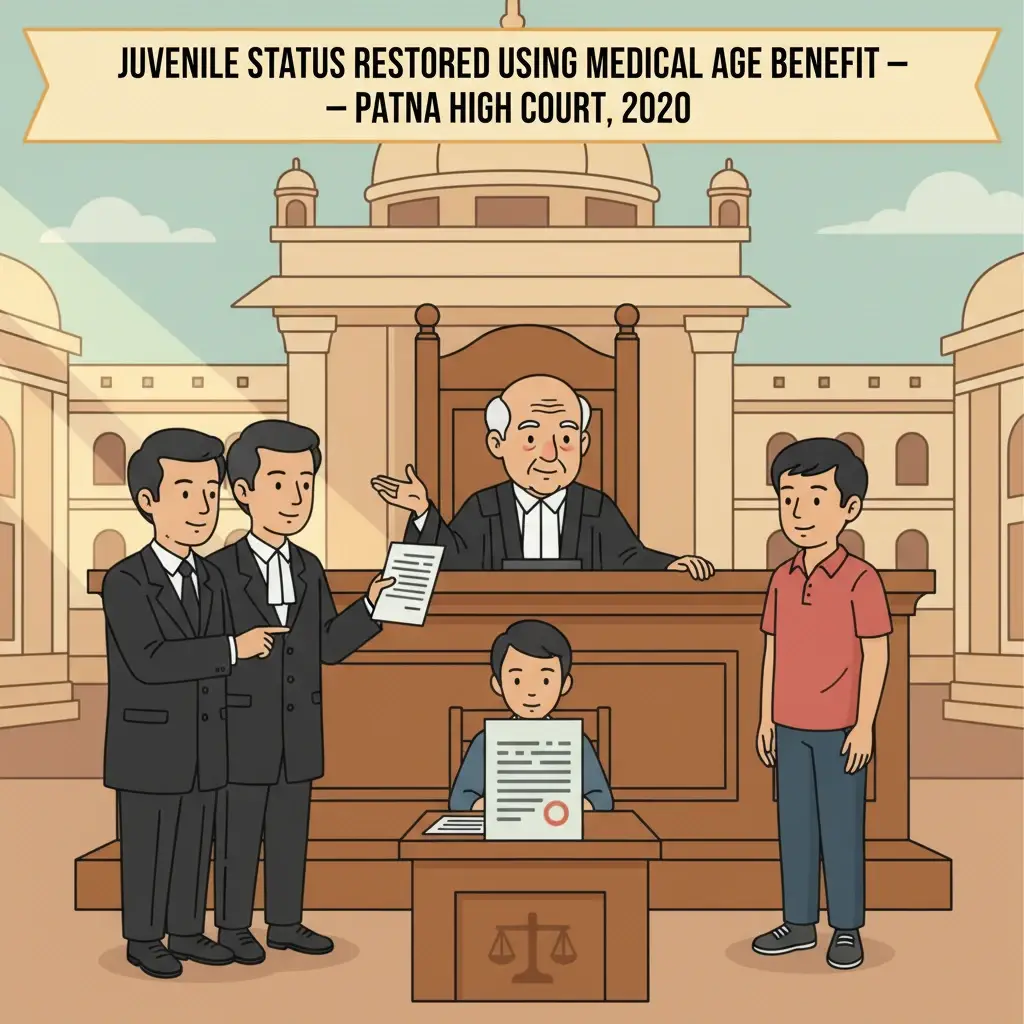
Accordingly, in the concluding portion of the judgment, the Patna High Court set aside the impugned order (passed by the courts below rejecting his claim of juvenility). The criminal revision was allowed to the extent that the petitioner would be treated as a juvenile.
This means that the subsequent proceedings in relation to the case should now be governed by the special procedure and protections given to juveniles in conflict with law, rather than the regular criminal justice process meant for adults.
Why This Judgment Matters
This judgment is important for young accused persons who do not have birth certificates or school records, and whose age has to be decided based on medical opinion. It shows that the Patna High Court is willing to carefully apply the benefit embedded in Rule 12(3)(b) of the Juvenile Justice Rules, 2007.
The Court clearly followed the Supreme Court’s approach in Darga Ram, recognising that medical age assessment is an estimate, not an exact science. When the age is given as a range, and especially when the occurrence took place earlier than the medical examination, the benefit must go to the accused if he or she may have been under 18 on the date of the incident.
Practically, this judgment means that where there is doubt in medical age estimation, courts in Bihar should lean in favour of treating the person as a juvenile, if reasonable calculation and statutory benefit place them below 18 at the relevant time. This affects not only the punishment but also the entire manner in which the case is dealt with, because juveniles are tried by the Juvenile Justice Board and are entitled to rehabilitative measures rather than ordinary imprisonment.
The decision reinforces that State counsel must come prepared with real material if they wish to oppose a claim of juvenility, and cannot simply rely on a bare medical age range without addressing the plus-minus two years margin and the one-year statutory benefit.
Legal Issues and Answers
- Issue: Whether the petitioner should be declared a juvenile in conflict with law on the date of the alleged occurrence, based on a medical age assessment of 20–21 years two years later.
Answer: Yes. Applying Rule 12(3)(b) of the Juvenile Justice Rules, 2007, read with the Supreme Court judgment in Darga Ram alias Gunga vs. State of Rajasthan, and considering the plus-minus two years variation and the two-year gap between examination and occurrence, the Patna High Court held that the petitioner would be around 17 years on the date of occurrence and must therefore be treated as a juvenile under the Juvenile Justice (Care and Protection of Children) Act, 2015.
Cases Cited by the Court
- Darga Ram alias Gunga vs. State of Rajasthan, (2015) 2 SCC 775.
Case Details
Case Number: Criminal Revision No. 106 of 2019 (arising out of P.S. Case No. 91 of 2016, Bausi Police Station, District Purnia)
Case Title: Karanvir Singh vs. The State of Bihar
Citation: 2020 (2) PLJR 279
Coram: Hon’ble Mr. Justice Rajeev Ranjan Prasad
Date of Judgment: 14.02.2020
Advocates:
- For the Petitioner: Mr. Sandeep Kumar, Advocate; Mr. Saket Tiwary, Advocate
- For the State/Respondent: Mr. Suresh Prasad Singh, APP
Nature of the Case: Criminal revision challenging the rejection of claim of juvenility and seeking declaration that the petitioner is a juvenile under the Juvenile Justice (Care and Protection of Children) Act, 2015.
Link to Judgment: Click here to view full judgment of Patna High Court
If you found this explanation helpful and wish to stay informed about how legal developments may affect your rights in Bihar, you may consider following Samvida Law Associates for more updates.







