

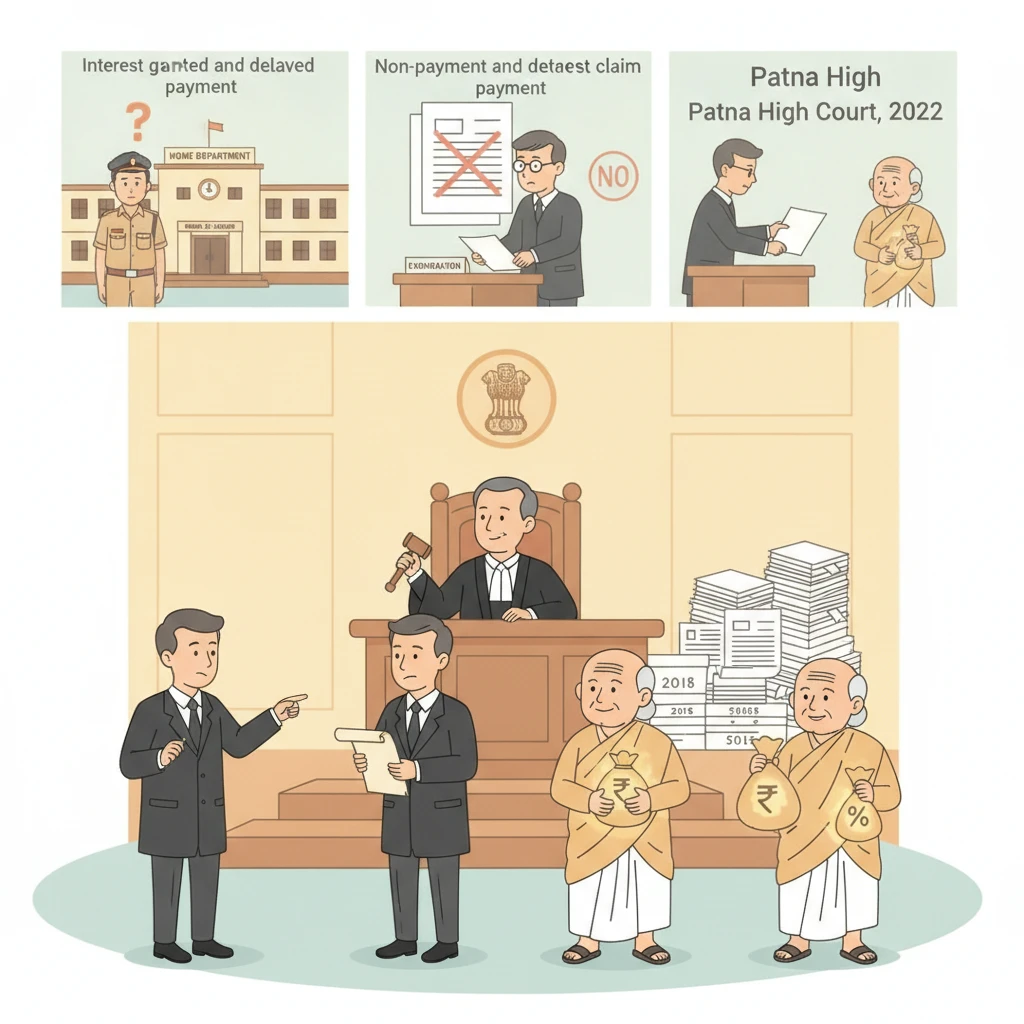
Case Background
The petitioner was a government employee under the Home Department of the State of Bihar. On certain allegations, he was subjected to a departmental disciplinary proceeding.
The disciplinary proceeding ultimately ended in his favour. He was exonerated on 29.09.2008.
His claim in this case related to arrears of salary for the period from 17.05.1996 to 30.11.1998. These amounts were not paid to him at the relevant time.
For several years after his exoneration, the petitioner did not move for salary arrears. For the first time, he submitted an application or representation in 2014 demanding the arrears of salary for the intervening period between 17.05.1996 and 30.11.1998.
In the meantime, the petitioner reached the age of superannuation and retired from service on 31.01.2015.
As there was no response to his demand, the petitioner approached the Patna High Court earlier in C.W.J.C. No. 1632 of 2015. Under the order dated 18.06.2018 in that case, the authorities were required to process and pay his arrears.
Following that earlier order, the State authorities calculated the arrears of salary at Rs. 3,00,274/- (Rupees Three Lakh Two Hundred Seventy Four). This amount was disbursed to the petitioner on 02.11.2018.
After receiving the arrears, the petitioner requested payment of interest on the delayed salary amount. He made a representation dated 04.09.2019, claiming interest at 12% per annum on the arrears amount.
The Superintendent of Police, West Champaran, Bettiah, rejected this representation by order dated 05.05.2019 (memo no. 63 (Vidhi)). The rejection order did not assign any reasonable ground for denying interest, according to the petitioner.
The petitioner therefore filed the present Civil Writ Jurisdiction Case No. 6385 of 2020 before the Patna High Court, challenging the rejection of interest and seeking directions for payment of interest on delayed salary arrears.
What the Court Examined and Decided
The writ petition came before Hon’ble Mr. Justice P. B. Bajanthri. The Court heard counsel for the petitioner and counsel for the State.
The reliefs sought by the petitioner were threefold. First, he sought quashing of the order dated 05.05.2019 issued by the Superintendent of Police, West Champaran, Bettiah, rejecting his representation for payment of 12% interest on the delayed salary.
Second, he prayed for a direction to the respondents to pay interest at 12% per annum on the sum of Rs. 3,00,274/-, which represented arrears of salary for the period 17.05.1996 to 30.11.1998. He emphasized that this amount was paid only on 03.11.2018 (as per his pleadings) after a delay of about 23 years and only because of the earlier order of the Patna High Court in C.W.J.C. No. 1632 of 2015.
Third, he sought any other relief to which the Court might find him entitled.
The Court identified a single, central question for consideration: whether the petitioner was entitled to interest on the belated payment of arrears of salary.
The petitioner’s side relied upon the long delay between the period for which salary was due and the actual payment. The arrears related to 1996–1998 but were only paid in 2018. He had also retired in 2015. The argument was that such belated payment ought to carry interest, particularly when the amount was released only after intervention of the High Court.
On the other hand, the State opposed the claim for interest. The Court recorded the State’s stand as set out in paragraph 11 of the counter affidavit. According to this paragraph, the Inspector General of Police (Headquarters), Bihar, Patna, had issued Memo No. 159/420430/P.1 dated 12.04.2019 to the Superintendent of Police, West Champaran at Bettiah.
In that memo, the Inspector General of Police (Headquarters) communicated that under the applicable financial manual, there was no provision for payment of interest on salary. He further directed the Superintendent of Police, West Champaran, that the petitioner’s representation seeking interest could be rejected after passing a detailed and speaking order.
Thus, the State’s defence rested on the claim that, as per financial rules, no interest was payable on delayed salary and that this justified rejection of the petitioner’s representation.
After hearing both sides, the Court again framed the core question: whether the petitioner was entitled to interest on arrears of salary.
The Court then referred to the decision of the Supreme Court in Vijay L. Mehrotra Vs. State of Uttar Pradesh and Others, reported in 2001 (9) SCC 687. In that case, the Supreme Court dealt with delayed payment of retiral benefits and directed the State to pay interest at 18% per annum from the date of retirement till the dates of actual payment.
The Patna High Court reproduced paragraphs 1 to 5 of the Supreme Court judgment. In that case, the employee had retired on 31.08.1997 and the various components of retirement benefits like GPF, GIS, leave encashment, arrears of pay, gratuity, commuted pension and detained amount were paid months and even years later. The Supreme Court held that such delay lacked justification and directed payment of simple interest at 18% from the date of retirement till the dates of payment, to be paid within 12 weeks.
Relying on this authority, the Patna High Court observed that belated settlement of arrears of salary is to be accompanied by payment of interest. The Court further noted that, apart from this binding precedent, the Payment of Interest Act also entitled the petitioner to interest on belated settlement of arrears of salary.
The Court then analysed the particular facts of the present case. It noted there was an “inordinate delay” from 1998 to 2018 in settlement of the petitioner’s arrears. However, the Court also took into account that the petitioner himself moved for arrears only on 20.08.2014.
Specifically, it recorded that the petitioner for the first time demanded arrears of salary on 20.08.2014 and, by virtue of the judicial pronouncement in his earlier writ petition, he was paid arrears only on 02.11.2018.
The Court then considered the fact that the petitioner had retired from service on 31.01.2015. Thus, the relevant period, in the Court’s view, for grant of interest would begin from the date when the petitioner first demanded arrears in 2014 and end on the date of actual payment in 2018.
Balancing these considerations, the Court held that the petitioner was entitled to interest at the rate of 8% per annum on the arrears of salary of Rs. 3,00,274/- during the intervening period from 20.08.2014 to 02.11.2018.
The Court directed that this interest amount be calculated and disbursed to the petitioner within three months from the date of receipt of the Court’s order.
To ensure compliance and deter further delay, the Court added a clear consequence. It held that if the authorities failed to pay the interest within three months, the petitioner would then be entitled to litigation cost quantified at Rs. 25,000/- (Rupees Twenty Five Thousand).
With these observations and directions, the Patna High Court disposed of the writ petition.
Why This Judgment Matters
This judgment is significant for government employees and retirees who receive their salary or arrears after a long delay.
The Patna High Court made it clear that when salary arrears are paid many years late, the employee can be entitled to interest. This remains true even if financial rules do not expressly provide for interest, because constitutional courts can grant such relief based on fairness and higher court judgments.
The Court relied on the Supreme Court’s ruling in Vijay L. Mehrotra, which recognises that employees should not suffer financially when the State delays payments without justification.
For employees, especially those nearing retirement, this decision shows that approaching the Court can result not only in release of arrears but also in compensation in the form of interest for the period of unjustified delay, at least from the date when a clear demand is made.
The judgment also sends a message to government departments and police authorities that they must process salary-related claims and arrears in a timely manner, or risk paying interest and litigation costs.
Legal Issues and Answers
-
Issue: Whether a retired government employee is entitled to interest on arrears of salary that were paid many years late, after a court order.
Answer: Yes. The Patna High Court held that the petitioner is entitled to interest at 8% per annum on the arrears amount of Rs. 3,00,274/- from 20.08.2014 (date of first demand) to 02.11.2018 (date of payment), to be paid within three months, failing which the State must also pay litigation costs of Rs. 25,000/-.
Cases Cited by the Court
- Vijay L. Mehrotra Vs. State of Uttar Pradesh and Others, 2001 (9) SCC 687.
Case Details
Case Number: Civil Writ Jurisdiction Case No. 6385 of 2020
Case Title: Faiyaz Ahmad v. The State of Bihar & Ors.
Coram: Hon’ble Mr. Justice P. B. Bajanthri
Citation: 2022(2) PLJR 113
Date of Judgment: 21.03.2022
Advocates:
- For the Petitioner: Mr. Md. Anisur Rahman
- For the Respondents (State): Mr. Md. Nadim Seraj, GP-5
Nature of the Case: Writ petition under civil writ jurisdiction challenging rejection of interest on delayed salary arrears and seeking direction for payment of such interest.
Link to Full Judgment: Click here to read the complete judgment of the Patna High Court
If you found this explanation helpful and wish to stay informed about how legal developments may affect your rights in Bihar, you may consider following Samvida Law Associates for more updates.







