
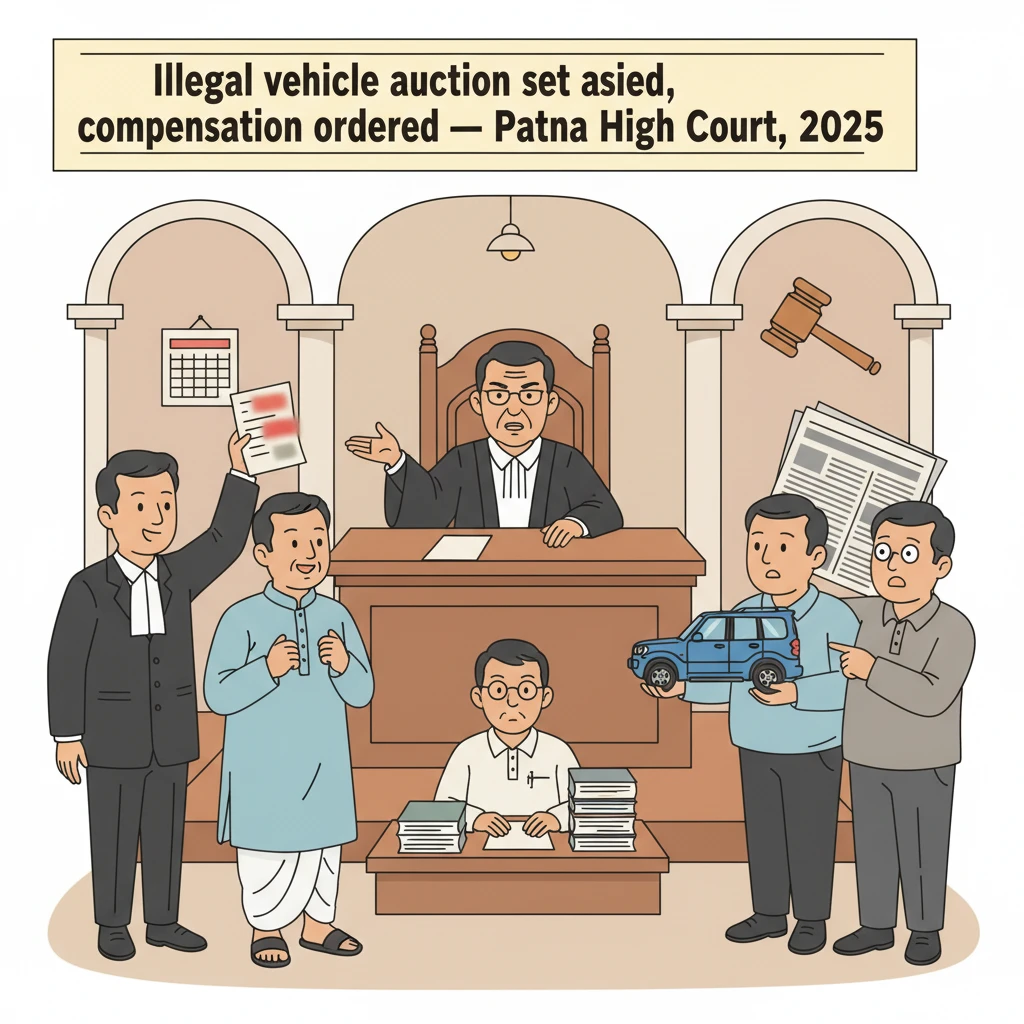
Case Background
The petitioner is the registered owner of a Mahindra Scorpio S9, manufactured in November 2018, with an insured value of Rs. 12,12,517/- for the period January 2019 to January 2022. On 25.12.2020, the vehicle was seized by the Officer-in-Charge of Sakra Police Station, Muzaffarpur, who also lodged an FIR as informant.
The seizure was in connection with Sakra P.S. Case No. 722 of 2020 under Sections 414/34 of the Indian Penal Code and Sections 30(a), 41, 56(B) and 56(D) of the Bihar Prohibition and Excise Act, 2016. It was alleged that 3.750 litres of foreign liquor were recovered from the Scorpio.
On legal advice, the petitioner applied for release of the vehicle before the Court of the Exclusive Special Excise Judge-1, Muzaffarpur, where the criminal case was pending. On 11.01.2023, that Court passed an order directing release of the vehicle in favour of the petitioner.
According to the petitioner, despite this clear release order, the vehicle was never returned. He alleged that the then Deputy Superintendent of Police (East), Muzaffarpur, was using the Scorpio as an official vehicle. He brought this to the notice of the trial court through an application (Annexure-P/2), stating that the car was in use by the Dy.S.P. East.
On 07.10.2023, the petitioner filed another application before the trial court, seeking to know why the release order was not followed. The court called for reports from the Station House Officer, Sakra, and the District Magistrate, Muzaffarpur. This time it was reported that the petitioner’s vehicle had already been auction sold on 31.03.2023 and purchased by respondent no. 9, Bhola Sah.
The petitioner challenged the confiscation before the Excise Commissioner in Excise Appeal Case No. 30 of 2024, and thereafter before the Secretary (Liquor Prohibition and Excise), Government of Bihar, in revision (Excise Revision Case No. 11 of 2025). Both appeal and revision were dismissed and the confiscation order was upheld.
He then approached the Patna High Court in Civil Writ Jurisdiction Case No. 13123 of 2025 seeking quashing of the auction sale of his Scorpio, or in the alternative, compensation equal to the insured value of the vehicle. He also sought a judicial enquiry into alleged rackets in excise vehicle auctions in Muzaffarpur.
What the Court Examined and Decided
The Division Bench of Hon’ble Mr. Justice Rajeev Ranjan Prasad and Hon’ble Mr. Justice Sourendra Pandey first passed a detailed interim order on 14.11.2025. After perusing the State’s counter affidavit, the Court noted several missing and troubling aspects.
There was no clear record of any notice of confiscation having been served on the petitioner, despite his being the identified registered owner. The State’s counter did not annex the alleged ex parte confiscation order. There was also no explanation to the petitioner’s specific allegation that, even after the trial court’s release order dated 11.01.2023, the vehicle remained in possession of the then Dy.S.P. East and was being used as an official vehicle.
The State could not show any notice informing the petitioner of the date of auction or giving him an opportunity either to seek release or to participate in the auction. The Court also noted that the vehicle, which was only about two years old at the time of seizure and insured for Rs. 12,12,517/-, had been sold for Rs. 3,85,000/-—roughly 30% of the insured value—to respondent no. 9.
These facts led the Court, even at that early stage, to remark that the entire exercise of power, from seizure to confiscation and auction, indicated “foul play in action, arbitrary and malafide”. The Court issued notice to respondents 1 to 8 to explain why the impugned orders should not be set aside and why the State should not be directed to pay the insured value with interest, recoverable from erring officers. The auction purchaser was impleaded as respondent no. 9 and restrained from transferring the vehicle.
The Court also took note of a newspaper report that 490 vehicles were auctioned together, and called for a report from the District Magistrate, Muzaffarpur, on whether the procedure under Rule 12A of the Bihar Prohibition and Excise Rules, 2021, and other applicable rules for auction were followed. This writ petition was tagged with CWJC No. 4697 of 2025, where similar issues had arisen in Gopalganj.
On 17.12.2025, after hearing the Additional District Magistrate and Excise Superintendent, Muzaffarpur, the Court recorded further disturbing facts. Initially, Confiscation Case No. 79 of 2021–22 had been started for the petitioner’s vehicle. Though a format of notice existed on file, there was no proof of dispatch or service on the petitioner.
Later, this individual case was abandoned and a common Confiscation Case No. 03 of 2022–23 was started for 527 vehicles. In this common case, no individual notice was issued to the petitioner or other vehicle owners. By a single order (Memo No. 723 dated 15.03.2023), the then Deputy Development Commissioner, Muzaffarpur, passed a blanket confiscation of 490 vehicles, including the petitioner’s Scorpio.
Before this confiscation order, a notice had appeared in Prabhat Khabar on 18.02.2023, informing vehicle owners that they could apply for release under Rule 12A of the 2021 Rules by depositing 50% of the “latest insured value” and appear for hearing on 25.02.2023, and, if necessary, on 04.03.2023. The officers admitted that these same two dates were fixed for all 527 vehicles, and that the procedure for service of summons under the Code of Criminal Procedure, as required by Rule 13A(3), was not followed.
The Excise Superintendent wrote to the Motor Vehicle Inspector (MVI), Muzaffarpur, on 20.02.2023, asking for valuation of all 527 vehicles lying in 22 police stations. Within two days, on 22.02.2023, the then MVI sent a single valuation report for all vehicles. The present MVI, appearing before the Court, candidly stated that it would not have been possible to physically inspect 527 vehicles in 22 police stations in such a short time. He also confirmed that the record contained no basis for the valuations—no photographs, no physical verification notes, no explanation how particular values were fixed.
The Court then examined the auction process. A short-term auction notice dated 25.02.2023 fixed auction for 01.03.2023 and 23.03.2023, with leftover vehicles to be auctioned on 28.03.2023. The Bench questioned how auction could be announced on 25.02.2023 when the confiscation order was passed only later, on 15.03.2023, and when even the second date of hearing (04.03.2023) in the confiscation proceeding was yet to come.
The officers had no satisfactory answer. It stood admitted that the first auction notice pre-dated the confiscation order, and that auction on 01.03.2023 would have occurred even before the second hearing date fixed in the paper notice.
A second short-term auction notice dated 25.03.2023 fixed auction from 28.03.2023 to 31.03.2023. Under this notice, the petitioner’s Scorpio was auctioned, with minimum price of Rs. 3,80,000/- as per the disputed valuation report, and ultimately sold to respondent no. 9 for Rs. 3,85,000/-.
The Court asked whether these auction notices were published in any widely circulated newspaper as mandated by Rule 14(3) of the 2021 Rules. The Assistant Commissioner (Prohibition), Muzaffarpur, stated that for the first auction notice there was a letter to the Information and Public Relations Department for publication, but for the second notice—under which the petitioner’s car was sold—there was no record of any request or of any publication. It was thus admitted that no public advertisement was issued in a newspaper for the second auction.
Evidence also emerged that certain individuals purchased multiple vehicles in bulk. One Rohit Kumar bought eight vehicles for about Rs. 28 lakhs; another, Acchelal Rai, purchased four vehicles, including Tata trucks and a tempo; another, Kailash Rai, bought nine vehicles for about Rs. 1,90,000/-. Respondent no. 9 disclosed that he himself had purchased 12 vehicles in auction for a total of Rs. 10,65,000/-, later sold six as scrap without any official permission or surrender of registrations, and sold the petitioner’s vehicle to a third party through another dealer.
Against this backdrop, the Court reproduced in its judgment Rule 13A and Rule 14 of the Bihar Prohibition and Excise Rules, 2021, which lay down the procedure for confiscation and auction. The Bench found clear violations at multiple stages:
First, no valid individual show-cause notice was served on the petitioner as mandated by Rule 13A(2) and (3). Second, in the Prabhat Khabar notice, the confiscating authority imposed an unreasonable and legally unsustainable condition that vehicle owners must first deposit 50% of the “penalty” amount, even though no penalty had yet been determined, before their applications for release would be considered. Third, fixing the same two hearing dates for 527 vehicles was considered by the Court to be an “empty formality” incapable of providing a real opportunity of hearing.
Fourth, auction notices were issued even before the confiscation order, and dates of auction were fixed before the second hearing date in the confiscation proceeding, thereby pre-empting owners’ statutory rights of appeal and revision. Fifth, valuation of 527 vehicles was, in the Court’s view, a mere “paper work” done from the office without physical inspection, resulting in arbitrary and extremely low valuations. The petitioner’s two-year-old Scorpio, insured for over Rs. 12 lakh, was valued at Rs. 3,80,000/-.
Sixth, the mandatory requirement under Rule 14(3) to invite bids through public advertisement in at least one local or vernacular newspaper was ignored, at least in the second auction notice under which the petitioner’s vehicle was sold. The Court held this to be a “blatant violation” of the Rules.
In these circumstances, the Bench concluded that the officers involved in confiscation and auction had “not shown any respect for the rule of law”. It observed that it was difficult to believe that senior officers would repeatedly violate clear legal provisions without extraneous considerations. The Court also noted that similar irregularities in vehicle auctions in Gopalganj district were already under investigation by the Economic Offences Unit (EOU) in E.O.U. P.S. Case No. 42 of 2025.
Given the scale of alleged corruption and underhand dealing, the Court directed that the Economic Offences Unit, Bihar, Patna be added as respondent no. 10 and ordered the EOU to register a First Information Report regarding the fixation of valuations and conduct of auctions in this case, and to investigate the roles of officials and auction purchasers, including subsequent transfers of vehicles. The Bench clarified that investigation must be independent and not influenced by its observations.
On the petitioner’s personal grievance, the Court set aside the confiscation order and held that the auction sale of his vehicle was bad in law. Since the vehicle had already been sold on and transferred to a third party, the Court granted the petitioner’s alternative prayer for compensation rather than directing return of the vehicle.
The State of Bihar, through the Principal Secretary, Excise Department, was directed to pay the petitioner Rs. 12,12,517/- (the insured value) with interest at 6% per annum from three months after the date of seizure until payment, to be made within one month of receipt of the order. The Court noted that three months from seizure is the statutory period for passing a confiscation order, hence interest was allowed from that later date.
The Court also awarded Rs. 10,000/- as costs of litigation to the petitioner.
Relying on the earlier Patna High Court decision in K.K. Pathak @ Keshav Kumar Pathak v. Ravi Shankar Prasad & Ors., 2019 (1) PLJR 1051—left undisturbed by the Supreme Court—the Bench held that when the State pays compensation due to misuse or excessive use of power by its officers, the amount should be recovered from the erring officials. Accordingly, the State was directed to recover the difference between the insured value and the auction sale price, i.e. Rs. 12,12,517/- minus Rs. 3,85,000/- = Rs. 8,27,517/-, together with interest and costs, from the culpable officials in accordance with law within six months from the date of payment to the petitioner.
The Court further directed the Excise Department to take appropriate administrative action against the erring officials and to instruct all officers dealing with confiscation and auction to strictly follow the 2021 Rules within prescribed timelines.
Finally, recognising the seriousness and scale of suspected wrongdoing, the Bench expected the EOU to constitute a Special Investigation Team and conduct a time-bound probe. It decided to monitor, though not supervise, the progress of investigation and tagged this case with CWJC Nos. 4697 of 2025 and 12075 of 2025, listing them for further orders on 27.01.2026. The personal appearance of officers was dispensed with.
Why This Judgment Matters
This judgment is significant for ordinary vehicle owners whose cars, bikes or trucks are seized under prohibition or other laws in Bihar. The Patna High Court has made it clear that the government cannot quietly confiscate and auction your vehicle without following legal procedure and without giving you a real chance to be heard.
The Court examined the actual records, not just formal paperwork, and exposed how common orders and hurried valuations can be used to push through mass auctions. It recognised how one or two buyers repeatedly purchasing many vehicles at very low prices raises serious suspicion.
Practically, this decision gives three strong signals. First, if the rules under the Bihar Prohibition and Excise Act are not followed, confiscation and auction can be struck down. Second, when the government’s illegal actions cause loss to a citizen, the State may have to pay full compensation with interest and costs. Third, that money should then be recovered from the officials who misused their power, not from taxpayers in general.
By directing the Economic Offences Unit to register an FIR and investigate the entire auction process, the Court has also tried to protect other vehicle owners who may have suffered similar illegal auctions in Muzaffarpur and elsewhere.
Legal Issues and Answers
- Issue: Whether the confiscation of the petitioner’s vehicle and its auction sale by excise and district authorities in Muzaffarpur complied with Rule 13A and Rule 14 of the Bihar Prohibition and Excise Rules, 2021.
Answer: No. The Court held that there was complete violation of the mandatory procedures for notice, hearing, valuation, and public auction, rendering both confiscation and auction illegal. - Issue: What relief should be granted when an illegally auctioned vehicle has already passed into the hands of a third party purchaser.
Answer: The Court set aside the confiscation and declared the auction sale bad in law, but instead of ordering return of the vehicle, directed the State to pay the petitioner the full insured value with interest and litigation costs. - Issue: Whether responsibility for financial loss caused by misuse or excessive use of official power should rest only with the State or also with individual officers.
Answer: Following the earlier decision in K.K. Pathak, the Court directed that the difference between insured value and auction price, along with interest and costs, must be recovered from the erring officials in accordance with law.
Cases Cited by the Court
- K.K. Pathak @ Keshav Kumar Pathak v. Ravi Shankar Prasad & Ors., 2019 (1) PLJR 1051; Special Leave Petition (Cri) No. 003566 of 2019 before the Supreme Court was not interfered with.
Case Details
Case Number: Civil Writ Jurisdiction Case No. 13123 of 2025
Case Title: Sushil Kumar Singh v. The State of Bihar & Ors.
Citation: 2026 (1) PLJR 439
Court: High Court of Judicature at Patna
Coram: Hon’ble Mr. Justice Rajeev Ranjan Prasad; Hon’ble Mr. Justice Sourendra Pandey
Date of Judgment: 18.12.2025 (Uploaded on 19.12.2025)
Advocates:
- For the petitioner: Mr. Hari Kishore Thakur, Advocate; Mr. Aditya Dev, Advocate
- For the State of Bihar: Mr. Sumant Kumar Singh, AC to GA-2
- For respondent no. 9 (auction purchaser): Mr. Alok Kumar Alok, Advocate; Mr. Vivek Kumar Pandey, Advocate
- For the Economic Offences Unit (respondent no. 10): Mr. V.N.P. Sinha, Senior Advocate; Mr. Vijay Anand, Advocate
Nature of the Case: Writ petition (civil) under Article 226 of the Constitution challenging confiscation and auction sale of a seized vehicle under the Bihar Prohibition and Excise Act, 2016 and Rules, with ancillary prayer for compensation and for enquiry into alleged auction racket.
Link to Judgment: View full judgment on Patna High Court website
If you found this explanation helpful and wish to stay informed about
how legal developments may affect your rights in Bihar,
you may consider following Samvida Law Associates for more updates.







