
Case Background
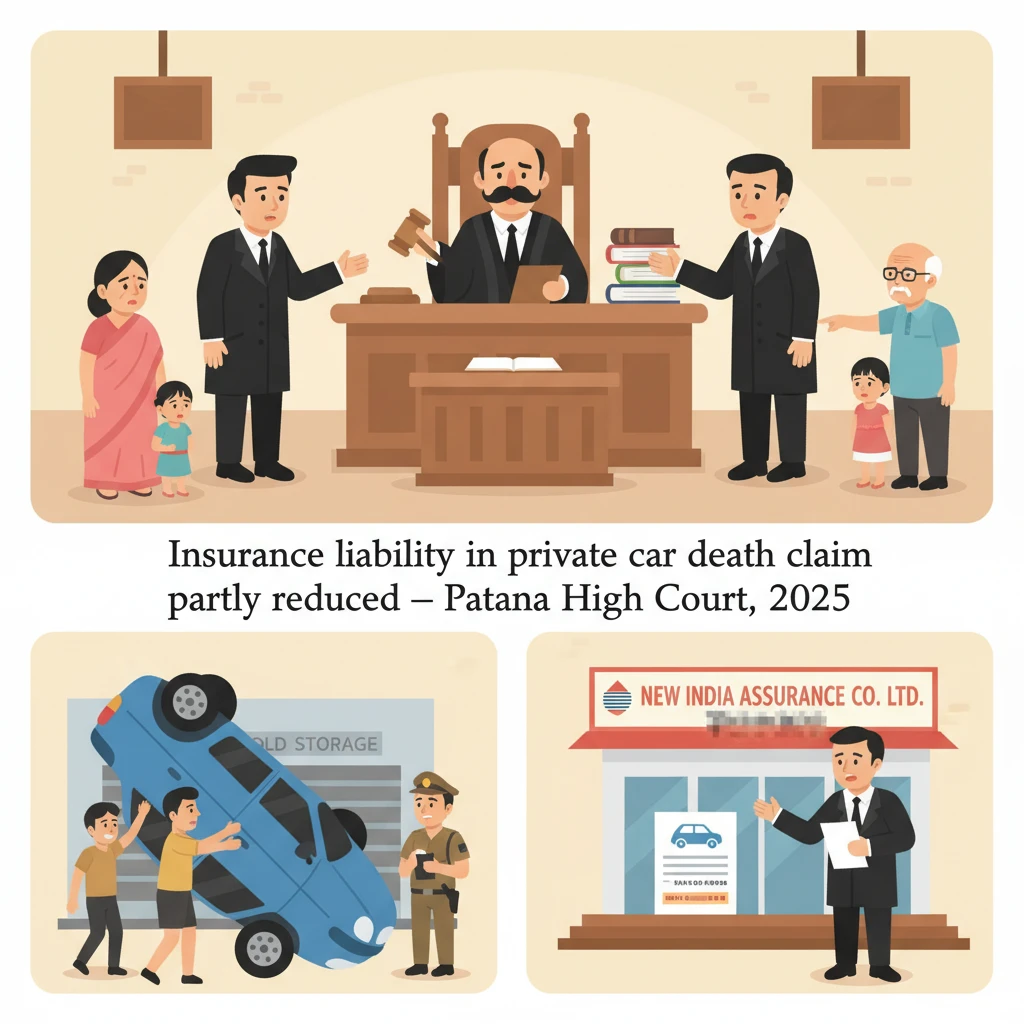
A road accident took place near a cold storage in the Sadar Muffasil police station area of Purnea district, Bihar. An Indica car bearing registration number BR-11R/3303 flipped over due to rash and negligent driving by its driver. No other vehicle was involved.
Inside the car were Dharmendra Kumar and one Nagendra Sharma. Dharmendra Kumar suffered serious injuries and died during treatment. On 05.01.2016, Sadar (Muffasil) P.S. Case No. 3 of 2016 was registered for offences under Sections 279, 337, 338 and 334 of the Indian Penal Code against the car’s driver.
Dharmendra Kumar’s widow, two minor children and his parents (Respondent Nos. 1 to 5) filed Claim Case No. 4 of 2016 before the District Judge-cum-Chairman, Motor Accident Claims Tribunal (M.A.C.T.), Purnea. They claimed compensation of Rs. 37,80,000/- for his death.
They arrayed the car owner, Anil Kumar (Respondent No. 6), as Opposite Party No. 1 and New India Assurance Company Ltd., the insurer of the car, as Opposite Party No. 2.
The owner admitted that he owned the car and that it was insured with New India Assurance Company Ltd. under policy no. 54080431150100001785 valid from 14.08.2015 to 13.08.2016. He also said the driver, Rajiv Kumar Mandal, had a valid driving licence and all documents were in order. He argued that since the vehicle was duly insured, the liability to pay compensation lay on the insurance company.
The insurance company filed a written statement disputing liability. It admitted the insurance but alleged that:
- the claim suffered from mis-joinder and non-joinder of parties,
- the driver had no valid licence,
- there was violation of policy terms and conditions, and
- the compensation claimed was excessive.
On an application under Section 170 of the Motor Vehicles Act, the Tribunal permitted the insurer to contest the claim on all grounds available to the owner, by order dated 07.04.2017.
The claimants examined five witnesses and produced several documents: FIR, charge-sheet, registration certificate, insurance policy, M.V.I. report, post-mortem report, death certificate, appointment letter of the deceased from Alkem Laboratories Ltd., salary statement, and the driver’s licence.
The insurer did not examine any witness or produce documents before the Tribunal.
After trial, the Tribunal held that Dharmendra Kumar, aged about 34 years, working as a Medical Representative with Alkem Laboratories Ltd. and earning an annual salary of Rs. 2,36,412/-, died due to rash and negligent driving of the car’s driver. It found that the vehicle was validly insured with the insurance company and the driver held a valid licence.
The Tribunal awarded Rs. 26,45,836/- as compensation with interest at 8% per annum and directed the insurance company to pay the entire amount to the claimants. Aggrieved, the insurer filed Miscellaneous Appeal No. 46 of 2018 before the Patna High Court under Section 173 of the Motor Vehicles Act.
What the Court Examined and Decided
Hon’ble Mr. Justice Jitendra Kumar framed two main questions:
- whether the claim petition was not maintainable due to non-joinder of the driver, and
- whether the claimants were entitled to compensation, and if so, from whom—the owner or the insurance company.
On behalf of the insurer, it was argued that the policy was a “Private Car Package Policy”. According to the insurer, the car was meant for private use and not for hire or reward. It relied on the deposition of the widow (A.W.1) that the car was “hired” by the deceased and argued that this use violated the policy condition that excluded use for “hire or reward”.
The insurer further argued that:
- the deceased was not a “third party” but had stepped into the shoes of the owner,
- the car was a private vehicle and not a public service vehicle,
- therefore, the insurer owed no liability to pay compensation to his legal heirs,
- even otherwise, its maximum liability under the policy was Rs. 7,50,000/-, with individual cover limited to Rs. 4,04,513/-,
- the driver had not been impleaded, so the claim petition was defective, and
- the statutory deposit of Rs. 25,000/- made in appeal should be refunded.
The claimants’ counsel supported the Tribunal’s award. He argued that the deceased was a third party in relation to the insurer and that any breach of policy terms, even if proved, could at best give the insurer a right to recover from the owner after paying the claimants. He also submitted that the owner is vicariously liable for the wrong of his driver and that non-joinder of the driver was not fatal.
The High Court first discussed the relevant provisions of the Motor Vehicles Act, 1988. It noted the statutory distinction between “private service vehicle” (Section 2(33)) and “public service vehicle” (Section 2(35)), and the mandate under Sections 146 and 147 requiring third-party insurance for all vehicles. It explained that:
- Act policies cover risks mandatory under Section 147—primarily third-party risk and, in case of public service vehicles, risk to passengers.
- Comprehensive or package policies may additionally cover risk of the owner, driver or occupants of a private vehicle, depending on the terms and extra premium paid.
Relying on a series of Supreme Court decisions such as Oriental Insurance Co. Ltd. v. Jhuma Saha, Dhanraj v. New India Assurance Co. Ltd., National Insurance Co. Ltd. v. Laxmi Narain Dhut, Oriental Insurance Co. Ltd. v. Meena Variyal, Sudhakaran K.V., New India Assurance Co. Ltd. v. Sadanand Mukhi, Bhagyalakshmi v. United Insurance Co. Ltd., National Insurance Co. Ltd. v. Balakrishnan, Jagtar Singh v. Sanjeev Kumar and Ramkhiladi v. United India Insurance Co., the Court summarised that:
- third-party risk is compulsorily covered; risk to owner or person stepping into his shoes is not automatically covered,
- for the owner or borrower of a vehicle, or a person stepping into the owner’s shoes, coverage arises only if a separate personal accident or comprehensive cover exists, and
- a borrower or person permitted to use a private vehicle is not regarded as a third party for the purpose of the Act policy.
On the first issue—non-joinder of the driver—the Court referred to Machindranath Kernath Kasar v. D.S. Mylarappa and an Allahabad High Court decision in Babu Singh v. Smt. Champa Devi. It held that the owner and driver are joint tortfeasors. The owner is vicariously liable for the acts of his driver, and his liability does not vanish merely because the driver is not made a party. The Motor Vehicles Act focuses on relief against the owner. Therefore, non-joinder of the driver did not make the claim petition defective.
Turning to the facts, the Court noted that:
- the car was insured under a Private Car Package Policy,
- a premium of Rs. 1,748/- was specifically paid towards damage “for covering the owner and driver of the vehicle”,
- the net premium was Rs. 10,010/-, with total payment after tax at Rs. 11,412/-,
- the policy limited overall liability to Rs. 7,50,000/-, and individual covers to Rs. 4,04,513/-, and
- the policy prohibited use of the car for “hire or reward”.
The Court then examined whether there was a breach of policy because the deceased had allegedly hired the car. The widow (A.W.1) stated that the car was taken “on hire for fare” from Anil Kumar, the owner, who was a friend of the deceased. However, she produced no receipt for any fare and the insurance company did not adduce evidence to prove that the car was run on hire for reward.
In these circumstances, the Court held that there was no proof of violation of the “hire or reward” condition. It took the view that at most, the deceased was using the car with the owner’s permission and thereby stepped into the owner’s shoes, following the principle recognised in Ningamma and Sadanand Mukhi.
This finding had two important consequences:
- the deceased could not be treated as a third party; and
- the liability of the insurer arose only under the package policy’s individual cover for the owner/driver or permitted user, i.e. up to Rs. 4,04,513/-.
The total compensation awarded by the Tribunal was Rs. 26,45,836/-. The Court held that under the policy terms, the insurer’s liability to indemnify the owner was confined to Rs. 4,04,513/-. The remaining Rs. 22,41,323/- was the responsibility of the car owner, Anil Kumar.
However, the Court also recognised that the accident had occurred in 2016 and that the claimants were dependants of the deceased. It noted that though, strictly speaking, this was not a third-party case and, as held in Laxmi Narain Dhut, disputes between insured and insurer for “own damage” or similar claims should go before the Consumer Forum, no such objection about forum jurisdiction was raised before the Tribunal. The Tribunal had already adjudicated the matter, and remitting the case to the Consumer Forum after nine years would be a “travesty of justice”.
Applying the principle of “pay and recover”, the Court directed that the insurance company must pay the entire compensation amount of Rs. 26,45,836/- to the claimants. Thereafter, the insurer would be entitled to recover Rs. 22,41,323/- (i.e., the amount over and above Rs. 4,04,513/-) from the car owner.
The Court partly allowed the appeal, modifying the Tribunal’s award in this manner. It ordered that the insurer pay the amount within two months, failing which it would have to pay penal interest at 9% per annum. It also ordered that the statutory amount of Rs. 25,000/- deposited by the insurer in the High Court be returned to it and directed that the Tribunal’s records be sent back.
Why This Judgment Matters
This judgment is significant for families of accident victims travelling in private cars and for car owners and insurers alike.
First, the Patna High Court has clearly stated that when a person travels in a private car with the owner’s permission, he may be treated as stepping into the shoes of the owner, not as a “third party”. In such cases, the compulsory insurance under the Motor Vehicles Act does not automatically cover his death or injury.
Second, the Court has clarified that where a private car is insured under a package policy, the insurer’s liability towards the owner or a person in his shoes is limited to the amount specified for individual cover. Any excess compensation must be borne by the owner.
Third, even though, in strict law, such disputes between owner and insurer should be taken to the Consumer Forum, the Court prioritised justice for the victim’s family. It did not disturb the Tribunal’s process after several years, but instead used the “pay and recover” route to ensure the family got timely payment.
For ordinary citizens, this decision underscores the need to understand what their vehicle insurance actually covers. For lawyers and insurers, it reinforces the limits of liability in private car package policies and the continued importance of Supreme Court rulings on who counts as a third party.
Legal Issues and Answers
- Issue: Was the claim petition before the Motor Accident Claims Tribunal bad for non-joinder of the car’s driver?
Answer: No. The Court held that the owner and driver are joint tortfeasors, and the owner is vicariously liable. The Motor Vehicles Act contemplates relief against the owner, so not impleading the driver did not make the claim non-maintainable. - Issue: Were the claimants entitled to compensation, and if so, from whom—the insurance company or the car owner?
Answer: Yes, the claimants were entitled to compensation. Under the private car package policy, the insurer’s liability towards the deceased—who stepped into the owner’s shoes—was limited to Rs. 4,04,513/-. The balance of Rs. 22,41,323/- was the liability of the owner, but applying “pay and recover”, the insurer was directed to pay the full amount first and then recover the excess from the owner. - Issue: Did taking the car “on hire” amount to a breach of the policy condition excluding use for “hire or reward”?
Answer: No breach was proved. Although the widow stated that the car was taken on hire, no receipt or evidence of fare or rent was produced, and the insurer led no evidence. The Court treated the deceased as using the car with the owner’s permission and not as a fare-paying passenger.
Cases Cited by the Court
- National Insurance Co. Ltd. v. Balakrishnan, (2013) 1 SCC 731
- Oriental Insurance Co. Ltd. v. Jhuma Saha, (2007) 9 SCC 263
- Dhanraj v. New India Assurance Co. Ltd., (2004) 8 SCC 553
- National Insurance Co. Ltd. v. Laxmi Narain Dhut, (2007) 3 SCC 700
- Oriental Insurance Co. Ltd. v. Meena Variyal, (2007) 5 SCC 428
- Oriental Insurance Co. Ltd. v. Sudhakaran K.V., (2008) 7 SCC 428
- New India Assurance Co. Ltd. v. Sadanand Mukhi, (2009) 2 SCC 417
- Bhagyalakshmi v. United Insurance Co. Ltd., (2009) 7 SCC 148
- Jagtar Singh v. Sanjeev Kumar, (2018) 15 SCC 189
- Ramkhiladi v. United India Insurance Co., (2020) 2 SCC 550
- Ningamma v. United India Insurance Co. Ltd., (2009) 13 SCC 710
- Machindranath Kernath Kasar v. D.S. Mylarappa, (2008) 13 SCC 198
- Babu Singh v. Smt. Champa Devi & Ors., 1973 SCC OnLine All 137
- National Insurance Co. Ltd. v. Swaran Singh, (2004) 3 SCC 297 (referred for forum aspect)
- Yashpal Luthra v. United India Insurance Co. Ltd., 2011 ACJ 1415 (Del) (as referred in Balakrishnan)
Case Details
Case Number: Miscellaneous Appeal No. 46 of 2018
Case Title: The New India Assurance Company Ltd. v. Most. Rupali Devi & Ors.
Coram: Hon’ble Mr. Justice Jitendra Kumar
Date of Judgment: 12-12-2025
Citation: 2026 (1) PLJR 452
Advocates:
- For the Appellant (New India Assurance Company Ltd.): Mr. Raj Kumar Singh Vikram, Advocate
- For Respondent Nos. 1 to 5 (claimants/legal representatives of the deceased): Mr. Md Fazle Karim, Advocate
- For Respondent No. 6 (owner of the vehicle): None appeared
Nature of the Case: Miscellaneous appeal under Section 173 of the Motor Vehicles Act, 1988 against an award of the Motor Accident Claims Tribunal in a fatal accident claim.
Link to Judgment: Click here to read the full judgment of the Patna High Court
If you found this explanation helpful and wish to stay informed about
how legal developments may affect your rights in Bihar,
you may consider following Samvida Law Associates for more updates.







