
Case Background
The case arose from the services of a Livestock Assistant appointed on 08.11.1983 at the Cattle Farm, Pusa, under Rajendra Agricultural University (RAU). In 2002, he was promoted to the post of Field/Dairy Overseer.
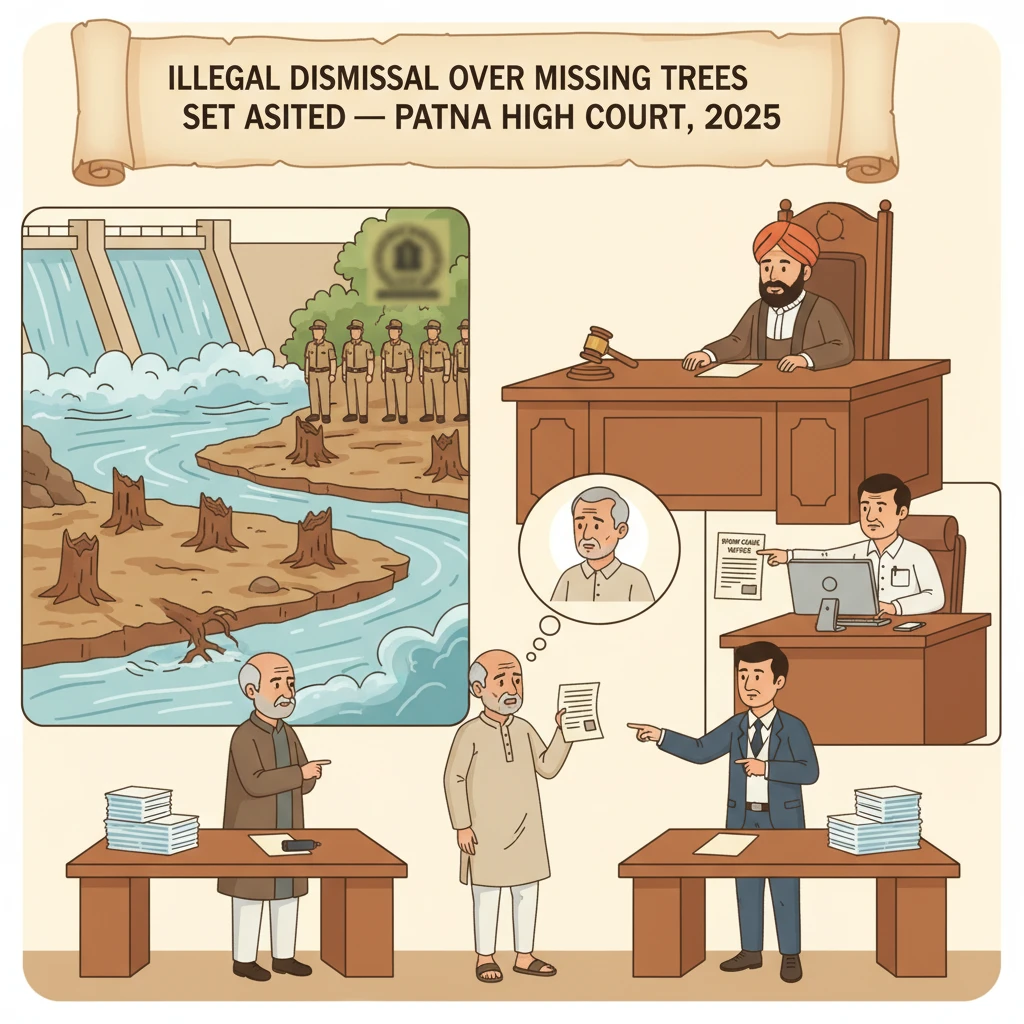
The Cattle Farm is situated on the bank of river Gandak. On 16.07.2004, there was a devastating flood in the Gandak, due to which many trees in the farm area were allegedly uprooted and washed away. The employee reported that 138 Sheesham trees had been lost in this flood.
He says that he made a written report about this loss on 27.09.2004 to the Superintendent, Cattle Farm, and that it was received by one Hari Lal Ram. According to him, this report was accepted and no action was taken at that time.
The employee continued in service without any recorded blame. On 10.08.2009 he was transferred to Tirhut College of Agriculture, Dholi, Muzaffarpur, and he formally handed over charge on 02.07.2011.
The issue of the missing trees resurfaced in 2012. By letter dated 24.02.2012, the University withheld his last pay slip, saying that he had not handed over charge of 140 Sheesham trees. On 02.06.2012, he was asked to explain the loss. He replied on 08.06.2012, referring back to his 27.09.2004 flood-loss report and stating that chowkidars had been deputed to protect the trees.
Despite this, a show cause notice dated 26.12.2012 was issued, stating that an Enquiry Committee had found no evidence that the trees were uprooted or lost in floods and that they appeared to have been illegally removed. He replied on 12.01.2013, again stressing the 2004 report, the prolonged floodwater in the area, subsequent construction of a protection dam in 2005 and excavation of soil from the forest area, and the fact that senior officers had verified his report.
On 31.03.2014, the University passed Resolution No. 12 to initiate departmental proceedings over the alleged loss of 138 Sheesham trees. This resolution covered the petitioner and six other employees. An Inquiry Officer and a Presenting Officer were appointed. A memo of charge was then served, and the petitioner submitted his reply on 24.04.2014 denying the allegations.
The Inquiry Officer submitted his report on 15.12.2014, communicated to the petitioner on 28.02.2015. On 13.03.2015, the Director (Administration) called for his reply. The petitioner sought a Hindi version of the enquiry material, which was supplied on 13.04.2015, and then asked for more documents, including chowkidar duty charts, orders of the Superintendent and any FIR relating to theft of trees. These were never supplied.
Ultimately, by Memo No. 131 dated 22.09.2015, the University dismissed him from service with immediate effect and ordered recovery of the remaining cost of 138 Sheesham trees from his final dues. Earlier, amounts had already been deducted from his salary towards alleged loss.
He approached the Patna High Court in 2016 seeking quashing of the dismissal order and recovery. Later, through I.A. No. 01 of 2024 (allowed on 08.02.2024), he was permitted to challenge the Office Memo dated 23.01.2014, the Enquiry Report dated 15.12.2014, Resolution No. 12 dated 31.03.2014, and the memo of charge.
What the Court Examined and Decided
Hon’ble Mr. Justice Anil Kumar Sinha examined whether the departmental enquiry and the dismissal order complied with the Bihar Government Servants (Classification, Control and Appeal) Rules, 2005 (CCA Rules, 2005) and principles of natural justice.
The petitioner argued that the enquiry was fatally flawed. According to him, the memo of charge did not contain the list of witnesses on whose evidence the department would rely. No oral enquiry was held, no date of enquiry was fixed, and he was never informed of any such date.
He further submitted that no witness was examined in his presence, and he was never given a chance to cross-examine anyone. The Inquiry Officer allegedly relied only on a preliminary enquiry report and written statements collected behind his back. He also pointed out that though a Presenting Officer had been appointed, the Inquiry Officer himself acted as the department’s representative, deciding that there was “no need to summon witnesses”.
The petitioner’s counsel highlighted that the preliminary enquiry report dated 16.08.2012 had not been supplied to him nor listed as part of the documents with the memo of charge. Yet, the Inquiry Officer used this report as the main basis to hold him guilty. He relied on several Supreme Court and Patna High Court decisions to argue that such an enquiry amounted to “no evidence” and violated mandatory procedure.
The petitioner also questioned the long delay: the alleged loss was of 2004, but the departmental proceedings started in 2012 without any explanation. According to him, by then records and witnesses were not easily available, causing serious prejudice. He also pointed out that the valuation of the trees had been raised from about Rs. 2.34 lakh to Rs. 7.50 lakh, and that Rs. 7,50,869/- had already been recovered from his salary before the Court examined the legality of that recovery.
On the other side, counsel for the University claimed that the proceedings followed the CCA Rules, 2005. They argued that the petitioner had been given the charge memo and adequate opportunity to reply and that the Inquiry Officer’s report was reasoned and based on records. They further said that oral examination of witnesses is not necessary in every case, especially when documents are sufficient, and that the shortage was clearly during the petitioner’s tenure as custodian of the Dairy Farm.
The University maintained that the petitioner delayed handing over charge until 02.07.2011, and that on handing over, a shortage of 138 Sheesham trees was detected. They said his flood story was an afterthought and that there was no contemporaneous official record of flood damage. A Committee constituted on 28.05.2012, after site inspection and examination of records, had rejected his explanation. That Committee’s report dated 16.08.2012 formed the basis of the departmental case.
They also explained that the value of the trees was first assessed at Rs. 2,34,698/- and later revised to Rs. 7,50,869/- on the basis of a re-assessment by the Divisional Forest Officer, Begusarai, through letter dated 12.03.2011.
The Court then turned to the procedural requirements of Rule 17(3) of the CCA Rules, 2005. This provision requires that, along with the articles of charge, the delinquent must be given not only the list of documents but also the list of witnesses the department proposes to examine. The Court referred to its earlier judgment in Sudarshan Singh v. The State of Bihar and Ors. (CWJC No. 7439 of 2021), where non-supply of the list of witnesses was held to vitiate the enquiry.
In the present case too, the memo of charge had a list of letters and documents issued by different authorities, but no list of witnesses. The Court held that non-compliance with Rule 17(3) meant the subsequent proceeding was vitiated.
The Court then examined the enquiry report. It found that the Inquiry Officer had “primarily relied” on the preliminary enquiry report dated 16.08.2012 and statements of witnesses collected during that earlier enquiry. The petitioner had not participated in that enquiry, and its report had not been supplied to him or made part of the charge memo.
The Court held that using an ex parte preliminary enquiry in this way, without supplying the report and without affording an opportunity to cross-examine or rebut the material, vitiated the departmental enquiry. The Inquiry Officer had even recorded that there was no need to summon witnesses because their statements would not differ from what they had earlier said in the preliminary enquiry.
The Court noted that, although a Presenting Officer had been appointed, he led no oral evidence and exhibited no documents. Instead, the Inquiry Officer took upon himself the role of the department’s representative and prepared the enquiry report on his own ipse dixit.
The Court referred to Rule 17(14) of the CCA Rules, 2005, which requires that on the date fixed for enquiry, oral and documentary evidence must be produced, witnesses examined by the Presenting Officer, cross-examined by the delinquent, and, if necessary, re-examined. None of this was done.
Relying on the Supreme Court decision in Anil Kumar v. Presiding Officer, AIR 1985 SC 1121, the Court repeated that an enquiry report should not be a bare conclusion of the Inquiry Officer. It must show the charges, the manner of conducting the enquiry, the evidence on record, its analysis, and reasons for the findings in the light of the delinquent’s explanation.
The Court also cited S. K. Verma v. The State of Bihar, 2000 (1) PLJR 116, where it was held that if no witnesses are examined during enquiry, the charges cannot be treated as proved, and that the delinquent must have a reasonable opportunity to cross-examine witnesses and adduce evidence.
Applying these principles, the Court held that in this case no witness had been produced by the Presenting Officer and no documents had been properly exhibited. The Inquiry Officer’s reliance on the preliminary enquiry, without involving the petitioner, violated natural justice. Therefore, the punishment based on such an enquiry could not stand.
On the delay issue, the Court noted that the alleged loss was from 2004, but the departmental proceeding started in 2012, an eight-year gap without justification. The petitioner’s contemporaneous report dated 27.09.2004 about trees washed away in the flood had been received by an official and not questioned for years. Reviving the matter after such a long time, when relevant records and witnesses might not be available, caused clear prejudice. The Court relied on the Supreme Court’s decision in P. V. Mahadevan v. M. D., T. N. Housing Board, (2005) 6 SCC 636, which holds that inordinate and unexplained delay can vitiate disciplinary action.
The Court found that the disciplinary authority, while passing the dismissal order, had merely reproduced the findings of the Inquiry Officer without applying its own mind to the evidence or to the petitioner’s representation.
On this combined factual and legal analysis, the Court concluded that the entire departmental proceeding was vitiated by gross procedural illegality and breach of natural justice. It held that the charges against the petitioner could not be said to be proved.
Accordingly, the Court quashed the punishment order (Memo No. 131 dated 22.09.2015), the Enquiry Report dated 15.12.2014, the Office Order dated 23.01.2014, and Resolution No. 12 dated 31.03.2014 (including the memo of charge).
The Patna High Court directed the University to reinstate the petitioner immediately with all consequential and monetary benefits if he had not yet superannuated. If he had retired, the University was ordered to pay all consequential monetary benefits including retiral benefits. In both situations, the respondents were directed to refund the entire sum of Rs. 7,50,869/- recovered from the petitioner. These payments are to be made within three months from the date of the judgment.
Why This Judgment Matters
This judgment is important for government and university employees in Bihar and beyond who face departmental action. The Patna High Court clearly states that employers must strictly follow the CCA Rules, 2005 and basic natural justice before imposing serious penalties like dismissal and heavy recovery.
The Court has shown that a charge memo without a list of witnesses is not a minor defect; it can nullify the entire enquiry. Similarly, relying on a preliminary enquiry held behind the employee’s back, without calling witnesses in a regular enquiry, is not acceptable.
The judgment also protects employees from disciplinary proceedings being started after long, unexplained delays. When allegations are very old and records are hard to trace, it is unfair to revive them without clear reasons.
For employees accused of loss of public property, this decision emphasises their right to see all material used against them, cross-examine witnesses, and present their own defence. For departments and universities, it is a reminder that shortcuts in procedure can be more costly than conducting a proper, lawful enquiry.
Legal Issues and Answers
-
Issue: Whether a departmental enquiry based on a charge memo without a list of witnesses, and conducted without oral evidence or cross-examination, is valid under the Bihar Government Servants (CCA) Rules, 2005.
Answer: No. The Court held that non-compliance with Rule 17(3) and 17(14), including failure to provide a list of witnesses and to hold a proper oral enquiry, vitiated the entire proceeding. -
Issue: Whether the Inquiry Officer could rely on a preliminary enquiry report and statements collected behind the petitioner’s back to find him guilty.
Answer: No. Reliance on an ex parte preliminary enquiry, without supplying the report or allowing cross-examination or rebuttal, violated principles of natural justice and rendered the enquiry unsustainable. -
Issue: Whether initiation of departmental proceedings in 2012 for an alleged loss of 2004, without explanation, was permissible.
Answer: The Court held that the unexplained eight-year delay caused serious prejudice to the petitioner. Following Supreme Court precedent, such inordinate delay vitiated the disciplinary action.
Cases Cited by the Court
- Anil Kumar v. Presiding Officer, AIR 1985 SC 1121
- S. K. Verma v. The State of Bihar, 2000 (1) PLJR 116
- P. V. Mahadevan v. M. D., T. N. Housing Board, (2005) 6 SCC 636
- Sudarshan Singh v. The State of Bihar and Ors., CWJC No. 7439 of 2021 (Patna High Court)
- Other Supreme Court and Patna High Court authorities were relied upon by counsel but the key decisions applied are those listed above.
Case Details
Case Number: Civil Writ Jurisdiction Case No. 10204 of 2016
Case Title: Dilip Kumar Rai v. Rajendra Agricultural University & Ors.
Court: High Court of Judicature at Patna
Coram: Hon’ble Mr. Justice Anil Kumar Sinha
Date of Judgment: 19.11.2025 (C.A.V.; CAV Date 16.09.2025; Uploading Date 19.11.2025)
Citation: 2026(1) PLJR 210
Advocates:
- For the Petitioner: Mr. Sumeet Kumar Singh, Mr. Nikhil Singh, Ms. Deepali Singh, Mr. Kumar Vikram
- For the Respondents: Mr. Arvind Ujjwal
Nature of the Case: Writ petition challenging dismissal from service and recovery of alleged loss, arising out of departmental proceedings
Link to Judgment (Official): Patna High Court Judgment
If you found this explanation helpful and wish to stay informed about
how legal developments may affect your rights in Bihar,
you may consider following Samvida Law Associates for more updates.







