
Case Background
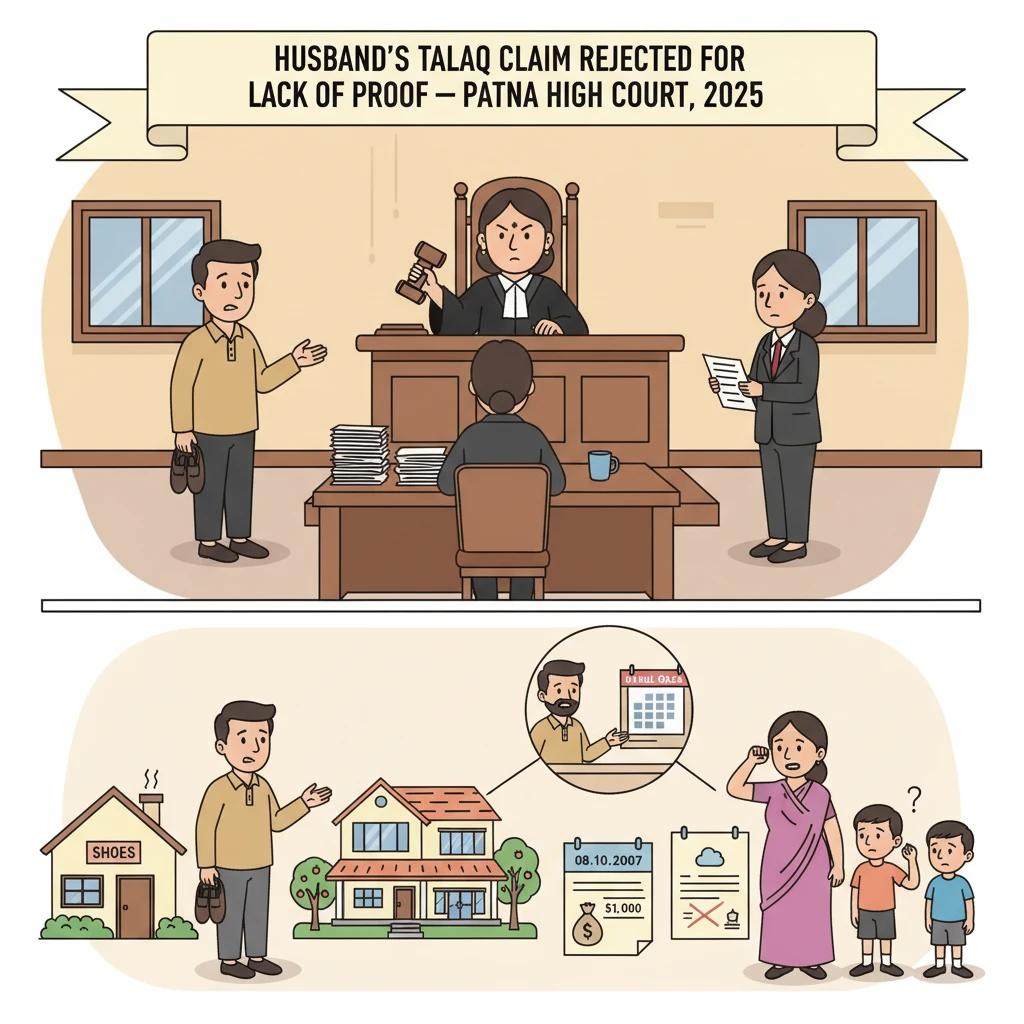
This case arose out of a matrimonial dispute between a Muslim husband (the appellant) and wife (the respondent) from West Champaran district, Bihar.
The parties were married on 12.01.2000. Two sons, Abdullah and Waliullah, were born from the marriage. Initially, they lived together as husband and wife.
According to the husband, differences later developed, and the wife frequently stayed at her parental home. He claimed he worked as a salesman in a shoe shop, was poor, and that the wife preferred living with her economically better-off parents.
He stated that he approached Darul Qaza, Bettiah, for “Bidagari” of the respondent. There, an order was passed for the wife to stay at the matrimonial home. The husband alleged that after staying at her matrimonial house for about 15 days, the wife’s brothers took her back to her parental home where she has been residing since.
The husband further asserted that he filed Matrimonial Case No. 03 of 2007 under Section 281 of Muslim Law. In spite of court directions in that case, he claimed, the wife did not continue to stay at her matrimonial home. He also mentioned that several criminal cases were pending between the parties.
On these grounds, he said he decided to divorce her and pronounced “talaq” three times on 08.10.2007 in presence of witnesses. He then filed Title Suit No. 198 of 2007 before the Principal Judge, Family Court, West Champaran at Bettiah under Section 308 of Muslim Law and Section 7(1)(A) of the Family Courts Act. He sought a declaration that the triple talaq allegedly pronounced on 08.10.2007 was valid, legal and operative from that date.
The Family Court dismissed his suit by judgment and decree dated 28.02.2017, holding that the husband had not properly proved pronouncement of triple talaq as claimed. Aggrieved, he filed the present Miscellaneous Appeal No. 392 of 2017 before the Patna High Court under Section 19(1) of the Family Courts Act, 1984.
What the Court Examined and Decided
Before the Family Court, both sides led evidence. The husband examined four witnesses: P.W. 1 Nasim Akhter, P.W. 2 Shamim Akhter, P.W. 3 Md. Arif, and P.W. 4 himself (Shams Tabrej). They broadly supported his stand that the marriage took place on 12.01.2000, two sons were born, and that later the wife quarreled with the husband and his family, frequently stayed at her parental home, and refused to return.
The husband and his witnesses stated that due to interference of the wife’s brothers and the tense atmosphere, he finally pronounced “talaq” three times on 08.10.2007. They claimed that from that date there was no matrimonial relationship and that he had already paid Rs. 2,100 towards “Dain Mehar” and iddat expenses, though the marriage dain mehar was allegedly Rs. 51,000.
On the other hand, the wife examined four witnesses: O.P.W. 1 Noorshed Alam, O.P.W. 2 Gulab Noor, O.P.W. 3 Shahnaz Begum and O.P.W. 4 herself (Isarat Jahan). They confirmed the marriage of 12.01.2000 and that she initially lived a peaceful conjugal life.
The wife’s side, however, alleged that the husband and his family started torturing her for non-fulfilment of dowry demand and ultimately ousted her from the matrimonial home. Since then, she has been living at her parental home with her two sons.
The wife clearly denied that any talaq was ever pronounced on 08.10.2007 or at any other time. She insisted she was still legally married to the husband and stated that she was willing to perform her marital duties, but the husband was not interested in continuing the relationship. She also denied receipt of any “Dain Mehar” or iddat expenses.
She further pointed out that in Complaint Case No. 2948-C of 2007, on 06.11.2008, the husband’s father had introduced her as the wife of the husband, which according to her showed that no divorce had taken place.
On these rival pleadings and evidence, the Family Court framed several issues, including whether the husband had in fact given divorce to the wife on 08.10.2007 in the presence of witnesses, and whether he was entitled to the relief sought under Section 308 of Muslim Law and Section 7(1)(A) of the Family Courts Act.
The Family Court held that the husband failed to prove proper pronouncement of triple talaq and dismissed his suit. The appeal before the Patna High Court questioned this finding.
Before the High Court, the husband’s counsel argued that the Family Court’s judgment and decree were mechanical and suffered from non-application of mind. It was submitted that the Court below failed to properly appreciate that the talaq was pronounced on 08.10.2007 in the presence of P.Ws. 1, 2 and 3. The counsel also emphasized earlier proceedings: the case before Darul Qaza, Bettiah, and Matrimonial Case No. 03 of 2007 under Section 281 of Muslim Law, where the wife allegedly disobeyed directions to stay with the husband. According to the appellant, these circumstances justified and corroborated his talaq claim.
The wife’s counsel, on the other hand, supported the Family Court’s decision. He submitted that the trial court had evaluated the evidence of both sides correctly and had rightly concluded that the husband had not proved valid pronouncement of talaq.
The High Court framed two main points for determination:
(i) Whether the appellant was entitled to the relief claimed in his petition/appeal.
(ii) Whether the judgment of the Principal Judge, Family Court, was just, proper and sustainable in law.
Before deciding these issues, the High Court first examined whether the alleged triple talaq claimed to have been pronounced on 08.10.2007 was given in accordance with Mohammadan Law.
The husband claimed that he had pronounced three talaqs in the presence of P.W. 1 Nasim Akhtar, P.W. 2 Shamim Akhtar and P.W. 3 Md. Arif. However, the Court noticed a crucial gap: P.W. 1 Nasim Akhtar did not clarify in his examination-in-chief that the triple talaq was in fact pronounced in his presence. This weakened the core of the husband’s version.
Additionally, in paragraph 12 of the plaint, the husband had himself stated that he had earlier pronounced talaq to the respondent, paid the iddat expenses and “Dain Mehar” amount, and later re-married the respondent. However, he did not clarify the date of this alleged re-marriage.
The Court then referred to Section 336(5) of the “Principles of Mohomedan Law”, which deals with the remarriage of a divorced couple. The Court quoted the provision to note that where a husband has repudiated his wife by three pronouncements, it is not lawful for him to marry her again unless she has married another man, and that intermediate marriage has been consummated and then dissolved by divorce or death. Without proof of such an intermediate marriage and its dissolution, remarriage after triple talaq is irregular and not valid.
The Court observed that this mandatory procedure for remarriage after triple talaq had not been followed by the husband. Despite claiming an earlier triple talaq followed by remarriage, he did not show that the legal bar to remarriage had been removed as required by Section 336(5).
This omission led the Court to conclude that a “concocted story” of earlier triple talaq and remarriage had been planted by the husband in the case. It was an admitted fact that the parties married on 12.01.2000 and had two sons. The husband’s narrative that, due to a quarrel, he suddenly pronounced three talaqs on 08.10.2007 “at the spur of the moment” was found inconsistent with Mohammadan Law.
The Court highlighted that under Mohammadan Law, there should be intermediate periods between the first, second and third talaq; an instantaneous, one-sitting pronouncement of triple talaq in such circumstances was not acceptable under the legal principles referred to by the Court.
Further, at the time of marriage, the dain mehar was Rs. 51,000. Yet the husband claimed to have paid only Rs. 2,100 as dain mehar after the alleged talaq. This discrepancy raised serious doubt about the truthfulness of his story.
On an overall assessment, the Court found that the alleged earlier pronouncement of triple talaq had not been proved by “cogent and reliable evidence” and appeared “hypothetical”. It held that the so-called previous pronouncement of talaq had not taken place properly as per the law in force at the relevant time.
Consequently, the High Court agreed with the Family Court’s conclusion that the husband had not established his claim of pronouncement of triple talaq on 08.10.2007. It found no merit in the appeal and held that there was no ground to interfere with the Family Court’s judgment.
The High Court therefore dismissed the Miscellaneous Appeal No. 392 of 2017, affirming the Family Court’s judgment dismissing Title Suit No. 198 of 2007.
Why This Judgment Matters
This judgment is significant for Muslim spouses in Bihar and beyond who may face sudden claims of “triple talaq” in court.
First, it shows that a husband cannot merely assert that he has pronounced talaq; he must prove it clearly with reliable evidence. Witnesses must specifically support that talaq was actually pronounced in their presence.
Second, the Patna High Court underlines that triple talaq cannot be treated as a casual, spur-of-the-moment act. The Court stresses that the procedure under Mohammadan Law, including the manner of pronouncement and legal conditions for remarriage, must be respected.
Third, the decision protects wives from being declared “divorced” on the basis of unproven or inconsistent stories. Where the husband’s version is doubtful, and the wife continues to assert that she is still married and wants to live with him, courts will demand strict proof.
Finally, the case confirms that appellate courts like the Patna High Court will support Family Courts when they carefully evaluate evidence and refuse to grant declarations based on weak or contradictory claims of talaq.
Legal Issues and Answers
- Issue: Did the husband validly pronounce triple talaq on 08.10.2007 in accordance with Muslim law, entitling him to a declaration that the marriage stood dissolved?
Answer: No. The Patna High Court held that the husband failed to prove proper pronouncement of triple talaq on 08.10.2007 and that his story of earlier talaq and remarriage was not in line with the requirements of Mohammadan Law. - Issue: Was the judgment of the Principal Judge, Family Court, West Champaran at Bettiah dismissing the husband’s suit just, proper and sustainable in law?
Answer: Yes. The High Court affirmed the Family Court’s judgment, holding that there was no error and no ground for interference.
Cases Cited by the Court
- The judgment refers to the text “Principles of Mohomedan Law” and specifically Section 336(5) on remarriage of divorced couples. No other judicial precedents are expressly cited or relied upon in the text provided.
Case Details
Case Number: Miscellaneous Appeal No. 392 of 2017; arising out of Title Suit No. 198 of 2007
Case Title: Shams Tabrej v. Isarat Jahan
Coram: Hon’ble Mr. Justice P. B. Bajanthri and Hon’ble Mr. Justice S. B. Pd. Singh
Citation: 2025(3) PLJR 67
Date of High Court Judgment: 05.05.2025
CAV Date: 18.04.2025
Nature of the Case: Miscellaneous Appeal under Section 19(1) of the Family Courts Act, 1984 against a decree of the Family Court in a matrimonial declaration suit under Section 308 of Muslim Law and Section 7(1)(A) of the Family Courts Act.
Court of First Instance: Court of the Principal Judge, Family Court, West Champaran at Bettiah, in Title Suit No. 198 of 2007.
Result in Family Court: Suit dismissed; the Family Court held that the husband had not proved valid pronouncement of triple talaq.
Result in High Court: Appeal dismissed; Family Court judgment affirmed; no interference warranted.
Advocates:
For the Appellant (Husband): Mr. Mahta Alam, Advocate
For the Respondent (Wife): Mr. Bashishtha Narayan Mishra, Advocate; Mr. Avinash Raj, Advocate; Mr. Braj Kishor Mishra, Advocate
Link to Judgment: https://patnahighcourt.gov.in/viewjudgment/MiMzOTIjMjAxNyMxI04=-FNyhmfT6Abo=
If you found this explanation helpful and wish to stay informed about
how legal developments may affect your rights in Bihar,
you may consider following Samvida Law Associates for more updates.







