

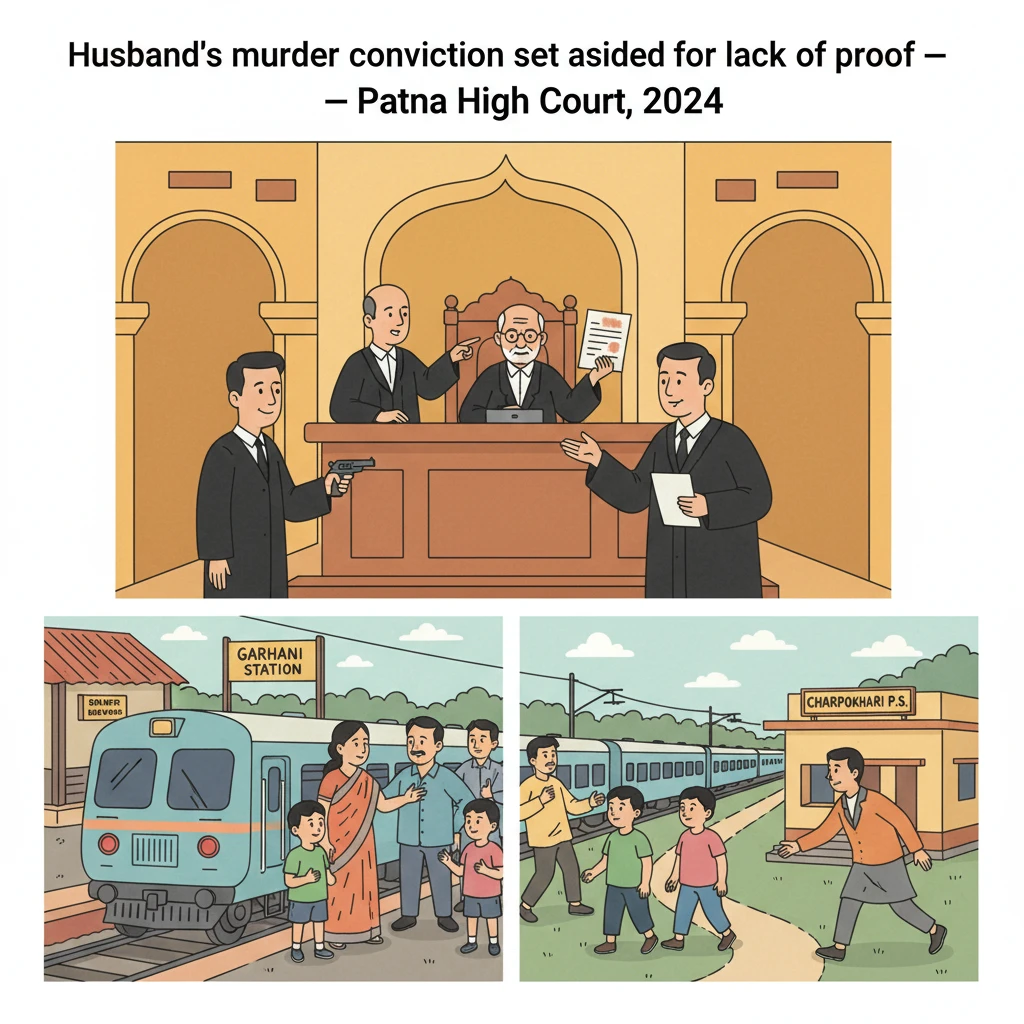
Case Background
The criminal appeal came before the Patna High Court against a judgment dated 11.07.2017 and order of sentence dated 17.07.2017 passed by the 4th Additional District and Sessions Judge, Bhojpur at Ara, in Sessions Trial Case No. 112 of 2015. The trial had arisen out of Charpokhari P.S. Case No. 40 of 2015.
The trial court had found the appellant, the husband of the deceased woman, guilty under Section 302 of the Indian Penal Code and sentenced him to imprisonment for life with a fine of Rs. 50,000/-. Out of this, Rs. 40,000/- was directed to be paid to the sons of the deceased. He was also charged under Section 120B/34 of the IPC and Section 27 of the Arms Act.
The prosecution story started with the fardbeyan of the victim’s 12‑year‑old son, recorded on 06.02.2015 at about 2:15 p.m. at Charpokhari Police Station. He alleged that his mother was shot dead by his father inside a passenger train after the family’s visit to the family court at Ara, where she had filed a case against her husband in 2012.
On the basis of this fardbeyan, Charpokhari P.S. Case No. 40 of 2015 was registered under Sections 302, 120B/34 of IPC and Section 27 of the Arms Act against four accused, including the husband. After investigation, police submitted charge-sheet first against a co-accused, and later a supplementary charge-sheet against the husband. Trial of both was amalgamated.
What the Court Examined and Decided
The High Court, speaking through Hon’ble Mr. Justice Shailendra Singh (Hon’ble Mr. Justice Rajeev Ranjan Prasad concurring), closely examined the entire evidence: the child witnesses’ statements, the “chance witnesses”, the medical evidence and the investigation lapses.
The prosecution case was that on 06.02.2015, the victim, along with her twin sons (PW‑4 and PW‑5), went to the family court at Ara in connection with a case she had filed against her husband in 2012. As the husband did not appear, the court fixed a new date, 19.03.2015. Thereafter, they went to Ara Railway Station around 1:00 p.m. to board a passenger train.
According to PW‑5’s fardbeyan, he saw his father (the appellant) at Ara station along with two uncles and another relative. All of them allegedly boarded the same train in another coach. When the train later halted at Garhani, the uncles allegedly told the father that this was a good chance to shoot the victim. On that instigation, the father allegedly fired three shots at his wife from a pistol inside the coach and then all accused escaped by jumping off the slowing train. The victim died on the spot.
The boy further said that when the train reached Charpokhari station, he and his brother, frightened, got down. While walking towards Charpokhari Police Station, they met their maternal relatives who took them to the police station, where his statement was recorded. The motive alleged was the husband’s illicit relationship with another woman and the resulting strained marriage, physical torture, and the wife’s decision to live at her maternal home and file a family court case.
The prosecution examined nine witnesses including the two sons (PW‑4 and PW‑5), three relatives projected as “chance witnesses” (PW‑1, PW‑2, PW‑3), the investigating officer (PW‑6), police officials (PW‑7 and PW‑8) and the doctor who conducted the post-mortem (PW‑9). Two empty cartridges were produced as material exhibits.
In defence, the appellant examined four witnesses and produced several registers from his CRPF posting in Jammu to support a plea of alibi, claiming he was on duty there on the date of occurrence.
Defence Arguments
Counsel for the appellant argued that the main eye-witnesses, the minor sons, were tutored by their maternal relatives. There were material contradictions in their statements. No independent passenger from the allegedly crowded train coach was examined, nor any railway employee.
It was submitted that PW‑1, PW‑2 and PW‑3 were close relatives of the victim and had been projected as chance witnesses at crucial places, but their presence there was doubtful and their versions contradictory. Counsel pointed out that the investigation was done by the local police, not the railway police, despite the alleged crime occurring in a train coach. The officer who allegedly seized the empty cartridges was not examined. The IO did not seize bloodstains from the coach.
It was also pointed out that medical evidence suggested shots from two different positions, whereas the prosecution claimed all three shots were fired in one go. Finally, the appellant relied on his alleged presence at his duty station in Jammu supported by registers.
State’s Stand
The State’s counsel maintained that the appellant was the shooter and the sons of the victim, present throughout, had consistently supported the prosecution story in their Section 164 Cr.P.C. statements and in court. The presence of PW‑1 to PW‑3 was said to be natural and their evidence trustworthy. The post-mortem report was said to fully match the allegation of three gunshot injuries.
Scrutiny of Chance Witnesses
The High Court referred to the Supreme Court ruling in Rajesh Yadav and Another vs. State of Uttar Pradesh, (2022) 12 SCC 200, which requires very cautious scrutiny of chance witnesses and insists that they adequately explain their presence at the place of occurrence.
On examining PW‑1 and PW‑2, the Court found their presence at the alleged meeting point with the children (Varni Mor) improbable. Timings and distances did not match. The alleged occurrence was around 1:45 p.m. at Garhani Halt. The train then travelled 8–10 km to Charpokhari. PW‑2 admitted he reached Varni Mor, about 500 gaj from Charpokhari station, at 2:00 p.m., which did not tally with the time needed for train movement and walking by the children.
Neither PW‑1 nor PW‑2 gave a convincing reason for being at Varni Mor, especially as PW‑2 lived in another district. Their statements differed about how other people at the station reacted to the crying children. They contradicted each other about how the children reached Piro station—PW‑1 said by motorcycle, whereas PW‑4 said they went in a police vehicle.
The Court also noted that persons named by PW‑1 as accompanying them to Piro station were neither examined nor shown to have had their statements recorded by the IO. PW‑1’s version that no police action had begun at Piro until their arrival conflicted with PW‑2’s claim that the body was being removed as soon as they reached.
PW‑3, another relative, claimed to be present at Piro station when police prepared the inquest report, and said he came to know of a murder while waiting for a train. But he did not mention seeing PW‑1 and PW‑2 there, and they also did not speak of his presence. This made his presence appear “suspicious” to the Court.
Conduct of the Children and Suppression of First Version
The High Court found the conduct of the 12‑year‑old sons after the alleged killing “some suspicious”. According to them, they left their mother’s body in the coach at Garhani, travelled to Charpokhari, and then got down alone and walked towards the police station, instead of seeking help from passengers or railway staff.
The Court also focused on PW‑5’s admission in cross-examination that his first beyan was taken on a blank paper and that his grandfather and uncle had not signed that first statement. Yet the exhibited fardbeyan (Ext. 4), on which the FIR was based, carried signatures of PW‑1, PW‑2, PW‑5 and his brother. The prosecution gave no explanation for this mismatch.
From this, the Court inferred that the earliest version of PW‑5 had been suppressed and not produced, a serious defect when he was projected as an eye-witness.
Doubt About Place of Occurrence and Investigation Lapses
The FIR claimed the murder took place inside a passenger train coach at Garhani Halt. The Court found several reasons to doubt this:
First, when a serious offence occurs on a train or railway premises, the Government Railway Police or Railway Protection Force normally investigate, and train guards or other officials usually make some report. In this case, no railway official from the concerned train, Charpokhari station or Piro station was examined. No explanation was offered.
Second, prosecution witnesses themselves said there were many passengers in the coach and at Piro station when the body was taken out, yet not a single independent passenger was examined.
Third, Ara is a major railway station equipped with CCTV cameras. If the appellant and co-accused had boarded the train there, their movement could have been checked through footage. The IO made no such effort.
Fourth, PW‑5 said his mother had a railway ticket, but the IO was silent about recovery of ticket, purse or other belongings. He also admitted in cross-examination that bloodstains in the coach were not seized.
Fifth, the seizure of two empty cartridges from the coach was said to be by a police official, Pitambar Chaudhary of Charpokhari Police Station. He was never examined, and the cartridges were produced in court unsealed, as PW‑8 admitted. This damaged the credibility of the seizure.
In addition, the Court found the presence of the three chance witnesses (PW‑1, PW‑2, PW‑3) at the alleged locations not natural and their evidence inconsistent. All of this, taken together, meant the prosecution failed to prove beyond reasonable doubt that the murder happened in the manner and place alleged.
Medical Evidence and Child Witnesses
The doctor (PW‑9) found three gunshot injuries. He said two were caused from the left side to right side, and the third from the right side, indicating shots from two different positions. However, PW‑4 and PW‑5 never stated that the assailant changed position. This inconsistency between medical and ocular versions further weakened the prosecution case.
The trial court had relied heavily on PW‑4 and PW‑5 to convict the appellant, yet in the same judgment refused to rely on them regarding the co-accused Sheo Chaudhary @ Ramjee Rai, observing that child witnesses’ evidence required corroboration. The High Court found this approach inconsistent and improper.
Plea of Alibi
The appellant pleaded that he was at his posting in Kishtwar, Jammu, on the date of occurrence. He produced several registers and examined defence witnesses. The High Court agreed with the trial court in rejecting this plea because DW‑1, a CRPF Sub-Inspector, stated that while the appellant had returned from leave on 31.01.2015, he subsequently became absent and it was unclear whether he again went on leave or simply absented himself.
Thus the alibi was not proved. However, the prosecution’s failure to prove guilt beyond reasonable doubt remained decisive.
Final Decision
After weighing all circumstances, the Court held that:
The victim was undoubtedly killed by gunshot injuries, and she was on litigating terms with her husband. But the prosecution failed to present convincing, independent evidence fixing the responsibility on the appellant. Key witnesses appeared planted or tutored, the place of occurrence was not proved, and the investigation was seriously defective.
The Court therefore extended the benefit of doubt to the appellant, set aside his conviction and sentence, allowed the appeal, and directed that he be released forthwith if not required in any other case. The lower court records were ordered to be sent back, and copies of the judgment sent to the trial court and jail authorities.
Why This Judgment Matters
This judgment shows that in criminal cases, especially murder, courts will not uphold a conviction merely because there is a strong suspicion or a bad relationship between spouses.
The Patna High Court emphasised that:
If key witnesses are close relatives whose presence at the scene seems doubtful, their statements must be closely checked. Where the alleged crime scene is a public place like a train, failure to examine independent passengers and railway staff can be fatal to the prosecution.
The case also underlines the duty of investigators to:
Involve the proper agency (such as railway police for offences on trains), collect physical evidence like bloodstains and tickets, safeguard seized articles properly, and preserve the earliest version of eye-witnesses, rather than replacing it with a later, possibly tutored statement.
For accused persons, the judgment reaffirms that if there are serious gaps and contradictions in the prosecution story, the benefit of doubt must go to the accused, even in grave offences like murder.
Legal Issues and Answers
- Issue: Whether the prosecution proved beyond reasonable doubt that the appellant murdered his wife by shooting her inside a passenger train coach.
Answer: No. The Patna High Court found major contradictions, unreliable chance witnesses, doubtful conduct of child witnesses, non-proof of place of occurrence, and serious investigation lapses, and therefore set aside the conviction. - Issue: Whether the appellant’s plea of alibi, claiming he was on duty in Jammu, was established.
Answer: No. The defence evidence showed that after returning from leave the appellant became absent and it was not clear if he was officially on leave, so the Court did not accept the alibi. - Issue: How far can uncorroborated child-witness testimony and unconvincing chance witnesses sustain a conviction for murder.
Answer: The Court held that in the presence of contradictions, suspicious conduct, and lack of independent corroboration, such evidence is unsafe to rely on for sustaining a conviction.
Cases Cited by the Court
- Rajesh Yadav and Another vs. State of Uttar Pradesh, (2022) 12 SCC 200 – cited on the law regarding appreciation of evidence of chance witnesses.
Case Details
Case Number: Criminal Appeal (DB) No. 937 of 2017; arising out of Charpokhari P.S. Case No. 40 of 2015; Sessions Trial Case No. 112 of 2015.
Case Title: Kamlesh Kumar Rai v. The State of Bihar
Citation: 2024(2) PLJR 233
Coram: Hon’ble Mr. Justice Rajeev Ranjan Prasad; Hon’ble Mr. Justice Shailendra Singh
Advocates: For the appellant – Mr. Ravindra Kumar, Advocate; Mr. Sandeep Kumar Pandey, Advocate. For the State – Ms. Shashi Bala Verma, Additional Public Prosecutor.
Nature of the Case: Criminal appeal (Division Bench) against conviction and sentence under Section 302 IPC and allied provisions.
Link to Judgment: Patna High Court Judgment
If you found this explanation helpful and wish to stay informed about
how legal developments may affect your rights in Bihar,
you may consider following Samvida Law Associates for more updates.







