
Case Background
This case arose from a matrimonial dispute between a husband and wife whose marriage took place in 2017. According to the wife, she was subjected to cruelty and harassment by her husband and his family for dowry and for giving birth to a girl child.
The wife alleged that soon after marriage, demands for dowry started. She claimed that her sister-in-law once tried to assault her with a knife while intoxicated, and that her mother-in-law mentally harassed her. She further alleged that her father-in-law attempted to sexually abuse her after consuming alcohol and taunted her about failure to provide a car as dowry. Similar allegations of physical and sexual assault were levelled against the husband’s uncle.
After the birth of a female child, the wife stated that the family members were displeased and wanted a male child instead. She alleged that she was coerced to give the girl in adoption to her elder sister-in-law. On her refusal, she alleged that the husband and his brother assaulted her and that there were also allegations of sexual abuse against the brother-in-law.
According to the FIR, when she complained to her husband about these incidents, he allegedly assaulted her and threw her out of the matrimonial home along with the minor daughter, forcing her to live at her parental house. She alleged that on 09.08.2024, all the accused came to her parental house and tried to forcibly take away the child, but did not succeed.
Later, on 25.08.2024, the husband allegedly took away the minor child deceitfully. Despite repeated requests, the accused persons allegedly refused on 11.09.2024 to return the child. This led the wife to lodge Nayagaon P.S. Case No.184 of 2024.
The FIR invoked multiple provisions of the Bharatiya Nyaya Sanhita (BNS) corresponding to earlier Indian Penal Code sections, including those relating to wrongful restraint, hurt, outraging modesty, cruelty by husband or relatives, insult, criminal intimidation, use of obscene words and common intention, as well as sections 3 and 4 of the Dowry Prohibition Act.
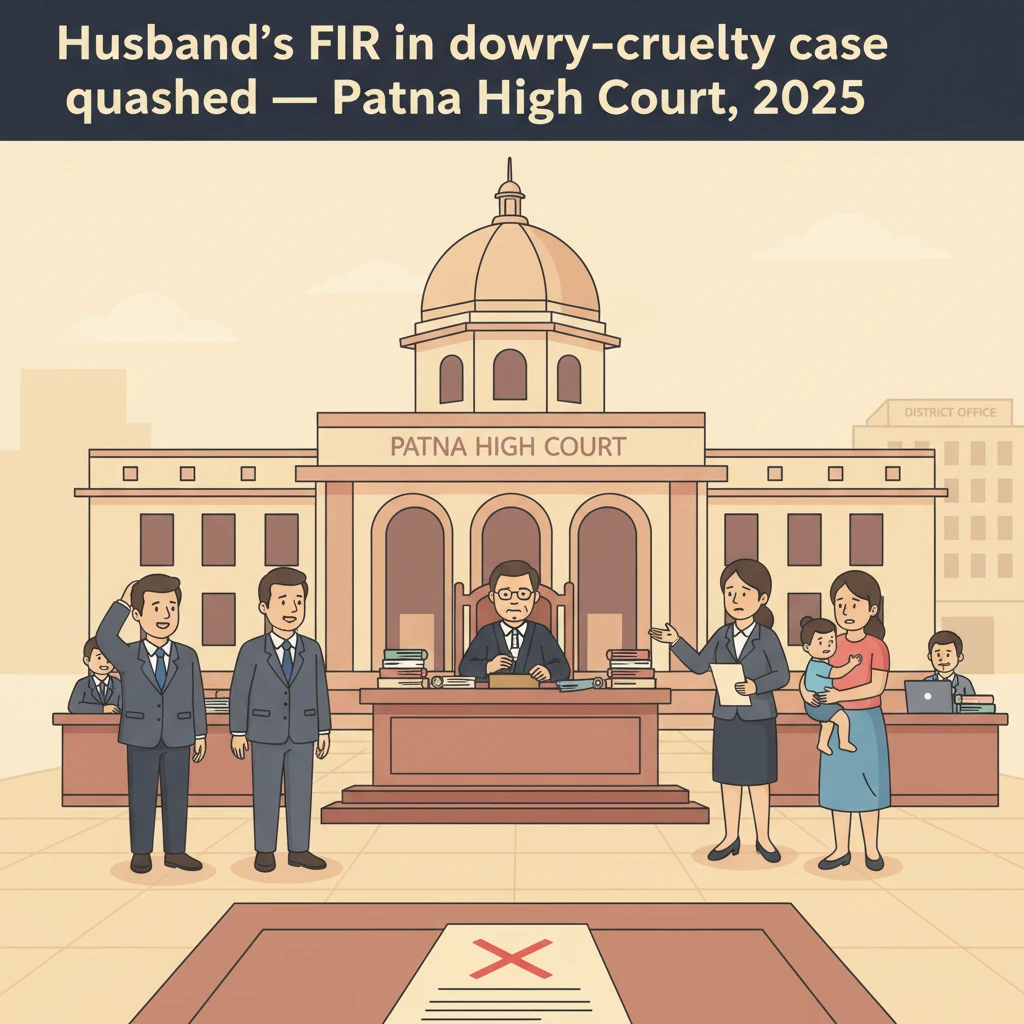
The husband then approached the Patna High Court under Section 482 of the Code of Criminal Procedure / Section 528 of the Bharatiya Nagarik Suraksha Sanhita (BNSS), asking for the FIR to be quashed against him.
Earlier, by order dated 04.02.2025, further proceedings in the police case were stayed. On 16.05.2025, the matter was referred to mediation before the Mediator of the Patna High Court, but mediation failed. The wife has also approached the Family Court separately for custody of the child.
What the Court Examined and Decided
The matter was heard by Hon’ble Mr. Justice Purnendu Singh. On the day of hearing, counsel for the husband did not respond despite repeated requests from the wife’s senior counsel to appear. However, the Court proceeded to hear the matter on merits based on the submissions of the learned senior counsel for the informant and the record.
The wife’s senior counsel told the Court that the FIR contained detailed and serious allegations against the husband and his relatives for dowry demand, cruelty, and sexual abuse. He emphasized that the husband and his family were allegedly unhappy with the birth of a girl child and forced the wife to give the child in adoption to the elder sister-in-law. When she refused, she was allegedly assaulted and finally driven out.
He submitted that the husband later abducted the child and that, aggrieved by these acts, the wife filed the FIR. He also informed the Court that the wife had already moved the Family Court seeking custody of the child.
To oppose the quashing request, he relied on the Supreme Court decision in M/s Neeharika Infrastructure Pvt. Ltd. vs. State of Maharashtra (2021 SCC Online SC 315). That judgment lays down that High Courts should be very slow in stopping investigation or quashing FIRs at an early stage and that police must be allowed to investigate cognizable offences except in very rare situations.
He further relied on the Supreme Court decision in Veena Mittal vs. State of Uttar Pradesh & Ors. (Criminal Appeal No.122 of 2022). In that case, the Supreme Court held that the High Court had wrongly quashed proceedings against the husband’s mother and sister by assuming they would not be direct beneficiaries or linked to the crime, despite allegations in the FIR.
The senior counsel argued that, as investigation was still going on, the Patna High Court should not examine the veracity or truth of the allegations and should not quash the FIR at this stage.
After hearing the submissions and perusing the case records, the Court focused on whether the allegations in the FIR made out a case of “cruelty” by the husband under Section 85 of the BNS (earlier Section 498A IPC). The Court reproduced Section 85 of BNS, which punishes a husband or his relatives who subject a woman to cruelty with imprisonment up to three years and fine.
The Court first evaluated whether there was material to show that the husband had driven the informant to commit suicide or caused grave injury or danger to her life, limb or health, which is an essential aspect of “cruelty” under the law. On examining the FIR carefully, the Court found no material on record to draw such a conclusion against the husband.
Regarding the reliance on the Neeharika Infrastructure judgment, the Court held that the principle laid down there concerned offences like cheating, criminal breach of trust and forgery, and mainly guided when to grant or deny interim stay of investigation. In the present matrimonial case, the factual matrix and allegations were different. The Court concluded that the Neeharika judgment did not directly assist the informant.
Similarly, the Court found that the Veena Mittal judgment was not relevant in the present case. In Veena Mittal, the focus was on whether there were specific allegations against the groom’s mother and sister. Here, the Court noted that “sweeping allegation” had been made by the wife against her husband, but at no point since the marriage in 2017 had she earlier alleged cruelty by the husband.
The Court then referred to the landmark Supreme Court decision in State of Haryana & Ors. vs. Ch. Bhajan Lal & Ors., later clarified in Lalita Kumari vs. Government of U.P. In Lalita Kumari, the Supreme Court recognised that in certain categories of cases, including matrimonial and family disputes, a preliminary inquiry may be held before registering an FIR, considering the nature of such disputes.
The Patna High Court emphasised that matrimonial disputes are private conflicts between spouses and are not typically offences against society. It relied on B.S. Joshi vs. State of Haryana, where the Supreme Court highlighted that courts should encourage genuine settlements in matrimonial matters and that prolonged criminal litigation can destroy the young years of the parties.
The Court also discussed the extent of High Court powers under Section 482 Cr.P.C. (now Section 528 BNSS). Citing State of Karnataka vs. Muniswamy, the Court reiterated that it can quash criminal proceedings where allowing them to continue would be an abuse of the process of the Court or where the ends of justice so require. The inherent power is meant to ensure that criminal proceedings do not become a weapon of harassment or persecution.
The Court then noted guidance from State of Bihar vs. Mohd. Khalique, where the Supreme Court cautioned that quashing of FIRs should be done sparingly and only in rare cases. However, it also recognised that if documents produced by an accused are of unimpeachable character and show that the accusations are unsustainable, forcing a full criminal trial would itself be unjust.
Applying these principles, the Court looked closely at the specific role attributed to the husband in the FIR. It found that the serious allegations of sexual abuse and physical assault were primarily directed against the father-in-law and uncle. The FIR did not state that the husband himself had assaulted the wife, except for a general statement that he assaulted and ousted her, without supportive details or earlier history of cruelty since 2017.
The Court concluded that the husband appeared to have been made a “prey” by the wife mainly to attract Section 498A IPC (now Section 85 BNS) simply because he was her husband, while concrete allegations were against other family members.
The Court was also conscious that the couple had a minor child who required “equal attention, care and love of both father and mother”. The wife had already sought custody of the child before the Family Court, which was the proper forum to decide custody issues. The Court referred to decisions such as Howarth v. Northcott and Mausami Moita Ganguli v. Jayant Ganguli to underline that the welfare of the child is of paramount importance.
Continuing criminal proceedings against the husband based only on general and omnibus allegations, in this background, was held to be an abuse of the process of law. Therefore, the Court exercised its inherent power to protect the husband from unnecessary criminal trial.
In the result, the Patna High Court quashed and set aside the FIR in Nayagaon P.S. Case No.184 of 2024, but only with respect to the husband–petitioner. The petition was allowed. The Court also expressed hope that, even after quashing the FIR against the husband, the parties, being husband and wife, might still reconcile their strained relationship amicably, preferably outside the Court.
Why This Judgment Matters
This judgment shows how the Patna High Court can step in to stop criminal proceedings where the allegations against the husband are only general and not backed by specific facts. It underlines that dowry and cruelty laws must not be misused as a tool of pressure when the main accusations lie against other family members.
For spouses facing similar situations, the decision clarifies that matrimonial disputes involving children should preferably be handled with sensitivity, keeping the child’s welfare at the centre. Criminal law is a serious step, and courts will look closely at whether the FIR really discloses cruelty by the particular accused or not.
The judgment also reflects that having a separate child custody case in the Family Court does not automatically justify criminal proceedings against a spouse when the basic ingredients of cruelty are missing. At the same time, proceedings against other accused are not automatically affected by this order.
Legal Issues and Answers
- Issue: Did the FIR disclose specific, legally sufficient allegations of cruelty and dowry-related offences against the husband so as to justify continuation of criminal investigation against him?
Answer: No. The Court found that the serious allegations were primarily against other in-laws, that there was no clear material showing cruelty by the husband, and that continuing proceedings against him would amount to abuse of process. Therefore, the FIR was quashed only as against the husband.
Cases Cited by the Court
- M/s Neeharika Infrastructure Pvt. Ltd. vs. State of Maharashtra, 2021 SCC Online SC 315
- Veena Mittal vs. The State of Uttar Pradesh & Ors., Criminal Appeal No.122 of 2022 arising out of SLP (Crl) No.5732 of 2019
- State of Haryana & Ors. vs. Ch. Bhajan Lal & Ors., (1992) Supp (1) SCC 335
- Lalita Kumari vs. Govt. of U.P., (2014) 2 SCC 1
- State of Karnataka vs. Muniswamy & Ors., (1977) 2 SCC 699
- State of Bihar & Anr. vs. Mohd. Khalique & Anr., (2002) 1 SCC 652
- State of Madhya Pradesh & Ors. vs. Shri Ram Singh, AIR 2000 SC 870
- B.S. Joshi vs. State of Haryana, (2003) 4 SCC 675
- G.V. Rao vs. L.H.V. Prasad, (2000) 3 SCC 693 : 2000 SCC (Cri) 733
- Howarth v. Northcott, 152 Conn 460
- Mausami Moita Ganguli v. Jayant Ganguli, (2008) 7 SCC 673
Case Details
Case Number: Criminal Miscellaneous No. 74937 of 2024 (arising out of Nayagaon P.S. Case No.184 of 2024, District Saran)
Case Title: Ankit Kumar Singh vs. The State of Bihar & Megha Singh
Coram: Hon’ble Mr. Justice Purnendu Singh
Date of Judgment: 16-12-2025
Citation: 2026(1) PLJR 370
Advocates:
- For the Petitioner (husband): Mr. Radha Mohan Singh, Advocate
- For the State (Opposite Party No.1): Mr. Ajit Kumar, APP
- For the Informant / Opposite Party No.2 (wife): Mr. Ashish Giri, Senior Advocate; Mr. Rajat Kumar Tiwary, Advocate; Ms. Deepika Sharma, Advocate
Nature of the Case: Petition under Section 482 Cr.P.C. / Section 528 BNSS for quashing of FIR in a matrimonial dowry-cruelty case
Link to Full Judgment: Click here to read the Patna High Court judgment
If you found this explanation helpful and wish to stay informed about
how legal developments may affect your rights in Bihar,
you may consider following Samvida Law Associates for more updates.







