
Case Background
The case arises from a matrimonial dispute between a husband (appellant) and wife (respondent), both residents of Begusarai district in Bihar.
Their marriage was solemnised on 19.12.2001 according to Hindu rites and customs. After marriage, they lived together in the husband’s family home. Two daughters were born in 2003 and 2005, and a son, Aryan, was born in 2007.
According to the husband, the relationship began to deteriorate about two years after marriage. He alleged that the wife’s behaviour towards his parents and brothers became arrogant and that she often ill-treated them. He further claimed that she used to display violent temperament on trivial issues raised by his parents and other in-laws.
The husband stated that on 01.01.2006, the wife prepared to go out in the morning. When he inquired where she was going, she allegedly quarrelled with him and threatened to commit suicide, though she was pacified after considerable persuasion.
He also alleged that on the same night he found a note, said to be in the handwriting of the wife, in which she admitted her arrogant behaviour, questionable character and adulterous conduct. He further stated that her parents and brothers used to support her, and they allegedly threatened him from time to time.
The husband’s stand was that despite the birth of three children, the wife’s conduct remained cruel and unpleasant towards him and his family members.
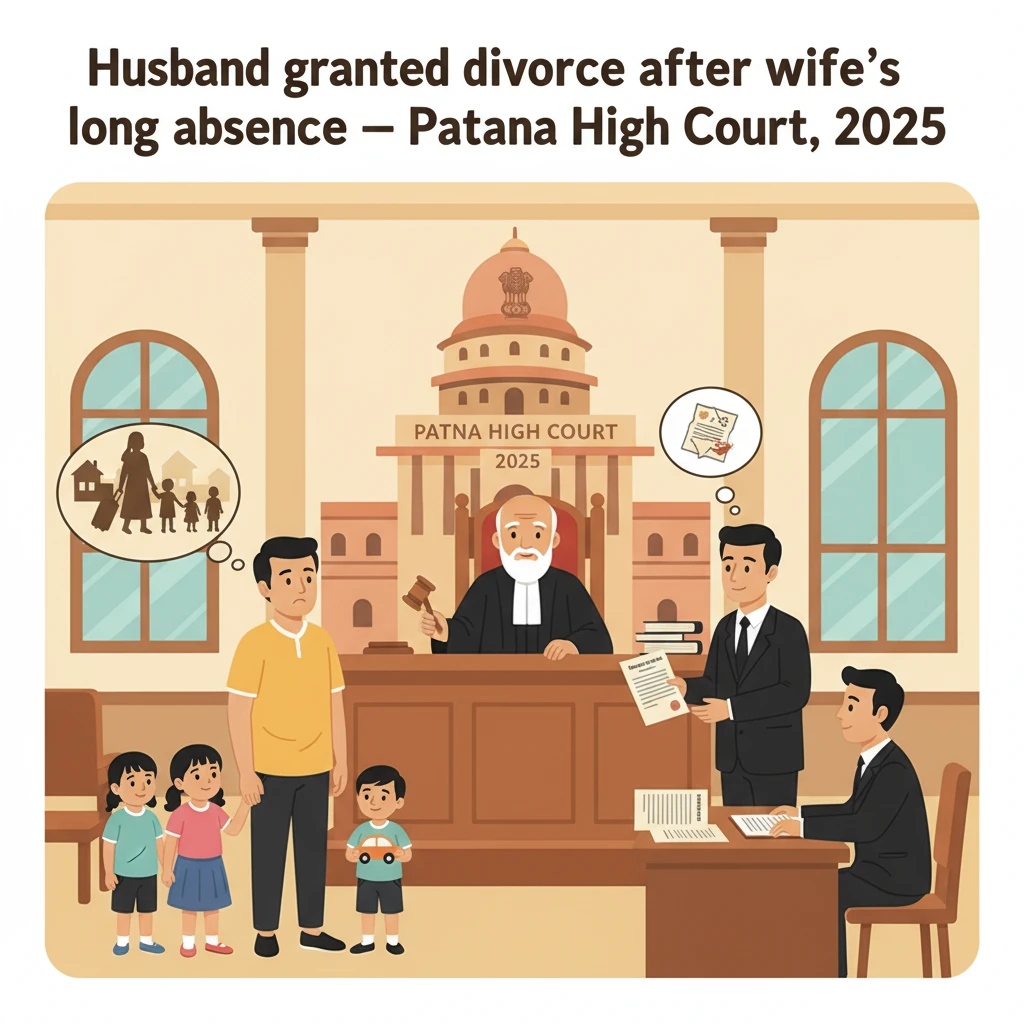
He stated that on 15.12.2011 the wife left the matrimonial home and went to her parental house (naihar) along with her clothes, jewellery and the children, without informing him or seeking his permission. He claimed that he made repeated efforts to bring her back, but she refused and clearly expressed her wish to obtain a divorce.
On 04.01.2015, when he again went to her parental house to persuade her to return, he alleged that he was misbehaved with by the wife and her family members. Thereafter, he filed a complaint before the Chief Judicial Magistrate on 13.02.2015.
On these facts, the husband filed Divorce Case No. 106 of 2015 before the Principal Judge, Family Court, Begusarai, seeking dissolution of marriage mainly on the grounds of desertion, cruelty and adultery.
In that divorce case, the wife did not appear. Still, by judgment and decree dated 12.07.2017, the Family Court dismissed the husband’s petition. The trial court disbelieved the two witnesses, including the husband himself and his father, and held that the husband had deliberately deserted his wife and that his allegation of adultery against her was false and itself amounted to cruelty by the husband.
Aggrieved by the dismissal of his divorce petition, the husband filed Miscellaneous Appeal No. 853 of 2017 before the Patna High Court under Section 19(1) of the Hindu Marriage Act.
What the Court Examined and Decided
The Patna High Court, comprising Hon’ble the Acting Chief Justice and Hon’ble Mr. Justice S. B. Pd. Singh, heard the appeal. The judgment was authored by Hon’ble Mr. Justice S. B. Pd. Singh.
On the date of hearing, only the learned counsel for the appellant-husband, Mr. Kumar Ravish, appeared. The respondent-wife did not appear, despite valid service of notice.
The Court first recorded the procedural history of service of notice on the wife. Initially, a dasti notice was served, which was accepted by the wife’s sister-in-law, Puja Kumari. However, no one appeared on behalf of the wife.
On 17.03.2025, the High Court directed the appellant to take fresh steps for service of notice through newspaper publication. By order dated 22.07.2025, the Court held that the notices issued through newspaper publication were sufficient. Even after this, no appearance was entered on behalf of the respondent-wife before the High Court.
Before the Family Court also, the wife had not appeared. Thus, at both stages – trial in the Family Court and appeal before the Patna High Court – the wife chose not to contest the proceedings.
On merits, the husband’s case was that the wife had treated him and his family with cruelty, had left the matrimonial home with the children and belongings on 15.12.2011 without any reasonable cause, and had refused to return despite several requests.
He also relied on the alleged note written by the wife, where she is said to have admitted arrogant behaviour, questionable character and adulterous conduct. Additionally, he claimed that the conduct of the wife’s parents and brothers in supporting her and threatening him added to his suffering.
In support of his divorce petition, the husband examined himself and his father as witnesses. They supported his version of events in full. Since the wife never appeared, there was no cross-examination of these witnesses.
The trial court nevertheless dismissed the divorce petition, holding that the husband had himself deliberately deserted his wife and that levelling false allegations of adultery against her amounted to cruelty by the husband.
The appellant’s argument before the High Court was that the Family Court’s dismissal was cursory, without proper appreciation of the pleadings and evidence, and that the Family Court had wrongly saddled him with costs. He contended that there was sufficient material on record to show cruelty and desertion by the wife.
He further argued that the respondent-wife’s failure to appear either before the Family Court or the High Court, despite repeated notices and opportunities, itself showed her lack of interest in living with him or contesting the allegations. According to him, this absence was strong evidence of desertion.
The High Court evaluated the situation in light of the undisputed facts:
First, the marriage was solemnised on 19.12.2001 and three children were born from the wedlock.
Second, the wife left the matrimonial home on 15.12.2011 and has stayed at her parental house since then, along with the children, as per the husband’s consistent stand.
Third, the wife did not appear before the Family Court to deny or explain the allegations. She also did not respond to the notices or appear before the Patna High Court, even after dasti service and newspaper publication.
The High Court noted that the evidence of the two prosecution witnesses (the husband and his father) remained intact because there was no cross-examination due to the wife’s absence. The Court observed that there was nothing on record to disbelieve or discard their testimony.
However, the High Court also recognised that normally, allegations of cruelty, desertion and adultery must be strictly tested and proved. In this case, due to the complete absence of the respondent-wife from the proceedings, there was no direct rebuttal or alternative version from her side.
The Court then took a broader view of the matrimonial relationship. It observed that, given the wife’s continued and prolonged absence from both matrimonial life and court proceedings, forcing the litigation to continue endlessly would serve no purpose.
The Court reasoned that the continued absence of the respondent-wife from the proceedings before the Family Court and the High Court showed that the relationship of husband and wife had effectively become non-existent. It emphasised that the wife had remained silent for many years, despite ample opportunity to present her version regarding the dispute.
Further, the Court found it significant that there was no effort from the wife to seek restitution of conjugal rights or payment of matrimonial dues. This, according to the Court, was evidence of complete abandonment of the relationship by the respondent-wife.
In this context, the High Court concluded that the matrimonial bond had broken down beyond repair, and that continuing the legal process would not revive the relationship. The Court therefore found sufficient justification to interfere with the Family Court’s decision.
Accordingly, the Patna High Court set aside the judgment and decree dated 12.07.2017 passed by the Principal Judge, Family Court, Begusarai in Divorce Case No. 106 of 2015.
The Court declared that the appellant and the respondent are divorced, and granted a decree of dissolution of their marriage solemnised on 19.12.2001. It recorded that this declaration would operate as a decree reflecting cessation of the relationship between the spouses.
The Registry was directed to prepare the decree of divorce accordingly. As a result, Miscellaneous Appeal No. 853 of 2017 was allowed.
Why This Judgment Matters
This judgment is important for couples involved in long-standing matrimonial disputes where one party completely withdraws from both the relationship and the court proceedings.
The Patna High Court recognised that when a spouse stays away from the matrimonial home for many years and repeatedly ignores court notices, it can be treated as strong evidence of abandonment of the marriage.
The Court also highlighted that continuing such litigation endlessly, without any participation from the absent spouse, serves no useful purpose. In such situations, the Court may step in to bring finality by granting a decree of divorce.
For people facing similar situations, this decision shows that the Court will look at the overall conduct of the parties, including whether the other spouse has made any effort to resume marital life or claim matrimonial rights, rather than only at technicalities.
Legal Issues and Answers
- Issue: Whether the Family Court was justified in dismissing the husband’s divorce petition and disbelieving his evidence when the wife never appeared to contest the case.
Answer: No. The Patna High Court held that there was no reason to discard the unchallenged evidence of the husband and his father, and that the Family Court’s dismissal of the divorce petition was unsustainable. - Issue: Whether the long absence of the wife from the matrimonial home and from the court proceedings justified granting a decree of divorce.
Answer: Yes. The Court held that the respondent-wife’s prolonged absence, failure to contest the case, and lack of any effort to seek restitution of conjugal rights or matrimonial dues showed complete abandonment of the relationship, warranting dissolution of the marriage.
Cases Cited by the Court
- No prior judgments or case law have been cited or discussed in the text of this decision.
Case Details
Case Number: Miscellaneous Appeal No. 853 of 2017
Case Title: Arun Kumar v. Sushmita Kumari
Citation: 2025 (4) PLJR 398
Court: High Court of Judicature at Patna
Coram: Hon’ble the Acting Chief Justice; Hon’ble Mr. Justice S. B. Pd. Singh (Judgment per Hon’ble Mr. Justice S. B. Pd. Singh)
Advocates: For the appellant: Mr. Kumar Ravish, Advocate; For the respondent: None appeared
Date of Judgment: 02.09.2025
CAV Date: 05.08.2025
Nature of the Case: Miscellaneous Appeal under Section 19(1) of the Hindu Marriage Act against dismissal of a divorce petition (Divorce Case No. 106 of 2015) by the Principal Judge, Family Court, Begusarai
Impugned Order: Judgment and decree dated 12.07.2017 passed by the Principal Judge, Family Court, Begusarai in Divorce Case No. 106 of 2015
Outcome: Appeal allowed; Family Court judgment and decree set aside; marriage dated 19.12.2001 dissolved; decree of divorce directed to be prepared
Link to Judgment: Click here to view the official Patna High Court judgment
If you found this explanation helpful and wish to stay informed about how legal developments may affect your rights in Bihar, you may consider following Samvida Law Associates for more updates.







