

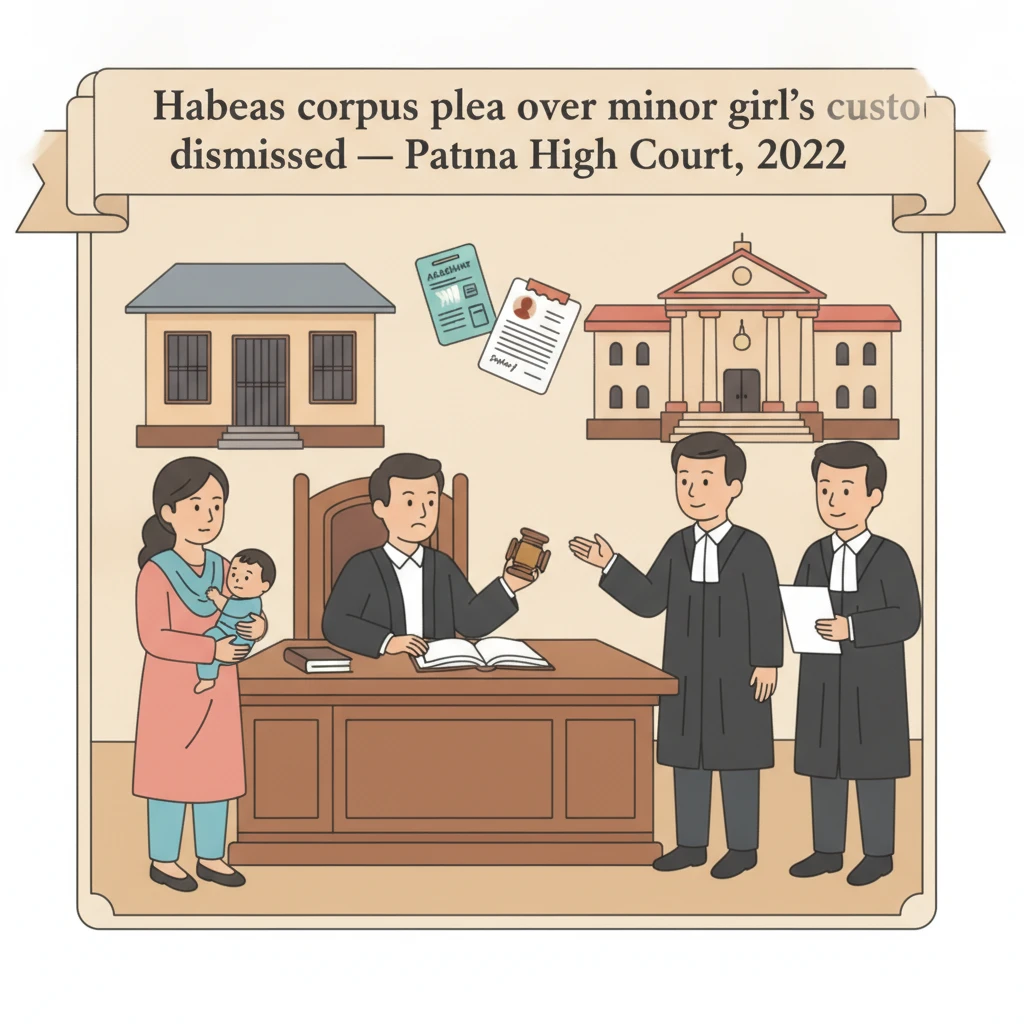
Case Background
The writ petition arose from a criminal case registered at Sugauli Police Station, District East Champaran, bearing P.S. Case No. 515 of 2020.
According to the First Information Report, on 22.08.2020 the informant’s minor daughter, referred to in the judgment as X, aged about 15 years, went out of the house at about 8:00 PM to attend the call of nature. She did not return home that night.
The family searched for her but could not find her. On 23.08.2020 at about 10:00 AM, the informant made an enquiry from one woman in the village regarding the whereabouts of her son, said to be Wosear Miyan @ Rahamdin Miyan. The woman and her family members did not give a satisfactory reply.
On this basis, the informant suspected that his daughter had been abducted by the said young man and his family members for the purpose of marriage. The matter was first taken to the village Mukhiya, who suggested that it should be resolved through a Panchayati. A Panchayati was fixed for 09.10.2020 at 4:00 PM.
The accused persons, however, did not follow the directions of the Mukhiya and the Panches. Instead, they allegedly threatened that if a police complaint was made, there would be dire consequences.
Finally, on 11.10.2020, Sugauli P.S. Case No. 515 of 2020 was registered on the basis of the written report. The case was registered under Sections 363, 366A, 504 and 506 of the Indian Penal Code and Section 8 of the Protection of Children from Sexual Offences Act. Investigation was taken up by the police.
During investigation, the girl was recovered. Her statement was recorded under Section 164 of the Code of Criminal Procedure. In that statement she claimed she was a major, disclosed that she had married Wosear Miyan @ Rahamdin Miyan of her own free will, and further stated that a baby had been born out of the relationship.
The Investigating Officer then produced the girl before the Special Judge, POCSO Act, East Champaran, Motihari, along with a medical report. The medical report, based on radiological study at Sadar Hospital, Motihari, assessed her age to be 19 years.
On 27.08.2021, the Special Judge, POCSO Act, Motihari passed an order sending the girl and her minor child to Balika Grih, Motihari, till further orders. The court relied on the educational certificate and Aadhaar card produced by the girl’s father, which showed her date of birth as 08.03.2005, and ignored the medical age assessment. The Child Welfare Committee and officials of Balika Grih were directed to take proper care of the girl and her child and to produce her before the court on 09.09.2021.
Later, on 01.11.2021, an application was filed before the same court for release of the girl, claiming she was a major who had voluntarily married and wanted to live in her matrimonial home. On 02.11.2021, the learned 6th Additional Sessions Judge, Motihari, East Champaran dismissed the application, again not accepting the medical age report.
Challenging the orders dated 27.08.2021 and 02.11.2021, and seeking release of the girl and her child, the present criminal writ petition bearing Criminal Writ Jurisdiction Case No. 161 of 2022 was filed before the Patna High Court. The main relief sought was a writ of habeas corpus along with a writ of certiorari to quash the two impugned orders.
What the Court Examined and Decided
The matter was heard by a Division Bench of the Patna High Court comprising Hon’ble Mr. Justice Ashwani Kumar Singh and Hon’ble Mr. Justice Rajeev Ranjan Prasad. The oral order was delivered on 24.02.2022 by Justice Ashwani Kumar Singh.
Counsel for the petitioner argued that the impugned orders were illegal, improper and against law. He relied on the medical report of Sadar Hospital, Motihari, which, on radiological examination, assessed the girl’s age as more than 19 years. He also pointed out that the girl had disclosed her age as 20 years.
On that basis, the petitioner’s side submitted that she could not be treated as a minor. Being a major, she had a right to marry a person of her choice and to live with him. Therefore, sending her to Balika Grih and continuing to keep her there was termed as unlawful detention. It was further argued that the petitioner had no other equally effective alternative remedy to challenge the impugned orders, so the writ petition was maintainable.
On the other side, the learned counsel for the State submitted that the writ petition was “thoroughly misconceived”. According to him, the impugned orders were revisable under Sections 397 and 401 of the Code of Criminal Procedure. Therefore, it could not be said that no alternative and efficacious remedy was available.
The State’s counsel relied upon Section 94(2) of the Juvenile Justice (Care and Protection of Children) Act, 2015. He pointed out that this provision lays down a clear order of preference for determining age: first, the date of birth certificate from the school or matriculation or equivalent certificate from the examination board; in its absence, the birth certificate from a corporation, municipal authority or panchayat; and only in the absence of both, an ossification test or other latest medical age determination test can be used.
In this case, the school certificate showing the girl’s date of birth as 08.03.2005 was available. Therefore, as per law, the court below was justified in relying on that certificate and not on the medical opinion.
The High Court examined the rival submissions and perused the records. It agreed with the State’s arguments.
The Bench reproduced Section 94(2) of the 2015 Act in the judgment. It explained that this subsection is drafted in “preferential” terms. This means that only when the higher priority document is not available, can the next kind of document be considered, and medical tests are to be used only when none of the documentary proofs mentioned in clauses (i) and (ii) are available.
The Court clarified that where the certificate from the school or examination board is available, it must be treated as the primary proof of age. Only when such certificate is not available, can the birth certificate from local authorities be used. Finally, if neither certificate is available, the age may be determined by ossification or other medical tests.
Applying this legal position to the facts, the Court noted that educational certificates from the school last attended by the girl were produced. These clearly recorded her date of birth as 08.03.2005.
On 27.08.2021, when the Special Judge, POCSO Act, Motihari directed that the girl be sent to Balika Grih till further orders, she was, in the eyes of law, a juvenile on the basis of that recorded date of birth. Therefore, the Special Judge rightly relied on the school certificate under Section 94(2) of the 2015 Act and ignored the medical opinion regarding age. The High Court found no illegality in this approach.
The Bench then considered whether a writ of habeas corpus could at all be used to attack such an order. It framed the issue in simple terms: can an order passed by a competent court, even if alleged to be improper, be challenged as “illegal detention” in a habeas corpus petition?
The Court answered this by referring to several decisions of the Supreme Court.
In Saurabh Kumar v. Jailor, Koneila Jail & Anr., the Supreme Court held that where a person is in custody by virtue of a judicial order, it cannot be called illegal detention for the purpose of habeas corpus. Even if the Magistrate acted mechanically or in a careless manner, a habeas corpus petition would not be maintainable.
In State of Maharashtra & Ors. v. Tasneem Rizwan Siddiquee, the Supreme Court ruled that when a person is in detention under a court’s order, no writ of habeas corpus can be issued.
Further, in Serious Fraud Investigation Office v. Rahul Modi & Anr., the Supreme Court held that directing the remand of an accused is a judicial function, and its correctness cannot be examined in a habeas corpus writ petition.
Based on these rulings, the Patna High Court stated that when detention in custody is pursuant to a judicial order of a Magistrate or other competent court, a writ of habeas corpus is not maintainable. Even an illegal or irregular exercise of jurisdiction in passing the remand order cannot be treated as illegal detention; instead, the proper remedy is to challenge the order through revision or appeal as provided in law.
The High Court then referred to its own Full Bench judgment in Shikha Kumari v. State of Bihar through Principal Secretary, Home (Police) Department & Ors., reported in 2020 (2) PLJR 15. There, the Full Bench had specifically dealt with cases where minor girls, who had eloped, were sent to Protection Home, After-Care Home, Remand Home or Nari Niketan by judicial orders.
The Full Bench, after considering several Supreme Court decisions including Independent Thought v. Union of India & Anr., held that if a minor girl is sent to such institutions by a competent court’s order, it cannot be treated as illegal confinement giving rise to a right to file a habeas corpus petition. The Full Bench also expressly overruled a contrary Division Bench view in Sahebi Khatoon @ Sahebi v. State of Bihar & Ors.
Relying on all these precedents, the Division Bench held that the present writ petition was not maintainable. The girl’s stay in Balika Grih and her custody were in pursuance of valid judicial orders of the Special Judge, POCSO Act, Motihari. Any grievance about age determination or continuation of custody had to be raised before the competent revisional or appellate forum under Sections 397 and 401 of the Code of Criminal Procedure, not through a writ of habeas corpus.
In conclusion, the Court held that the writ petition “not only lacks merit but is also misconceived” and dismissed it accordingly.
Why This Judgment Matters
This judgment is significant for families, young persons and lawyers dealing with cases of elopement involving alleged minors in Bihar.
First, it clarifies that for deciding whether a person is a child under the Juvenile Justice Act, school records and board certificates have first priority. Medical tests like ossification will be considered only if such documents are not available.
Second, it confirms that when a minor girl is sent to Balika Grih or similar homes by order of a competent court, that custody is not “illegal detention”. The correct remedy is to challenge the order in revision or appeal under the Code of Criminal Procedure, not to file a habeas corpus petition in the High Court.
Third, for people in similar situations, this judgment sends a clear message: even if a girl claims to be major and says she married by choice, if school documents show she is underage, courts will treat her as a child and ensure her protection in accordance with the Juvenile Justice Act and POCSO Act.
Finally, it reinforces the earlier Full Bench decision of the Patna High Court in Shikha Kumari, bringing consistency and certainty to the law on habeas corpus in such cases.
Legal Issues and Answers
- Issue: Whether the Special Judge was right in treating the girl as a minor and sending her to Balika Grih despite a medical report indicating she was above 19 years.
Answer: Yes. Under Section 94(2) of the Juvenile Justice Act, 2015, the school certificate showing her date of birth as 08.03.2005 had to be preferred over medical opinion. She was therefore a juvenile in law on the relevant date. - Issue: Whether a writ of habeas corpus is maintainable to challenge judicial orders sending a minor girl to Balika Grih or similar homes.
Answer: No. Detention pursuant to a judicial order of a competent court is not illegal detention. Any challenge must be made through statutory remedies like revision or appeal, not habeas corpus. - Issue: Whether the petitioner lacked any other effective remedy so as to justify invoking writ jurisdiction.
Answer: No. The impugned orders were revisable under Sections 397 and 401 CrPC, providing an efficacious statutory remedy.
Cases Cited by the Court
- Saurabh Kumar v. Jailor, Koneila Jail & Anr., (2014) 13 SCC 436
- State of Maharashtra & Ors. v. Tasneem Rizwan Siddiquee, (2018) 9 SCC 745
- Serious Fraud Investigation Office v. Rahul Modi & Anr., (2019) 5 SCC 266
- Shikha Kumari v. State of Bihar through Principal Secretary, Home (Police) Deptt. & Ors., 2020 (2) PLJR 15 (Full Bench, Patna High Court)
- Independent Thought v. Union of India & Anr., (2017) 10 SCC 800
- Sahebi Khatoon @ Sahebi v. State of Bihar & Ors., Cr.WJC No. 991 of 2010 (overruled by Shikha Kumari)
Case Details
Case Number: Criminal Writ Jurisdiction Case No. 161 of 2022; arising out of Sugauli P.S. Case No. 515 of 2020
Case Title: Salamdin Miyan v. The State of Bihar & Ors.
Coram: Hon’ble Mr. Justice Ashwani Kumar Singh and Hon’ble Mr. Justice Rajeev Ranjan Prasad
Citation: 2022 (1) PLJR 855
Advocates: Mr. Binay Kumar, Advocate for the petitioner; Mr. Prabhu Narayan Sharma, AC to AG, for the State/respondents
Nature of the Case: Criminal writ petition seeking writ of habeas corpus and certiorari in relation to custody of alleged minor victim in POCSO case and challenge to orders of Special Judge sending her to Balika Grih
Date of High Court Order: 24.02.2022
Link to Judgment: Click here to access the full Patna High Court judgment
If you found this explanation helpful and wish to stay informed about how legal developments may affect your rights in Bihar, you may consider following Samvida Law Associates for more updates.







