

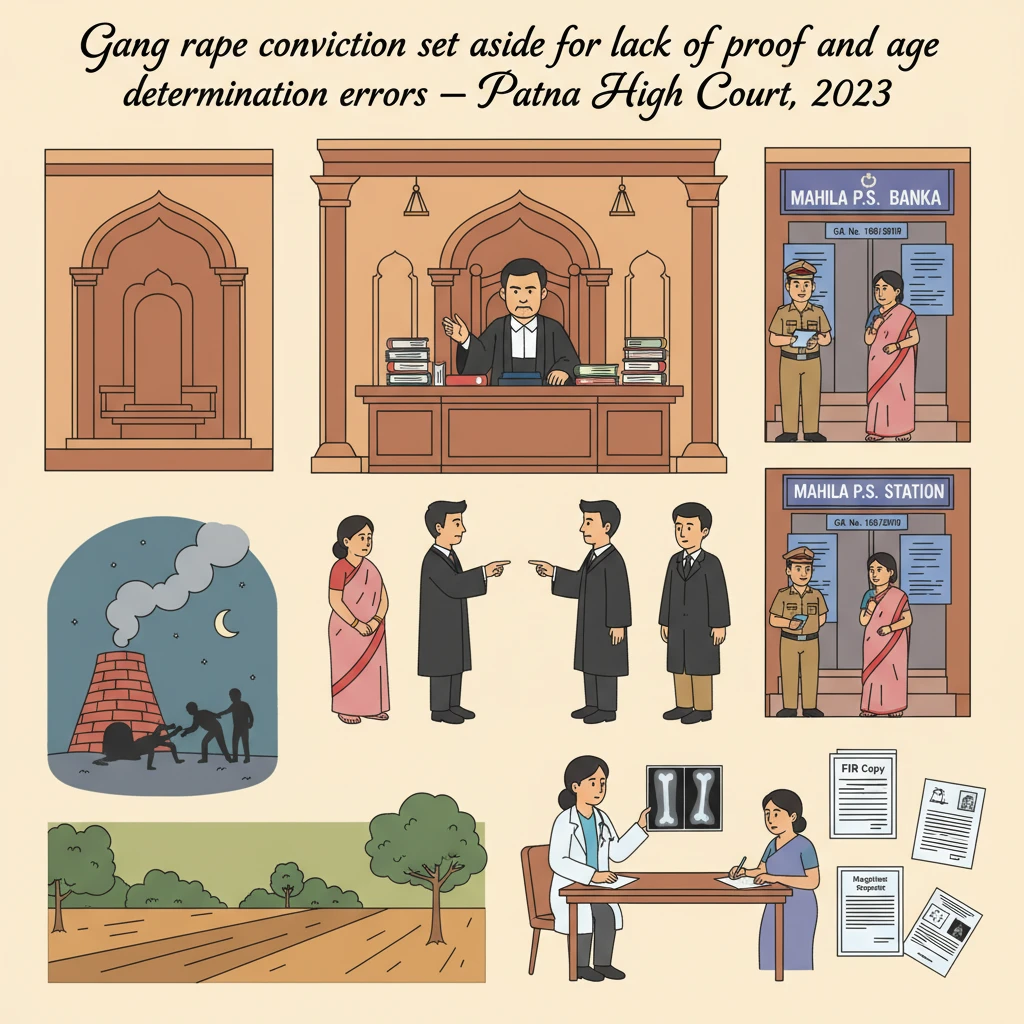
Case Background
The case arose from Mahila (Banka) P.S. Case No. 60 of 2019, based on a written report submitted by the prosecutrix on 09.12.2019. She alleged that on the evening of 08.12.2019, around 7:00 PM, when she went to a field outside her village to defecate, two male relatives from the village assaulted and raped her near a brick kiln.
The written report stated that the two accused, including the present appellant, first beat her, tied her mouth, dragged her near a brick kiln and then committed rape on her one after the other. She further alleged that they threatened her with serious consequences if she told anyone.
According to the written report, when she returned home she narrated the incident to her aunt. A cousin went to the accused’s house to complain, where he was allegedly assaulted by the accused. Local villagers then gathered after hearing the uproar. The prosecutrix later went first to Barahat Police Station and then to Mahila Police Station, Banka, where her written application led to registration of the FIR under Section 376D of the Indian Penal Code (IPC) and Section 4 of the Protection of Children from Sexual Offences Act, 2012 (POCSO Act).
The police arrested the appellant and a co-accused, Sohan Kumar, from their house on 09.12.2019. The prosecutrix’s statement under Section 164 of the Code of Criminal Procedure (CrPC) was recorded before a Magistrate. She was also medically examined; a Medical Board, on radiological examination, assessed her age between 15 and 16 years, and noted certain marks and a hymen injury which could be caused by sexual intercourse. Vaginal swab was collected for laboratory examination.
The investigating agency filed a charge-sheet against both accused under Section 376D IPC and Section 4 POCSO Act. Since Sohan Kumar was stated to be below 18 years on the date of occurrence, his case was separated and sent to the Juvenile Justice Board, Banka on 10.12.2019. Cognizance of offences against the appellant was taken on 25.04.2020, and charges were framed under Section 376D IPC and Section 4 POCSO Act. The appellant denied the charges and claimed trial.
The trial was conducted by the 6th Additional Sessions Judge-cum-Special Judge (POCSO), Banka, in G.R. No. 168 of 2019. On 27.10.2021 the Trial Court convicted the appellant under Section 376D IPC and Section 4 POCSO Act and, on 29.10.2021, sentenced him to 20 years’ rigorous imprisonment and fine of Rs. 20,000/- under Section 376D IPC, and 10 years’ rigorous imprisonment and fine of Rs. 10,000/- under Section 4 POCSO Act, with default sentences.
Aggrieved, the appellant filed Criminal Appeal (DB) No. 15 of 2022 before the Patna High Court under Section 374(2) CrPC challenging both the conviction and sentence.
What the Court Examined and Decided
The Patna High Court, through an oral judgment delivered on 06.12.2023 by a Division Bench comprising Hon’ble Mr. Justice Chakradhari Sharan Singh and Hon’ble Mr. Justice Bibek Chaudhuri, scrutinised the entire trial record. The Court considered the prosecution evidence, the defence submissions and the reasoning of the Trial Court.
Seven prosecution witnesses were examined at trial, including the prosecutrix (PW-5), her mother (PW-4), her aunt (PW-3), and her cousin (PW-2). The Investigating Officer deposed as PW-1, the doctor as PW-6 and the Magistrate who recorded the Section 164 CrPC statement as PW-7. Various documents such as the FIR, written report, medical and supplementary injury reports, Section 164 CrPC statement, forwarding letter, serological report and general report were exhibited.
After closure of evidence, the appellant was examined under Section 313 CrPC. However, the Trial Court put only a single broad question to him about the allegation that he, along with other accused, committed gang rape on the prosecutrix on 08.12.2019. He denied the allegation as false. No defence witness was produced.
In appeal, the defence first challenged the finding that the prosecutrix was a “child” within Section 2(1)(d) of the POCSO Act. Counsel argued that the prosecution failed to prove her age in the manner required by Section 34 of the POCSO Act and Section 94 of the Juvenile Justice (Care and Protection of Children) Act, 2015. It was highlighted that:
The prosecutrix’s mother (PW-4) deposed that the prosecutrix was admitted to school in 2004 at the age of four years. On that basis, by 2019 she would be over 18 years old. The aunt (PW-3) deposed that the prosecutrix had passed Class-VIII in 2016. Despite school admission being admitted, no school or matriculation certificate or birth certificate was produced. The prosecution relied only on the medical board report, which assessed age as between 15-16 years, and on the prosecutrix’s own claim of being 15 years old in her written report.
The State argued that there was no reason to doubt the claim that the victim was 15 and that the medical opinion supported this. The Additional Public Prosecutor contended that if there was no reasonable doubt about age, there was no need to follow the formal age determination procedure. She also relied on Section 34(3) POCSO Act, stating that even if age had not been determined strictly as per Section 34(2), the trial would not be invalid.
The High Court rejected this State argument after closely reading PW-4’s testimony. The Bench noted that the mother’s evidence, taken at face value, indicated that the girl was more than 18 years old at the time of alleged occurrence in December 2019. This created a clear and serious doubt about whether she was a child. Once such doubt existed, the law required a formal age determination process.
The Court referred to the Supreme Court’s decision in Jarnail Singh v. State of Haryana, (2013) 7 SCC 263, where it was held that the rules for determining a juvenile’s age also apply to victims of crime. Under that framework, and under Section 94(2) of the Juvenile Justice Act, 2015, the first attempt must be to obtain school or matriculation certificates, then birth certificates from municipal or panchayat authorities, and only if those are not available, medical tests like ossification may be used. Medical opinion is thus the last resort.
The High Court found that in this case, despite evidence that the prosecutrix was a school-going girl and had been admitted long back, the prosecution neither produced school records nor birth certificates, nor did the Trial Court direct that such records be obtained. It simply relied on a radiological estimate. This, in the Court’s view, was not compliant with the mandatory sequence of age-determination steps laid down by law and by the Supreme Court.
On this basis, the Court held that the prosecution had failed to prove that the prosecutrix was a child under Section 2(1)(d) POCSO Act. Consequently, the conviction under Section 4 POCSO Act was held unsustainable. Since POCSO provisions were inapplicable, Section 29 of the POCSO Act, which creates a reverse burden on the accused, also had no application.
The Court then examined whether the conviction for gang rape under Section 376D IPC could stand independently. It noted that the case essentially rested on the prosecutrix’s own version, and that, as a matter of principle, conviction can be based on the sole testimony of a victim of sexual assault only if the Court finds her to be a truthful witness of “sterling” quality, consistent from the outset.
The Bench compared the written report given on 09.12.2019 with the Section 164 CrPC statement recorded the next day, and found significant discrepancies. In the FIR-based written report, the prosecutrix said that both accused came together, assaulted her, tied her mouth and dragged her to the brick kiln before both raped her. In the Section 164 statement, she said that only the appellant came initially, tied her mouth with a muffler, dragged her towards the brick kiln, and then called someone, after which Sohan Kumar arrived and first raped her followed by the appellant.
This change in sequence and presence was regarded as substantial. According to the Court, it was not a minor variation but went to the root of the prosecution story about how the incident unfolded.
The Court also carefully examined her deposition at trial as PW-5. She denied any friendship or association with co-accused Sohan Kumar, though admitting that both studied in the same class. Yet she also stated that before the date of occurrence, Sohan Kumar had done “wrong acts” with her 5-7 times and similar acts 5-6 times even after the incident in question, but no complaint was ever lodged against him. This suggested a complex personal relationship, which the Court found relevant for assessing the reliability of her allegations.
Regarding the appellant, she stated he had beaten her 2-3 times before the incident and even later, suggesting he disapproved of her relationship with Sohan Kumar. However, in cross-examination she claimed that the appellant was not her neighbour and that she did not know him earlier, which directly conflicted with other evidence.
PW-2, her cousin, testified that the houses of the accused named in the FIR were only 300-400 metres away from his house. Evidence also suggested that PW-2 and the prosecutrix’s family lived in the same premises with a common courtyard. This cast doubt on her claim of not knowing the appellant earlier.
PW-3, the aunt, stated in cross-examination that the FIR was lodged 3-4 days after the occurrence and that her own statement was recorded two days after the occurrence. This suggested that some other occurrence, involving beating and injuries to the prosecutrix, may have taken place before 08.12.2019, which again did not fully align with the prosecution timeline.
Taking the entire evidence together, the High Court concluded that the prosecutrix’s testimony contained self-contradictions and was not of such consistent and impeccable quality that a conviction for a grave offence like gang rape could rest solely on it.
On the forensic side, the Court noted that while the Forensic Science Laboratory found semen on the cutting of the victim’s undergarment (janghiya), the serological report did not connect that semen with the appellant. Further, despite the specific provision under Section 53A CrPC for medical examination of a person accused of rape, the prosecution chose not to get the appellant medically examined. Because of this omission, the forensic material did not conclusively link him to the alleged act.
In view of these serious doubts—on age, on factual consistency of the prosecutrix’s versions, on the nature of her relationship with the juvenile co-accused, and on the absence of a firm forensic link—the Bench held that it would not be safe to uphold the conviction. The appellant was therefore entitled to the benefit of doubt.
Accordingly, the Court set aside the judgment of conviction and order of sentence dated 27.10.2021 and 29.10.2021 passed by the Special Judge. The appellant was acquitted of offences under Section 376D IPC and Section 4 POCSO Act. As he was in custody, the Court directed his release forthwith, if not required in any other case.
Why This Judgment Matters
This decision is significant for both victims and accused persons in serious sexual offence cases, especially those involving young persons.
First, the Patna High Court has emphasised that when the age of a victim is important, courts and police cannot rely casually on medical estimates alone. If school or birth records exist, they must be collected and examined. This is crucial because POCSO law and its reverse burden under Section 29 apply only when the victim is conclusively shown to be under 18.
Second, the judgment reinforces that a conviction for rape or gang rape can rest on the sole testimony of the victim, but only if her version is consistent and trustworthy from the start. If there are serious contradictions between the FIR, the Section 164 statement and court testimony, courts must be slow to uphold conviction, especially where the rest of the evidence does not strongly support the story.
Third, it underlines the importance of proper investigation. Here, failure to medically examine the accused under Section 53A CrPC weakened the prosecution case, because forensic evidence could not be linked to him with certainty.
For families and lawyers dealing with similar cases in Bihar, this judgment clarifies that both sides must pay close attention to age documents, consistency in statements, and timely, scientifically sound investigation. It also shows that appellate courts are prepared to closely re-examine sexual offence convictions where legal safeguards are not properly followed.
Legal Issues and Answers
-
Issue: Did the prosecution legally establish that the prosecutrix was a “child” under Section 2(1)(d) of the POCSO Act, so as to attract POCSO offences and the reverse burden under Section 29?
Answer: No. The Court held that in light of the mother’s deposition about school admission and age, and non-production of school or birth records as required by Section 94(2) of the Juvenile Justice Act, 2015 and the principles in Jarnail Singh, the prosecution failed to prove that the prosecutrix was under 18. Therefore, POCSO provisions, including Section 29, could not be applied. -
Issue: Could the conviction for gang rape under Section 376D IPC be sustained solely on the prosecutrix’s testimony and the available medical and forensic evidence?
Answer: No. The Court found major contradictions between the FIR, the Section 164 CrPC statement and her trial deposition, as well as inconsistencies about her relationship with the co-accused and the appellant. The forensic evidence did not link semen to the appellant, and he was not medically examined under Section 53A CrPC. The Court held that her solitary testimony was not of such sterling quality as to sustain conviction, and extended the benefit of doubt to the appellant.
Cases Cited by the Court
- Jarnail Singh v. State of Haryana, (2013) 7 SCC 263 – relied upon for applying the juvenile age-determination framework to child victims and for the hierarchy of documents and medical opinion in age assessment.
Case Details
Case Number: Criminal Appeal (DB) No. 15 of 2022; arising out of Mahila (Banka) P.S. Case No. 60 of 2019; G.R. No. 168 of 2019.
Case Title: Shrikant Mandal @ Shrikant Kumar Mandal v. State of Bihar.
Coram: Hon’ble Mr. Justice Chakradhari Sharan Singh and Hon’ble Mr. Justice Bibek Chaudhuri.
Citation: 2024(1) PLJR 770.
Advocates: Mr. Ajay Mukherjee, Advocate for the appellant; Ms. Shashi Bala Verma, Additional Public Prosecutor, for the State.
Nature of the Case: Criminal appeal under Section 374(2) CrPC against conviction and sentence for offences under Section 376D IPC and Section 4 POCSO Act, decided by the Patna High Court.
Date of High Court Judgment: 06.12.2023.
Trial Court: Court of the 6th Additional Sessions Judge-cum-Special Judge (POCSO), Banka.
Result: Appeal allowed; conviction and sentence set aside; appellant acquitted of all charges and directed to be released if not required in any other case.
Link to the Judgment: Patna High Court Judgment – Criminal Appeal (DB) No. 15 of 2022
If you found this explanation helpful and wish to stay informed about
how legal developments may affect your rights in Bihar,
you may consider following Samvida Law Associates for more updates.







