
Case Background
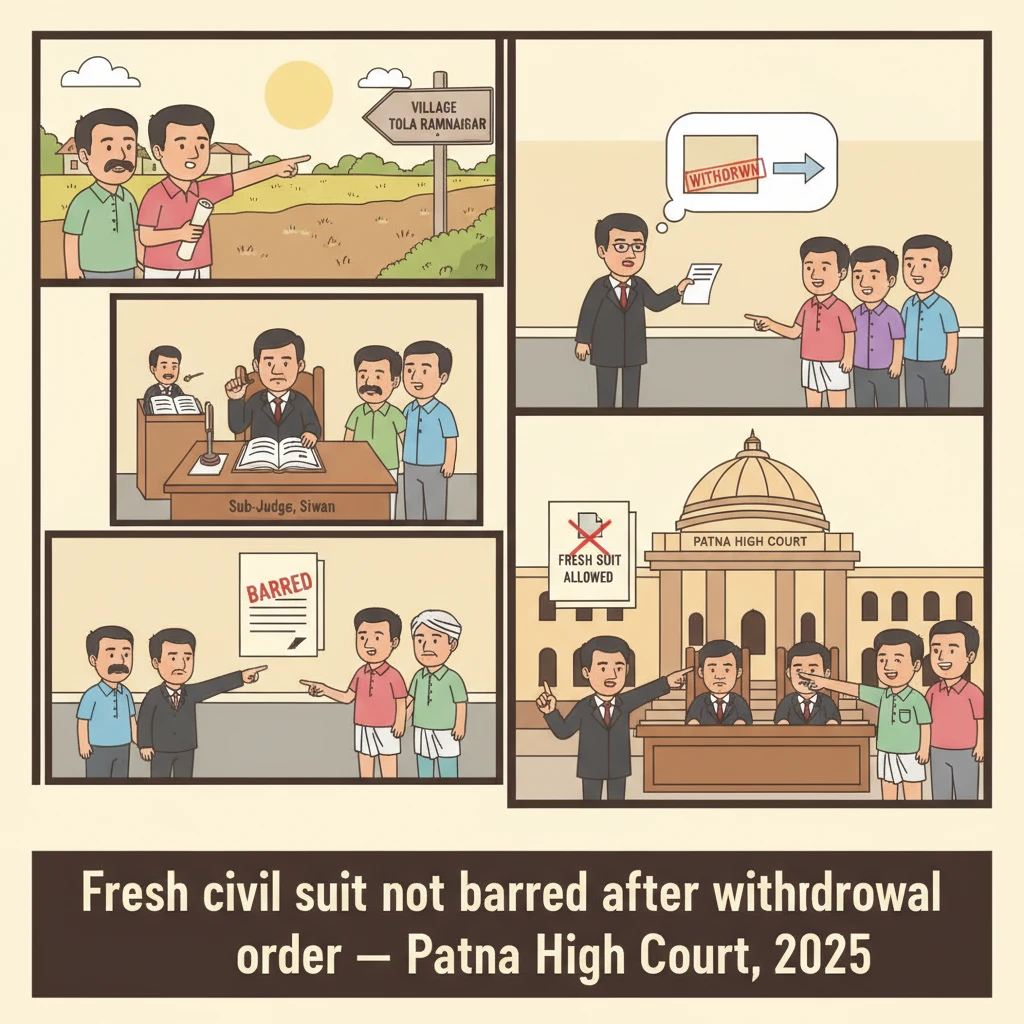
The dispute arose from land-related claims in Village Siwan Tola Ramnagar, under Siwan Police Station, District Siwan. The petitioner had first filed Title Suit No. 160 of 1979 before the Sub-Judge, Siwan.
During that earlier suit, the petitioner moved an application dated 16.07.1984 under Order XXIII Rule 1 of the Code of Civil Procedure, 1908 (CPC). In that application, the petitioner asked the court to allow withdrawal of the suit and also to grant liberty to file a fresh suit regarding the same subject matter after correcting the defects.
The trial court passed orders on 29.07.1985 and 10.08.1985 in Title Suit No. 160 of 1979. These orders recorded that the plaintiff’s withdrawal petition was heard and allowed, and that the plaintiff would withdraw the suit upon depositing the costs of Rs. 232/-. The suit was then treated as withdrawn.
Later, the petitioner instituted a fresh case, Title Suit No. 340 of 1985, before the court of Sub-Judge-VIII, Siwan, concerning the same subject matter and cause of action.
In that later suit, defendant no. 32 filed a petition dated 09.03.2005 under Section 10 CPC raising an objection about the maintainability of the suit. The learned Sub-Judge-VIII, Siwan, by order dated 22.12.2012 in T.S. No. 340 of 1985, allowed the petition of defendant no. 32 and disposed of the suit, holding it to be barred by Order XXIII Rule 1(4) CPC.
Aggrieved by this order of disposal, the plaintiff of the title suit (petitioner in the High Court) filed Civil Revision No. 54 of 2013 before the Patna High Court, challenging the correctness of the trial court’s decision.
What the Court Examined and Decided
The Patna High Court, through Hon’ble Mr. Justice Ramesh Chand Malviya, heard the petitioner and the respondents and focused on one central question: whether the fresh Title Suit No. 340 of 1985 was barred because the earlier Title Suit No. 160 of 1979 had been withdrawn without explicit liberty to file a fresh suit.
The petitioner’s counsel argued that after summons were issued in T.S. No. 340 of 1985, the defendants appeared and filed written statements. Defendant no. 32 later filed petitions under Section 10 CPC on 29.11.2004 and 03.03.2005 raising questions about maintainability.
On the earlier T.S. No. 160 of 1979, the petitioner’s counsel submitted that the suit had been withdrawn with the permission of the court and that liberty to file a fresh suit was in fact granted. He referred to the order dated 16.07.1984, by which the court allowed the plaintiff to withdraw the suit with costs of Rs. 232/-. His specific argument was that the permission to file a fresh suit need not always be in express words in the order; it can be gathered from the nature of the application and the way the court allows it.
On the other side, the respondents’ counsel argued that in T.S. No. 160 of 1979, although the suit was withdrawn, the court did not grant liberty to file a fresh suit. Therefore, according to the respondents, when the petitioner later filed T.S. No. 340 of 1985 on the same subject matter and cause of action, the suit was hit by the bar under Order XXIII Rule 1(4) CPC. The respondents supported the trial court’s order dated 22.12.2012 and relied upon judicial precedents to say that the bar was correctly applied.
The High Court then closely examined the materials on record, especially the withdrawal application dated 16.07.1984 (referred to as application under Order 23 Rule 1 CPC for withdrawal of T.S. No. 160 of 1979). A part of the relief clause in Hindi was reproduced in the judgment. From this, the Court found that the plaintiff had clearly prayed to withdraw the suit and to be allowed to bring a fresh suit in respect of the same property (tk;nkn) after removing defects.
The High Court stressed that an application filed under Order XXIII Rule 1 of CPC, seeking withdrawal of a suit “with liberty to institute a fresh suit on the same subject matter”, has to be treated as one combined, indivisible prayer. The Court cannot split this application into two separate parts, i.e., withdrawal of the suit on one hand and liberty to file afresh on the other, in such a way that one part is allowed and the other part is silently refused.
The judgment explains that if such a composite application is allowed by the court without expressly refusing any part of it, then the legal position is that the entire prayer is deemed to have been allowed. In other words, when the court allows the application and permits withdrawal of the suit, without saying anything negative about liberty, it should be read as allowing both: (a) withdrawal, and (b) liberty to file a fresh suit on the same subject matter and cause of action.
The High Court then referred to the actual orders passed in T.S. No. 160 of 1979. The order sheet entries dated 29.07.1985 and 10.08.1985 were quoted. These entries show that:
On 29.07.1985, the court recorded the presence of parties, took note of the application dated 16.07.1984 filed by the plaintiff, heard the plaintiff’s lawyer, and then directed that the plaintiff must deposit Rs. 232/- as costs by 10.08.1985, after which the suit would be treated as withdrawn.
On 10.08.1985, the order records that the plaintiff deposited the costs of Rs. 232/-, and accordingly, the suit was allowed to be withdrawn as per the plaintiff’s prayer.
The High Court pointed out that the operative part of the order allowing withdrawal of the earlier suit did not anywhere reject the prayer for liberty to file a fresh suit. The order simply allowed the application and withdrawal without imposing any reservation or restriction. Since the application was one under Order XXIII Rule 1 CPC including a prayer for liberty, the High Court held that the earlier order must be read as granting that liberty.
The Court also discussed Order XXIII Rule 1(3) CPC, which sets out when a court can allow withdrawal of a suit with liberty to file a fresh suit. It provides that if the court is satisfied that the suit must fail due to a formal defect, or there are sufficient grounds to allow the plaintiff to bring a fresh suit for the same subject matter or part of the claim, then the court may grant permission to withdraw the suit with liberty to bring a fresh one.
To support this interpretation, the Patna High Court relied on two earlier decisions. First, it cited the Calcutta High Court judgment in Sukumar Banerjee v. Dilip Kumar Sarkar, AIR 1982 Calcutta 17. In that case, it was held that if the plaintiff applies to withdraw the suit with liberty to sue afresh, and the court’s order simply gives permission to withdraw the suit without saying anything about liberty, the order should still be understood as granting liberty to sue afresh on the same cause of action.
Second, the Court referred to its own earlier decision in Khudi Rai v. Lalo Rai, AIR 1926 Pat 259, where the Patna High Court had held that when an application is made to withdraw with liberty to file a fresh suit, and the court passes an order allowing withdrawal but is silent on liberty, the order must be read along with the application and construed as giving permission to institute a fresh suit.
Applying these principles, the High Court concluded that the petitioner in the present case had lawfully filed T.S. No. 340 of 1985 on the same subject matter and cause of action after withdrawal of T.S. No. 160 of 1979, because liberty to institute a fresh suit was deemed to have been granted by the earlier withdrawal order.
Therefore, the trial court’s view that the fresh suit was barred under Order XXIII Rule 1(4) CPC was held to be incorrect. The Patna High Court found that the learned Sub-Judge-VIII, Siwan, had committed an error in law by disposing of T.S. No. 340 of 1985 on that ground.
Consequently, the High Court allowed the Civil Revision, set aside the impugned order dated 22.12.2012 of the Sub-Judge-VIII, Siwan, and directed the trial court to decide Title Suit No. 340 of 1985 on its merits in accordance with law.
Why This Judgment Matters
This judgment is important for litigants who have earlier withdrawn a civil suit and later want to file a fresh suit on the same matter. Many people, including lawyers and judges, sometimes assume that if the earlier order does not clearly mention “liberty to file fresh suit”, the second suit is automatically barred.
The Patna High Court clarifies that where the plaintiff’s application under Order XXIII Rule 1 CPC clearly asks both to withdraw the suit and to be given liberty to sue again, and the court allows that application without rejecting any part of the prayer, the order must be read as granting liberty.
For parties in rural areas and small towns, who frequently correct mistakes and re-file suits, this decision reassures them that a technical reading should not defeat their rights when the court’s earlier order had in substance allowed their combined request.
The decision also guides trial courts to read applications and orders together, instead of splitting them artificially, and to avoid shutting out cases on technicalities where the litigant has complied with the court’s directions, including payment of costs.
Legal Issues and Answers
-
Issue: Whether the fresh Title Suit No. 340 of 1985 was barred under Order XXIII Rule 1(4) CPC because the earlier Title Suit No. 160 of 1979 had been withdrawn without express liberty to file a fresh suit.
Answer: No. The Patna High Court held that since the plaintiff’s withdrawal application in T.S. No. 160 of 1979 sought withdrawal with liberty to file a fresh suit and that application was allowed in toto without any express refusal of liberty, the order must be construed as granting liberty. Therefore, the fresh suit was not barred, and the trial court’s order disposing of T.S. No. 340 of 1985 as barred was set aside.
Cases Cited by the Court
- Sukumar Banerjee v. Dilip Kumar Sarkar, AIR 1982 Calcutta 17 – cited for the principle that an order allowing withdrawal of a suit on an application that seeks withdrawal with liberty to sue afresh must be read as granting that liberty, even if the order is silent on it.
- Khudi Rai v. Lalo Rai, AIR 1926 Pat 259 – cited for the view that an order permitting withdrawal, passed on an application seeking withdrawal with liberty, should be construed as granting permission to institute a fresh suit, even when the order does not expressly mention liberty.
Case Details
Case Number: Civil Revision No. 54 of 2013
Case Title: Laxman Raut v. Bhola Raut & Ors.
Court: High Court of Judicature at Patna
Coram: Hon’ble Mr. Justice Ramesh Chand Malviya
Citation: 2025(4) PLJR 345
Date of Judgment: 22.09.2025
CAV Date: 16.09.2025
Nature of the Case: Civil Revision against order of Sub-Judge-VIII, Siwan, in Title Suit No. 340 of 1985 concerning withdrawal of earlier suit and bar under Order XXIII Rule 1 CPC.
Impugned Order: Order dated 22.12.2012 passed by Sub-Judge-VIII, Siwan, in T.S. No. 340 of 1985 allowing the petition of defendant no. 32 and disposing of the suit as barred.
Advocates:
For the Petitioner: Mr. Y. C. Verma, Senior Advocate; Ms. Prem Sheela Pandey, Advocate; Mr. Vikas Kumar Jha, Advocate.
For the Respondents: Mr. Udit Narayan Singh, Advocate.
Link to Judgment: Click here to read the full Patna High Court judgment
If you found this explanation helpful and wish to stay informed about
how legal developments may affect your rights in Bihar,
you may consider following Samvida Law Associates for more updates.







