
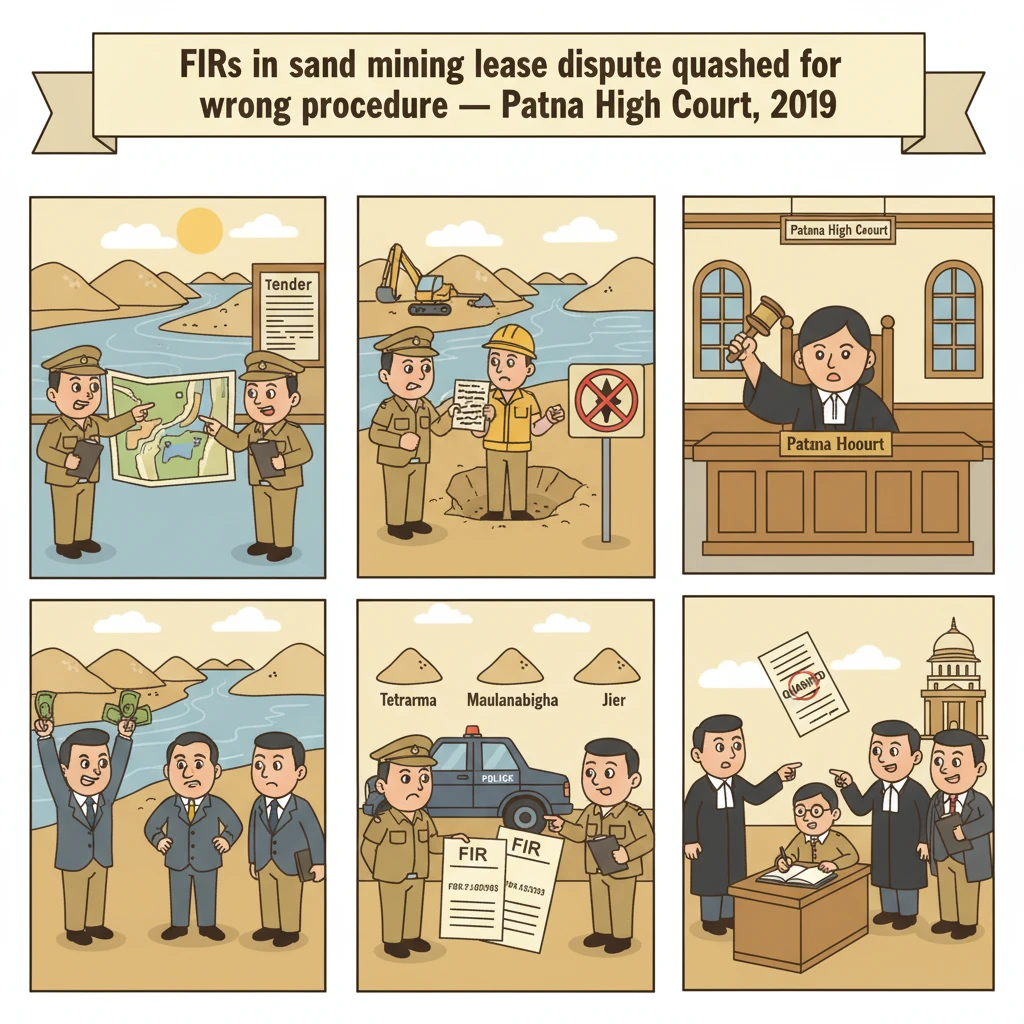
Case Background
The petitioner is a private company incorporated under the Indian Companies Act. It participated in a tender process issued by the Department of Mines and Geology, Government of Bihar, through notification dated 22.07.2014. The notification invited tenders to settle sand ghats in different districts of Bihar, including Nalanda, for the period 2015–2019.
The petitioner made the highest bid for the Nalanda sand ghats and was declared the successful bidder for the period from 01.01.2015 to 31.12.2019. A mining lease deed in Form “O” was executed in its favour by the Department of Mines and Geology for the years 2015–2016 and 2017–2018.
A team of district officers later inspected the mining sites leased to the petitioner. Based on irregularities allegedly found during inspection, Mines Inspector Reyazul Haque submitted written reports. On the basis of these reports, three FIRs were registered on 21.02.2018:
- Manpur P.S. Case No. 25 of 2018
- Asthawan P.S. Case No. 31 of 2018
- Sare P.S. Case No. 14 of 2018
These FIRs were registered under Section 15 of the Environment (Protection) Act, 1986 and Rule 40 of the Bihar Minor Mineral Concession Rules, 1972.
The petitioner then filed three criminal writ petitions in the Patna High Court. Each petition sought quashing of one FIR. As the parties, facts and legal issues were common, the High Court heard all three matters together and disposed them of by a single judgment dated 27.02.2019.
What the Court Examined and Decided
The Court first noted the core accusation in all three cases. During inspection of three sand ghats—Tetrama, Maulanabigha and Jier—the inspecting team allegedly found that mining operations were being carried out in violation of the approved mining plan and environmental clearance conditions.
The allegation was not that the petitioner had no mining lease. Rather, the allegation was that, despite having a lease, the petitioner did not follow the terms of the mining plan and the environmental clearance.
The petitioner’s main legal argument focused on the special procedure laid down in two central laws:
- The Mines and Minerals (Development and Regulation) Act, 1957 (MMDR Act, 1957)
- The Environment (Protection) Act, 1986 (1986 Act)
Counsel for the petitioner argued that Section 22 of the MMDR Act says no court can take cognizance of offences under that Act or the rules except on a written complaint by a person authorised by the Central or State Government. According to the petitioner, this means that the normal procedure under the Code of Criminal Procedure (Cr.P.C.), including registration of an FIR under Section 154 and police investigation, stands excluded for such offences.
The petitioner submitted that there is no provision in the MMDR Act, 1957 or the 1972 Rules that empowers the police to investigate offences under these provisions. The only proper method is through a complaint by an authorised officer, not through an FIR.
Similarly, the petitioner relied on Section 19 of the 1986 Act. This provision bars any court from taking cognizance of offences under the Environment (Protection) Act except on a complaint by:
- The Central Government or an authority or officer authorised by it; or
- Any person who has given prior notice of not less than sixty days in the prescribed manner.
The petitioner argued that as no such complaint had been filed, and no sixty days’ notice procedure had been followed, the police had no authority to register FIRs and investigate offences under Section 15 of the 1986 Act. Therefore, allowing the investigation to continue would be an abuse of the process of the court, warranting quashing of the FIRs under the principles laid down by the Supreme Court in State of Haryana & Ors. vs. Bhajan Lal & Ors., 1992 Supp (1) SCC 335.
On the other hand, the State argued that the Mines Inspector was a competent authority to initiate criminal action. It relied on Section 21(6) of the MMDR Act, which says that offences under Section 4(1) shall be cognizable, notwithstanding anything in the Cr.P.C. The State’s stand was that once an offence is cognizable, the police have statutory power to register an FIR and investigate.
The State further submitted that under the agreement with the mining department, the petitioner was required to obtain environmental clearance and strictly comply with it. During inspection, violations of environmental laws and the mining plan were noticed. Hence, the FIRs were rightly instituted.
The Department of Mines supported the State’s stand. Its counsel argued that after police investigation, the final report under Section 173 Cr.P.C. could be treated as a complaint. According to this view, there was no legal bar on registration of FIRs; the question of proper cognizance would only arise at a later stage.
The Patna High Court then closely examined the relevant provisions of the MMDR Act, the 1972 Rules, and the 1986 Act.
It first noted that Section 4(1) of the MMDR Act prohibits any person from undertaking mining operations without a proper licence or lease. Section 4(1-A) restricts transport and storage of minerals except in accordance with the Act and rules. Section 21(1) prescribes punishment for contravention of Section 4(1) or 4(1-A). Section 21(6) declares that such offences shall be cognizable.
Crucially, the Court observed that in the present case it was an admitted fact that the petitioner was a valid settlee and held a mining lease. There was no allegation that it was operating without a lease or licence. Therefore, the penal provision making such conduct a cognizable offence under Section 21(1) read with Section 21(6) did not directly arise against the petitioner on these facts.
The Court then turned to Section 22 of the MMDR Act, which clearly states that no court shall take cognizance of any offence punishable under the Act or the rules except upon a written complaint by a person authorised by the Central or State Government. This, according to the Court, creates an express bar on taking cognizance on the basis of a police report under Section 173(2) Cr.P.C.
The Court reinforced this reading by referring to Rule 41 of the Bihar Minor Mineral Concession Rules, 1972. Rule 41 states that no court shall take cognizance of any offence punishable under those rules except upon a written complaint by specified mining authorities or other officers empowered by the Government. It also says that no court below a Magistrate of the First Class can try such offences.
In short, both Section 22 of the MMDR Act and Rule 41 of the 1972 Rules require a written complaint by an authorised officer and do not permit cognizance on a police report.
Next, the Court examined the Environment (Protection) Act, 1986. Section 15 of that Act provides penalties for contravention of its provisions, rules, orders or directions. Section 19, however, again restricts cognizance. It states that no court shall take cognizance of any offence under the Act except on a complaint by the Central Government or an authorised authority/officer, or by a person who has given sixty days’ prior notice of the alleged offence and his intention to file a complaint.
The Court recorded that admittedly no such complaint had been made against the petitioner by a public servant under Section 19. Therefore, institution of FIRs under Section 15 of the 1986 Act was “patently bad in law”.
The Court then explained a more general rule: when a special statute, like the MMDR Act or the Environment (Protection) Act, prescribes a specific procedure for prosecuting offences, that special procedure overrides the general procedure under the Cr.P.C. This flows from Section 4(2) Cr.P.C., which recognises that special laws may apply differently.
In this context, the Court rejected the argument that a police report after investigation could be treated as a “complaint”. Section 2(d) Cr.P.C. defines a “complaint” as an allegation made orally or in writing to a Magistrate with a view to his taking action, but specifically excludes a police report. An explanation to Section 2(d) only deems a police report to be a complaint where, after investigation, it discloses a non-cognizable offence. The present cases did not fall in that category.
Since the law clearly says a complaint does not include a police report, the Court held that filing a final report under Section 173(2) Cr.P.C. after investigating these FIRs would be “an exercise in futility”.
Putting these strands together, the Court concluded:
- Under the MMDR Act and 1972 Rules, as well as under the 1986 Act, criminal prosecution must start with a written complaint by an authorised officer (or, in limited cases under the 1986 Act, a private person with proper prior notice).
- Registration of FIRs and investigation by the police for such offences is not contemplated by these special statutes.
- Courts cannot take cognizance of these offences on the basis of a police report, so allowing the FIRs to continue would serve no legal purpose and would be an abuse of process.
Relying on the principles laid down by the Supreme Court in State of Haryana vs. Bhajan Lal, the Patna High Court held that this was an appropriate case to exercise its writ jurisdiction and quash the criminal proceedings.
Accordingly, the Court set aside:
- The FIR in Manpur P.S. Case No. 25 of 2018
- The FIR in Sare P.S. Case No. 14 of 2018
- The FIR in Asthawan P.S. Case No. 31 of 2018
- All investigations conducted by the police in these cases
The writ petitions were allowed.
Why This Judgment Matters
This judgment is significant for anyone involved in mining activities in Bihar, including sand ghat settlers, contractors and companies. It makes clear that where the MMDR Act and Environment (Protection) Act apply, the police cannot simply register an FIR and start investigating without following the special procedure laid down in these Acts.
For leaseholders, it clarifies that if the authorities believe there is a violation of mining plans or environmental conditions, they must proceed through properly authorised complaints before the Magistrate, not through routine police FIRs. If the correct procedure is not followed, criminal proceedings can be challenged.
For government departments, the judgment is a reminder that special statutes override the general Cr.P.C. It emphasises the need to act through the officers and in the manner specifically authorised by those special laws. Failure to do so can lead to quashing of entire criminal cases, even where alleged violations exist.
Legal Issues and Answers
Issue: Can the police register and investigate FIRs for alleged violations relating to sand mining leases under the MMDR Act, 1957, the 1972 Rules and Section 15 of the Environment (Protection) Act, 1986?
Answer: No. The Patna High Court held that these special laws require a written complaint by an authorised officer (or a duly notified complainant under Section 19 of the 1986 Act). Courts cannot take cognizance on a police report, so FIRs and police investigations in such matters are not legally sustainable.
Issue: Can a police report filed after investigation under Section 173(2) Cr.P.C. be treated as a “complaint” for the purpose of Section 22 MMDR Act, Rule 41 of the 1972 Rules or Section 19 of the 1986 Act?
Answer: No. The Court held that under Section 2(d) Cr.P.C., a “complaint” expressly does not include a police report. Except in the limited situation of non-cognizable offences covered by the explanation to Section 2(d), which was not applicable here, a police report cannot be converted into a complaint.
Cases Cited by the Court
- State of Haryana & Ors. vs. Bhajan Lal & Ors., 1992 Supp (1) SCC 335 (cited for principles on quashing FIRs under writ jurisdiction).
Case Details
Case Numbers:
- Criminal Writ Jurisdiction Case No. 2267 of 2018
- Criminal Writ Jurisdiction Case No. 2288 of 2018
- Criminal Writ Jurisdiction Case No. 2282 of 2018
Case Title:
- M/s. Mahadev Enclave Pvt. Ltd. vs. The State of Bihar & Ors. (in all three writ petitions, with different police station case references)
Coram:
- Hon’ble Mr. Justice Ashwani Kumar Singh
Citation:
- 2019 (3) PLJR 166
Advocates:
- For the petitioner: Mr. Gautam Kumar Kejriwal, Advocate; Mr. Rahul, Advocate; Mr. Alok Kumar Jha, Advocate
- For the State of Bihar: Mr. Gyan Prakash Ojha, GA-7; Mr. Gopal Krishna, AC to GA-7
- For the Department of Mines and Geology: Ms. Kalpana, Advocate
Nature of the Case:
- Criminal writ petitions seeking quashing of FIRs and police investigations arising out of alleged violations of mining plan and environmental clearance conditions under the MMDR Act, 1957, the Bihar Minor Mineral Concession Rules, 1972, and the Environment (Protection) Act, 1986.
Date of Judgment: 27.02.2019
Link to Judgment: Patna High Court Judgment
If you found this explanation helpful and wish to stay informed about
how legal developments may affect your rights in Bihar,
you may consider following Samvida Law Associates for more updates.







