

Case Background
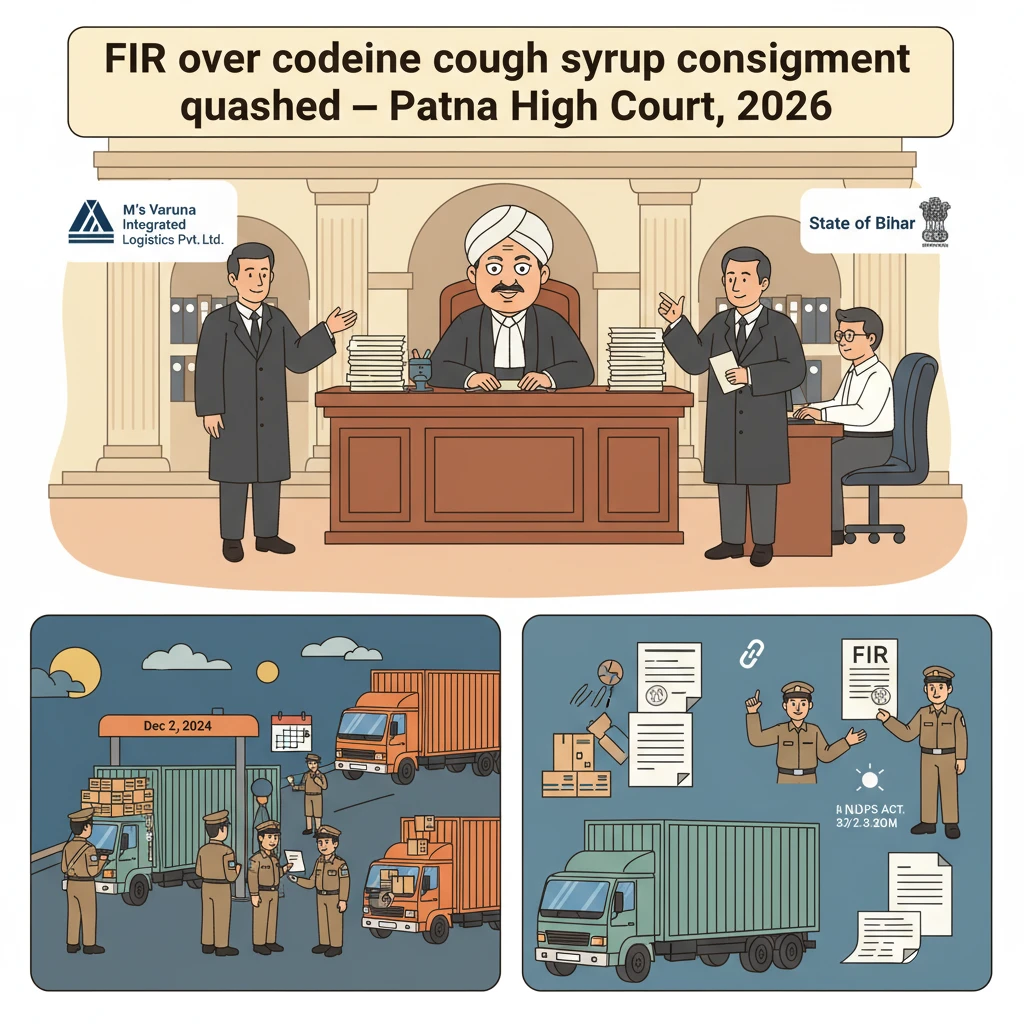
This case arose from checking of vehicles at the Integrated Check Post, Mohania, in Kaimur district, Bihar. The informant, posted there as a Sub-Inspector in the Excise Police, lodged a written complaint on 02.12.2024.
According to the complaint, vehicles suspected of carrying illegal material were being checked. A container truck coming from Uttar Pradesh was intercepted. As no independent public persons were willing to witness the search, Excise Constables were treated as independent witnesses and the drivers were searched.
During the search of this truck or container, Phensedyl Codeine Cough Syrup 100 ml bottles were allegedly recovered in cartons, totalling 11,105 litres. The FIR states that the codeine cough syrup was being taken to Ranchi and bills were provided for the consignment.
On the same day in the evening, another truck was intercepted. On search, 11,850 litres of Phensedyl Codeine Cough Syrup were recovered. Bills for this second consignment were also produced, and it was stated that the goods were being transported from Haryana to Ranchi.
The FIR further records that both trucks were coming without a digital lock. The informant mentioned that there was a “complete banned” on liquor and intoxicating substances being transported without a digital lock, and that transportation of such large quantities of codeine cough syrup created suspicion. On this basis, Kaimur Excise P.S. Case No. 920 of 2024 was registered for offences under Sections 8(c), 21(c) and 29 of the Narcotic Drugs and Psychotropic Substances Act, 1985 (NDPS Act).
M/s Varuna Integrated Logistics Pvt. Ltd., through its authorised representative, approached the Patna High Court in Criminal Miscellaneous No. 22814 of 2025. The company is the owner of one of the trucks (Reg. No. NL‑01Q‑1335) and had been made an accused as an unknown truck owner in the FIR. The petition sought quashing and setting aside of the FIR and all proceedings arising from it.
What the Court Examined and Decided
The matter was heard by Hon’ble Mr. Justice Sourendra Pandey. The Court heard Mr. Chitranjan Sinha, Senior Advocate for the petitioner, assisted by other counsel, and Mrs. Sangeeta Sharma, APP for the State.
The central question before the Patna High Court was whether the large consignments of Phensedyl Codeine Cough Syrup transported through Bihar could legally be treated as “narcotic drugs” under the NDPS Act, so as to justify prosecuting the transporter under Sections 8(c), 21(c) and 29 of that Act.
The petitioner’s side argued that, on a plain reading of the FIR, the complaint was originally framed as a violation of the Bihar Prohibition and Excise Act. The informant had in fact requested registration of an FIR under the appropriate provisions of that Act. However, according to the petitioner, with mala fide intention and only to justify illegal detention and arrest, the reference to the Bihar Prohibition and Excise Act was struck out and “NDPS Act” was inserted.
The petitioner contended that Phensedyl Cough Syrup is a legally manufactured medicinal product. It is produced by M/s Abbott Healthcare Private Limited under a valid manufacturing licence and falls under Schedule H1 of the Drugs and Cosmetics Act, 1940, and the Drugs and Cosmetics Rules, 1945.
It was submitted that the seized consignment of Phensedyl Cough Syrup was manufactured under a valid licence in Himachal Pradesh and was being transported from Abbott’s licensed warehouse in Haryana to Abbott’s super distributor in Ranchi. The truck in question was transporting this consignment on the basis of proper booking, under valid vehicle registration and authorisation.
The petitioner emphasised that the goods were in transit from Haryana to Ranchi and were not meant for sale, distribution, or consumption in Bihar. The consignment was described as neither an illegal intoxicant drug nor a narcotic substance, but a lawful medical product.
The petitioner also argued that no specific overt act or role had been attributed to the transport company beyond ownership of the truck. The company was only engaged in transportation and logistical support across the country, and was neither the supplier nor receiver of the cough syrup.
A key plank of the petitioner’s case was a Government of India notification dated 14.11.1985. This notification listed various narcotic drugs and gave an exemption at entry 35 for:
Codeine (Methyl Morphine) and its salts (i.e., including codeine phosphate), dilutions and preparations containing not more than 100 milli grams of the drug per dosage unit and with a concentration of not more than 2.5 percent in undivided preparations and which has been established in therapeutic practice.
The petitioner pointed out that it was not even the prosecution case that the bottles contained codeine beyond the specified limit. The approved level of codeine phosphate in the cough syrup was 10 mg per 5 ml dosage, which is far below the 100 mg per dosage unit limit in the notification. Therefore, according to the petitioner, the product fell within the permitted medicinal category and outside the definition of narcotic drug for the purpose of Section 8 NDPS Act.
The petitioner also relied on Supreme Court decisions such as Inder Mohan Goswami vs. State of Uttranchal, (2007) 12 SCC 1, where the Court cautioned that criminal prosecution should not be used as an instrument of harassment or to pressurise an accused. The petitioner further invoked the well-known principles laid down in State of Haryana and Ors. vs. Ch. Bhajan Lal and Ors., AIR 1992 SC 604, regarding quashing of criminal proceedings when no offence is made out.
In addition, the petitioner cited judgments of the Allahabad High Court and the Punjab and Haryana High Court, where similar FIRs regarding Phensedyl Cough Syrup had been quashed under Sections 8, 21(c), 22, 25, 29 and 60(3) of the NDPS Act, in light of the same central government notification.
On the other hand, the State argued that the petitioner’s truck was carrying a consignment banned in Bihar and that the recovered quantity was of commercial level. The State relied on Bihar Government Notification No. 11 dated 18.10.2016, under which all medicines and medicinal preparations containing codeine are notified as intoxicants for the purposes of the Bihar Prohibition and Excise Act.
The State further pointed out that the trucks were transporting codeine-containing cough syrup without any secured locking system. Although bills were produced, the suspicious circumstances led to seizure of the consignment and making the transport company an accused.
After examining the submissions and documents, the Patna High Court described this as “yet another case” where police had lodged an FIR under the NDPS Act without first verifying that the seized Phensedyl Cough Syrup was in fact a medicinal product.
The Court noted that similar seizures of codeine-based cough syrups under different brand names were repeatedly being treated as NDPS offences in Bihar on the assumption that medicinal products containing codeine are banned in the State.
The Court specifically took note of the same Government of India notification dated 14.11.1985 set out above. It then examined Section 8 of the NDPS Act, which prohibits certain activities relating to narcotic drugs and psychotropic substances.
The Court reasoned that the prohibition in Section 8 applies only where the substance in question qualifies as a “narcotic drug”. Since Phensedyl Cough Syrup contains codeine compounded with chlorpheniramine maleate and each dosage unit of 5 ml contains only 10 mg of codeine phosphate, the product does not exceed 100 mg of the drug per dosage unit in an undivided preparation.
Therefore, the Court held that such cough syrup falls within the exception in entry 35 of the 14.11.1985 notification and is not a narcotic drug for the purposes of the NDPS Act. Consequently, Section 8 and related penal provisions like Section 21(c) and Section 29 do not apply to such medicinal preparations.
To reinforce this conclusion, the Court relied on a Division Bench judgment of the Allahabad High Court in Vibhor Rana vs. Union of India, decided on 24.12.2021. In that case, the composition of a similar cough syrup (New Cough Linctus) with 10 mg codeine phosphate per 5 ml dose was held to fall within the same exception, leading the Allahabad High Court to quash proceedings under Sections 8, 21(c), 22, 25, 29 and 60(3) of the NDPS Act.
Finding the facts of the present case similar, and noting that the petitioner’s company was only a transporter and neither supplier nor receiver of the consignment, the Patna High Court concluded that the allegations in the FIR were not tenable in law.
Accordingly, the Court quashed Kaimur Excise P.S. Case No. 920 of 2024 and the entire criminal proceedings arising from it. The criminal miscellaneous application was allowed.
Why This Judgment Matters
This judgment is important for transporters, logistics companies, and pharmaceutical distributors moving codeine-based cough syrups and similar medicines through Bihar.
The Patna High Court has clearly held that medicinal preparations containing codeine within the limits set by the 14.11.1985 Central Government notification are not “narcotic drugs” under the NDPS Act. Therefore, merely carrying such medicines, even in large quantities and through Bihar, does not by itself attract NDPS offences.
The ruling also highlights that transporters, who simply move goods under lawful documents and are neither suppliers nor recipients, should not be casually roped in under harsh NDPS provisions without specific allegations of illegal intent.
For people dealing in lawful pharmaceutical products, the judgment sends a message that NDPS law cannot override central notifications that carve out exceptions for properly regulated medicines. It also signals to law-enforcement agencies that they must verify composition and legal status of seized medicines before registering NDPS cases.
Legal Issues and Answers
- Issue: Whether Phensedyl Codeine Cough Syrup, containing 10 mg of codeine phosphate per 5 ml dose, qualifies as a narcotic drug so as to attract Sections 8(c), 21(c) and 29 of the NDPS Act.
Answer: No. The syrup falls within the exception under entry 35 of the 14.11.1985 Central Government notification and is therefore not a narcotic drug; NDPS provisions do not apply. - Issue: Whether a transporter, being only the owner of the truck carrying such medicinal consignment with valid documents, can be prosecuted under the NDPS Act on the facts alleged in the FIR.
Answer: No. The petitioner company was merely a transporter and neither supplier nor recipient; in the absence of a tenable NDPS offence, the FIR and proceedings were liable to be quashed.
Cases Cited by the Court
- Inder Mohan Goswami vs. State of Uttranchal, (2007) 12 SCC 1.
- State of Haryana and Ors. vs. Ch. Bhajan Lal and Ors., AIR 1992 SC 604.
- Vibhor Rana vs. Union of India, judgment dated 24.12.2021, Division Bench of the Allahabad High Court.
- The Court also noted similar decisions of the Punjab and Haryana High Court regarding Phensedyl Cough Syrup.
Case Details
Case Number: Criminal Miscellaneous No. 22814 of 2025
Arising out of: Kaimur Excise P.S. Case No. 920 of 2024, dated 02.12.2024
Case Title: M/s Varuna Integrated Logistics Pvt. Ltd. through its representative Mr. Vinay Kumar Singh @ Binay Kumar Singh vs. The State of Bihar
Citation: 2026 (2) PLJR 462
Court: High Court of Judicature at Patna
Coram: Hon’ble Mr. Justice Sourendra Pandey
Date of Judgment: 17.02.2026 (CAV; CAV date 09.02.2026; uploading and transmission 17.02.2026)
Advocates for Petitioner: Mr. Chitranjan Sinha, Senior Advocate; Mr. Sanchay Srivastava, Advocate; Mrs. Sonali Priya, Advocate; Mr. Sushant Srivastava, Advocate; Mr. Abhiyanshu Ranjan, Advocate
Advocate for State: Mrs. Sangeeta Sharma, APP
Nature of Case: Criminal miscellaneous petition seeking quashing of FIR and criminal proceedings under Sections 8(c), 21(c) and 29 of the NDPS Act.
Link to Judgment: View full judgment on the Patna High Court website
If you found this explanation helpful and wish to stay informed about
how legal developments may affect your rights in Bihar,
you may consider following Samvida Law Associates for more updates.







