

Case Background
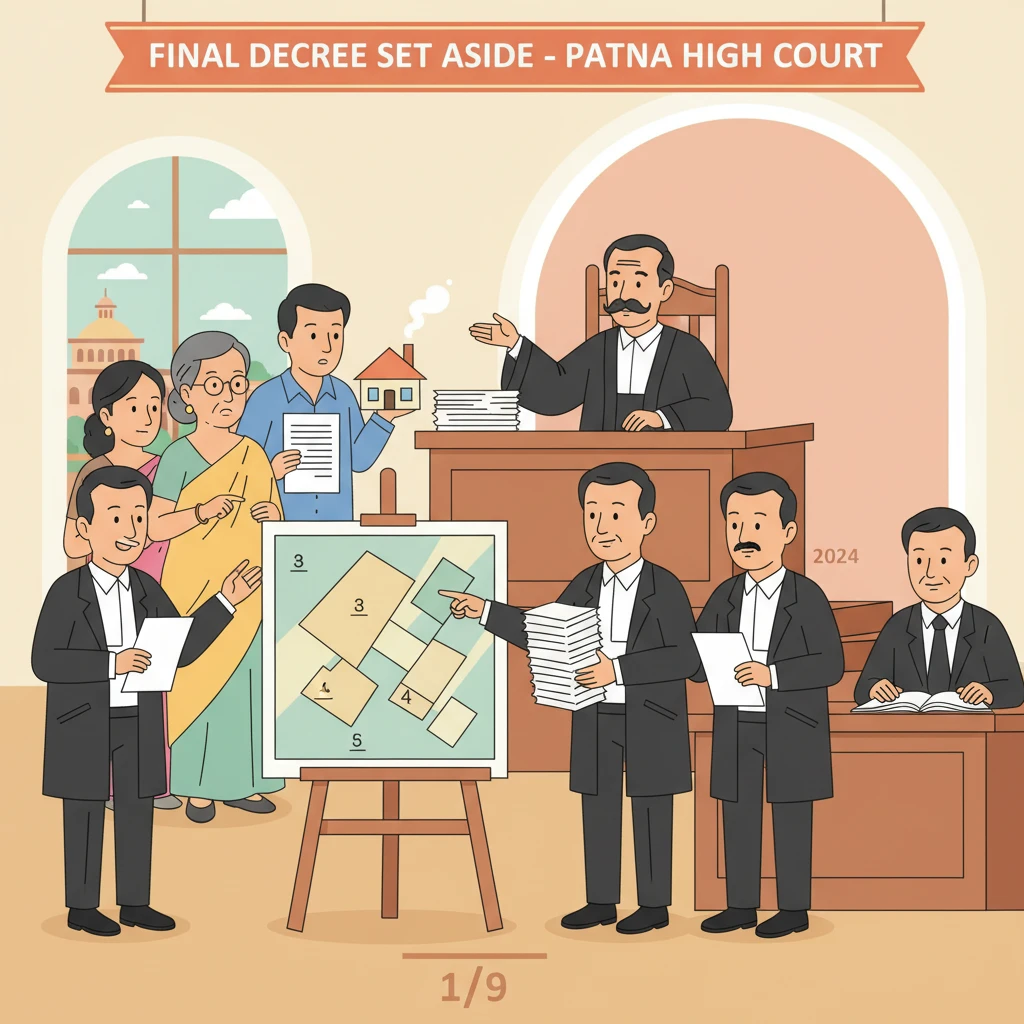
A title partition suit, Title Suit No. 274/1999, was filed by the plaintiff in the Court of the Subordinate Judge, Bhabhua. The plaintiff sought partition of 1/9 share in the properties described in Schedule-A of the plaint.
The defendants entered appearance and filed three separate written statements, contesting the claim. After trial, by judgment and decree dated 17.10.2016, the learned Sub Judge-II decreed the suit and granted partition of 1/9 share in favour of the plaintiff.
Following the preliminary decree, the plaintiff moved an application for preparation of the final decree before the Subordinate Judge-II, Bhabhua on 22.11.2016. For this purpose, a Survey Knowing Pleader Commissioner was appointed to divide the property and work out specific allotments.
While these final decree proceedings were going on, persons described as intervenors, forming respondent 2nd set in the High Court, filed an intervention application under Order I Rule 10 read with Section 151 of the Code of Civil Procedure. They claimed to be purchasers of parts of the suit property and sought to be added as parties and to have their purchased lands allotted to them in the final decree.
By order dated 21.12.2016, the learned Sub Judge-II, Kaimur at Bhabhua, partially allowed their prayer. Without expressly impleading them as parties to the suit, the Trial Court directed the Survey Knowing Pleader Commissioner to allot to them the properties described in Schedule-Ka of the intervention petition, out of the share of their vendors.
Aggrieved by this direction issued during the final decree proceedings, the original plaintiff filed a civil miscellaneous petition under Article 227 of the Constitution of India before the Patna High Court, challenging the order dated 21.12.2016.
What the Court Examined and Decided
The Patna High Court, exercising its supervisory jurisdiction under Article 227, focused on whether the Trial Court could direct allotment of land in favour of the intervenors in the final decree proceedings, without first adding them as parties to the suit.
To understand the dispute, the High Court considered what the intervenors had placed on record. According to their application under Order I Rule 10 and Section 151 of the Code, they relied heavily on statements made by some defendants in their written statements in the partition suit.
The intervenors pointed to paragraphs 15, 16 and 17 of the written statement filed on behalf of defendant nos. 2 and 4. In those paragraphs, the defendants stated that they had executed a sale deed bearing no. 6216 dated 23.06.1998 in favour of the father of the intervenors, namely Chandra Deo Dubey. This sale was in respect of Khata No. 74, Plot No. 324, area 4 decimals, and possession was said to have been handed over. The intervenors claimed they were residing there after constructing a house.
The intervenors also relied on paragraph 16 of the same written statement, where defendant nos. 2 and 4 stated that they had executed sale deed no. 6215 in favour of the intervenors. This was in respect of Khata No. 74, Plot No. 334, area 28 decimals, and Plot No. 372, area 16.5 decimals. Possession of these lands was also said to have been handed over.
Further, by referring to paragraph 17 of the written statement filed by defendant no. 6, the intervenors pointed out that defendant no. 6 had allegedly executed sale deed no. 1848 dated 10.03.1997 and sale deed no. 8246 dated 04.08.1998. These deeds concerned land in Khata No. 74, Plot No. 334, area 4 x 3/4 decimals, which was sold to the intervenors, who claimed to have been in possession since long.
On the strength of these pleadings, the intervenors contended that the plaintiff had deliberately not made them parties to the suit, although they were purchasers and their father, Chandra Deo Dubey, was a necessary party. They therefore prayed to be added as defendants and sought a direction to the Survey Knowing Pleader Commissioner to allot their acquired properties, as detailed in Schedule-Ka of their petition, in their favour during the final decree proceedings.
The plaintiff filed a rejoinder to the intervention application on 06.12.2016, opposing the intervenors’ prayer. The plaintiff’s counsel argued before the High Court that the Trial Court’s order dated 21.12.2016 was legally unsustainable for several reasons.
First, it was argued that the Learned Subordinate Judge had not even allowed the prayer to implead the intervenors as parties. Despite this, the Court went on to direct allotment of lands in their favour from the share of their vendors. According to the petitioner, issuing such directions in favour of individuals who were not parties to the proceeding amounted to gross illegality.
Second, the petitioner’s counsel submitted that, since the intervenors had not been impleaded as parties, they had no locus standi before the Trial Court. No order, it was argued, can be passed either in favour of or against a person who is not a party to the proceeding.
Third, the petitioner contended that the Trial Court, by directing the Commissioner to earmark lands for the intervenors, had in effect “preempted” the work of the Commissioner by fixing specific allotments in favour of persons outside the suit. This was said to be contrary to law and the scheme of partition and final decree proceedings.
The petitioner also argued that the Trial Court had failed to follow Section 44 of the Transfer of Property Act. Under that provision, a purchaser from a co-sharer can obtain possession only by a proper partition in accordance with law. The petitioner submitted that no share and no allotment can be granted to a person who is not a party to the suit, and therefore the order directing allotment to the intervenors was bad in law and should be set aside.
On the other side, the counsel for the intervenors/respondents 2nd set supported the Trial Court’s order. They argued that the plaintiff had deliberately excluded the intervenors despite admitting in the pleadings that land had been sold to them. According to them, the plaintiff was not even the daughter of the common ancestor from whom the parties were claiming their shares, and respondent no. 1 had set up the plaintiff to seek partition while several plots had already been sold by the parties, including the plaintiff herself.
The intervenors maintained that they had purchased the land even before the filing of the title suit and that the land had been duly mutated in their favour. They pointed out that the plaintiff herself had made an averment that land sold by a co-sharer would be alienated from the share of the vendor, yet, with alleged malafide intention, she sold land of other shareholders. Their case was that they had a rice polishing mill on the suit land and therefore sought impleadment and allotment of the share of their vendors in their favour during the final decree proceedings.
Crucially, counsel for the intervenors claimed that the Trial Court had, in substance, allowed their prayer for impleadment, but had “inadvertently” failed to mention in the order that they were being added as parties, even though it went ahead and directed allotment of their share.
The Patna High Court carefully examined the intervention application and the order of the Trial Court. It noted that the intervenors’ application specifically sought two reliefs: (i) that they be impleaded as parties, and (ii) that the Survey Knowing Pleader Commissioner be directed to allot the lands in Schedule-Ka of the suit property to their share.
The High Court found that, although the Trial Court considered the intervention petition, it did not pass any order on the first and crucial prayer—impleadment of the intervenors as parties. Instead, it merely observed that the sale deeds in favour of the intervenors were executed before the institution of the suit and that the lands purchased by them fell within the share of their vendors. On that basis, it proceeded directly to order allotment of Schedule-Ka land to the intervenors by carving it out from the share of their vendors.
The High Court held that, because the Trial Court failed to address or grant the prayer for impleadment, the portion of the order that allotted land to the intervenors was an order passed in favour of strangers to the proceeding. An order in favour of a non-party, in such a manner, could not be sustained in law.
Accordingly, the Patna High Court set aside the order dated 21.12.2016. It directed the Trial Court to first pass a specific order on the prayer of the intervenors/respondents 2nd set regarding their impleadment as parties in the suit. Only after deciding that question, the Trial Court was to consider their other prayer relating to allotment of share in the suit property.
The High Court further directed that this exercise be completed within one month from the date of receipt or production of a copy of its order. With these directions, the civil miscellaneous petition filed by the plaintiff under Article 227 stood allowed.
Why This Judgment Matters
This decision of the Patna High Court is important for people involved in partition suits and for purchasers who buy property from co-sharers.
The ruling makes clear that a court cannot, during final decree proceedings, grant concrete benefits or allotments in favour of persons who are not even parties to the case. Before any such relief can be considered, the court must first decide whether those persons should be added as parties.
For purchasers, the judgment underlines that their rights in a co-sharer’s property must be worked out through proper legal steps, including impleadment and partition proceedings, and not through short-cut directions issued in their favour as strangers.
For plaintiffs and defendants in partition suits, the ruling is a warning: if they sell parts of the disputed property to outsiders, those purchasers may later seek to join the case. The court must handle such applications carefully and follow due process, instead of issuing direct allotment orders without deciding who is properly before the court.
Legal Issues and Answers
- Issue: Can a Trial Court, in final decree proceedings of a partition suit, direct allotment of specific land to purchasers who have not yet been impleaded as parties?
Answer: No. The Patna High Court held that passing such an order amounts to granting relief in favour of strangers to the proceeding and is unsustainable. The court must first decide on impleadment and only then consider allotment. - Issue: What course should the Trial Court adopt when purchasers file an intervention application seeking impleadment and allotment during final decree proceedings?
Answer: The High Court directed that the Trial Court must first pass a clear order on the prayer for impleadment of the intervenors as parties, and only thereafter examine their prayer for allotment of share, and this should be done within the time stipulated by the High Court.
Cases Cited by the Court
- No earlier judgments are cited or relied upon in the text of this decision.
Case Details
Case Number: Civil Miscellaneous Jurisdiction No. 90 of 2017
Case Title: Dalgira Devi v. Ramkrit Mallah & Ors.
Citation: 2024 (2) PLJR 570
Court: High Court of Judicature at Patna
Coram: Hon’ble Mr. Justice Arun Kumar Jha
Date of Judgment: 01-04-2024
Nature of the Case: Civil miscellaneous petition under Article 227 of the Constitution of India challenging an interlocutory order passed in final decree proceedings arising out of a partition suit (Title Suit No. 274/1999).
Trial Court Order Challenged: Order dated 21.12.2016 passed by Sub-Judge II, Kaimur at Bhabhua in T.S. No. 274/1999 (F.D.), Registration No. 3340/2014.
Advocates:
For the Petitioner: Mr. Parth Gaurav, Advocate
For the Respondents: Mr. Rajani Kant Pandey, Advocate
Link to Full Judgment: Click here to read the official Patna High Court judgment
If you found this explanation helpful and wish to stay informed about
how legal developments may affect your rights in Bihar,
you may consider following Samvida Law Associates for more updates.







