
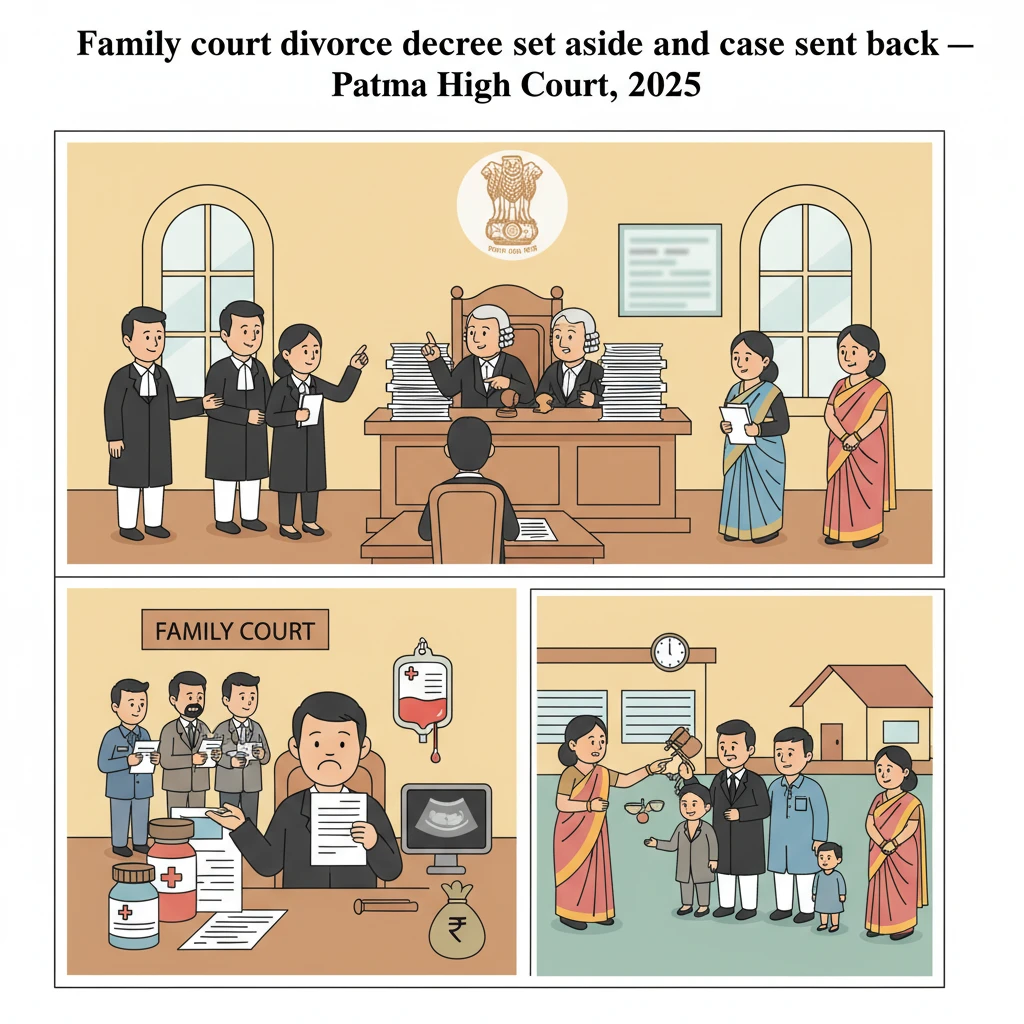
Case Background
This case arose out of a matrimonial dispute between a husband (the appellant) and his wife (the respondent). Their marriage was solemnised on 29.06.2006 according to Hindu rites and rituals.
After marriage, the wife went to live at her matrimonial home (sasural). According to the husband’s case, she stayed there for about a week. Her brother then came and took her back to her parents’ house. Later, she again returned to her sasural.
The husband filed Matrimonial Case No. 12 of 2008 before the Principal Judge, Family Court, Bhagalpur, under Sections 12 and 13 of the Hindu Marriage Act, 1955. He sought a decree of nullity and divorce mainly on the ground that the marriage was never consummated and that the wife was allegedly impotent and barren.
The wife appeared in the case and filed her written statement. She denied all the allegations made by the husband. She, instead, alleged harassment and cruelty for dowry by the husband and his family members and stated that she had already filed Complaint Case No. 2231 of 2008 against them.
After trial, the Family Court dismissed the husband’s petition by judgment and decree dated 29.06.2019. Against that dismissal, the husband filed Miscellaneous Appeal No. 778 of 2019 before the Patna High Court.
What the Court Examined and Decided
The appeal was heard by a Division Bench of the Patna High Court consisting of Hon’ble the Chief Justice and Hon’ble Mr. Justice S. B. Pd. Singh. The judgment in the appeal was delivered on 25.09.2025, authored by Hon’ble Mr. Justice S. B. Pd. Singh.
The core grievance of the husband was that the Family Court had wrongly rejected his divorce and nullity petition. He claimed that the Family Court had not properly appreciated his evidence and supporting medical documents, and had dismissed the case on an incorrect legal basis.
According to the husband’s pleadings, during the periods when the wife stayed in the matrimonial home, he repeatedly tried to establish physical relations with her. However, she allegedly refused every time. He stated that even a single act of consummation never took place.
On this basis, he alleged that the marriage had not been consummated owing to the wife’s impotency. He further alleged that the wife had been exercising frequent mental and physical cruelty against him and his family members since 30.06.2006, and that she had failed to discharge her matrimonial obligations towards him and his in-laws.
The husband claimed that her alleged infertility and behaviour caused him great torture, harassment, pain and grief. On these grounds he prayed for annulment of the marriage by a decree of nullity and for divorce under Sections 12 and 13 of the Hindu Marriage Act, 1955.
To support his case, the husband examined four witnesses: P.W. 1 himself (Anjan Kumar Roy), P.W. 2 Sadanand Roy, P.W. 3 Krishna Kant Roy and P.W. 4 Kailash Choudhary. He also produced several documents, which were exhibited as:
- Ext-1: Medical prescription of Dr. R. N. Jha
- Ext-2: Ultrasound report
- Ext-3: Report of examination of blood
- Ext-4: Report of examination of blood (immuno serological)
- Ext-5: Report of examination of urine
On the other side, the wife examined herself as O.P.W. 1, her brother Pankaj Kumar Singh as O.P.W. 2, and O.P.W. 3 Bipin Kumar Roy.
In her defence, as recorded by the High Court, the wife stated that the allegations of impotency, barrenness and cruelty made by the husband were false. She alleged that she was mentally and physically tortured for non-fulfilment of dowry demands. When the demands kept increasing despite her family’s efforts, she filed Complaint Case No. 2231 of 2008 against the husband and his family members.
The wife’s side further stated that only after she filed the complaint case did the husband initiate the divorce case, allegedly to put pressure on her and to oust her from his life. It was also submitted on her behalf before the High Court that the husband had already performed a second marriage with one Kajal Devi and that a child was born out of this second marriage.
The High Court carefully perused the record of the Family Court as well as the impugned judgment. It then turned to Section 12 of the Hindu Marriage Act, 1955, which deals with voidable marriages and grounds on which they can be annulled. The Court reproduced Section 12 in full in its judgment.
From the record, the High Court found that the husband’s divorce and nullity petition was filed essentially on the ground of alleged infertility (barrenness) of the wife, coupled with non-consummation. To support this, he had produced the medical and pathological reports (Exhibits 1 to 5).
The High Court noted that O.P.W. 3 had clearly stated in evidence that the wife had been living at her parents’ house since 2008. O.P.W. 2, the wife’s brother, also claimed in his deposition that the husband had performed a second marriage with one Kajal Devi, without obtaining divorce from his first wife, and that a child had been born from this second marriage.
Despite such facts and documentary exhibits being on record, the High Court observed that the Principal Judge, Family Court, did not take the pain to examine these facts and the medical documents from the point of their genuineness and authentication.
Instead, the Family Court concentrated its findings mainly on the legal point that barrenness is not a ground for divorce under the Hindu Marriage Act and, on that basis, dismissed the petition. The High Court held that the Family Court ought to have first examined the material facts and the evidentiary value of Exhibits 1 to 5 before arriving at any conclusion.
In the impugned judgment, as noted by the High Court, the Family Court had held that from Exhibits 1 to 5 (the medical prescription, ultrasound report and pathological reports) it was not clear whether the opposite party (wife) was barren or not and that no conclusive proof of barrenness was on record.
Before the High Court, counsel for the husband further argued that he wanted to produce the concerned doctor and pathologist to get those medical reports legally proved, as they were issued by those professionals. This meant that the medical evidence had not yet been tested through the testimony of the experts who authored them.
Considering all this, the High Court came to the view that the Family Court had not properly dealt with the evidence nor given the parties a fair opportunity to establish or challenge the authenticity and meaning of the medical documents. The trial court had limited itself to stating that barrenness is not a ground for divorce, without fully assessing whether the facts pleaded could fall within the grounds under Section 12(1)(a) (impotence leading to non-consummation) or other relevant provisions, and without first deciding the factual dispute.
Therefore, the High Court set aside the judgment and decree dated 29.06.2019 passed in Matrimonial Case No. 12 of 2008 by the Principal Judge, Family Court, Bhagalpur.
The High Court did not itself grant divorce or annulment. Instead, it remanded the matter back to the Family Court for a fresh decision on merits. It directed the Family Court to:
- Examine Exhibits 1 to 5 produced by the husband, including their genuineness and evidentiary value.
- Grant opportunity to both parties to adduce their evidence, including calling the doctor and pathologist if sought.
- Decide the case on merits within three months from the date of receipt of a copy of the High Court’s order.
The parties were specifically directed to cooperate in the proceedings.
With these directions, Miscellaneous Appeal No. 778 of 2019 was disposed of. Any pending interlocutory applications were also disposed of.
Why This Judgment Matters
This judgment is important for couples involved in divorce and nullity proceedings, especially in Bihar. It shows that the Patna High Court insists that Family Courts must carefully examine all evidence before rejecting or accepting a claim.
For spouses who allege non-consummation or medical issues like impotency or infertility, the decision highlights that such claims must be backed by proper medical proof. At the same time, courts must give them a fair chance to prove those documents through doctors and experts.
For respondents, especially wives facing divorce after filing dowry or cruelty complaints, the judgment shows that higher courts will check whether the Family Court has genuinely considered their side and the full record, including allegations of second marriage and continued residence at parental home.
More broadly, the ruling reinforces that Family Courts cannot dispose of matrimonial cases on narrow legal points alone. They must look at the entire factual picture and decide only after testing all key evidence.
Legal Issues and Answers
-
Issue: Whether the Family Court was justified in dismissing the husband’s petition for nullity and divorce without fully examining the medical reports and other material evidence on record.
Answer: No. The Patna High Court held that the Family Court failed to examine the genuineness and evidentiary value of Exhibits 1 to 5 and concentrated only on the abstract point that barrenness is not a ground for divorce. The judgment and decree were therefore set aside and the matter remanded for fresh consideration. -
Issue: What should be the proper course when medical evidence has been exhibited but not proved through the concerned experts.
Answer: The High Court directed that the husband be allowed to produce the doctor and pathologist to legally prove the reports, and that both parties must be given opportunity to adduce evidence before the Family Court decides the matter on merits. -
Issue: How should the Family Court proceed after remand in a voidable marriage and divorce case under the Hindu Marriage Act.
Answer: The Family Court must examine the medical exhibits, consider all oral and documentary evidence, hear both sides, and then decide the case on merits within three months of receiving the High Court’s order, with cooperation from both parties.
Cases Cited by the Court
- No earlier case law has been cited or relied upon in the text of this judgment.
Case Details
Case Number: Miscellaneous Appeal No. 778 of 2019
Case Title: Anjan Kumar Roy v. Smt. Mala Devi
Citation: 2025(4) PLJR 374
Court: High Court of Judicature at Patna
Coram: Hon’ble the Chief Justice; Hon’ble Mr. Justice S. B. Pd. Singh
Date of High Court Judgment: 25.09.2025
Impugned Judgment: Judgment and decree dated 29.06.2019 in Matrimonial Case No. 12 of 2008, Principal Judge, Family Court, Bhagalpur
Advocates:
- For the Appellant (husband): Mr. Syed Masleh Uddin Ashraf, Advocate; Mr. Rana Hasan, Advocate; Ms. Huma Yunus, Advocate
- For the Respondent (wife): Mr. Rajesh Kumar, Advocate
Nature of the Case: Miscellaneous Appeal against dismissal of a matrimonial petition for nullity and divorce under Sections 12 and 13 of the Hindu Marriage Act, 1955; remand to Family Court for fresh decision on merits.
Link to Judgment: Click here to read the full judgment of the Patna High Court
If you found this explanation helpful and wish to stay informed about
how legal developments may affect your rights in Bihar,
you may consider following Samvida Law Associates for more updates.







