

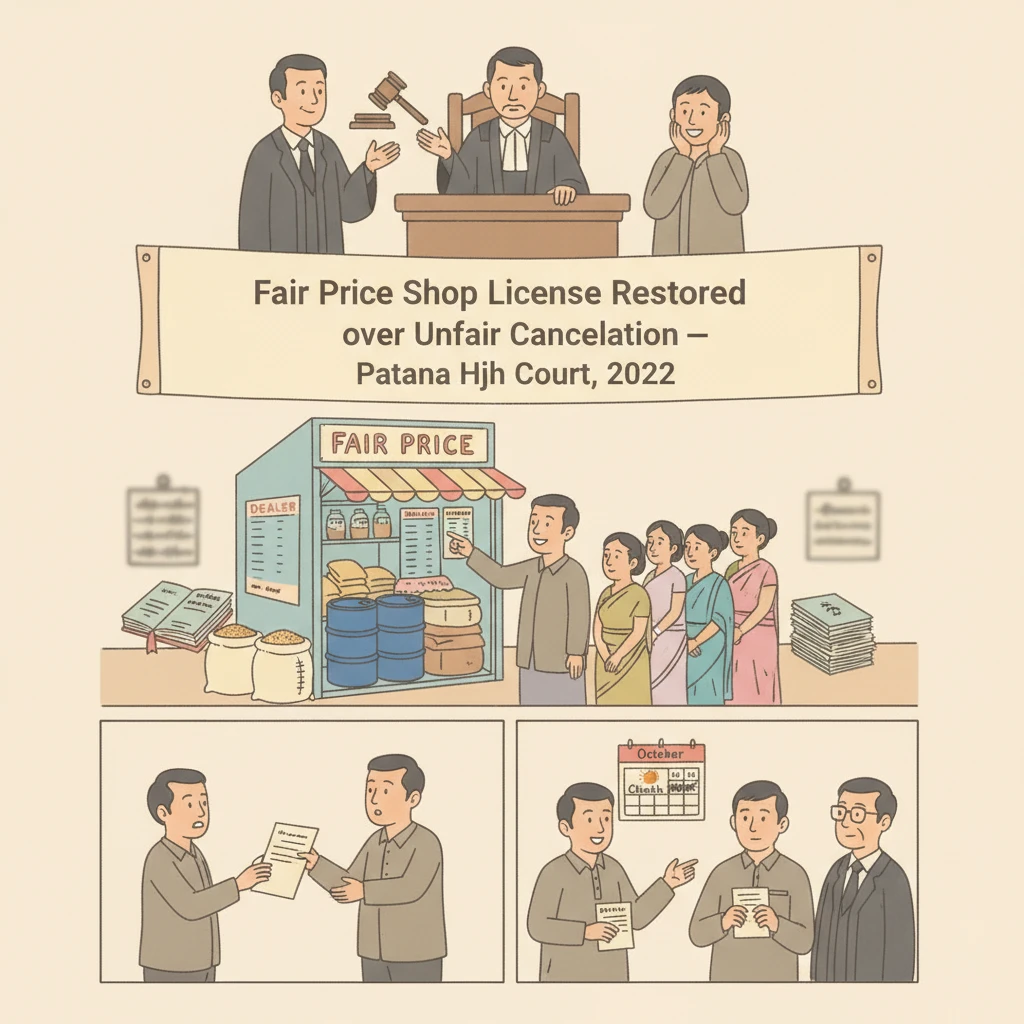
Case Background
The case arose from the cancellation of a Public Distribution System (PDS) licence granted to a dealer under Licence No. 86 of 2016, for a fair price shop in Jitwarpur Gram Panchayat, District Saran (Chapra), Bihar.
On 12.10.2017, a joint inspection team visited the dealer’s fair price shop. Following this inspection, the Sub Divisional Officer, Sonepur, Saran, who is the Licensing Authority under the Bihar Targeted Public Distribution System (Control) Order, 2016, issued a show cause notice dated 15.10.2017.
The notice listed several alleged irregularities: non-display of the list of beneficiaries, non-display of sample food grains, non-display of the Weight and Measure licence, belated distribution of kerosene oil for September 2017 in October 2017, and non-distribution of food grains and kerosene oil every month.
The dealer submitted a written reply within the stipulated time, annexing documents and affidavits of beneficiaries in his support. Despite this, by order dated 30.11.2017, issued under Memo No. 1220, the Sub Divisional Officer cancelled the PDS licence.
The dealer challenged this cancellation in appeal before the District Magistrate, Saran, in Supply Appeal No. 80 of 2017. On 22.10.2018, the District Magistrate dismissed the appeal and upheld the cancellation.
The dealer then filed Supply Revision No. 29 of 2019 before the Commissioner, Saran Division, Chapra. On 11.11.2019, the Commissioner also rejected the revision and affirmed the earlier orders.
Aggrieved by these three orders, the dealer approached the Patna High Court in Civil Writ Jurisdiction Case No. 9309 of 2020. He sought quashing of the cancellation order, the appellate order, and the revisional order, and restoration of his PDS licence.
What the Court Examined and Decided
The Patna High Court, through Hon’ble Mr. Justice Anil Kumar Sinha, closely examined the inspection report, the show cause notice, the reply of the dealer, and the reasoning in the orders of the Licensing Authority, the Appellate Authority, and the Revisional Authority.
On facts, the Court first noted the exact allegations in the show cause notice: non-display of beneficiaries’ list, non-display of sample grains, non-display of Weight and Measure licence, belated distribution of kerosene for September 2017 in October 2017, and failure to distribute food grains/kerosene each month and every month.
The dealer, in his reply, had taken specific defences. He stated that the Weight and Measure licence had been renewed up to October 2018. He asserted that lists of beneficiaries and sample food grains were displayed in his shop. He explained that because of the Chhath festival, he first prioritised distribution of food grains and thereafter distributed kerosene in the following month. He also stated that distribution was being done under the supervision of the Panchayat Level Vigilance Committee, that prescribed quantity at prescribed rate was always delivered, and that entries were made in the distribution register.
He produced a photocopy of the distribution register and affidavits from some beneficiaries who denied making complaints against him. On the other hand, the State relied on the joint inspection report and maintained that irregularities were found, justifying cancellation strictly under Clauses 25 and 27 of the 2016 Order.
The Court then assessed how the Licensing Authority had dealt with each allegation.
Regarding allegation (iii), non-display of the Weight and Measure licence, the Court observed that the Licensing Authority had not recorded any adverse finding. From the order, it appeared that the plea of renewal of the Weight and Measure licence up to October 2018 was accepted.
On allegation (i) and (ii), non-display of list of beneficiaries and sample food grains, the Court referred to its earlier decision in Raghuvir Prasad v. The State of Bihar and Others, reported in 2015 (2) PLJR 910. In that case, the Court had held that irregularities in maintenance of a notice board or stocks are too trivial to form the basis of cancellation of a licence. Applying the same reasoning, the Court held that non-display of beneficiaries’ list or sample food grains by itself could not justify cancellation of the PDS licence.
The more serious charges were allegation (iv) and (v). On allegation (iv), delayed distribution of kerosene oil for September 2017 in October 2017, the dealer had clearly stated that due to the Chhath festival he first distributed food grains and then kerosene oil in the subsequent month.
The Licensing Authority rejected this explanation and concluded that such delay showed a “guilty mindset” and “wrong intention” of the dealer. The High Court found that this conclusion was unsupported by any cogent material. Importantly, there was no allegation or finding that the dealer had diverted the kerosene oil for black marketing or for any unauthorised purpose.
The Court held that, without evidence of diversion or misuse, mere delayed distribution by one month, especially when an explanation relating to a widely observed festival had been offered, could not automatically be read as proof of bad intention. The Licensing Authority had failed to apply a judicious mind to this defence.
On allegation (v), that the dealer was not distributing food grains and kerosene every month, the Court examined the specific pleas and documents filed by the dealer. He had asserted that distribution was carried out in the presence of the Panchayat Level Vigilance Committee at prescribed rates and quantities. The Committee made entries in the distribution register. This register, along with affidavits from beneficiaries like Hiramuni Kumari, Harendra Rai and Radha Ballam Rai, was filed with the reply.
The Licensing Authority rejected this defence by stating that signatures of beneficiaries on these affidavits did not match their signatures on statements recorded during the inspection. On this basis, the Authority disbelieved the affidavits and treated them as an attempt to cover up irregularities.
The High Court found this approach fundamentally flawed. It noted that the Licensing Authority had not considered the distribution register and the certificate from the Panchayat Level Vigilance Committee at all. There was “not even a whisper” in the order about these materials, though they were crucial to determining whether distribution took place regularly at proper rates and quantities.
The Court then drew attention to Clause 23 of the Bihar Targeted Public Distribution System (Control) Order, 2016. This clause imposes a duty on the Sub Divisional Officer to obtain, each month, a certificate of distribution of food grains and other commodities from the fair price shop owner, jointly certified by the local Mukhiya or head of the municipal body and a member of the local vigilance committee.
It observed that the Sub Divisional Officer had failed to discharge this statutory duty. Even when the distribution register, certified by the Panchayat Level Vigilance Committee, was produced by the dealer, it was not examined. The non-consideration of this specific plea and supporting material amounted to denial of adequate opportunity to the dealer and breach of the principles of natural justice.
Further, the Court held that simply rejecting the beneficiaries’ affidavits on the ground of mismatch in signatures, without giving the dealer a chance to examine or cross-examine those beneficiaries, was a one-sided exercise. This again violated natural justice.
The Court emphasised that in law the burden lies on the authority alleging misconduct to prove the charges by cogent reasons and relevant evidence. In this case, instead of properly proving the allegations, the authorities rejected the dealer’s defence in a perfunctory and mechanical manner.
On the legal framework, the dealer had argued that cancellation under Clause 27 of the 2016 Order must be read with the conditions set out in Clause 25, which specify the types of serious misconduct like diversion, overcharging, or black marketing. The Court noted that there was no allegation that the dealer had charged excess price, reduced quantity, or indulged in black marketing. The authorities had not shown how delayed distribution or alleged non-distribution fitted within the circumstances envisaged in Clause 25.
The Court also observed that the revisional authority, the Commissioner, Saran Division, had gone beyond the original charges. While affirming the cancellation, the Commissioner recorded that the dealer did not supply food grains at prescribed rates and quantities. However, this was never a part of the original show cause notice or the charges framed. Introducing such a new adverse finding at the revisional stage was impermissible.
In light of these findings, the Court concluded that the decision-making process of the Licensing Authority, and its affirmation by the appellate and revisional authorities, suffered from apparent errors. The orders were arbitrary, unreasonable, and violative of the principles of natural justice.
Consequently, the Court set aside the order dated 30.11.2017 of the Sub Divisional Officer, Sonepur, Saran, as well as the appellate order dated 22.10.2018 of the District Magistrate, Saran, and the revisional order dated 11.11.2019 of the Commissioner, Saran Division.
The Court issued a positive direction to respondent no. 4, the Sub Divisional Officer, Sonepur, Saran (Chapra), to restore PDS Licence No. 86 of 2016 forthwith and permit the dealer to run the fair price shop in accordance with law. The writ application was allowed without any order as to costs.
Why This Judgment Matters
This judgment is significant for fair price shop dealers and PDS beneficiaries across Bihar. It reinforces that cancellation of a PDS licence is a serious step and cannot be based on minor procedural lapses or assumptions about “guilty mindset” without evidence.
The Patna High Court makes it clear that authorities must strictly follow the safeguards built into the Bihar Targeted Public Distribution System (Control) Order, 2016. They must collect and consider monthly certificates and distribution registers, and they cannot ignore documents and certificates submitted by local vigilance committees or public representatives.
The decision also underscores that when beneficiaries’ statements are used against a dealer, the dealer should be given a fair chance to confront such evidence. Rejecting affidavits without such opportunity violates natural justice.
For poor households dependent on ration, this judgment indirectly protects their rights. A fair price shop should not be shut down unfairly, as it can disrupt access to essential food grains and kerosene. For honest dealers, the ruling shows that courts will intervene if authorities act mechanically or beyond the charges framed.
Legal Issues and Answers
Issue: Whether the cancellation of the PDS fair price shop licence under the Bihar Targeted Public Distribution System (Control) Order, 2016, on the basis of alleged irregularities in display and distribution, was legally sustainable.
Answer: No. The Patna High Court held that the cancellation order and the confirming appellate and revisional orders were arbitrary, unsupported by evidence, and violative of natural justice, and therefore liable to be set aside.
Issue: Whether non-consideration of the distribution register and certificates of the Panchayat Level Vigilance Committee, and unilateral rejection of beneficiaries’ affidavits, satisfied the requirement of fair hearing.
Answer: No. The Court held that ignoring these materials and denying the dealer an opportunity to examine or cross-examine beneficiaries amounted to denial of adequate opportunity and breach of natural justice.
Issue: Whether the revisional authority could affirm cancellation by recording an additional finding that the dealer supplied food grains at non-prescribed rate and quantity, when such a charge was never framed.
Answer: No. The Court held that going beyond the original charges rendered the revisional order bad in law.
Cases Cited by the Court
Dharampal Satyapal Limited v. Deputy Commissioner of Central Excise, Gauhati and Others, (2015) 8 SCC 519.
Sant Lal Gupta and Others v. Modern Cooperative Group Housing Society Limited and Others, (2010) 13 SCC 336.
Oryx Fisheries Private Limited v. Union of India and Others, (2010) 13 SCC 427.
Raghuvir Prasad v. The State of Bihar and Others, 2015 (2) PLJR 910.
Case Details
Case Number: Civil Writ Jurisdiction Case No. 9309 of 2020
Case Title: Arun Singh alias Arun Kumar Singh v. The State of Bihar and Others
Coram: Hon’ble Mr. Justice Anil Kumar Sinha
Citation: 2022 (1) PLJR 560
Advocates:
For the petitioner: Mr. Anand Kumar Ojha, Mr. Ram Kishore Singh
For the respondents: Mr. Gyan Shankar, AC to GP 2
Nature of the Case: Writ petition challenging cancellation of PDS fair price shop licence and affirming appellate and revisional orders.
Link to Full Judgment: Patna High Court Judgment dated 31-01-2022
If you found this explanation helpful and wish to stay informed about
how legal developments may affect your rights in Bihar,
you may consider following Samvida Law Associates for more updates.







