
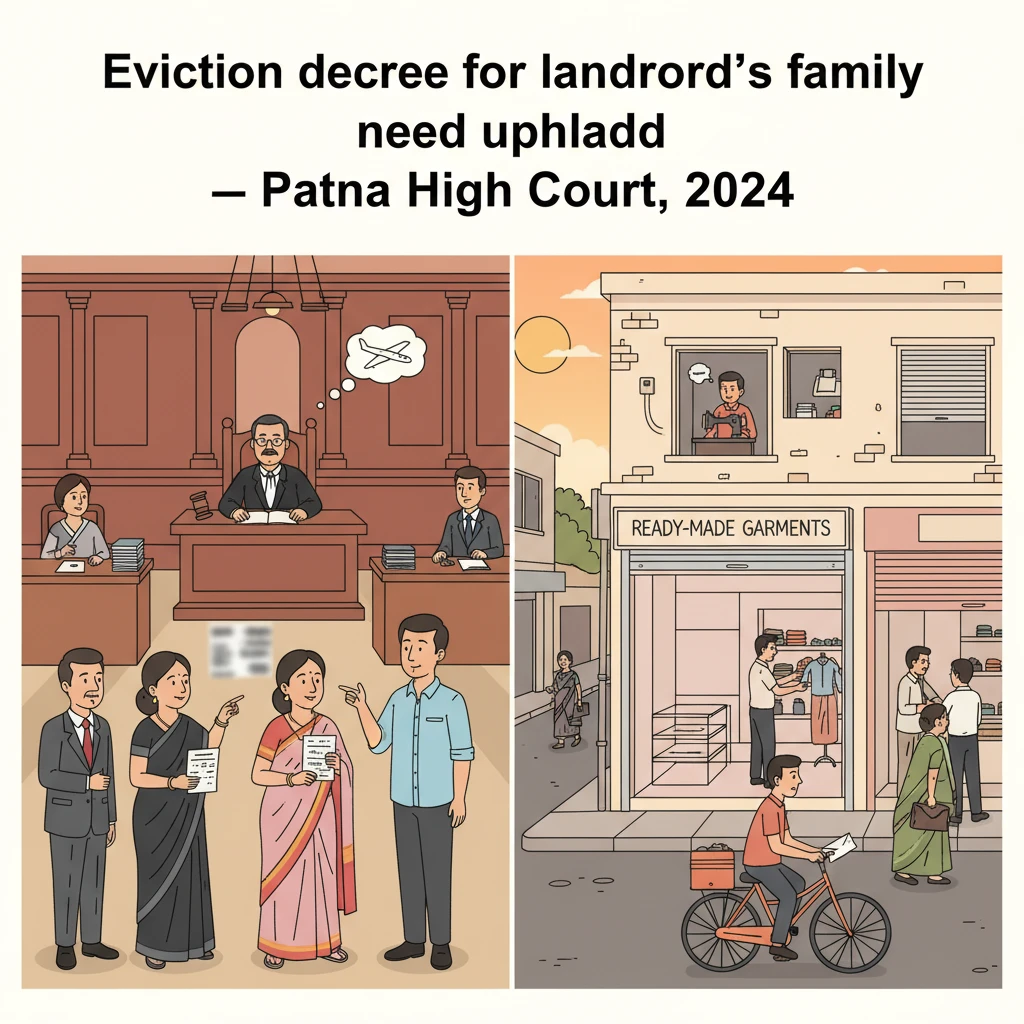
Case Background
The dispute concerns a small shop at Gaya measuring 24 feet north–south and 10½ feet east–west. The shop was part of the property purchased by one Late Habibur Rahman Khan. After his death on 13.10.2006 due to Hepatitis B, he left behind his widow, the present plaintiff, three sons – Arif Habib Khan, Faiz Khan and Asif Habib Khan – and a married daughter, Reshmi Habib Khan.
The plaintiff’s family was described as a trader family with good reputation in the cloth business. One of the family shops, previously occupied by a tenant named Salahuddin, was vacated on 19.03.2010. The eldest son Arif Habib Khan then started a ready‑made garments business in that vacated shop.
According to the plaintiff, her second son Faiz Khan had completed his graduation but had no work and was “sitting idle.” Faiz wanted to start a ladies’ and kids’ ready‑made garments business in the present suit shop, which was said to be the most suitable location. The plaintiff alleged that she requested her tenant, the defendant, to vacate the shop. He initially asked for six months’ time but ultimately refused to vacate on 31.05.2010.
On this basis, the plaintiff filed Eviction Suit No. 08 of 2010 before the court of Munsif‑I, Gaya, claiming reasonable and bona fide personal necessity of the shop for Faiz Khan’s proposed cloth business. She also stated that structural changes like showcases, racks, shelves, a counter, and a trial room needed to be constructed in the suit premises for the new business.
The defendant contested the suit. He denied the plaintiff’s claim of personal necessity and put forward a different picture of the tenancy. He said the plaintiff’s late husband had executed an Ekrarnama dated 25.01.1994 (marked Ext.A) in his favour. This document allegedly fixed the tenancy for 35 years, up to 2028, at a rent of Rs. 1300 per month. The defendant also stated that he had paid Rs. 3,25,000 as “advance rent” to late Habibur Rahman Khan, and that he was inducted as a fixed‑term tenant for 35 years.
According to the defendant, after the Ekrarnama, he regularly paid rent till August 2006, for which receipts were issued by late Habibur Rahman Khan. After Habibur’s death, the plaintiff allegedly pressurised him to pay Rs. 2,00,000 as further advance and increase the rent to Rs. 4,000 per month, otherwise she would sue for eviction. Feeling aggrieved, he started sending rent by money order at Rs. 1,800 per month. He also claimed that Faiz Khan was not unemployed and that the plea of personal necessity was mala fide.
An additional written statement was filed by the defendant, asserting that Faiz Khan had gone to Saudi Arabia and was running a tailoring shop there to earn his livelihood. It was also pleaded that a suitable space to open a shop was available on the first floor of the same premises, where Faiz could start his cloth business, and that the plaintiff owned several other shop rooms already let out to tenants.
The trial court, after recording evidence from both sides, decreed the suit on 22.04.2014. It held that the plaintiff’s need for the shop for her son Faiz Khan was reasonable and bona fide and directed the defendant to vacate the suit premises and deliver possession within 60 days. Against this eviction decree, the tenant filed Civil Revision No. 90 of 2014 before the Patna High Court.
What the Court Examined and Decided
The Patna High Court, presided over by Hon’ble Mr. Justice Nawneet Kumar Pandey, heard the civil revision against the decree of eviction. The main attack by the tenant was twofold: first, that he had a protected 35‑year tenancy under the Ekrarnama; second, that the landlord’s case of personal necessity for Faiz Khan was not genuine.
On the tenant’s side, it was argued that Ext.A, the Ekrarnama dated 25.01.1994, clearly showed that the tenancy was for a fixed term of 35 years ending in 2028. According to the tenant, this was not a formal “Kirayanama” or registered lease deed but only a memorandum recording the terms of an oral agreement between him and late Habibur Rahman Khan. He contended that, being only a memorandum, it did not require compulsory registration and could still be looked into under Section 49 of the Registration Act, 1908 for collateral purposes.
The learned counsel for the tenant submitted that even if the document was not registered, it should be admissible at least to show the nature and duration of the tenancy. On this basis, he claimed that the plaintiff could not seek eviction before the expiry of the alleged 35‑year period.
The trial court had already rejected this stand, treating Ext.A as an unregistered lease deed for a term exceeding one year and, therefore, invalid and inoperative for want of registration. The High Court examined this aspect in detail by referring to the legal provisions applied by the trial court.
The trial court relied on Section 17(1)(d) of the Registration Act, 1908 and Section 107 of the Transfer of Property Act, 1882. These provisions make it mandatory that leases of immovable property for a term exceeding one year must be made by a registered instrument. The High Court noted that the trial court, in paragraphs 9 to 15 of its judgment, had discussed this issue elaborately and concluded that the agreement between the parties was inoperative and invalid because it was not registered as the law requires.
Affirming this view, the High Court agreed that the tenancy in question could not be treated as a fixed‑term lease up to 2028. Instead, Section 106 of the Transfer of Property Act, 1882 was invoked. Section 106 provides that a lease for any purpose other than agricultural or manufacturing purposes is presumed to be a month‑to‑month tenancy. Since the shop premises were clearly used for commercial (cloth business) purposes and no valid fixed‑term registered lease existed, the court held that the tenancy was only from month to month.
On the tenant’s plea about Section 49 of the Registration Act, 1908, the High Court noted that the trial court had relied on the Supreme Court decision in Satish Chand Mukhan and others v. Goverdhan Das Byas and others (AIR 1984 SC 143). In that case, it was held that the terms of a lease are not a “collateral purpose” for which an unregistered lease document can be used. Relying on this precedent, the High Court endorsed the trial court’s conclusion that Ext.A could not be used to prove a 35‑year tenancy.
Having upheld the legal position that the tenancy was month‑to‑month, the High Court then turned to the question of personal necessity and the bona fide need of the plaintiff.
The plaintiff’s case was that Faiz Khan, her second son, was unemployed after graduation and wanted to start a ladies’ and kids’ ready‑made garments business in the suit shop. The defendant alleged that this was false, claiming Faiz was actually running a tailoring shop in Dubai (Saudi Arabia was mentioned in the additional written statement) and that the plaintiff had a habit of getting shops vacated on the pretext of personal necessity only to re‑let them.
The High Court examined the evidence. From the plaintiff’s side, six witnesses were examined: P.W.1 Chunni Singh proved municipal holding tax receipts (Ext.1) showing that the premises belonged to the plaintiff. P.W.2 was the plaintiff herself and P.W.3 was her eldest son Arif Habib Khan, who proved money order coupons (Ext.2 to 2/C) for rent tendered for May to August 2012. P.W.4 Abutarab Mohammad Bashirat, P.W.5 Faisal Nezami, P.W.6 Quanain Khan and P.W.7 Faiz Khan, for whose benefit the shop was sought, all supported the plaintiff’s case.
From the defendant’s side, eight witnesses were produced. D.W.2 was the defendant himself. D.W.4 Birendra Singh proved a rent receipt dated 06.09.2006 (Ext.B). D.W.6 Baliram Singh and D.W.7 Umashankar Prasad proved various money order receipts (Ext.C to C/22). Other witnesses, including D.W.3, a worker in the defendant’s shop, were also examined.
The High Court noted a major inconsistency in the defendant’s case regarding Faiz Khan’s whereabouts. In the written statement, the defendant claimed that Faiz was running a tailoring shop in Dubai. However, during cross‑examination of P.W.2 (the plaintiff) and P.W.3 (her eldest son), the defence put suggestions that Faiz was working in Delhi, which contradicted the written statement. This inconsistency weakened the tenant’s claim that the plaintiff’s plea was false.
The tenant also argued that the plaintiff habitually got premises vacated on the ground of personal necessity and then let them out again. In particular, it was said that Salahuddin had vacated another shop earlier for the business of the plaintiff’s eldest son, but the shop was later let to someone else. The trial court had considered Salahuddin’s oral evidence. Salahuddin, who was around 65–70 years old at the time he vacated the shop, stated that he left the shop due to his inability to continue running it. He also admitted that he vacated six months before the present suit was filed.
The High Court noted that this evidence actually showed that, during the pendency of the present suit, the plaintiff did not let out her commercial premises to other tenants. This went against the allegation that she was misusing the ground of personal necessity.
The High Court further observed that witnesses on behalf of the plaintiff had categorically stated that Faiz Khan was sitting idle and had no work. Considering this, along with the overall circumstances, the court agreed with the trial court that the plaintiff required the suit premises reasonably and in good faith for her son’s business.
In conclusion, Justice Nawneet Kumar Pandey held that the trial court had not committed any illegality, irregularity, or impropriety either in rejecting the tenant’s reliance on the unregistered Ekrarnama or in accepting the plaintiff’s personal necessity. Consequently, the civil revision was dismissed, and the eviction decree in favour of the landlord stood confirmed.
Why This Judgment Matters
This decision is significant for both landlords and tenants dealing with long‑term shop rentals in Bihar and elsewhere. It shows that an unregistered document claiming to fix tenancy for many years cannot override the legal requirement of registration for leases beyond one year. Without proper registration, such arrangements may be treated only as month‑to‑month tenancies.
For tenants, the judgment is a warning that paying lump‑sum “advance rent” or relying on informal agreements does not automatically guarantee long‑term security if the document is not legally valid. For landlords, it confirms that courts can order eviction when the landlord genuinely needs the premises for a family member’s livelihood, provided the need is shown to be reasonable and in good faith.
The case also highlights that if a tenant makes inconsistent claims about the landlord’s family situation, such contradictions can seriously damage the tenant’s defence. Evidence about how other shops were vacated and used will also be closely examined, rather than assumed to be mala fide.
Legal Issues and Answers
- Issue: Whether the tenant had a protected fixed‑term tenancy till 2028 under the unregistered Ekrarnama dated 25.01.1994.
Answer: No. The court held that the agreement, being for a term exceeding one year and unregistered, was inoperative and invalid; the tenancy was only month‑to‑month under Section 106 of the Transfer of Property Act, 1882. - Issue: Whether the plaintiff’s claim of personal necessity for her son Faiz Khan was reasonable and made in good faith.
Answer: Yes. Based on oral and documentary evidence, and noting contradictions in the tenant’s version, the court upheld the finding that the suit premises were reasonably and bona fide required for the son’s cloth business. - Issue: Whether the trial court’s decree of eviction suffered from any illegality, irregularity, or impropriety warranting interference in revision.
Answer: No. The Patna High Court found no such defect and therefore dismissed the civil revision.
Cases Cited by the Court
- Satish Chand Mukhan and others v. Goverdhan Das Byas and others, AIR 1984 SC 143 – cited for the principle that the terms of a lease are not a “collateral purpose” for which an unregistered lease deed can be used under Section 49 of the Registration Act, 1908.
Case Details
Case Number: Civil Revision No. 90 of 2014
Case Title: Sunil Kumar v. Anjum Shireen
Court: High Court of Judicature at Patna
Coram: Hon’ble Mr. Justice Nawneet Kumar Pandey
Date of High Court Judgment: 03.09.2024
Trial Court Order Under Challenge: Judgment and decree dated 22.04.2014 passed by the Court of Munsif‑I, Gaya, in Eviction Suit No. 08 of 2010
Citation: 2024 (4) PLJR 296
Advocates:
For the petitioner/tenant: Mr. Md. Waliur Rahman, Mr. S. P. Singh
For the respondent/landlord: Mr. Abdul Mannan Khan, Mr. Avinava Kumar, Mr. Hafiz Shahbaz
Nature of the Case: Civil revision against a decree of eviction in an eviction suit based on personal necessity
Link to Full Judgment: Patna High Court Judgment in Civil Revision No. 90 of 2014
If you found this explanation helpful and wish to stay informed about
how legal developments may affect your rights in Bihar,
you may consider following Samvida Law Associates for more updates.







