

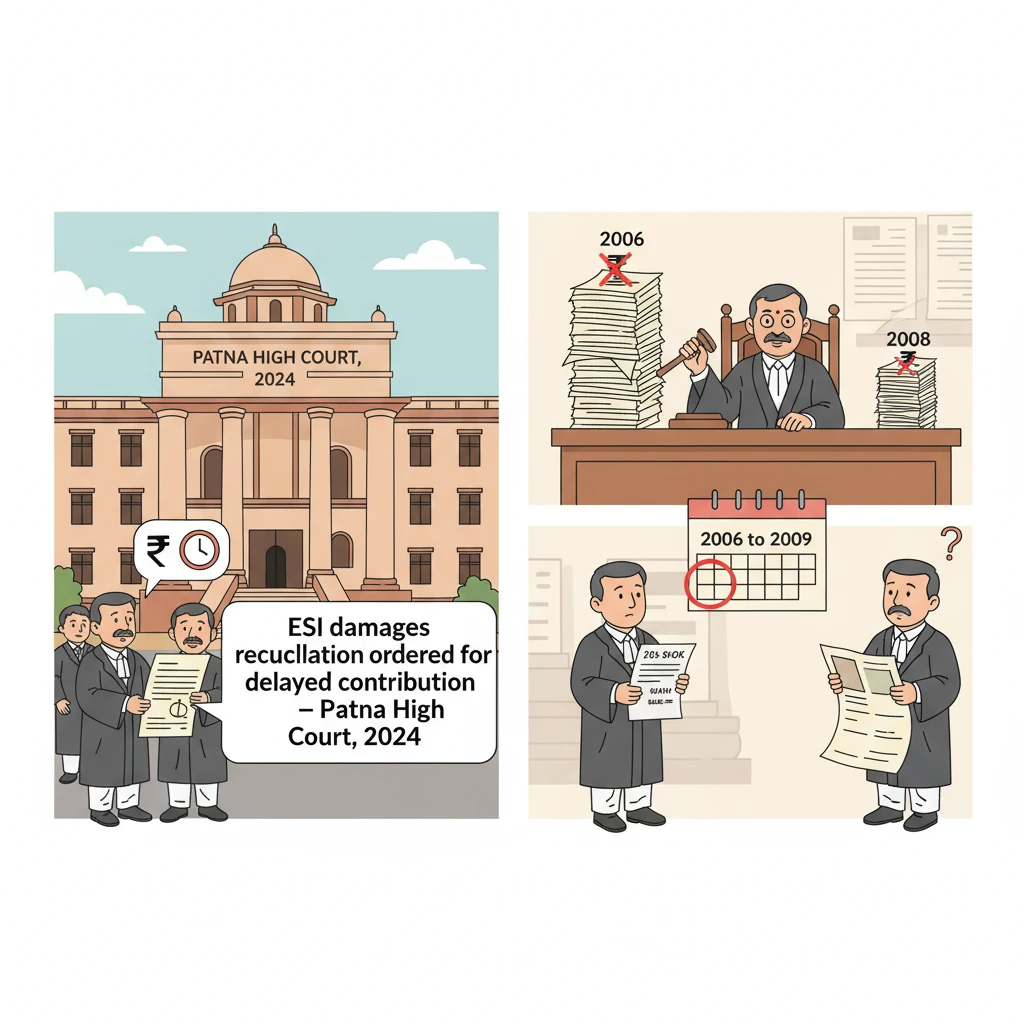
Case Background
The petitioner company runs a plant and office at Industrial Area, Patliputra, Patna. It is covered under the Employees State Insurance Corporation Act, 1948 and has been regularly depositing ESI contribution for its employees at the Patna plant.
In February 2006, the company received a letter dated 20.02.2006 from the Deputy Regional Director, Employees State Insurance Corporation, Regional Office, Bihar, Patna. In this letter, a huge demand of Rs.1,01,96,368/- was raised towards ESI contribution on “escaped wages” for the period 2000 to 2003.
The company protested this demand. On its objection, the ESI authorities carried out a fresh inspection of the company’s records on 05.12.2007. After re-verification, the authorities realised that the earlier demand was wrongly calculated.
The earlier figure of more than one crore rupees was then corrected. A fresh demand of only Rs.1,27,105/- was raised by letter dated 02.06.2008 towards ESI contribution on escaped wages for the same period 2000 to 2003.
The company deposited this corrected amount on 24.08.2009. However, after this payment, the Regional Director (respondent no.2) passed an order dated 22.05.2014 under Section 85B of the ESI Act, 1948. By this order, the authority imposed damages of Rs.1,09,620/- on the company for delay in payment.
Aggrieved, the company filed Civil Writ Jurisdiction Case No. 3496 of 2015 before the Patna High Court. It sought quashing of the damages order dated 22.05.2014 and requested a fresh order of assessment of damages by taking the delay period as starting from 02.06.2008 (the corrected demand) up to 24.08.2009 (the payment date).
What the Court Examined and Decided
The Patna High Court, through Hon’ble Mr. Justice Mohit Kumar Shah, focused on two main questions: from which date the delay should be counted for imposing damages, and whether the authority had exercised its discretion properly while levying damages under Section 85B of the ESI Act.
On behalf of the petitioner company, it was argued that the “correct” demand of Rs.1,27,105/- was made only on 02.06.2008. The earlier demand dated 20.02.2006 for Rs.1,01,96,368/- was admittedly based on a wrong calculation and later revised. Therefore, according to the company, delay could be counted only from 02.06.2008.
The petitioner pointed out that it deposited the demanded amount on 24.08.2009. If a grace period of 21 days is allowed from 02.06.2008, as per ESI instructions, the delay would be only about 14 months and 23 days. Damages should therefore be computed only for this shorter period.
However, in the impugned order dated 22.05.2014, the Regional Director calculated damages by treating the delay as having started from 13.03.2006 (after allowing 21 days from the first demand dated 20.02.2006) up to 24.08.2009. This worked out to about 3 years, 5 months and 11 days. Damages were then imposed at the maximum rate of 25% under Regulation 31C of the Employees State Insurance (General) Regulations, 1950.
The petitioner further argued that no reasons were given in the order for using the highest slab of damages under Regulation 31C. The authority simply applied the top rate without explaining why a lower rate was not considered.
The petitioner also relied on the language of Section 85B of the ESI Act, 1948. This provision says that the Corporation “may recover” damages. According to the petitioner, this means that the power is discretionary, not automatic. The adjudicating authority must consider mitigating circumstances and cannot act mechanically by always applying the maximum rate of damages.
On the other hand, the respondents (ESIC authorities) argued, with reference to their counter affidavit, that the delay should be counted from the first demand dated 20.02.2006. They said that the company had not deposited ESI contribution on escaped wages for 2000–2003, leading to the original demand of Rs.1,01,96,368/-.
They admitted that the company protested, the records were re-inspected, and the corrected demand of Rs.1,27,105/- was made on 02.06.2008, which was paid on 24.08.2009. They justified the damages of Rs.1,09,620/- as being in line with Regulation 31C of the 1950 Regulations.
The respondents relied on instructions from ESI headquarters contained in Letter No. T-11/11/-10/06-Ins. III dated 27.03.1986. This circular states that damages on omitted wages, where employee-wise details are not available, are to be claimed after giving 21 days’ grace from the date of the demand letter/C-18 notice from the Regional/Sub-Regional office.
The High Court first examined the sequence of events. It noted that the first demand notice dated 20.02.2006 claimed Rs.1,01,96,368/-. On the company’s objection, the authorities re-verified the records and found their calculation incorrect. They then revised the amount to Rs.1,27,105/- and issued a fresh demand notice dated 02.06.2008. This was the amount actually payable and eventually deposited on 24.08.2009.
The Court then turned to larger principles. It observed that it is a well-settled principle of law that a public authority cannot be allowed to take advantage of its own wrong. It referred to the equitable maxim “Nullus commodum capere potest de injuria sua propria” – meaning that no one can take benefit from his own wrong.
To support the petitioner’s submission on discretion in imposing penalties, the Court referred to two Supreme Court decisions.
First, it quoted paragraph 8 of Hindustan Steel Limited v. State of Orissa, AIR 1970 SC 253 :: (1969) 2 SCC 627. In that case, the Supreme Court held that liability to pay penalty does not arise merely on proof of default. Imposition of penalty is a quasi-criminal matter and should not ordinarily be made unless the default is deliberate, contumacious or in conscious disregard of obligation. Even when penalty is lawful, the authority must exercise discretion judicially, and it may refuse to impose penalty in cases of technical or venial breach or bona fide belief.
Second, the Court referred to Prestolite (India) Limited v. Regional Director, 1994 Supp (3) SCC 690. The Supreme Court there held that even if regulations prescribe guidelines and upper limits for damages, authorities cannot insist that mitigating circumstances are never relevant. The order must show reasons why the grounds for delayed payment are not accepted and why a particular rate of damages is justified. It cannot be passed mechanically.
Applying these principles, the Patna High Court held that Section 85B of the ESI Act clearly confers discretionary power to levy damages. The authority must consider all relevant circumstances and mitigating factors. It must give reasons for rejecting the employer’s objections and for choosing the rate of damages.
In the present case, the Court found that the Regional Director had failed to furnish any reason in the order dated 22.05.2014 for not accepting the petitioner’s objections. This defect alone rendered the order unsustainable and fit to be set aside.
The Court then adopted what it described as a “pragmatic view”. It accepted that the petitioner was liable to pay Rs.1,27,105/- towards ESI contribution on escaped wages for 2000–2003. However, it also took note of the ESI headquarters circular dated 27.03.1986, which requires damages on omitted wages to be claimed only after allowing a grace period of 21 days from the demand letter.
Since the first demand dated 20.02.2006 was admittedly erroneous and was corrected only by the demand dated 02.06.2008, the period between these two demands had been spent by the authorities in rectifying their own mistake. The Court held that for this intervening period, the employer could neither be blamed nor faulted.
Therefore, the Court concluded that the notice dated 02.06.2008 must be treated as the only valid demand for the purpose of calculating damages. After allowing the mandatory 21-day grace period, the delay period would start from 23.06.2008 and run up to 24.08.2009, the date of payment.
On this basis, the Court quashed the damages order dated 22.05.2014. It directed respondent no.2 to recalculate damages in terms of Regulation 31C of the 1950 Regulations and the circular dated 27.03.1986, strictly following the observations made by the Court about the correct delay period.
The authority has been ordered to complete this recalculation and raise a fresh demand within four weeks from the date of judgment. The petitioner company must then pay the recalculated damages within four weeks of receiving the fresh demand. The writ petition was allowed to this limited extent.
Why This Judgment Matters
This judgment is important for employers covered under the ESI Act, especially those who face large demands on “escaped wages” after inspections.
The Patna High Court has made it clear that authorities cannot penalise an employer for the period during which the department itself is correcting its own wrong demand. Damages for delay must be counted only from the date of a correct and valid demand notice, after the statutory grace period.
The decision also reinforces that the power to levy damages under Section 85B is discretionary. Authorities must apply their mind, consider mitigating factors, and record reasons, particularly when using the maximum rate of damages under Regulation 31C.
For employers in Bihar and beyond, this ruling signals that unfair or mechanical imposition of ESI damages can be challenged. At the same time, it confirms that genuine liability for contribution on escaped wages must still be honoured, and delay after a proper demand can lead to damages.
Legal Issues and Answers
- Issue: From which date should the delay be calculated for imposing damages on omitted ESI wages when an earlier demand was later found erroneous?
Answer: The Patna High Court held that only the corrected demand notice dated 02.06.2008 is a valid basis. After 21 days’ grace, damages must be calculated for delay from 23.06.2008 up to 24.08.2009. - Issue: Can the ESI authority mechanically impose maximum damages under Section 85B and Regulation 31C without recording reasons or considering mitigating circumstances?
Answer: No. The Court held that Section 85B confers discretionary power. The authority must act judicially, consider all relevant circumstances, and give reasons, especially when applying the highest slab of damages. - Issue: Was the damages order dated 22.05.2014 legally sustainable?
Answer: No. The Court quashed the order because it calculated delay from the date of an admittedly erroneous demand and gave no reasons for rejecting the employer’s objections or for applying the maximum rate of damages.
Cases Cited by the Court
- Hindustan Steel Limited v. State of Orissa, AIR 1970 SC 253 :: (1969) 2 SCC 627.
- Prestolite (India) Limited v. Regional Director, 1994 Supp (3) SCC 690.
Case Details
Case Number: Civil Writ Jurisdiction Case No. 3496 of 2015
Case Title: Hindustan Coca-Cola Beverages Pvt. Ltd. v. The Employees State Insurance Corporation & Anr.
Citation: 2024(4) PLJR 522
Coram: Hon’ble Mr. Justice Mohit Kumar Shah
Advocates:
- For the petitioner: Mr. Kumar Manish, Advocate; Ms. Aishwarya Shankar, Advocate
- For the respondents: Mr. Rabindra Kr. Choubey, Advocate
Nature of the case: Writ petition (civil) challenging an order imposing damages under Section 85B of the Employees State Insurance Act, 1948
Key Statutory Provisions and Instruments:
- Section 85B, Employees State Insurance Act, 1948
- Regulation 31C, Employees State Insurance (General) Regulations, 1950
- ESIC Headquarters Letter No. T-11/11/-10/06-Ins. III dated 27.03.1986
Link to the Judgment: View full judgment on Patna High Court website
If you found this explanation helpful and wish to stay informed about
how legal developments may affect your rights in Bihar,
you may consider following Samvida Law Associates for more updates.







