

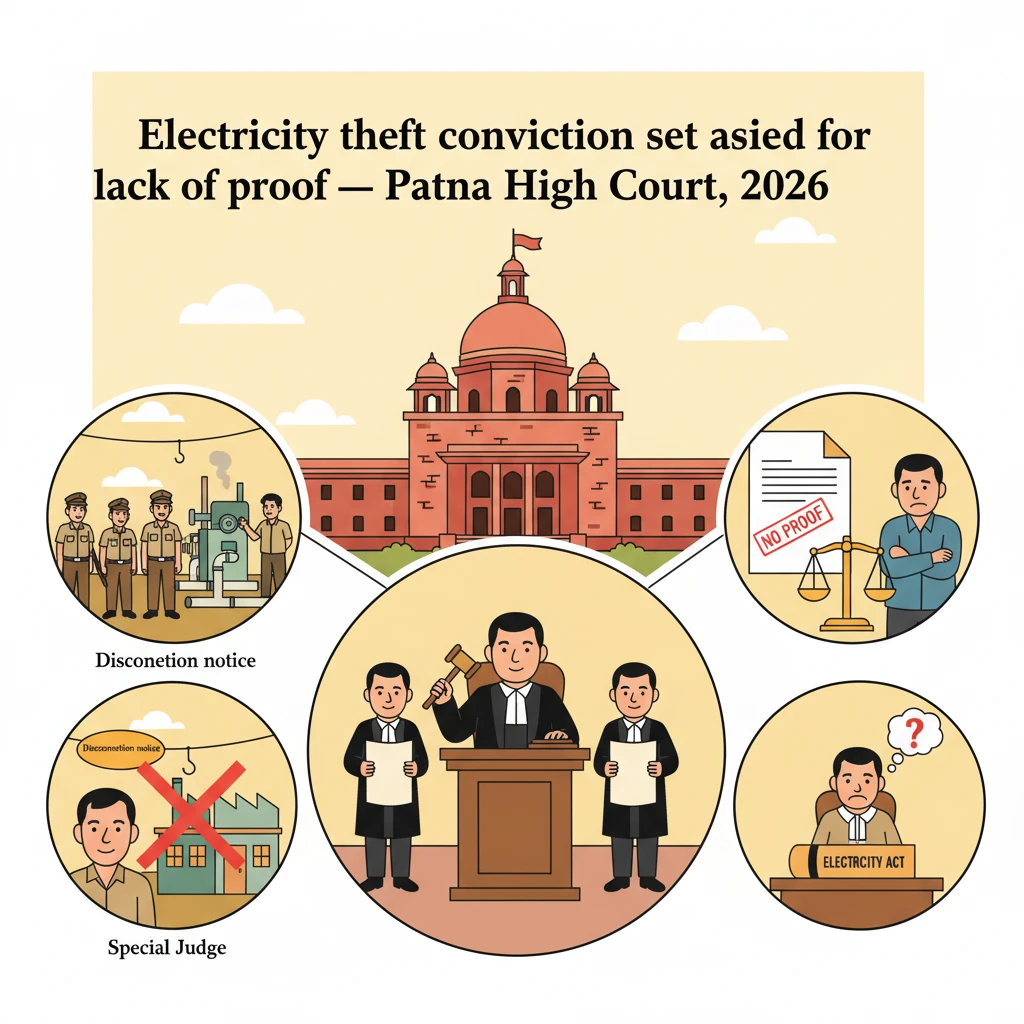
Case Background
This case arose from a raid conducted by the Electricity Department on 24.08.2011 at about 3:30 PM in village Janpur under Bodh Gaya Police Station, District Gaya. A raiding party was constituted by the Electricity Board under Order No. XII, Misc. No. 109/87-682.
The team included the Executive Engineer (informant), other departmental staff, and the then Deputy Executive Magistrate-cum-Block Agriculture Officer, along with police and armed forces. During the inspection they claimed to have found a plastic manufacturing unit allegedly using electricity illegally from an LT line by fixing a toka.
According to the Electricity Department, the accused’s earlier electricity connection at his godown on Godam Road, Bodh Gaya Market, had already been disconnected for non-payment of dues. They alleged that he then started drawing electricity directly from the LT line at village Janpur.
The raiding team prepared a seizure list (Exhibit-2), recording seizure of a starter, four motors of different HP capacities, PVC wires and related items. Seven persons were shown as members of the raiding party. The loss to the Electricity Department due to the alleged theft was assessed in the FIR at Rs. 43,77,888/-.
At the time of raid, one person named Anil Pandey was found present at the premises. He was stated to be the caretaker of the accused and was apprehended on the spot. On a written application by the Executive Engineer, Bodh Gaya P.S. Case No. 158 of 2011 was registered under Section 135 of the Electricity Act, 2003 against both Anil Pandey and the present appellant.
After investigation, the police treated Anil Pandey as innocent and did not submit charge-sheet against him. Only the appellant was sent up for trial for the offence under Section 135 of the Electricity Act. The Special Judge, Electricity, Magadh Area, Gaya took cognizance and, by order dated 13.02.2013, summoned the appellant and explained the accusation to him. No formal charge was framed.
During trial, the prosecution examined eight witnesses, most of them members of the raiding party, and proved documents including the written FIR, seizure list, formal FIR and an indemnity bond of Rs. 50,000/- given by the appellant on 12.06.2012. The appellant, in his statement under Section 313 CrPC, denied the allegations and claimed innocence. He did not produce any defence evidence.
The trial court convicted him under Section 135(1) of the Electricity Act, 2003 and sentenced him to rigorous imprisonment for three years and a fine of Rs. 5,000/-, with four months’ simple imprisonment in default. Treating the assessed loss of Rs. 43,77,888/- as the basis, it further imposed thrice that amount, i.e. Rs. 1,31,33,664/-, as fine for loss caused to the Electricity Department.
Aggrieved, the appellant filed Criminal Appeal (SJ) No. 168 of 2014 before the Patna High Court. The appeal was heard by Hon’ble Mr. Justice Shailendra Singh and decided on 21.01.2026.
What the Court Examined and Decided
The Patna High Court carefully examined the FIR, seizure list, evidence of all prosecution witnesses (PW-1 to PW-7), and the legal arguments raised by both sides. The central question was whether the prosecution had legally proved that the appellant was responsible for theft of electricity at the Janpur premises.
On behalf of the appellant, counsel pointed out that it was undisputed that the appellant was not present at the premises when the raid took place. The case against him rested mainly on what Anil Pandey allegedly disclosed to the raiding party and on the assumption that the premises belonged to or were controlled by the appellant.
The defence argued that the prosecution had failed to prove that the appellant had possession, control, or title over the premises. No independent witness from the locality was examined, although several people had gathered during the raid. The investigating officer (IO) was not examined at trial, which, according to the defence, caused serious prejudice because only the IO could explain how the police connected the appellant with the premises and what local inquiries were made.
It was also submitted that the seized articles described in the seizure list were never produced before the trial court, yet the trial court still drew an adverse presumption that these articles were used for electricity theft. Further, the defence pointed out that the mandatory procedure under Section 126 of the Electricity Act, 2003 and Clause 11.2.3 of the Bihar Electricity Supply Code, 2007 for assessing loss due to unauthorised use of electricity had not been followed.
On the other side, the Additional Public Prosecutor argued that the FIR and evidence of the raiding party clearly showed the appellant’s involvement. He stressed that the appellant had filed an application before the trial court seeking release of the seized electrical equipment in his favour, which was allowed on 10.04.2012. According to the State, this conduct amounted to an admission that the equipment and the premises belonged to the appellant.
The State also contended that non-examination of the IO was not fatal because all material witnesses, including the Executive Magistrate (PW-7), supported the prosecution case.
The High Court first dealt with the issue of connection between the appellant and the premises. It noted that all raiding-party witnesses, including PW-7, accepted that at the time of raid Anil Pandey was present and was described as the caretaker of the appellant. The responsibility for illegal use of electricity was fastened on the appellant mainly on the basis of Pandey’s alleged disclosure.
However, the Court highlighted that during investigation the police themselves found Anil Pandey to be innocent and did not send him up for trial. Although many independent persons had gathered at the spot, none was made witness to the search and seizure. There was also no claim that they refused to cooperate.
In such circumstances, the Court held that examination of the IO was of “great significance”, especially because the appellant was not present at the spot. Only the IO could have explained what steps were taken to verify who owned or controlled the premises, whether neighbours were questioned, and on what basis possession was attributed to the appellant. By not examining the IO, the prosecution deprived the appellant of his valuable right to cross-examine the IO on these crucial aspects. This, the Court found, caused “serious prejudice” to the appellant.
The Court closely examined the testimony of PW-7, the Executive Magistrate-cum-Block Agriculture Officer, who was an important independent official in the raiding party. In his examination-in-chief, PW-7 said that Anil Pandey, found at the premises, initially refused to disclose the owner’s name. But in cross-examination, he admitted that Pandey later disclosed the appellant’s name. The Court noted this inconsistency.
PW-7 further admitted that he had not seen the appellant committing theft of electricity and that he named the appellant only on the basis of information provided by Anil Pandey. He also conceded that no document showing the appellant’s title or ownership over the premises was produced at the spot. Other prosecution witnesses gave similar evidence: their knowledge linking the premises to the appellant came only through Anil Pandey, not from any document, local inquiry, or direct observation.
On this basis, the Court concluded that the prosecution had failed to establish any reliable link between the appellant and the premises, whether in the form of ownership, possession or control. This went to the very root of the case, because without proving that connection, criminal liability for electricity theft at that site could not be fastened on the appellant.
The Court then considered the argument that no formal charge under Section 135(1)(a) of the Electricity Act had been framed. While acknowledging that the offence was punishable with imprisonment up to three years, the Court found no specific prejudice shown by the appellant on this ground. It held that the omission to frame a formal charge had not, by itself, vitiated the trial because the appellant clearly understood the accusation and defended himself.
Next, the Court dealt with the non-production of seized articles. It noted that wires, motors and starters were said to have been seized but were never produced before the trial court. Relying on the Supreme Court’s reasoning in Mahaveer vs. State of Maharashtra and Another (2025 SCC OnLine SC 2180), the Court observed that the legal presumption of electricity theft under the statute is not automatic. For the presumption to apply, it must first be proved that artificial or unauthorised means were actually used.
The Court also referred to Jitendra and Another vs. State of M.P. ((2004) 10 SCC 562), where the Supreme Court held that when a case is based on seizure of specific materials, the “best evidence” is the seized material itself, which should be produced and marked as exhibits. Mere oral evidence or panchnama is insufficient in serious offences.
Applying these principles, the Patna High Court held that in an electricity theft case where the accused was not caught at the spot and denied any connection with the premises, failure to produce the seized electrical equipment, without any explanation, was a serious flaw. It went against the prosecution and made it unsafe to rely on the alleged seizure.
The Court then examined the prosecution’s reliance on the appellant’s application seeking release of the seized articles. It accepted that such an application had been filed and allowed, but stressed that the prosecution’s primary burden to prove the appellant’s connection with the premises could not shift because of it. Importantly, the application was never exhibited during trial, nor was the appellant confronted with it or allowed to explain the circumstances of filing it. The Court therefore refused to treat this application as an admission sufficient to impose criminal liability.
Finally, the Court considered how the alleged loss of Rs. 43,77,888/- was calculated. It found that neither the FIR nor the seizure memo showed the method adopted for working out this figure. Referring to Section 126 of the Electricity Act, the Court noted that when unauthorised use of electricity is found, the Assessing Officer must make a provisional assessment, serve it on the person concerned or in charge of the premises, and give an opportunity to file objections.
In this case, there was no material to show compliance with Section 126 or Clause 11.2.3 of the Bihar Electricity Supply Code, 2007. Despite this, the trial court had imposed a fine of Rs. 1,31,33,664/- (three times the assessed loss) solely on the basis of the figure mentioned in the FIR. The High Court held that this approach was legally unsustainable. Before placing such a huge financial burden on an accused, the court must be satisfied that the assessment was done strictly as per law, which had not been done.
Taking all these aspects together, the Court held that the prosecution had “miserably failed” to prove that the appellant had any connection with the premises or that he was responsible for illegally running the plastic unit using stolen electricity. The foundation of the case was described as “fragile and unreliable”. Accordingly, the judgment of conviction and the order of sentence were set aside, and the appeal was allowed.
Since the appellant was already on bail, the Court discharged him and his sureties from their bail bonds and directed transmission of the judgment to the trial court for necessary compliance.
Why This Judgment Matters
This judgment of the Patna High Court is important for anyone facing electricity theft allegations, especially business owners and small industrial units.
First, it shows that the Electricity Department and police cannot simply rely on statements like “caretaker said this belongs to X” to fix criminal liability. They must properly prove who owns or controls the premises, through documents, local inquiries, or reliable witnesses.
Second, when the case is based on seizure of equipment such as wires and motors, those items must be produced in court. Oral statements or seizure lists alone are not enough, particularly when the accused was not caught at the spot.
Third, before claiming huge losses and asking for heavy fines, officials must follow the procedure under Section 126 of the Electricity Act and the Bihar Electricity Supply Code. There must be a proper assessment, notice, and opportunity to object.
For laypersons, this decision underlines that even in electricity theft cases, basic rules of fair trial, proper evidence, and due process of law must be followed. If the prosecution fails on these counts, a conviction cannot stand.
Legal Issues and Answers
- Issue: Did the prosecution prove that the appellant owned, possessed, or controlled the Janpur premises where electricity was allegedly stolen?
Answer: No. The Patna High Court held that there was no reliable evidence linking the appellant to the premises; the case rested mainly on Anil Pandey’s disclosure, who was later found innocent, and no independent witnesses or documents were produced. - Issue: Could the Court safely draw a presumption of electricity theft and uphold conviction without production of seized equipment and without examining the investigating officer?
Answer: No. The Court held that non-production of seized articles and non-examination of the IO caused serious prejudice to the appellant and prevented application of statutory presumptions, making the conviction unsustainable. - Issue: Was the heavy fine based on alleged loss of Rs. 43,77,888/- valid in the absence of compliance with Section 126 of the Electricity Act and the Bihar Electricity Supply Code?
Answer: No. The Court held that there was no proof of lawful assessment of loss as required by Section 126 and Clause 11.2.3, hence the fine of Rs. 1,31,33,664/- could not be justified.
Cases Cited by the Court
- Mahaveer vs. State of Maharashtra and Another, 2025 SCC OnLine SC 2180
- Jitendra and Another vs. State of M.P., (2004) 10 SCC 562
Case Details
Case Number: Criminal Appeal (SJ) No. 168 of 2014; arising out of Bodh Gaya P.S. Case No. 158 of 2011; Trial No. 208/13/189/14; G.R. No. (E) 49 of 2011
Case Title: Md. Maksood Alam vs. State of Bihar
Citation: 2024(2) PLJR 541
Court: High Court of Judicature at Patna
Coram: Hon’ble Mr. Justice Shailendra Singh
Date of Judgment: 21.01.2026
Advocates:
- For the Appellant: Mr. Sumeet Kumar Singh, Advocate; Mrs. Deepali Singh, Advocate; Mr. Anmol Kumar, Advocate; Mr. Kumar Vikram, Advocate; Mr. Amarendra Kumar, Advocate
- For the State: Mr. Anand Mohan Prasad Mehta, Additional Public Prosecutor
Nature of Case: Criminal appeal against conviction and sentence under Section 135(1) of the Electricity Act, 2003, passed by the Special Judge, Electricity, Magadh Area, Gaya.
Final Outcome: Conviction and sentence set aside; appeal allowed; appellant and sureties discharged from bail bonds.
Link to Judgment: Patna High Court Judgment
If you found this explanation helpful and wish to stay informed about how legal developments may affect your rights in Bihar, you may consider following Samvida Law Associates for more updates.







