
Case Background
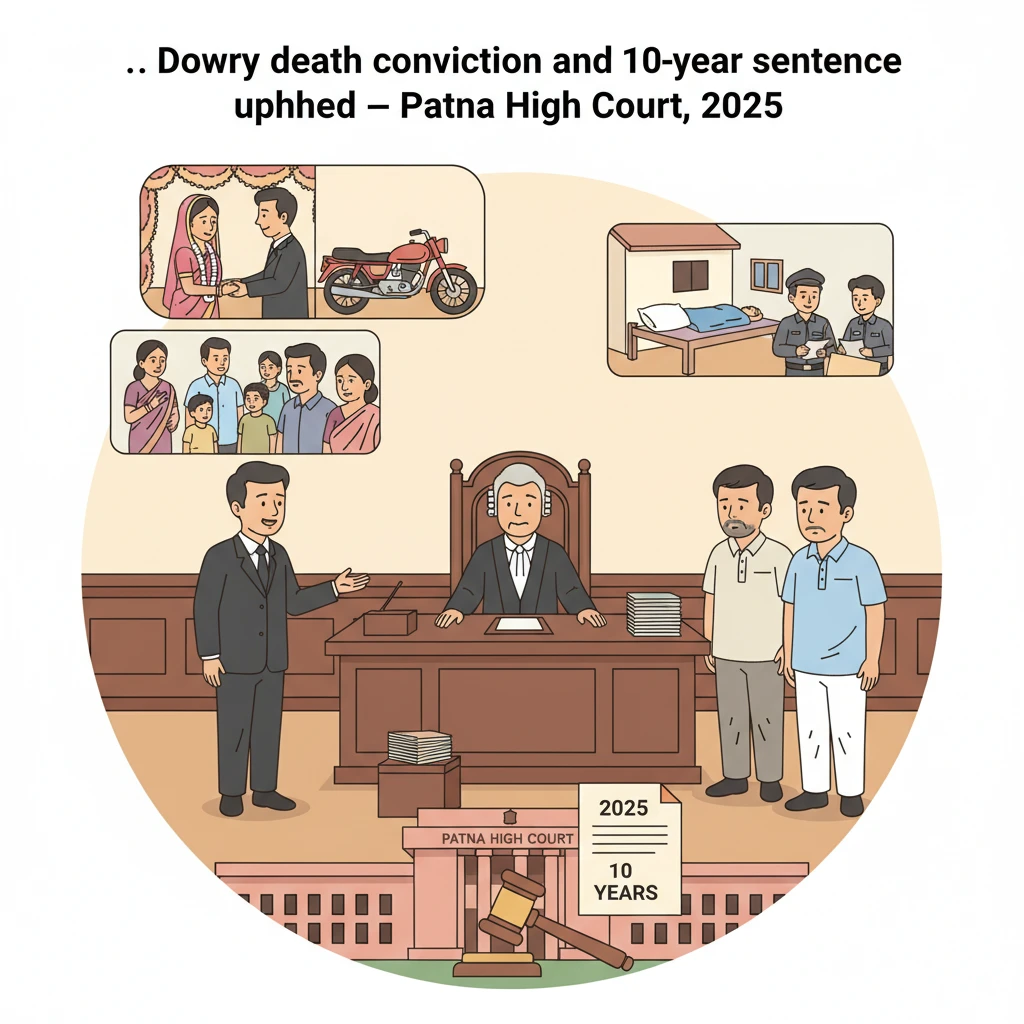
This case arose from the death of a young married woman in Muzaffarpur district. Her father lodged a statement (fardbeyan) at Kathaiya Police Station, which became Kathaiya P.S. Case No. 189 of 2018.
He stated that his daughter had married the appellant on 28.03.2014. After the marriage, the couple had a daughter. According to him, within six months of the marriage, his son-in-law and others began demanding a motorcycle and Rs. 2,50,000 as dowry and started torturing his daughter.
The father said he purchased a motorcycle and gifted it to his son-in-law. However, the demand for money allegedly continued. He further stated that the appellant and others again assaulted and tortured his daughter and demanded Rs. 2,50,000 in cash for casting the roof and for the appellant to go abroad. The daughter is said to have resisted these demands.
The informant also stated that on 26.07.2018, as the appellant had to go abroad, he took a loan of Rs. 1,00,000 and gave it to his son-in-law. Later, on 13.07.2018 at about 2:00 PM, the elder son-in-law of the informant informed him that perhaps his daughter had been killed. On receiving this information, the informant, along with his son, wife and others, went to his daughter’s matrimonial home.
There they saw his daughter’s dead body lying on a cot. All members of her in-laws’ family were missing from the house. A white coloured pillow, soaked and smeared, was found in an adjacent room. The informant believed that his daughter had been killed by pressing her mouth with that pillow because his monetary demand had not been met.
On this basis, Kathaiya P.S. Case No. 189 of 2018 was initially registered under Sections 302, 120B/34 of the Indian Penal Code (IPC). Later, by order dated 23.07.2018, Section 304B IPC (dowry death) was added in place of Section 302 IPC.
After routine investigation, including recording of witnesses’ statements, the police submitted charge sheet against the appellant under Section 304B IPC. The trial court took cognizance under Section 304B/34 IPC and committed the case to the Court of Sessions as Sessions Trial No. 259 of 2019.
On 15.06.2019, the trial court framed charges against the appellant under Sections 304B/34 and 302/34 IPC. He pleaded not guilty and claimed trial.
After trial, by judgment dated 14.05.2025 and order dated 22.05.2025, the District and Additional Sessions Judge–XIII, Muzaffarpur convicted the appellant for offence under Section 304B IPC and sentenced him to rigorous imprisonment for ten years and fine of Rs. 10,000, with two months’ simple imprisonment in default.
The appellant then filed Criminal Appeal (SJ) No. 2307 of 2025 before the Patna High Court. At the beginning of the High Court hearing on 12.11.2025, his counsel did not press the prayer for suspension of sentence and bail, so that prayer was treated as not pressed. The appeal proceeded only on the challenge to conviction and sentence.
What the Court Examined and Decided
The Patna High Court carefully examined the evidence recorded during the trial, the arguments of both sides, and the applicable law on dowry death.
The defence case, as gathered from cross-examination and the appellant’s statement under Section 313 CrPC, was a total denial. Counsel argued that:
• the appellant was falsely implicated merely because he was the husband,
• the incident was actually a suicide,
• allegations in the FIR did not match the postmortem and inquest reports,
• non-examination of the first Investigating Officer meant the place of occurrence was not proved, causing serious prejudice, and
• the trial court had convicted him mechanically without properly appreciating the evidence.
The State argued that the FIR clearly showed the death occurred within seven years of marriage in the matrimonial home and was preceded by dowry demands. It relied on the consistent depositions of the father (PW-5), brother (PW-4) and another relative (PW-3) about harassment and demands, and on the medical evidence showing unnatural death.
Key prosecution witnesses
PW-5, the father of the deceased and informant, stated in his examination-in-chief that his son-in-law used to assault his daughter and demand Rs. 2,50,000 and a motorcycle. He described how his daughter was killed in the appellant’s house. He also stated that medical examination showed fractures in her chest bone, head injury and a lacerated wound on the leg.
In cross-examination, PW-5 confirmed that his daughter’s marriage took place in 2014 and she died on 13.07.2018. The High Court noted that his statement about dowry demand and the timing of death clearly established that the death occurred within five years of marriage and that dowry demands had been made prior to death. Nothing was brought out in cross-examination to discredit his evidence on these crucial points.
PW-4, the deceased’s brother, supported the father’s account regarding dowry demands and the reason behind the death. He confirmed that these demands were part of the initial prosecution story and were linked to the death.
PW-3, another relative, also supported PW-5 on dowry demands and said he went to the place of occurrence and saw the dead body.
PWs 1 and 2 were declared hostile and did not support the prosecution. PWs 7, 8 and 9, villagers of the appellant, said they had no knowledge of the occurrence and their evidence was found to be of no use.
PWs 6 and 10, also villagers of the appellant, stated that when they visited the appellant’s house they found the deceased’s body lying on a cot. However, they did not speak about the assault or dowry and their evidence was also of limited use.
Investigating and medical evidence
PW-11, the second Investigating Officer, took over investigation after the retirement of the first I.O. Pramod Kumar Singh. He stated that the appellant was arrested on 11.09.2018 and that he completed investigation and submitted the charge sheet. He identified the first I.O.’s signature on the inquest report.
PW-12, the doctor who conducted the postmortem at SKMCH, Muzaffarpur on 13.07.2018, found the following injuries:
• abrasion on the right chin 1” x ½” and over chest 2” x 1”,
• fracture of sternum and 3rd to 6th ribs on the left side,
• about one litre of blood in the chest cavity with laceration of the left lung, and
• subdural hemorrhage at the occipital region of the brain.
He opined that the deceased died due to haemorrhage, coma and shock caused by the above injuries, which were caused by a hard and blunt object. Time since death was within 12 to 24 hours prior to postmortem. The High Court treated this as clear proof that the death was not in normal circumstances.
Application of Section 304B IPC and Section 113B Evidence Act
The Court noted the four essential ingredients of Section 304B IPC:
1. Death of a woman by burns or bodily injury or otherwise than under normal circumstances.
2. Such death occurring within seven years of marriage.
3. Soon before her death, the woman subjected to cruelty or harassment by her husband or his relatives.
4. Such cruelty or harassment connected with dowry demand.
The Court found, on facts, that:
• the marriage on 28.03.2014 and death on 13.07.2018 were admitted and proved, showing death within seven years (indeed within five years) of marriage;
• the postmortem report showed multiple fractures and internal bleeding, clearly ruling out natural death;
• the father, brother and relative consistently deposed that the appellant demanded a motorcycle and money and assaulted the deceased over these demands; and
• these demands and harassment continued up to a time “soon before” the death.
On this basis, the Court held that the prosecution had discharged its initial burden and all ingredients of Section 304B IPC were proved. Therefore, under Section 113B of the Evidence Act, the Court was bound to presume that the appellant caused the dowry death.
The Court referred to and relied on decisions such as Prem Kumar vs. State of Rajasthan (2009 (2) PCCR 194), Jagdish and Others vs. State of Uttarakhand (2015 (2) PLJR SC 345), Ram Badan Sharma vs. State of Bihar (Cr. Appeal No. 1493 of 2004), and Satvir Singh & Others vs. State of Punjab & Another ((2001) 8 SCC 633). These judgments explain that:
• once the basic facts of dowry demand, cruelty and death within seven years of marriage are proved, the presumption of dowry death must be drawn;
• dowry harassment usually happens within the four walls of the house, so evidence of close relatives like parents and siblings carries weight; and
• even if the death is suicidal but unnatural and linked with dowry-related cruelty soon before death, Section 304B IPC applies.
The Court accepted the prosecution’s position that the testimony of PW-5, PW-4 and PW-3 was consistent with the FIR and that their evidence on demand of dowry and cruelty was trustworthy.
Rejection of defence arguments
On the argument regarding non-examination of the first Investigating Officer, the defence relied on the Patna High Court decision in Kaila Yadav @ Balram Yadav vs. State of Bihar (Cr. Appeal No. 628 of 2012) and on the Supreme Court decision in Baijnath & Others vs. State of Madhya Pradesh.
The Patna High Court distinguished these cases. It noted that in the present matter:
• the second Investigating Officer (PW-11) had been examined,
• the place of occurrence was independently proved by several witnesses who saw the dead body at the appellant’s house, and
• there was no real doubt that the death occurred in the appellant’s home.
Therefore, the absence of the first I.O. did not cause prejudice and the prosecution case could not be discarded on that ground.
The Court also emphasised that under Section 313 CrPC, if any fact is especially within the knowledge of the accused, he must explain the incriminating circumstances. In this case, everything about the wife’s death in the matrimonial home was within the appellant’s knowledge, yet he gave no explanation and only denied the allegations. The Court agreed with the trial court that such silence became an additional link in the chain of circumstances against him.
Finding on guilt and sentence
After reviewing the evidence and case law, the High Court held that the trial court’s finding of guilt under Section 304B IPC was correct. It found no reason to interfere and affirmed the conviction.
On sentence, defence counsel argued that the appellant had already been in custody for about seven years and two months out of the ten-year sentence and sought reduction of sentence “for the ends of justice”.
The Court, however, referred to Supreme Court decisions in State of M.P. vs. Bablu ((2014) 9 SCC 281), State of M.P. vs. Udaibhan ((2016) 4 SCC 116) and Ravada Sasikala vs. State of A.P. ((2017) 4 SCC 546). These cases stress that:
• punishment must be adequate, just and proportionate to the gravity and manner of the crime,
• undue leniency undermines deterrence and shocks the conscience of society, and
• courts have a duty to balance the interests of the accused and of society, particularly in serious offences.
Considering that the appellant was the husband, the wife died an unnatural death within five years of marriage at his house due to injuries by a hard and blunt object, and he failed to explain the circumstances, the Court held that he did not deserve any leniency. It refused to reduce the ten-year sentence.
Accordingly, the appeal was dismissed, and any pending interlocutory applications were disposed of.
Why This Judgment Matters
This judgment is important for families and women facing dowry pressure.
First, it shows that when a young married woman dies in her matrimonial home within seven years of marriage and there is reliable evidence of dowry demands and cruelty, the Patna High Court will strongly apply the law on dowry death.
Second, the Court accepted the consistent statements of the father, brother and close relative as strong evidence. The Court recognised that dowry-related cruelty usually happens inside the home, away from outsiders, so relatives’ testimony is often the main proof.
Third, the Court made it clear that the husband cannot remain silent when his wife dies unnaturally in his house. If he does not give any convincing explanation, that silence can go against him.
Fourth, the Court refused to reduce the sentence even though the appellant had already spent more than seven years in jail. It said that in serious offences like dowry death, courts must think of the conscience of society and avoid undue leniency.
For readers, this judgment reinforces that dowry harassment and violence leading to a woman’s death will be treated very seriously. It also shows that documenting demands, lodging complaints, and supporting victims with timely legal action are crucial for justice.
Legal Issues and Answers
-
Issue: Whether, on the facts proved, the offence of dowry death under Section 304B IPC was made out against the appellant husband.
Answer: Yes. The Court held that the deceased’s unnatural death within five years of marriage, combined with consistent evidence of dowry demands and cruelty by the husband, satisfied all ingredients of Section 304B IPC. The statutory presumption under Section 113B Evidence Act applied, and the appellant failed to rebut it. -
Issue: Whether non-examination of the first Investigating Officer and alleged inconsistencies between FIR and medical evidence created reasonable doubt requiring acquittal.
Answer: No. The Court held that the second Investigating Officer’s evidence and the testimony of witnesses who saw the body at the appellant’s house sufficiently proved the place of occurrence. The postmortem clearly showed an unnatural death, and there was no material inconsistency undermining the prosecution case. -
Issue: Whether the ten-year sentence of rigorous imprisonment for the dowry death required reduction considering the period already undergone in custody.
Answer: No. Referring to Supreme Court guidance on proportionate sentencing, the Court held that the appellant, being the husband responsible for his wife’s dowry death, did not deserve any leniency and upheld the full ten-year sentence and fine.
Cases Cited by the Court
- Prem Kumar vs. State of Rajasthan, 2009 (2) PCCR 194
- Jagdish and Others vs. State of Uttarakhand, 2015 (2) PLJR SC 345
- Ram Badan Sharma vs. State of Bihar, Criminal Appeal No. 1493 of 2004 (Supreme Court, 21.08.2006)
- Satvir Singh & Others vs. State of Punjab & Another, (2001) 8 SCC 633
- Kaila Yadav @ Balram Yadav vs. State of Bihar, Criminal Appeal No. 628 of 2012 (Patna High Court)
- Baijnath & Others vs. State of Madhya Pradesh, as quoted in the judgment
- State of M.P. vs. Bablu, (2014) 9 SCC 281
- State of M.P. vs. Udaibhan, (2016) 4 SCC 116
- Ravada Sasikala vs. State of A.P., (2017) 4 SCC 546
Case Details
Case Number: Criminal Appeal (SJ) No. 2307 of 2025; arising out of Kathaiya P.S. Case No. 189 of 2018; Sessions Trial No. 259 of 2019
Case Title: Md. Hasib vs. The State of Bihar
Court: High Court of Judicature at Patna
Coram: Hon’ble Mr. Justice Alok Kumar Pandey
Date of Patna High Court Judgment: 12.11.2025
Impugned Trial Court Judgment: Judgment of conviction dated 14.05.2025 and order of sentence dated 22.05.2025 by District and Additional Sessions Judge–XIII, Muzaffarpur
Relevant Police Station and Case: Kathaiya P.S. Case No. 189 of 2018, District Muzaffarpur
Offence Involved: Section 304B IPC (dowry death), with reference to Section 34 IPC; Section 302 IPC was initially invoked but later replaced by Section 304B IPC during investigation
Outcome: Appeal dismissed; conviction under Section 304B IPC affirmed; sentence of 10 years’ rigorous imprisonment and fine of Rs. 10,000 with two months’ simple imprisonment in default upheld
Citation: 2026(1) PLJR 199
Advocates: Mr. Nafisu Zzoha, Advocate for the appellant; Mr. Mukeshwar Dayal, A.P.P. for the State of Bihar
Nature of Case: Criminal appeal (single judge) against conviction and sentence for dowry death by the Sessions Court
Link to Judgment: Patna High Court judgment in Cr. Appeal (SJ) No. 2307 of 2025
If you found this explanation helpful and wish to stay informed about how legal developments may affect your rights in Bihar, you may consider following Samvida Law Associates for more updates.







