
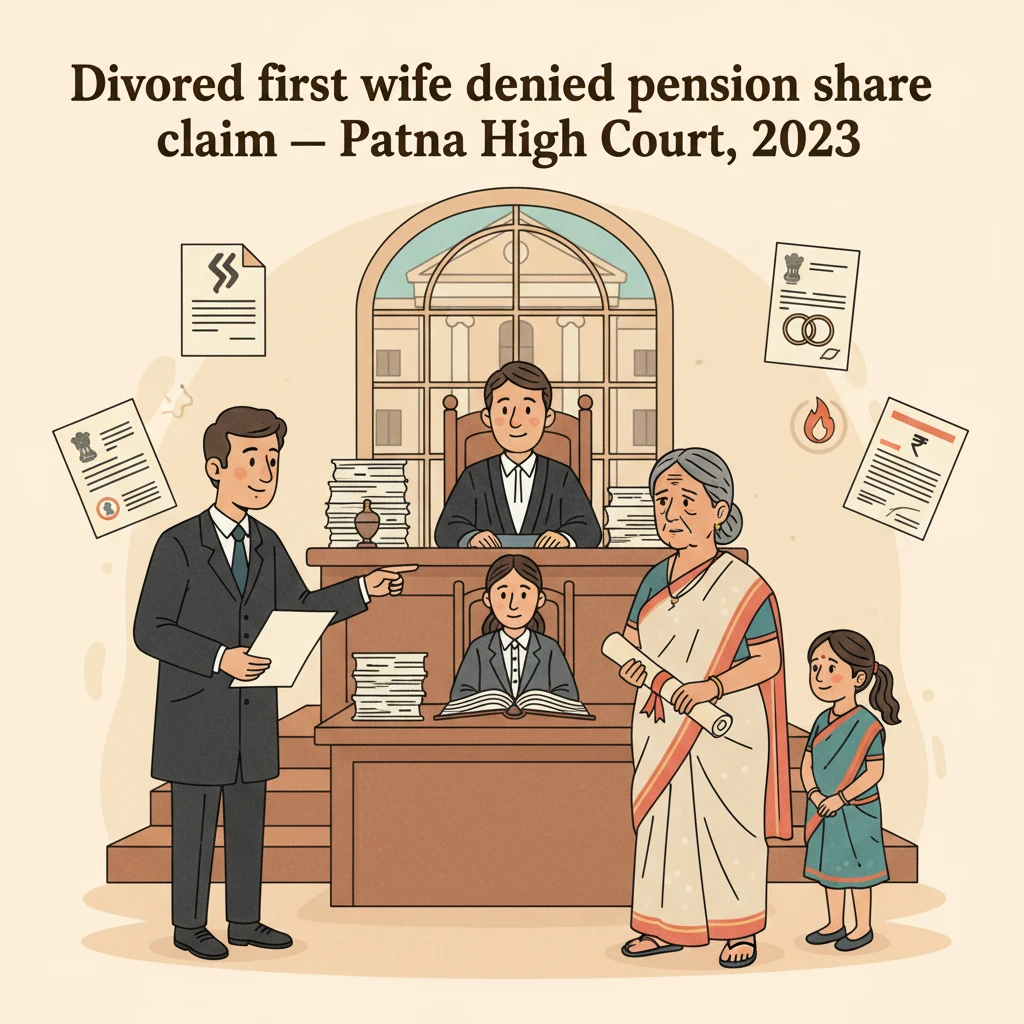
Case Background
The case arose from a family dispute over death-cum-retiral benefits of a college lecturer employed at S.S.V. College, Kahalgaon, under Tilka Manjhi Bhagalpur University.
The appellant married Late Ajab Lal Pandit @ Neelkusum in May 1962. From this marriage, a daughter, Archna Kumari, was born in 1987. The husband worked as a Lecturer in S.S.V. College, Kahalgaon, from his appointment on 02.07.1977.
In 1986, the husband filed Matrimonial Case No. 12 of 1986 before the District Judge seeking dissolution of the marriage by a decree of divorce. On 16.04.1988, the District Judge passed an ex parte order granting a decree of divorce against the appellant.
After obtaining the divorce decree, the husband married respondent no. 9 on 07.06.1989. From this second marriage, one daughter was born.
The appellant then challenged the ex parte divorce. She filed Marriage Case No. 31 of 1989 before the District Judge, Bhagalpur, seeking revocation of the decree of divorce. While this case was pending, her husband died on 08.11.1992.
Due to the husband’s death, the District Judge dismissed Marriage Case No. 31 of 1989 on 29.01.1993, holding that the case could not proceed after his death. The appellant then filed Miscellaneous Appeal No. 174 of 1993 before the High Court, which was also dismissed on 10.05.1994 on the same ground, namely, that the husband had already died.
After these proceedings, the appellant made several representations before the authorities to claim death-cum-retiral benefits of Late Ajab Lal Pandit. When she did not receive any reply or relief, she sought information under the Right to Information Act regarding the status of her representations and the status of the death-cum-retiral benefits.
By letter dated 05.05.2012, the University informed her that all death-cum-retiral benefits and compassionate appointment had been given to the private respondent (respondent no. 9), who claimed to be the second wife of Late Ajab Lal Pandit.
Aggrieved by this, the appellant filed Civil Writ Jurisdiction Case No. 4916 of 2018 before a Single Judge of the Patna High Court. The learned Single Judge found the writ petition to be totally misconceived and dismissed it by judgment dated 29.08.2018.
The appellant then preferred Letters Patent Appeal No. 1476 of 2018 before the Division Bench of the Patna High Court challenging the dismissal of her writ petition.
There was a delay of 6 days in filing this appeal, for which the appellant filed Interlocutory Application No. 7992 of 2018 seeking condonation of delay. The Division Bench first considered the question of limitation, allowed the interlocutory application, and condoned the delay.
What the Court Examined and Decided
After condoning the delay, the Division Bench proceeded to examine the Letters Patent Appeal on merits against the judgment of the learned Single Judge.
The main grievance of the appellant before the Division Bench was that she had never remarried after the ex parte divorce decree and that, as the first wife, she should receive at least half of the pensionary and other death-cum-retiral benefits of Late Ajab Lal Pandit. She claimed this included gratuity, leave encashment, group insurance amount, and similar benefits.
The appellant’s counsel argued that the University authorities had only given assurances but did not release any amount to her despite her having submitted a succession certificate dated 23.01.1993. It was also argued that the appellant is a rustic lady with little income, now very old, who requires financial support from her deceased husband’s property and benefits, at least to the extent of half share, especially since she has not remarried.
On the other side, the State, the University, and respondent no. 9 opposed the appeal.
The learned counsel for the respondents submitted that the ex parte divorce decree was passed after due notice to the appellant and after examination of the evidence. They argued that the appellant did not challenge the ex parte decree during the lifetime of Late Ajab Lal Pandit. The decree remained in force throughout his life and continues to stand even after his death, as it has never been set aside by any competent court.
Counsel for respondent no. 9 pointed out that she had married Late Ajab Lal Pandit on 07.06.1989, after the divorce decree of 16.04.1988. One daughter was born from this marriage. Importantly, respondent no. 9 and her daughter were nominated by Late Ajab Lal Pandit in his service records for various benefits.
It was further submitted that the University has rightly not released any payment in favour of the appellant because she was not the nominee and because the divorce decree had already severed the marital relationship between her and the deceased employee.
The Division Bench carefully considered the materials on record and the rival submissions. The Court first recorded that it is an undisputed fact that the appellant was the first wife of Late Ajab Lal Pandit @ Neelkusum. It also noted that, after obtaining a decree of divorce against her, the deceased married respondent no. 9, and that the divorce decree still stands and has not been set aside by any competent court.
The Court then turned to the key documentary evidence: the service records of the deceased employee. These were brought on record by respondent no. 9 through a second supplementary counter affidavit.
On examining the service book, the Court noted that in column no. 5, concerning marital status, it was written “I have a wife.” Although it did not expressly name the person in this column, the subsequent columns made it clear who was being referred to.
In column no. 7, under “nomination for GPF” (General Provident Fund), the names mentioned were “Smt. Kumari Nirmala Sah (wife)” and “Kumari Aprajita Kashyap (daughter).”
Similarly, in column no. 9, for “nomination for D.C.R. gratuity and family pension,” the same names were recorded as nominees: “Smt. Kumari Nirmala Sah (wife)” and “Kumari Aprajita Kashyap (daughter).”
The Division Bench highlighted that the appellant’s name did not appear as a nominee anywhere in the service records for receiving post-death benefits such as gratuity, pension, or other amounts. On this basis, the Court drew a clear conclusion: if the appellant’s name was not mentioned as a nominee in the service book, she could not lawfully claim those benefits.
The Court therefore held that the appellant is not entitled to death-cum-retiral benefits of Late Ajab Lal Pandit, in view of two main facts: first, the standing divorce decree that has never been set aside; and second, the explicit nomination in favour of respondent no. 9 and her daughter in the service records.
After this analysis, the Division Bench considered whether the learned Single Judge had committed any error in dismissing the writ petition. The Court held that, in light of the facts and circumstances discussed, it could not be said that the Single Judge had committed any error warranting interference in appellate jurisdiction.
The Division Bench agreed with the view taken by the Single Judge, upheld the dismissal of the writ petition, and consequently dismissed the Letters Patent Appeal.
Thus, while the Court acknowledged the appellant as the first wife, it placed decisive weight on the continued validity of the divorce decree and the formal nominations made by the deceased employee. Sympathy for the appellant’s personal hardship did not override the legal position arising from the divorce and service records.
Why This Judgment Matters
This judgment is important for separated or divorced spouses who seek pension or death benefits from a deceased government or university employee.
The Patna High Court has made it clear that once a decree of divorce is passed and remains in force, the divorced spouse cannot claim post-death service benefits as a wife or husband unless recognised by law or specifically nominated.
The decision also highlights the importance of service records. The Court treated the nomination entries for GPF, gratuity, and family pension as decisive. Those whose names are not recorded as nominees cannot claim benefits simply on the basis of past marriage or personal hardship.
For employees and their families, this reinforces the need to keep service records and nominations updated. For divorced spouses, it shows that without a successful challenge to the divorce decree, later claims to spousal benefits are unlikely to succeed.
Legal Issues and Answers
- Issue: Whether a divorced first wife, whose divorce decree still stands and whose name is not recorded as nominee in the service book, can claim death-cum-retiral benefits of the deceased employee.
Answer: No. The Court held that since the divorce decree has not been set aside and the appellant is not a nominee in the service records, she cannot lawfully claim any post-death service benefits. - Issue: Whether the Single Judge’s dismissal of the writ petition challenging the grant of benefits to the second wife and daughter required interference by the Division Bench in appeal.
Answer: No. The Division Bench found no error in the Single Judge’s reasoning and dismissed the Letters Patent Appeal.
Cases Cited by the Court
- The judgment does not refer to or rely upon any reported case law by name or citation.
Case Details
Case Number: Letters Patent Appeal No. 1476 of 2018 in Civil Writ Jurisdiction Case No. 4916 of 2018
Case Title: Rajeshwari Devi v. The State of Bihar & Ors.
Citation: 2023 (1) PLJR 709
Court: High Court of Judicature at Patna
Coram: Hon’ble Mr. Justice P. B. Bajanthri and Hon’ble Mr. Justice Arun Kumar Jha
Date of Judgment: 17.01.2023
Advocates:
- For the Appellant: Mr. Prashant Kumar Dwivedi, Advocate
- For the State: Mr. Prabhat Ranjan Singh, AC to AAG-15
- For the University: Mr. Diwakar Yadav, Advocate
- For Respondent No. 9: Mr. Abdul Mannan Khan, Advocate and Mr. Suman Kumar, Advocate
Nature of the Case: Letters Patent Appeal against dismissal of a writ petition (civil) seeking death-cum-retiral benefits and related service dues.
Outcome: Interlocutory Application for condonation of 6 days’ delay allowed; Letters Patent Appeal dismissed; judgment of the learned Single Judge affirmed.
Link of the judgement; https://patnahighcourt.gov.in/viewjudgment/MyMxNDc2IzIwMTgjMSNO-xLvL8hGcTXE=
If you found this explanation helpful and wish to stay informed about
how legal developments may affect your rights in Bihar,
you may consider following Samvida Law Associates for more updates.







