
Case Background
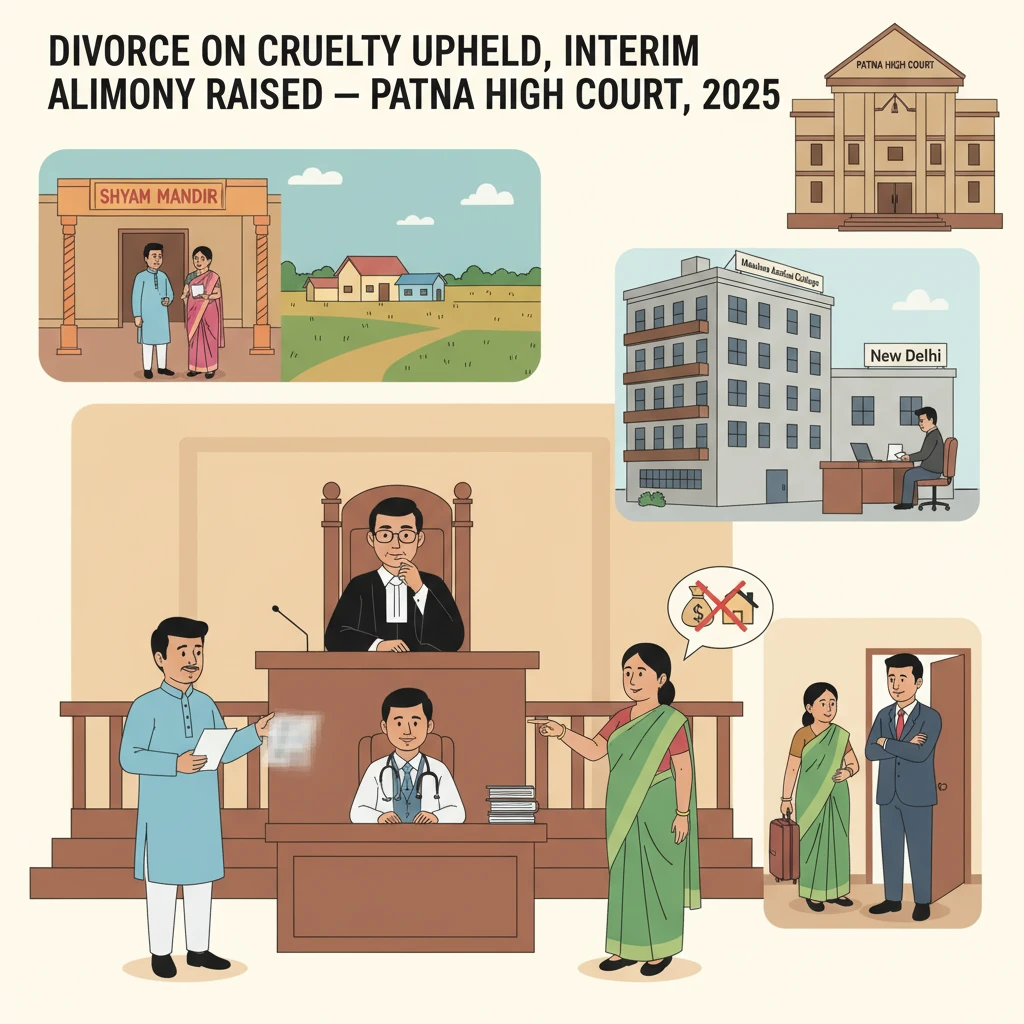
The parties married on 11 January 2016 according to Hindu rites. The husband is a doctor, working as a Senior Resident in the Microbiology Department at Maulana Azad Medical College, New Delhi, at the relevant time.
According to the husband’s case before the Family Court, the marriage never got consummated. The wife allegedly refused to cohabit from the beginning, both at the matrimonial home in the village and later when they shifted to New Delhi.
The husband stated that the wife’s behaviour towards him and his family members was rude and insulting. She allegedly used abusive language, insisted on purchase of a flat in New Delhi, refused to perform normal household duties like making breakfast, and pressed that he should live separately from his old parents.
He further alleged that she threatened to implicate him and his family in false criminal and dowry cases. He claimed she suffered from adenomyosis and depression, became aggressive, and that despite his efforts for her treatment and to make the marriage work, she did not cooperate.
On 27 January 2017, the wife allegedly left the matrimonial home with all her stridhan and went to her parental home. The husband claims he went there and requested her to return, but she and her family refused and continued to insult him.
On these allegations, the husband filed Matrimonial (Divorce) Case No. 1298 of 2017 before the Principal Judge, Family Court, Patna, under Section 13(1)(i-a) of the Hindu Marriage Act, 1955, seeking dissolution of marriage on the ground of cruelty and desertion.
Notice was served on the wife, but she did not appear before the Family Court. The case proceeded ex parte. The Family Court, by judgment and decree dated 01.08.2022, granted divorce to the husband on grounds of cruelty and desertion, dissolving the marriage solemnized on 11.01.2016. No permanent alimony was awarded at that stage.
The wife then filed Miscellaneous Appeal No. 674 of 2023 before the Patna High Court, challenging the divorce decree and also raising grievance about absence of permanent alimony. The appeal was filed belatedly along with an application for condonation of delay.
By the time the appeal was heard, the husband had already entered into a second marriage and had a child from that marriage, as recorded by the High Court in its order dated 21.11.2024.
What the Court Examined and Decided
The High Court, coram Hon’ble the Acting Chief Justice and Hon’ble Mr. Justice S. B. Pd. Singh (who authored the judgment), examined two broad aspects:
(a) whether the Family Court’s decree of divorce on the grounds of cruelty and desertion required interference; and
(b) what should be done regarding permanent alimony for the wife, which the Family Court had not granted.
On the first aspect, the Court noted that the wife had been validly served before the Family Court but chose not to appear. As a result, she did not lead any evidence to counter the husband’s allegations.
The husband, on the other hand, examined three witnesses: P.W. 1 – Dr. Kumar Kaushalendra, P.W. 2 – Sharda Devi (his mother), and P.W. 3 – himself, Dr. Shyam Kishore Kumar. No documentary evidence was produced by him, but there was unchallenged oral testimony.
The High Court reminded itself of the scope of a first appellate court’s powers. Referring to the Supreme Court’s decision in “Jagdish Singh v. Madhuri Devi”, (2008) 10 SCC 497, the Court noted that while a first appellate court can re-appreciate oral and documentary evidence, it must exercise caution and not lightly disturb findings of the trial court based on oral evidence, unless the approach is clearly erroneous or unreasonable.
The key legal test for “cruelty” under Section 13(1)(i-a) of the Hindu Marriage Act was discussed. The Court quoted extensively from “Joydeep Majumdar v. Bharti Jaiswal Majumdar”, (2021) 2 RCR (Civil) 289, where the Supreme Court held that mental cruelty must be such that it becomes impossible for the wronged spouse to continue in the matrimonial relationship, having regard to the background, education, and status of the parties.
The Court also cited the landmark judgment in “Samar Ghosh v. Jaya Ghosh”, (2007) 4 SCC 511, where the Supreme Court gave illustrative instances of mental cruelty. Among these, the High Court highlighted that:
- a unilateral decision to refuse sexual intercourse for a considerable period without physical incapacity or valid reason may amount to mental cruelty; and
- a long period of continuous separation can show that the matrimonial bond is beyond repair, and insisting on continuation of the tie may itself amount to mental cruelty.
The Family Court had already found that the wife had treated the husband with mental cruelty and had deserted him. The High Court examined whether this view was sustainable.
The husband’s case was that the marriage was never consummated because the wife consistently refused cohabitation without any valid reason. Her conduct was described as rude and abusive towards him and his family, combined with threats to lodge false cases and pressure to live separately from his old parents.
The High Court noted the Family Court’s observation that a unilateral and prolonged refusal to have sexual relations without physical disability or valid cause amounts to mental cruelty. Similarly, threatening false criminal cases and creating a hostile atmosphere also falls within mental cruelty.
In addition, the wife allegedly left the matrimonial home on 27.01.2017, taking all her stridhan, and did not return despite the husband’s efforts. This was treated as desertion.
Crucially, these assertions went unrebutted because the wife did not contest the divorce petition in the Family Court. The High Court concluded that the husband had made out a case for dissolution of marriage on the grounds mentioned in Section 13(1)(i-a).
The Court also took note of its earlier order dated 21.11.2024 in this very appeal, where it recorded that:
- the marriage took place on 11.02.2016 (noting the date as recorded in that order) and the parties had been living separately since January 2017; and
- in the meantime the husband had contracted a second marriage and had a child.
Given the long separation, the non-appearance of the wife at trial, and the second marriage of the husband, the High Court saw no basis to interfere with the Family Court’s divorce decree. The finding of cruelty and desertion, and the consequent dissolution of marriage, were upheld.
On the second aspect—permanent alimony—the High Court found that the Family Court had erred in not granting any sum towards permanent alimony to the wife while dissolving the marriage.
The Court reproduced Section 25 of the Hindu Marriage Act, which allows grant of permanent alimony and maintenance either at the time of the decree or any time thereafter, on an application by the wife or husband. It stressed that even after a decree of divorce, the court does not become functus officio and can still award alimony.
The judgment referred to several Supreme Court decisions on maintenance and permanent alimony:
- “Rajnesh v. Neha”, (2021) 2 SCC 324 – laying down a comprehensive framework and factors for deciding maintenance and permanent alimony;
- “Kiran Jyot Maini v. Anish Pramod Patel”, 2024 SCC OnLine SC 1724 – reiterating Rajnesh principles;
- “Pravin Kumar Jain v. Anju Jain”, 2024 SCC OnLine SC 3678 – summarising key factors for determining permanent alimony, including income of both parties, their social and financial status, standard of life during marriage, sacrifices made, and financial capacity of the husband;
- “Sukhdev Singh v. Sukhbir Kaur”, 2025 SCC OnLine SC 299 – clarifying that Section 25 is discretionary (“may”), and the court must consider the conduct of the party seeking maintenance; and
- “Vinny Parmvir Parmar v. Parmvir Parmar”, (2011) 13 SCC 112 – stating that permanent alimony should enable the wife to live in reasonable comfort without being excessive so as to affect the husband’s condition.
The High Court stressed that there is no fixed formula for permanent alimony; it is fact-specific. It also cited para 74 of “Rajnesh v. Neha” to underline that the duration of the marriage is a relevant factor, especially where marriages break down within a short time.
On the facts, the Court noted:
- the husband is a Government doctor, earning about Rs. 2,50,000 per month, and is an Assistant Professor in AIIMS, Deoghar;
- he has re-married and has a child from his second wife;
- the wife has not re-married, has no children, and is dependent on her old-aged parents with no other proven source of income;
- she is currently getting Rs. 20,000 per month (Rs. 15,000 for daily expenses and Rs. 5,000 for rent) as maintenance under Maintenance Case No. 421 of 2022.
During the hearing of the appeal, the Court tried to facilitate an amicable settlement. On 21.11.2024, it recorded that the husband offered Rs. 10 lakh as permanent alimony, which the Court found too meagre considering his income and remaining service years. The Court asked him to pay Rs. 5 lakh immediately to show bona fides, and directed the wife to give a reasonable counter-proposal.
Later, on 13.02.2025, the Court noted that:
- the wife proposed Rs. 50 lakh as permanent alimony, which the Court suggested could be reasonably reduced to Rs. 35 lakh;
- the husband, however, stated he could not pay more than Rs. 15 lakh, which the Court again found unsatisfactory.
Ultimately, the Court decided to determine an amount on merits. It held that, keeping in view the parties’ status, the husband’s income, his age and service prospects, and the wife’s dependence, it was appropriate to grant Rs. 35,00,000 (Rupees Thirty Five Lakhs) as “interim permanent alimony”.
This amount was directed to be paid by the husband to the wife within three months from the date of judgment, failing which it would carry simple interest at 6% per annum. The earlier Rs. 5,00,000 paid by the husband during the appeal would be set off against this figure.
Importantly, the Court clarified that this grant is “interim permanent alimony”, and it is still open to the wife to file an application under Section 25 of the Hindu Marriage Act before the competent court for determination of final permanent alimony.
With these directions, the High Court upheld the divorce, granted interim permanent alimony of Rs. 35 lakh, and disposed of the Miscellaneous Appeal No. 674 of 2023, with no order as to costs. All pending interlocutory applications were also disposed of.
Why This Judgment Matters
This Patna High Court judgment is important for spouses, especially women, who may have faced marital breakdown but did not effectively participate in the original divorce case.
First, it shows that if a party does not appear in the Family Court and lets the case go ex parte, the High Court will be slow to disturb a decree of divorce when the other side’s evidence stands unchallenged, particularly after long separation and remarriage.
Second, the decision reinforces that refusal to cohabit and threats of false criminal cases can amount to mental cruelty, depending on facts. Continuous separation from early in the marriage can also justify divorce.
Third, the judgment is significant on maintenance and alimony. Even if the Family Court does not grant permanent alimony at the time of divorce, the higher court can step in to secure a reasonable lump sum, especially when one spouse is financially weaker and dependent.
The Court has made it clear that:
- the earning spouse’s real income and future service prospects are relevant;
- the non-earning spouse’s dignity and basic comfort must be protected; and
- short duration of marriage does not wipe out the right to fair financial support.
Finally, the Court has kept the door open for the wife to seek further relief under Section 25, making this judgment a useful reference for spouses who miss the opportunity to seek permanent alimony at the time of divorce.
Legal Issues and Answers
- Issue: Should the Patna High Court interfere with the Family Court’s decree of divorce granted on the grounds of cruelty and desertion?
Answer: No. The Court held that the husband had proved cruelty and desertion under Section 13(1)(i-a) of the Hindu Marriage Act, and the Family Court’s findings did not warrant interference. - Issue: Is the wife entitled to permanent alimony when the Family Court granted divorce without awarding any such amount?
Answer: Yes, in principle. The High Court held that permanent alimony can be granted even after the divorce decree and ordered the husband to pay Rs. 35 lakh as interim permanent alimony, leaving it open for the wife to move under Section 25 for final determination.
Cases Cited by the Court
- Joydeep Majumdar v. Bharti Jaiswal Majumdar, (2021) 2 RCR (Civil) 289
- Samar Ghosh v. Jaya Ghosh, (2007) 4 SCC 511
- Jagdish Singh v. Madhuri Devi, (2008) 10 SCC 497
- Rajnesh v. Neha, (2021) 2 SCC 324
- Kiran Jyot Maini v. Anish Pramod Patel, 2024 SCC OnLine SC 1724
- Pravin Kumar Jain v. Anju Jain, 2024 SCC OnLine SC 3678
- Sukhdev Singh v. Sukhbir Kaur, 2025 SCC OnLine SC 299
- Vinny Parmvir Parmar v. Parmvir Parmar, (2011) 13 SCC 112
- Aditi alias Mithi v. Jitesh Sharma, (2023) SCC OnLine SC 1451 (referred in interim orders)
Case Details
Case Number: Miscellaneous Appeal No. 674 of 2023
Case Title: Arpana Kumari v. Shyam Kishore Kumar
Citation: 2025 (4) PLJR 407
Court: High Court of Judicature at Patna
Coram: Hon’ble the Acting Chief Justice; Hon’ble Mr. Justice S. B. Pd. Singh
Date of Judgment: 18-09-2025
Advocates:
For the appellant-wife: Mr. Dilip Kumar Roy, Advocate
For the respondent-husband: Mr. Satyendra Kumar Sinha, Advocate
Nature of the Case: Miscellaneous appeal against a Family Court decree of divorce under Section 13(1)(i-a) of the Hindu Marriage Act, 1955; consideration of cruelty, desertion, and grant of interim permanent alimony under Section 25.
Link to Judgment: Patna High Court official judgment link
If you found this explanation helpful and wish to stay informed about
how legal developments may affect your rights in Bihar,
you may consider following Samvida Law Associates for more updates.







