
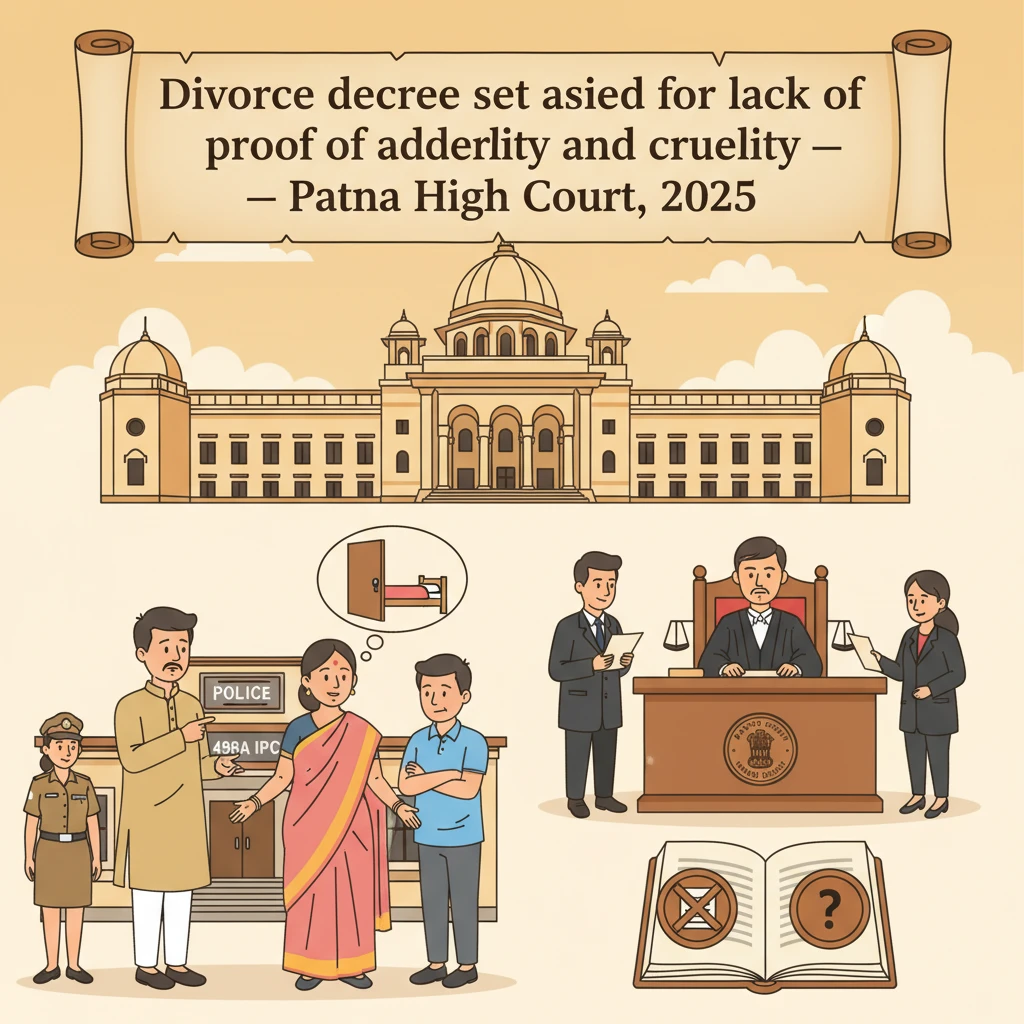
Case Background
These matters arose from a matrimonial dispute between a wife and husband from Jehanabad district, Bihar. Their marriage was solemnized on 11.07.2000 as per Hindu rites and customs.
After some years of marriage, serious disputes developed between them. The wife alleged cruelty and dowry demand by her husband and in-laws. She filed Complaint Case No. 1055 of 2012 on 09.01.2013, which was later registered as Mahila P.S. Case No. 12 of 2013 on 04.02.2013 under Section 498A of the Indian Penal Code.
Later, the husband filed Matrimonial Case No. 66 of 2013 before the Principal Judge, Family Court, Jehanabad, seeking a decree of divorce on the ground of cruelty and alleged adulterous relationship of the wife with a co-villager (arrayed as respondent no. 2 in the matrimonial case).
On 08.05.2015, the Principal Judge, Family Court, Jehanabad:
- decreed Matrimonial Case No. 66 of 2013, dissolving the marriage, and
- in Maintenance Case No. 81 of 2014, allowed Rs. 5,000/- per month to the wife under Section 125 Cr.P.C.
Aggrieved by the decree of divorce, the wife filed Miscellaneous Appeal No. 307 of 2015 before the Patna High Court under Section 19(1) of the Family Courts Act, 1984.
She also filed Criminal Revision No. 584 of 2015 challenging the quantum of maintenance of Rs. 5,000/- per month as inadequate, claiming that she needed Rs. 20,000/- per month for her livelihood.
On the other hand, the husband filed Criminal Revision No. 618 of 2015 challenging the same maintenance order of Rs. 5,000/- per month passed in Maintenance Case No. 81 of 2014.
All three matters were heard together by a Division Bench of the Patna High Court and decided by a common judgment dated 26.03.2025.
What the Court Examined and Decided
The Patna High Court examined in detail the pleadings, the evidence led before the Family Court, and the reasoning given by the Principal Judge, Family Court, Jehanabad.
The husband’s case in the matrimonial suit was that after the marriage on 11.07.2000 the couple lived together for about three months, but he later discovered that his wife was in a close and improper relationship with a co-villager (respondent no. 2). He alleged that respondent no. 2 frequently visited his house, and that he once found his wife and this man inside the house with the outer door bolted from inside.
The most serious allegation was that on 27.11.2012, when the husband returned from the market, he allegedly found the bedroom locked from inside and, on raising an alarm, his wife and respondent no. 2 came out “in a very ashamed condition.” He claimed he caught them “red handed living in adultery.”
According to the husband, after this incident the wife filed the criminal case under Section 498A IPC (Mahila P.S. Case No. 12 of 2013) on false allegations of torture and dowry demand against him and his family. He asserted that after discovering her alleged illicit relationship and facing a false criminal case, it was not possible for him to continue the marital relationship, so he filed Matrimonial Case No. 66 of 2013 for dissolution of marriage.
The wife, in her written statement and through her counsel, denied all allegations of adultery and bad character. She stated that she peacefully lived in the matrimonial home after marriage, but later her in-laws began to torture her for dowry, especially after her husband got employment in the Air Force. She said she had informed her parents, who tried to resolve the matter, and that there was a compromise at the Mahila Police Station, after which she returned to her matrimonial house.
The wife alleged that the torture resumed and therefore she filed Complaint Case No. 1055 of 2012, which became Mahila P.S. Case No. 12 of 2013 under Section 498A IPC. She repeatedly asserted that she was always ready to live with her husband, that she bore a good character, and that allegations of adultery were invented only to obtain a divorce. She also pointed out that the husband had given an undertaking before the High Court in a bail petition to keep her with dignity and honour but had not honoured it.
Before the Family Court, four witnesses deposed for the husband:
- P.W. 1 – Ram Dahin Yadav (husband’s father)
- P.W. 2 – the husband himself
- P.W. 3 – Sona Devi
- P.W. 4 – Sukhendra Kumar (husband’s brother)
Four witnesses deposed for the wife:
- O.P.W. 1 – Saroj Devi (wife’s mother)
- O.P.W. 2 – Vinod Yadav (wife’s father)
- O.P.W. 3 – Shambhu Kumar (wife’s uncle)
- O.P.W. 4 – the wife herself
The Family Court had framed several issues, including whether the husband was subjected to cruelty, whether he had cause of action, and whether he was entitled to a decree for dissolution of marriage. It held in favour of the husband, finding cruelty and desertion proved, and granted divorce.
The Patna High Court, however, re-examined the evidence closely. It noted that:
P.W. 1 (father of the husband) stated in chief about alleged illegal relationship of his daughter-in-law with respondent no. 2. But in cross-examination (para 6), he admitted that respondent no. 2 was his nephew and that he had never seen the wife and respondent no. 2 in a compromising position. He also admitted that he never lodged any complaint nor called a panchayati about the alleged illicit relationship. The High Court found that this supported the inference that the allegation of illicit relationship was developed later to gain advantage in the matrimonial suit.
P.W. 2 (the husband) admitted in cross-examination that he had no documentary proof of the alleged illegal relationship. He had not filed any complaint against respondent no. 2 for adultery or rape. He also could not explain why he filed the matrimonial case after 12 years of marriage, and notably, only after the wife had initiated the 498A case. In para 17 of his cross-examination, he conceded that the wife had already filed a case against him and his family before he filed the divorce case, suggesting an attempt to “settle the score.”
P.W. 3 (Sona Devi) and P.W. 4 (brother of the husband) gave contradictory versions. P.W. 3 claimed she alone was present when the husband allegedly caught his wife and respondent no. 2 in a compromising position on 27.11.2012. P.W. 4, however, stated that he was present at that time. Such contradictions weakened the credibility of their version.
P.W. 3 further said that earlier the in-laws used to stop respondent no. 2 from coming to the house, indicating that the family allegedly knew of this supposed “illegal act” but still never filed any complaint and only moved the court for divorce after the wife’s 498A case.
The High Court also relied upon the deposition of O.P.W. 1 (wife’s mother), which the Family Court had not properly appreciated. She said that the wife had gone to the matrimonial home and stayed for about three months after marriage. Later she came to her parental house, and the in-laws did not visit her thereafter. She also stated that after compromise at the Mahila Police Station, the wife was taken back to her matrimonial house on 25.09.2012, and within about two months, on 27.11.2012, the allegation of being caught in a compromising position was raised without any cogent evidence. The High Court read this as indicating that the husband was not interested in continuing the marriage and raised allegations of adultery to escape marital obligations.
On the legal ground of cruelty, the High Court noted that “cruelty” is not specifically defined in the Hindu Marriage Act, 1955, but referred to the settled position that cruelty involves conduct creating in the mind of the other spouse a reasonable apprehension that it will be harmful or injurious to live with the other spouse.
The Court referred to the Supreme Court’s decision in Samar Ghose vs. Jaya Ghose, 2007 (4) SCC 511, where it was held that cruelty involves sustained, grave, and weighty conduct affecting physical or mental health and that normal wear and tear of married life is not enough.
The Court also quoted from Narain Ganesh Dastane vs. Sucheta Narain Dastane, AIR 1975 1534, emphasising that the effect of the conduct must be judged on the particular spouse, and courts must not apply an abstract “reasonable man” standard to matrimonial relations.
Applying these principles, the Patna High Court held that:
- The husband had failed to prove any specific incident of cruelty with dates and supporting evidence.
- The burden of proving cruelty lay on the husband, as he sought divorce on that ground, and he had not discharged it.
- The allegations of adultery and illicit relationship were not backed by any reliable documentary or cogent oral evidence.
- Occasional harsh words or minor quarrels, which can occur in day-to-day conjugal life, could not amount to legal cruelty justifying divorce.
On the ground of desertion, the Court noted that, as per the husband’s own evidence, the wife was allegedly “caught” in the matrimonial home in a compromising position with respondent no. 2. This itself showed that she was living in the matrimonial house, and therefore the plea of desertion was unsustainable.
In conclusion, the Patna High Court found that the Principal Judge, Family Court, Jehanabad, had not correctly appreciated the evidence. The husband had failed to prove cruelty under Section 13(1)(ia) of the Hindu Marriage Act, failed to prove desertion, and also failed to prove adulterous or illegal physical relationship with respondent no. 2.
Therefore, the High Court allowed Miscellaneous Appeal No. 307 of 2015, set aside the order dated 08.05.2015 in Matrimonial Case No. 66 of 2013, and cancelled the decree dissolving the marriage.
On Criminal Revision No. 584 of 2015 filed by the wife regarding maintenance of Rs. 5,000/- per month, the Court did not alter the existing order. Instead, it granted liberty to the wife to file an appropriate application before the appropriate forum seeking enhancement of maintenance. The revision was disposed of on that basis.
On Criminal Revision No. 618 of 2015 filed by the husband challenging the same maintenance order, the Court held that since the divorce decree had been set aside and the marriage remained subsisting, his revision “has no leg to stand” and dismissed it.
Why This Judgment Matters
This decision of the Patna High Court is important for spouses, especially wives, facing serious allegations like adultery and cruelty in matrimonial disputes.
First, it reinforces that divorce cannot be granted on mere suspicion or unproved allegations. When a spouse accuses the other of adultery or bad character, the Court will insist on clear, cogent evidence. Contradictory statements and absence of complaints or panchayati weaken such claims.
Second, the judgment underlines that normal quarrels or harsh words in a marriage do not automatically amount to legal “cruelty.” Courts look for grave, sustained, and weighty conduct that genuinely makes cohabitation harmful or intolerable.
Third, the judgment shows that if one spouse files a criminal complaint (such as under Section 498A IPC), the other spouse cannot simply retaliate with a baseless divorce case to “settle the score.” The timing and background of cases are carefully scrutinised.
Finally, in maintenance matters, the Court has shown that even if a party is dissatisfied with the amount, the proper course is to approach the appropriate forum for enhancement. At the same time, an existing maintenance order will not be interfered with lightly, particularly when the marital relationship continues.
Legal Issues and Answers
-
Issue: Whether the husband proved cruelty and desertion by the wife so as to be entitled to a decree of divorce under Section 13(1)(ia) of the Hindu Marriage Act, 1955.
Answer: No. The Patna High Court held that the husband failed to prove cruelty or desertion by cogent and reliable evidence, and therefore the decree of divorce was set aside. -
Issue: Whether the allegations of adultery/illicit relationship between the wife and respondent no. 2 were proved.
Answer: No. The Court found that there was no documentary proof, no complaint against respondent no. 2, and significant contradictions in witnesses’ testimonies. Hence, the allegation had no legal value. -
Issue: What is the fate of the maintenance order of Rs. 5,000/- per month under Section 125 Cr.P.C. and the related revisions.
Answer: The maintenance order was left undisturbed. The wife’s revision was disposed of with liberty to seek enhancement before the appropriate forum, while the husband’s revision against the same order was dismissed.
Cases Cited by the Court
- Samar Ghose vs. Jaya Ghose, 2007 (4) SCC 511 – cited for the principles on what constitutes mental cruelty in matrimonial law.
- Narain Ganesh Dastane vs. Sucheta Narain Dastane, AIR 1975 1534 – cited for the approach to assessing cruelty based on the effect on the particular spouse, not an abstract reasonable person.
Case Details
Case Number: Miscellaneous Appeal No. 307 of 2015; Criminal Revision No. 584 of 2015; Criminal Revision No. 618 of 2015
Case Title (as per record):
- Miscellaneous Appeal No. 307 of 2015: Sangita Kumari vs. Surendra Kumar Himansu
- Criminal Revision No. 584 of 2015: Sangita Kumari vs. The State of Bihar & Anr
- Criminal Revision No. 618 of 2015: Surendra Kumar Himanshu vs. The State of Bihar & Anr
Coram: Hon’ble Mr. Justice P. B. Bajanthri and Hon’ble Mr. Justice S. B. Pd. Singh (CAV judgment authored by Hon’ble Mr. Justice S. B. Pd. Singh)
Citation: 2025 (2) PLJR 524
Advocates:
- In Miscellaneous Appeal No. 307 of 2015: For the appellant – Mr. Uday Kumar, Advocate; for the respondents – not specified in the judgment.
- In Criminal Revision No. 584 of 2015: For the petitioner – Mr. Uday Kumar, Advocate; for the respondents – Mr. Lalan Kumar, APP.
- In Criminal Revision No. 618 of 2015: For the petitioner – Dr. Binay Kumar Singh, Advocate; for the respondents – Mr. H. A. Khan, APP.
Nature of the Case:
- Miscellaneous Appeal: Appeal under Section 19(1) of the Family Courts Act, 1984 against a decree of divorce passed by the Family Court in a matrimonial case.
- Criminal Revision No. 584 of 2015: Criminal revision against an order granting maintenance under Section 125 Cr.P.C.
- Criminal Revision No. 618 of 2015: Criminal revision challenging the same maintenance order under Section 125 Cr.P.C.
Date of Patna High Court Judgment: 26.03.2025
Link to Judgment: Click here to view the full judgment of the Patna High Court
If you found this explanation helpful and wish to stay informed about
how legal developments may affect your rights in Bihar,
you may consider following Samvida Law Associates for more updates.







